
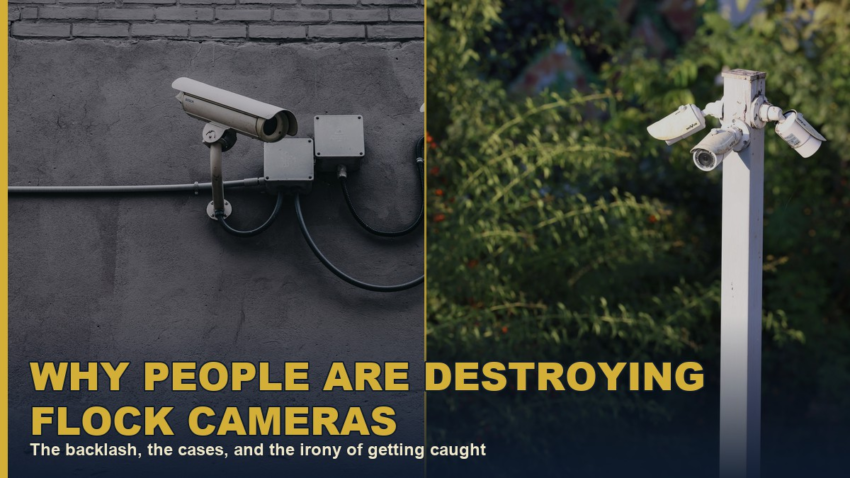
Across at least five states, people have been cutting down, smashing, and shooting Flock Safety license-plate cameras — and the pattern has been building for months, not days[1]. We already explained how the cameras and their nationwide data-sharing network actually work; this is about why people are trying to physically stop them, and what’s happened to the ones who got caught.
What people say they’re angry about
Two motives show up repeatedly in reporting on the incidents:
- Immigration enforcement: opponents point to documented cases of local Flock data reaching ICE’s “Immigration Violator” hotlist, arguing the cameras have become a quiet tool for deportation enforcement even in cities that never voted for that use[2].
- Being overruled locally: in La Mesa, California, the city council voted to keep its Flock cameras running even after a clear majority of the residents who showed up to the meeting spoke against them — cameras were smashed within weeks[1].
In Eugene-Springfield, Oregon, six cameras were cut down from their poles, at least one spray-painted, with a note left at the base of a severed pole reading: “Hahaha get wrecked ya surveilling fucks”[1]. Flock declined to confirm to reporters whether it even tracks how many of its own cameras have been destroyed nationwide[1].
The irony: the network that gets vandalized is used to find the vandals
The clearest documented case is Jeffrey Scott Sovern, a 41-year-old engineer in Suffolk, Virginia, charged with 13 felony counts of destruction of property after allegedly destroying 13 cameras between April and October. A search of his home turned up six solar panels used to power Flock cameras. Sovern has pleaded not guilty, but told reporters he believes license-plate readers are unconstitutional and that Flock has built “an unhealthy surveillance state”[3].
The Irony: Destroying One Camera Doesn’t Escape the Network
A camera goes down → the neighboring cameras on the same network keep recording every car nearby → investigators search that regional or national database for the vandal’s own vehicle.
What makes these cases resolvable at all is the same nationwide network the vandals are objecting to. Audit logs reviewed by reporters show the Morgan County Sheriff’s Office in Indiana ran nine separate searches in a single day after a local camera was destroyed — pulling data from roughly 94,054 cameras across the country, not just the local jurisdiction, looking for the suspect’s vehicle[3]. The Brunswick County Sheriff’s Office in Virginia searched data from 21,300 cameras for a similar case[3]. A Flock Safety spokesperson said the company “takes damage to our devices seriously, and we appreciate our local law enforcement partners investigating these incidents and holding individuals accountable”[3].
In other words: smashing a single camera doesn’t remove a vehicle from the system that catches the person who smashed it — it just adds one more search target to a database that, as we detailed in our previous piece, is already reachable through more doors than most residents realize.
What’s actually changing, beyond vandalism
Not every community that’s uncomfortable with the cameras is reaching for bolt cutters. Columbia Heights, Minnesota, and Appleton, Wisconsin, are among the municipalities that chose the slower, legal route — formally ending their Flock Safety contracts after resident pushback, rather than waiting for someone to destroy the hardware.
The Bottom Line
The people destroying Flock cameras aren’t a single organized movement — they’re scattered individuals reacting to specific local triggers, from ICE data access to a city council that ignored a packed public comment session. But the same nationwide camera network that makes people angry enough to reach for a hammer is also the tool investigators use to identify them afterward, which is turning isolated acts of vandalism into felony cases with real prison exposure. The communities that have actually removed the cameras did it through contracts, not crowbars.
Do you think destroying the hardware changes anything, or does it just give departments a reason to expand the network further? Weigh in below.
References
- TechCrunch. (2026, February 23). Americans are destroying Flock surveillance cameras. https://techcrunch.com/2026/02/23/americans-are-destroying-flock-surveillance-cameras ↩a ↩b ↩c ↩d
- Electronic Frontier Foundation. (2026, June). Are your local police using Flock Safety ALPRs to scan for immigrants? https://www.eff.org/deeplinks/2026/06/are-your-local-police-using-flock-safety-alprs-scan-immigrants ↩
- SAN. (2026, July). Vandals target Flock cameras. Police use Flock to catch them. https://san.com/cc/vandals-target-flock-cameras-police-use-flock-to-catch-them/ ↩a ↩b ↩c ↩d
Photo by Scott Webb via Pexels · Photo by Xayriddin Baxromxo’jayev via Pexels

Kemetic Minds Editorial Desk
Verified NewsroomPrimary-sourced investigative intelligence on civil rights, voting rights, federal policy, and consumer protection. Sourced from primary legal filings, government statistics, and direct field reporting.