
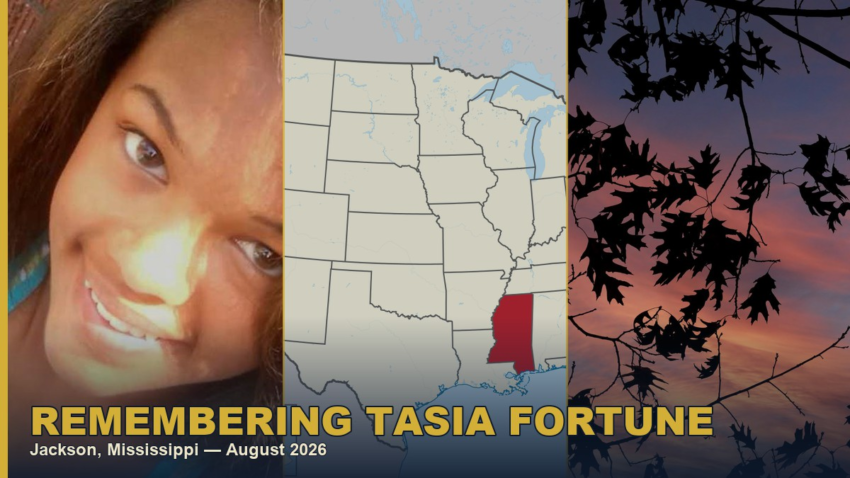
On the night of Monday, August 3, 2026, neighbors in a predominantly Black section of west Jackson found a woman hanging from a tree behind a vacant home on the 500 block of Road of Remembrance[1]. Three days later, the Hinds County Coroner identified her as 29-year-old Tasia Fortune. As of this writing, no cause or manner of death has been released, and a Jackson city councilman has formally asked federal prosecutors to investigate.
What happened
Tasia Fortune, 29, was found hanging from a tree in the backyard of a vacant home at 500 Road
of Remembrance in Jackson, Mississippi, at approximately 9:05 p.m. on Monday, August 3, 2026.
She was discovered by residents of the surrounding neighborhood, a predominantly Black area of
west Jackson[1][2]. Her body was not publicly
identified for three days — Hinds County Coroner Jeremiah Howard named her on Thursday,
August 6, after her family was notified[3].
Fortune’s aunt, Etta Avolio, described her in a GoFundMe campaign to cover funeral costs as
“a strong-minded, big-hearted, vibrant young woman” — a beloved daughter, sister, and
friend. Avolio added that the family “wants others to know that justice will be served, and
they hold firmly to their faith”[1].
Jackson police have publicly said only that they have not determined whether foul play was
involved. Fortune’s body was sent to the Mississippi State Medical Examiner’s Office for an
autopsy, and no ruling on cause or manner of death — suicide, homicide, or undetermined
— had been released as of this writing[3][4].
On Wednesday, August 5, Jackson Ward 3 Councilman Kenneth Stokes sent a letter to U.S.
Attorney Baxter Kruger’s office asking for federal involvement, writing that the city is
“in dire need of the assistance of the U.S. Attorney’s Office with the death of an unidentified
female discovered hanging in the backyard of an abandoned house on the Road of Remembrance in
Jackson, Mississippi.” Stokes said that regardless of whether a racial motive is ever
established, Mississippi’s history of lynching means any hanging death demands an answer:
“Hanging is an activity, a crime, that should never be an issue of being accepted by the
public…It’s wrong. It’s bad.”[5]
How this compares to other cases
Fortune’s death is the latest in a documented, multi-state pattern of Black hanging deaths
in which local authorities have moved toward a suicide finding quickly, only for families,
attorneys, or civil rights organizations to push back and demand a fuller homicide
investigation. KemeticMind has tracked this pattern in detail in our
timeline of contested “suicide” rulings in Black hanging deaths, 2000–2026. The
closest parallel is also in Mississippi:
Otis Byrd, Port Gibson, Mississippi (2015). Byrd, 54, went missing on March 2,
2015 and was found hanging from a tree about half a mile from his home 17 days later. More than
30 federal, state, and local investigators worked the case; the Department of Justice announced
in May 2015 that it had found no evidence of homicide, but closed the file without ever
establishing a definitive manner of death[6]. Like Fortune’s case, Byrd’s
death drew a formal federal review specifically because it was a hanging death of a Black
Mississippian — not because of any evidence pointing to a particular suspect.
Nationally, the Mississippi-based civil rights group JULIAN documented more than 70 suspected
modern-day lynchings and over 150 total fatal hate crimes and suspicious deaths across seven
Deep South states between 2000 and 2025 in its February 2026 report, A Crimson Record.
The report’s central finding is procedural: once a death is classified as a suicide, it
typically stops being investigated as a possible homicide[7].
What is — and isn’t — confirmed about “possible connections”
It is important to be precise here, in the same way we were in our earlier timeline piece.
No law enforcement agency, medical examiner, or advocacy organization — including
JULIAN — has published any finding connecting Fortune’s death to Otis Byrd’s, to any of
the other cases in our timeline, to any other Jackson-area incident, or to any organized group.
As of this writing, Fortune’s case does not yet have a public cause-of-death ruling at all, which
means it is not yet possible to say whether her death belongs in the same category as those
contested-suicide cases, or is something else entirely. What can be said is narrower and more
verifiable: Mississippi has one of the country’s deepest documented histories of racial-terror
lynching — more than 500 confirmed lynchings of Black Mississippians between 1877 and 1950,
part of the more than 4,400 documented nationally by the Equal Justice
Initiative[8] — and that history is precisely why officials like
Councilman Stokes, and families like Fortune’s, are asking for a federal review rather than
waiting on a local finding alone. That is a reasonable, evidence-grounded request regardless of
how the autopsy ultimately rules, not a claim that this case is already solved.
Finding Solutions: How to Push for an Independent Investigation
The single most effective thing families and communities can do in a case like this —
before a cause of death is even ruled — is to formally request independent, outside review
while the local investigation is still open. That’s exactly what moved the needle in the Otis
Byrd case and what Councilman Stokes is already doing for Tasia Fortune. Waiting until after a
suicide ruling is issued makes a reclassification far harder to win.
- Request a second, independent autopsy before burial, through a private
forensic pathologist, in addition to the state medical examiner’s exam — families in the
Trey Reed case did this and it produced findings the state exam did not. - Put the federal request in writing, the way Councilman Stokes did, to both
the U.S. Attorney’s Office and the FBI field office with jurisdiction, and ask for written
confirmation the request was received. - Document the scene yourself — photos, video, names of first responders
and witnesses — since local case files are not always shared with families in real time. - Loop in a civil rights legal organization early, not after a ruling is
final; the NAACP Legal Defense Fund and JULIAN both accept direct incident
reports[9].
📄 Get this checklist as a free, printable PDF you can keep on hand.
References
- Pittman, A. (2026, August 6). Tasia Fortune, 29, identified as woman found hanging in tree behind vacant Jackson home. Mississippi Free Press. https://www.mississippifreepress.org/tasia-fortune-identified-as-woman-found-hanging-in-tree-behind-vacant-jackson-home/ ↩a ↩b ↩c
- WLBT. (2026, August 4). Woman found hanging from tree behind Jackson home identified. https://www.wlbt.com/2026/08/04/woman-found-dead-behind-jackson-home-investigation-underway/ ↩
- Mississippi Today. (2026, August 6). Coroner identifies woman found hanging from a tree behind a vacant Jackson home. https://mississippitoday.org/2026/08/06/coroner-ids-woman-hanging-from-tree-behind-jackson-home/ ↩a ↩b
- Capital B News. (2026, August 6). Black woman found hanging in tree in Mississippi has been identified as Tasia Fortune. https://capitalbnews.org/black-woman-found-hanging-tasia-fortune/ ↩
- Revolt.tv. (2026, August 4). Jackson councilman urges U.S. Attorney’s Office to investigate death of woman reportedly found hanging from tree. https://www.revolt.tv/article/jackson-councilman-attorneys-office-investigation-woman-hanging ↩
- U.S. Department of Justice, Office of Public Affairs. (2015, May 29). Federal officials close the investigation into the death of Otis James Byrd [Press release]. https://www.justice.gov/archives/opa/pr/federal-officials-close-investigation-death-otis-james-byrd ↩
- theGrio. (2026, February 19). New report finds more than 70 suspected modern-day lynchings in the deep South since 2000. https://thegrio.com/2026/02/19/new-report-finds-more-than-70-suspected-modern-day-lynchings-in-the-deep-south-since-2000/ ↩
- Equal Justice Initiative. (n.d.). Lynching in America: Confronting the legacy of racial terror. https://eji.org/reports/lynching-in-america/ ↩
- NAACP Legal Defense and Educational Fund. (n.d.). Report an incident. https://www.naacpldf.org/report-an-incident/ ↩
Collage: Photo courtesy Tasia Fortune’s family via GoFundMe, as published by Mississippi Free Press · Map: TUBS, CC BY-SA 3.0, via Wikimedia Commons · Photo: Saif Siddique via Pexels

Kemetic Minds Editorial Desk
Verified NewsroomPrimary-sourced investigative intelligence on civil rights, voting rights, federal policy, and consumer protection. Sourced from primary legal filings, government statistics, and direct field reporting.