KEMETIC MINDS
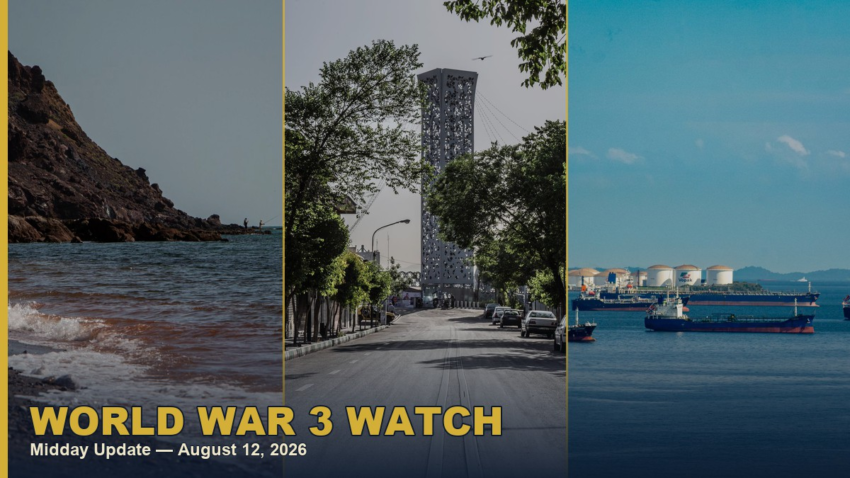
World War 3 Watch — Midday Update — August 12, 2026
- The U.S. military fired two Hellfire missiles at a Panama-flagged cargo ship accused of breaking the blockade on Iran (MSN, 2026a).
- Six people were killed in Houthi attacks on shipping in the Bab el-Mandeb strait — the first deaths of their kind in the war (Fox News, 2026; Al Jazeera, 2026).
- Trump declared “total control” over the Strait of Hormuz and added “I THINK WE WILL KEEP IT!” (Yahoo News, 2026).
- Iran answered that the strait will not be opened until the U.S. changes its “behaviour” and accepts its conditions (Al Jazeera, 2026).
- Taiwan’s Han Kuang exercises went public with American-style training, including the U.S. “backbriefing” method (RFI, 2026, authors’ translation).
- China announced a rare joint drill with Indonesia east of Taiwan; Taipei called it “fake drill, real expansion” (Deutsche Welle, 2026, authors’ translation).
The Story So Far
The maritime war around Iran escalated on two chokepoints at once: U.S. Hellfire missiles hit a blockade-runner in the Gulf of Oman, and Iran-backed rebels killed six people at Bab el-Mandeb (MSN, 2026a; Fox News, 2026).
Trump answered with “total control” over Hormuz; Tehran answered that the strait stays shut until its terms are met (Yahoo News, 2026; Al Jazeera, 2026).
On the parallel Taiwan flashpoint, Taipei brought American training into the open, and Beijing announced a rare joint naval drill with Indonesia east of the island (RFI, 2026, authors’ translation; Deutsche Welle, 2026, authors’ translation).
Two theaters, one day — each side pushing toward a red line neither claims it will cross.
Video: US Strikes Cargo Ship Over Iran Blockade, Escalating Maritime Tensions | Strait Of Hormuz News. Source: Mint.
1. A Wall of Steel: Hellfire Over the Gulf of Oman
The U.S. military fired two Hellfire missiles at a Panama-flagged cargo vessel accused of violating President Donald Trump’s blockade on Iran (MSN, 2026a). Al Jazeera placed the strike in the Gulf of Oman, saying U.S. forces targeted a vessel headed for an Iranian port (Al Jazeera, 2026).
The strike was a show of force as Tehran tries to evade the blockade and keep its grip on the strait (MSN, 2026b).
Iran had made lifting the blockade the price of reopening Hormuz; Trump’s answer on Wednesday was the phrase “a wall of steel” (MSN, 2026b).
“We totally control the Strait of Hormuz. We have control over it; nobody else,” he said (Al Jazeera, 2026). MSN’s roundup adds the punchline: the blockade is “a wall of steel,” and “Iran can’t do anything about it” (MSN, 2026b; MSN, 2026c).
Video: Saudi Arabia Houthi War LIVE: Houthis Kill 6 in 'Double-Tap' Strike on Ship in Red Sea | US Iran War. Source: Firstpost.
2. Six Dead at Bab el-Mandeb: The Red Sea Turns Lethal
Iran-aligned Houthi rebels killed six people on a ship in the Bab el-Mandeb strait, according to Fox News’ live coverage (Fox News, 2026). Yemeni officials said at least six died in two attacks on Tuesday on the Egyptian-owned cargo ship Tihamah (Yahoo News, 2026).
Yemeni authorities describe it as the first deaths from Houthi attacks on shipping since the U.S.-Israel war on Iran began (Al Jazeera, 2026).
The Houthis named a different target — “a Saudi military equipment transport ship” — without identifying the vessel (Yahoo News, 2026). Who owns the ship matters for who escalates next.
IMO Secretary-General Arsenio Dominguez condemned the attack, warning that “continued attacks on shipping only serve to escalate tensions and threaten global supply chains on which everyone depends” (Yahoo News, 2026).
Fox News’ live blog adds that Trump confirmed an Air Force One decoy amid the escalation (Fox News, 2026).
Video: Taiwan Begins Han Kuang Military Drills to Prepare for Potential Chinese Attack. Source: WION.
3. Total Control vs. Closed Door: The Diplomatic Dead End
The war began with “major combat operations” announced on February 28 — massive joint U.S.-Israeli strikes on military, government, and infrastructure sites (Yahoo News, 2026). Delegations met in June around a memorandum of understanding, yet strikes continued, with Hormuz the primary flashpoint (Yahoo News, 2026).
Trump’s Wednesday post claimed “total control” over the waterway — “I THINK WE WILL KEEP IT!” (Yahoo News, 2026). He dismissed Iran as broke: “No Money,” “300% INFLATION, and getting worse” — and declared it “the Bully of the Middle East No Longer” (Yahoo News, 2026).
The new secretary of Iran’s Supreme National Security Council, Mohsen Rezaei, told China’s ambassador, Cong Peiwu: “As long as America does not change its behaviour and does not accept Iran’s conditions, the Strait of Hormuz will not be opened” (Al Jazeera, 2026).
Iran closed the strait shortly after the U.S.-Israeli bombing began at the end of February, and now says it will discuss the waterway’s future only with Oman (Al Jazeera, 2026).
The economic stakes are concrete: one-fifth of the world’s oil and natural gas passes through Hormuz in peacetime, and energy prices are ticking higher (Al Jazeera, 2026).
4. Han Kuang Goes Loud: American Training in the Open
Taiwan’s annual Han Kuang exercises began August 5, running ten days and nine nights with about 20,000 regular and reserve troops (RFI, 2026, authors’ translation).
This year’s drills are studded with firsts: M1A2T tanks in their debut, an obstacle drill on the newly opened Danjiang Bridge, the first validation of the Coastal Operations Command, and a full mobilization of two brigades (RFI, 2026, authors’ translation).
Defense Minister Wellington Koo said the goal is to verify Taiwan’s sustained combat capability — in a real war, the objective is to defeat the enemy so a full-scale invasion fails (RFI, 2026, authors’ translation).
The most striking shift is visibility. Han Kuang now openly incorporates U.S.-style training, including the American “backbriefing” method, in which subordinates brief commanders on how they will execute a task (RFI, 2026, authors’ translation).
Scholars read the openness as strategic. David Sacks of the Council on Foreign Relations says it counters doubts about Washington’s reliability and signals to Beijing that Taiwan-U.S. ties remain solid (RFI, 2026, authors’ translation).
But the U.S.-based Taiwanese scholar Weng Li-chung warns: “The closer Taiwan-U.S. relations are in the Trump era, the more Taiwan must calculate the price it may have to pay” (RFI, 2026, authors’ translation).
5. Beijing’s Rare Joint Drill East of Taiwan
Beijing answered Taipei’s louder exercises with an unusual move of its own (Deutsche Welle, 2026, authors’ translation).
China’s Defense Ministry announced that the Type 054A frigate Honghe will hold navigation drills with an Indonesian frigate in waters east of Taiwan in mid-August — without publishing dates, coordinates, or routes (Deutsche Welle, 2026, authors’ translation).
The stated goal is maritime communication and replenishment, deepening “pragmatic cooperation between the two sides” and “jointly maintain[ing] regional peace and stability” (Deutsche Welle, 2026, authors’ translation).
Indonesia’s navy called it a “transit exercise” on the vessel’s way home, consistent with Jakarta’s non-aligned policy (Deutsche Welle, 2026, authors’ translation). Reuters notes how rare this is — China does not usually stage exercises with foreign militaries in waters around Taiwan (Deutsche Welle, 2026, authors’ translation).
Taipei was blunt. The Mainland Affairs Council condemned the drill as a “military provocation” — a “fake drill, real expansion” meant to create the illusion of Chinese jurisdiction over waters east of Taiwan (Deutsche Welle, 2026, authors’ translation).
Taiwan’s Foreign Ministry said only Beijing would take such “maliciously provocative, irresponsible” unilateral action in the region (Deutsche Welle, 2026, authors’ translation).
The timing is layered: the announcement came as U.S. deputy under secretary for policy Elbridge Colby met Indonesia’s defense minister in Jakarta, who insisted deeper U.S. ties do not mean hosting U.S. bases (Deutsche Welle, 2026, authors’ translation).
6. Split Screens: What Each Language Ecology Reports
Hold the English and Chinese source sets side by side and the war changes shape. The English-language batch is given over almost entirely to Hormuz: blockade enforcement, Trump’s “total control,” six dead at Bab el-Mandeb (MSN, 2026a; Yahoo News, 2026; Fox News, 2026).
The Chinese-language coverage plays a longer game. Sohu’s analysis frames the war as an economic and strategic contest, quoting retired U.S. General Arnold Punaro that Washington already holds the advantage and no longer needs to strike Tehran (Sohu, 2026, authors’ translation).
Sohu argues sanctions have never crushed Iran, which built survival capacity and a “resistance axis” crossing Syria, Yemen, and Iraq — and is now leaning on China and Russia (Sohu, 2026, authors’ translation).
The same analysis notes Trump is demanding compensation for 50 years of losses, and warns his “waiting-out” strategy “may actually face an unexpected reversal” (Sohu, 2026, authors’ translation).
The split shows up even in headlines. Trump says Iran has “No Money” (Yahoo News, 2026); China Daily reports Iran’s oil minister projecting a significant recovery in daily gas production (China Daily, 2026, authors’ translation). QQ News carried Tehran’s “no reopening” ultimatum on August 11 — hours before Al Jazeera’s English report of the same message (QQ News, 2026, authors’ translation; Al Jazeera, 2026).
Even the casualty story fractures by outlet: Yemeni officials named the Egyptian-owned Tihamah, Al Jazeera calls the ship Saudi, and the Houthis say they hit a Saudi military transport (Yahoo News, 2026; Al Jazeera, 2026).
And the Taiwan flashpoint appears in this source set only through Chinese-language reports, while the English-language articles look entirely westward (RFI, 2026, authors’ translation; Deutsche Welle, 2026, authors’ translation). How each language ecology narrates the same war is a front of its own — we mapped the divide in our narrative-comparison report on how US, Israeli, Iranian, and BRICS media each tell this war.
Is This Actually World War 3?
Today’s sources show a real war — but not the one the label implies. The kinetic fighting is asymmetric: U.S. missiles against a cargo ship, Houthi attacks on freighters, and continued exchanges of strikes in the U.S.-Israeli war on Iran (MSN, 2026a; Fox News, 2026; Yahoo News, 2026).
No source today describes U.S. or Israeli forces directly engaging Chinese or Russian forces. The Taiwan theater is moving in the language of training and drills — louder and more provocative, but still preparatory (RFI, 2026, authors’ translation; Deutsche Welle, 2026, authors’ translation).
What is already world-scale is the economy. With one-fifth of peacetime oil and gas flowing through Hormuz and prices ticking higher, the IMO warns the attacks “threaten global supply chains on which everyone depends” (Al Jazeera, 2026; Yahoo News, 2026).
Two theaters, two hard red lines — Trump’s “total control” against Tehran’s “not opened,” Taipei’s defiance against Beijing’s expanding footprint — all inside one supply chain the whole world shares. That is not yet World War 3; it is a war already being fought at world scale.
What You Can Do Right Now
- Review your household buffer of food, water, and medicine: the IMO warns the shipping attacks “threaten global supply chains on which everyone depends” (Yahoo News, 2026). Our survival skills and preparedness guide is a practical place to start.
- Verify before you share: today’s sources describe the same stricken ship three different ways (Yahoo News, 2026; Al Jazeera, 2026). Wait for a second confirmation before amplifying war updates.
- If your work or travel touches the region, follow the IMO’s advice: “thoroughly assess risks before transiting this and other regions and follow appropriate best management practices” (Yahoo News, 2026).
Kemetic Minds Analysis
This roundup pulled directly from the day’s English- and Chinese-language wires side by side, because the gap between what each side chooses to report is often as informative as any single strike count. Treat the Key Takeaways above as the verified factual floor, and the framing differences noted in the sections above as the more interesting, harder-to-fake signal about where this war is actually headed next.
References
- MSN. (2026, August 12). US Strikes Cargo Ship Over Iran Blockade Escalating Maritime Tensions Strait Of Hormuz News. msn.com
- MSN. (2026, August 12). Trump says the blockade stays even though Iran made lifting it the price of reopening Hormuz: 'A wall of steel'. msn.com
- Fox News. (2026, August 12). Iran-backed rebels kill 6 on ship in Bab el-Mandeb strait, as Trump confirms Air Force One decoy. foxnews.com
- MSN. (2026, August 12). Trump says US has ‘total control’ over Strait of Hormuz. msn.com
- Yahoo. (2026, August 12). Iran live updates: Trump says US has total control over Strait of Hormuz. yahoo.com
- Al Jazeera. (2026, August 12). Iran rejects Trump’s claim to ‘control’ Hormuz: What’s the latest in talks?. aljazeera.com
- QQ News. (2026, August 11). 伊朗官员:在伊方条件满足前霍尔木兹海峡不会开放 [Iranian official: Strait of Hormuz will not be opened until Iranian conditions are met]. news.qq.com
- Sohu. (2026, August 12). 美国不用再打击伊朗,另辟蹊径?退役将领:德黑兰正在遭遇痛苦 [No Need for the US to Strike Iran—Another Path? Retired General: Tehran Is Suffering]. m.sohu.com
- rfi.fr. (2026, August 12). 聚焦台海 – 2026汉光演习重要新发展:公开纳入美式军事训练 展现台美关系并未松动? [Focus on the Taiwan Strait — Major New Development in 2026 Han Kuang Exercises: Public Integration of US-Style Military Training Signals Taiwan-US Ties Remain Firm?]. rfi.fr
- dw.com. (2026, August 12). 中国将与印尼在台湾东部海域演习 台湾批“假演练、真扩张” [China to Hold Drills with Indonesia in Waters East of Taiwan; Taiwan Slams 'Fake Exercises, Real Expansion]. dw.com
- cn.chinadaily.com.cn. (2026, August 12). 伊朗石油部长:伊天然气日产能有望大幅回升 [Iran's oil minister says natural gas daily output capacity expected to rebound sharply.]. cn.chinadaily.com.cn
Investigative Methodology: This roundup is generated on a fixed schedule (noon and evening, America/Chicago) from live English- and Chinese-language wire sources. Every claim is grounded in fetched source text with an APA7 in-text citation; translated Chinese-language quotes are marked “authors’ translation.” Every video embed is verified to be a real, existing video via YouTube’s oEmbed endpoint before publication — none are written by the drafting model. No Wikipedia sources are used.
Stay Connected

Kemetic Minds Editorial Desk
Verified NewsroomPrimary-sourced investigative intelligence on civil rights, voting rights, federal policy, and consumer protection. Sourced from primary legal filings, government statistics, and direct field reporting.