KEMETIC MINDS — BREAKING NEWS
September 04, 2026
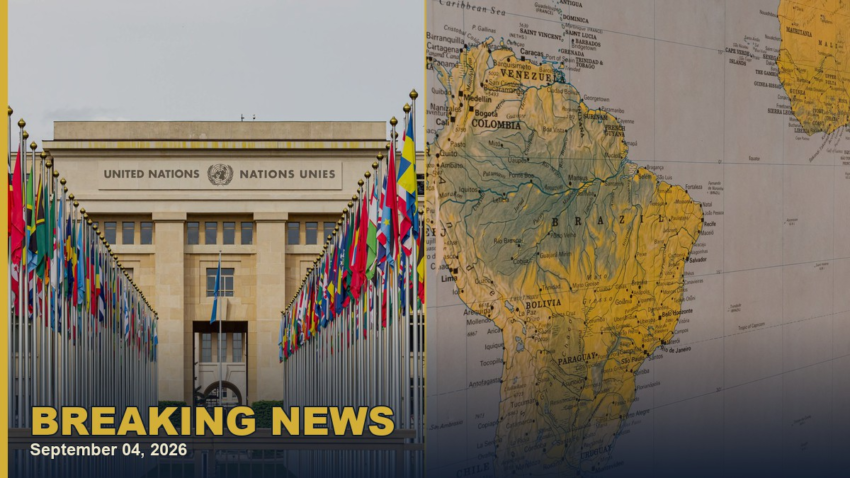
The UN General Assembly voted Friday at its headquarters in New York to replace the traditional Mercator world map with one that more accurately reflects Africa’s size, adopting the “Correct the Map” resolution by a vote of 164 in favor, one against and six abstentions, as reported by BBC News [1] and The Guardian [2].
Key Facts
- The resolution, sponsored by Togo and backed by African Union members, passed with the support of 164 nations, including France and the UK; the United States was the only nation to vote against it, and there were six abstentions [1].
- The US representative said the resolution was “superfluous” [2].
- The adopted design is based on the Equal Earth projection, an equal-area map created by a team of cartographers in 2018; the AU’s 54 member states adopted it in February [1].
- The Mercator map, in common use since the 16th century, shows Africa as similar in size to Greenland even though the continent is 14 times larger [1][2].
- The vote is non-binding and will not mandate or forbid any particular map use, but it is expected to result in updates to classroom curriculums and everyday technology [1][2].
Why the Map Was Changed
The Mercator layout was introduced in 1569 by the Flemish cartographer Gerardus Mercator to help European explorers navigate across the world [1] and to help sailors navigate the seas [2]. The distortion arises because it is impossible to accurately represent the surface of a globe on a two-dimensional chart; the Mercator map shows the curvature of the Earth by making countries near the equator seem smaller than they are, with countries nearer the poles appearing bigger [1]. Critics say this has led to the development needs and potential of countries near the equator being minimized [1].
Togo, which spearheaded the campaign for the resolution on behalf of the African Union, said the resolution “recognises and affirms that disproportionate cartographic representations, particularly those resulting from the Mercator projection, have had lasting cognitive, educational, cultural, geopolitical and socioeconomic effects, contributing to a drastic reduction in the perceived size of Africa and other regions of the world in the global collective imagination” [2]. A Change.org petition backing the #CorrectTheMap campaign, which has more than 11,000 signatures, says “You could fit the United States, China, India, Japan, Mexico and much of Europe into Africa and still have land to spare”; the African Union endorsed the campaign in August 2025 and then asked Togo to spearhead its adoption [2].
Reactions From Sponsors and Backers
Ahead of Friday’s vote, Togolese Foreign Minister Robert Dussey told the Reuters news agency: “A fair world begins with a fair map” [1]. Earlier, he had told a UN briefing: “A map is never neutral. It shapes perceptions, influences how the place of peoples and continents in the world is understood” [1]. Speaking before the resolution passed, he also said: “This discussion is not a political discussion [but] a scientific discussion, because there is scientific proof so we all have to accept the reality” [2].
France’s foreign minister, Jean-Noël Barrot, spoke in support of the resolution, saying: “[We] will abandon the Mercator projection in favour of map representations tailored to specific uses, more faithful to actual surface areas and in line with the recommendations of cartographers and scientists” [2].
What’s Still Unconfirmed
All substantive facts in this report are confirmed by the two published accounts, which agree on the vote count, the sole US objection, the six abstentions and the resolution’s non-binding character; no practical details on how institutions will phase in the new projection have yet been reported.
SUPPORT KEMETIC MINDS
Enjoying this coverage? Back the work and find every way to connect with us in one place.
References
- BBC. (2026, September 4). UN votes to adopt new world map showing Africa's true size. bbc.com ↩a ↩b ↩c ↩d ↩e ↩f ↩g ↩h ↩i ↩j
- The Guardian. (2026, September 4). UN votes to adopt new world map that shows Africa’s true scale. theguardian.com ↩a ↩b ↩c ↩d ↩e ↩f ↩g ↩h ↩i
Methodology: This report covers a single breaking story, selected because it was
independently covered by multiple news outlets within the last 20 hours. It is grounded
only in the fetched, cited source text above and does not draw comparisons to other news. No Wikipedia
sources are used, and no embeds are auto-generated.

Kemetic Minds Editorial Desk
Verified NewsroomPrimary-sourced investigative intelligence on civil rights, voting rights, federal policy, and consumer protection. Sourced from primary legal filings, government statistics, and direct field reporting.