

KEMETIC MINDS
History & Data Analysis | July 27, 2026
On July 24, 2026, Mississippi Gov. Tate Reeves said civil rights attorney Ben Crump and Rev. Al Sharpton “are to blame for the threats” surrounding the Nolan Wells drowning investigation and are “stoking division for personal gain.” Neither man has been linked by authorities to any threat, and neither had publicly responded at the time of the governor’s remarks. But the premise of the accusation — that division in Mississippi is something outside lawyers and preachers manufacture, rather than a structural feature of the state’s history — doesn’t hold up against the historical and statistical record. From the state’s 1861 secession declaration through its 1890 disenfranchisement constitution, the nation’s highest lynching count, and present-day gaps in income, maternal mortality, and voting rights, Mississippi has been divided along racial lines for longer than it has been a state that wasn’t. Here is that record, in the state’s own documents and the federal government’s own numbers.
The Accusation
Speaking as the FBI investigates threats against officials, witnesses, and family members connected to the death of 18-year-old Nolan Wells[1], Gov. Tate Reeves said: “Ben Crump and Al Sharpton are to blame for the threats. They are stoking division for personal gain. It’s sad to see.”[1] Mississippi Department of Public Safety Commissioner Sean Tindell confirmed the FBI probe and said threats against officials, witnesses, and their families are criminal acts regardless of who is to blame for them[2]. Wells’s mother, Christine Wonsley, has herself received threats[1]. As of publication, neither Crump nor Sharpton had responded publicly to the governor’s remarks, and authorities have not linked either man to any threat[1].
The Pattern Behind One Case
Wells is not the first young Black Mississippian whose family has rejected an official finding and brought in Crump. Demartravion “Trey” Reed, 21, was found hanging at Delta State University in September 2025; the state medical examiner ruled it a suicide, and Reed’s family retained Crump and funded a second, independent autopsy[3]. Rasheem Carter, 25, went missing near Laurel after telling his mother he was being targeted by white men in the area; his dismembered remains were recovered weeks later, and the medical examiner’s office said the condition of the remains made a cause of death impossible to determine[3]. In each case, a family’s public distrust of an official ruling — not an outside agitator inventing a grievance — is what preceded Crump’s and Sharpton’s involvement.
Division Is Not New: A Timeline
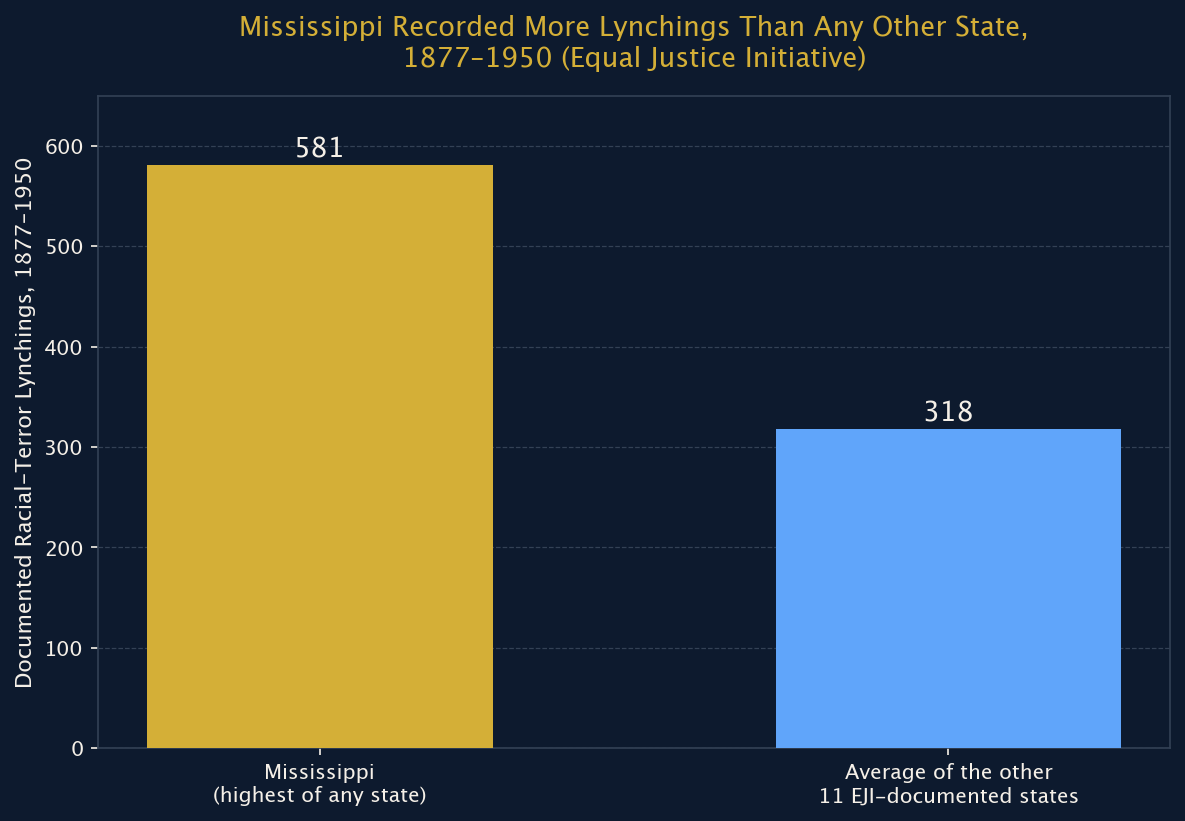
Whether “division” in Mississippi began with a phone call to Ben Crump or with the state’s own founding documents is a question the historical record answers directly. Mississippi’s 1861 secession declaration named its cause without euphemism: “Our position is thoroughly identified with the institution of slavery.” Twenty-nine years later, the state’s 1890 constitutional convention adopted poll taxes, literacy tests, and an “understanding clause” explicitly built to disenfranchise Black voters — a design other Southern states then copied, a strategy historians still call the “Mississippi Plan.” Between 1877 and 1950, Mississippi recorded 581 documented racial-terror lynchings, the highest total of any U.S. state[4]. Mississippi did not ratify the 13th Amendment abolishing slavery until 1987 — 122 years after the rest of the nation — and did not file the paperwork to make that ratification official with the federal government until 2013. The state did not retire the last U.S. state flag bearing the Confederate battle emblem until 2020.
Figure 1
Mississippi Racial Division: A Timeline, 1817–2026
Scroll to zoom, drag to pan, hover any point for detail. Selected events; not exhaustive.
Chart: Kemetic Minds. Sources: Equal Justice Initiative, Lynching in America; Mississippi Secretary of State; U.S. National Archives.
Race and Violence: What the Record Shows
Mississippi’s 581 lynchings between 1877 and 1950 were not spread evenly across the twelve states the Equal Justice Initiative studied — they represent roughly 14% of the region’s total (4,075) concentrated in a single state, nearly double the average of the other eleven[4]. Peer-reviewed research has since connected that history directly to present-day outcomes: a 2021 study in Health & Place found that U.S. Southern counties with the most documented lynchings have measurably lower life expectancy today than counties with none, with historical lynching and related covariates explaining over half the variance in county-level life expectancy across the region[5]. Separately, a 2011 study in The Review of Black Political Economy found that a metro area’s historical lynching rate is positively and significantly associated with its level of housing segregation today, even after controlling for the standard predictors of segregation[6]. Mississippi’s most infamous individual cases — Emmett Till’s 1955 murder in Money, the 1962 Ole Miss integration riot, Medgar Evers’s 1963 assassination in his own driveway, and the 1964 Freedom Summer murders of James Chaney, Andrew Goodman, and Michael Schwerner in Neshoba County — are not backdrop to this history. They are the history the statistics describe.
Figure 2
Mississippi vs. Average of Other EJI-Documented States, 1877–1950
Politics: Disenfranchisement, Then and Now
The 1890 constitution’s disenfranchisement clauses have a direct present-day descendant. Mississippi imposes lifetime, non-automatic voting bans for 23 categories of felony conviction, and between 2000 and 2015 only 335 of 166,494 people who completed sentences successfully navigated the process to regain their vote[7]. The racial skew is stark: at least 43,700 Black Mississippians — more than 5% of the state’s Black adult population — cannot vote because of a felony conviction, and Black residents make up over 60% of everyone disenfranchised statewide despite being about 37% of the state’s population[7]. Human Rights Watch has described the state’s voting-rights landscape as “a system built to exclude”[8]. This is the same instrument — using the criminal-legal system to remove Black political voice — that the 1890 convention’s own delegates designed, updated for the present.
Wealth and Health: The Present-Day Gaps
The median Black household in Mississippi earns $37,897 a year; the median White household earns $68,018 — a gap of roughly $30,121, or 79%[9]. On health, the Mississippi State Department of Health’s own maternal mortality reporting has repeatedly found Black women in the state die of pregnancy-related causes at roughly four times the rate of White women, a disparity independent reporting has confirmed using the same state data[10][11].
Figure 3
Present-day disparity ratios: Black Mississippians vs. White Mississippians (wealth, health, political voice)
Chart: Kemetic Minds. Sources: U.S. Census Bureau ACS 2019–2023 (income); Mississippi State Department of Health (maternal mortality); The Sentencing Project, Locked Out 2024 (felony disenfranchisement share vs. population share).
Relationships: A Ban That Outlived Its Enforceability
Mississippi’s state constitution banned interracial marriage from 1890 onward. The U.S. Supreme Court’s 1967 ruling in Loving v. Virginia struck down every such law nationwide as unconstitutional — but Mississippi left its own unenforceable ban on the books in its state constitution for two more decades, only removing it when voters approved a repeal in 1987, the same year the state finally ratified the 13th Amendment. For twenty years after interracial marriage was a constitutional right nationwide, Mississippi’s own founding document still said otherwise.
Kemetic Minds Analysis
Calling two civil rights figures the source of Mississippi’s “division” requires treating division itself as a recent invention rather than a documented, 165-year throughline running from the state’s own 1861 secession declaration to its own 2024 felony-disenfranchisement numbers. Nothing in the record above required Ben Crump or Al Sharpton to exist. The 1890 constitution’s authors wrote their disenfranchisement clauses without a press conference. The Equal Justice Initiative didn’t create Mississippi’s 581 lynchings; it counted them. The $30,121 median income gap and the fourfold maternal mortality disparity are measured by the state’s own health department and the federal government’s own Census Bureau, not by outside attorneys. What Crump and Sharpton actually do in each of these cases is amplify a family’s public disagreement with an official finding — a disagreement that, given the historical pattern above, families in Mississippi have had ample independent reason to hold before any attorney arrives.
References
- TheGrio. (2026, July 24). Mississippi Gov. Tate Reeves blames Ben Crump and Al Sharpton for threats, stoking division in Nolan Wells case. thegrio.com ↩a ↩b ↩c ↩d
- Fox News. (2026, July 24). Governor blames activists in Nolan Wells case for ‘stoking division,’ official says FBI probing threats. foxnews.com ↩
- Ben Crump Law. (2025, September 18). Attorney Ben Crump says family will seek second independent autopsy for Trey Reed; Kaepernick initiative will cover cost. bencrump.com ↩a ↩b
- Equal Justice Initiative. (2015). Lynching in America: Confronting the legacy of racial terror (3rd ed.). eji.org ↩a ↩b
- Kihlström, L., & Kirby, R. S. (2021). We carry history within us: Anti-Black racism and the legacy of lynchings on life expectancy in the U.S. South. Health & Place, 70, Article 102618. https://doi.org/10.1016/j.healthplace.2021.102618 ↩
- DeFina, R., & Hannon, L. (2011). The legacy of Black lynching and contemporary segregation in the South. The Review of Black Political Economy, 38(2), 165–181. https://doi.org/10.1007/s12114-011-9089-z ↩
- The Sentencing Project. (2024). Locked out 2024: Four million denied voting rights due to a felony conviction. sentencingproject.org ↩a ↩b
- Human Rights Watch. (2026, March 18). Black voting rights in Mississippi. hrw.org ↩
- Neilsberg Research. (2025). Mississippi median household income by race [ACS 2019–2023 5-year estimates]. U.S. Census Bureau. neilsberg.com ↩
- Mississippi State Department of Health. (2025). Mississippi maternal mortality report: Review of 2019–2023. msdh.ms.gov ↩
- Associated Press, via The Hill. (2023, December 7). Maternal mortality rate is much higher for Black women than white women in Mississippi, study says. thehill.com ↩
Methodology: Lynching totals are drawn directly from the Equal Justice Initiative’s Lynching in America report. Income figures are U.S. Census Bureau American Community Survey 2019–2023 5-year estimates. Maternal mortality figures are from the Mississippi State Department of Health’s own maternal mortality reporting. Felony-disenfranchisement figures are from the Sentencing Project’s Locked Out 2024 report. Peer-reviewed sources include full DOI links. No figures were estimated or sourced from Wikipedia.
📱 Stay Connected

Kemetic Minds Editorial Desk
Verified NewsroomPrimary-sourced investigative intelligence on civil rights, voting rights, federal policy, and consumer protection. Sourced from primary legal filings, government statistics, and direct field reporting.
1 thought on “Black News · Jul 26, 2026Tate Reeves Says Don’t Cause Division, But History Shows Mississippi Is Divided”