
- Date: November 6, 2026 (developing story; reflects reports through the morning of November 6)
- Category: Geopolitics / Macro Finance / Digital Infrastructure
- Byline: Kemetic Mind Editorial & Investigative Desk
A note on language: much of the best reporting on this story is in Spanish. Translations of quotes are ours and are marked. Allegations are attributed to who made them. No court has ruled on any of them.
1. Executive Summary / Incident Briefing
Incident briefing
- What happened: On November 2, the board of Paraguay’s central bank (the BCP) voted unanimously to open the resolution of Ueno Bank. Once the bank’s financial statements were adjusted, its solvency ratio was below 50% of the legal minimum. The decision was announced around 3 a.m. on November 3.[1][2][3]
- Who was hit: About 3 million customers, roughly 60% of the country’s adults, and $800 million to $850 million in public money.[1]
- The political fallout: President Santiago Peña, a business partner of Ueno’s owner, Grupo Vázquez, until March 2025, announced his resignation on November 5. The Chamber of Deputies voted 78–0 to impeach him minutes later. Congress then failed to accept the resignation, and the Senate opened an impeachment trial.[1][4][5]
- Legal status: Peña and the bank deny wrongdoing.[1] Prosecutors say Peña is under criminal investigation. The reports we reviewed show no charges against him.[6][7]
The shorthand version, “a fintech collapsed and took a president with it,” is close, but it hides the details that matter. Ueno did not fail because an app broke. According to the central bank, prosecutors and the press, it failed the oldest way a bank can fail: by lending to companies tied to its owners, past what the law allows. What was new was the delivery. A digital bank put one company’s balance sheet between most of a country’s adults and their money. When the regulator pulled the plug, a customer in San Lorenzo saw one message on her screen: “We can’t show your balance. Try again later” (our translation).[3]
Video: Associated Press, November 5, 2026 — “Paraguay President Santiago Peña resigns following bank collapse”. A one-minute AP report on the resignation announcement.
2. The Anatomy of an Overnight Lockout
How the night unfolded
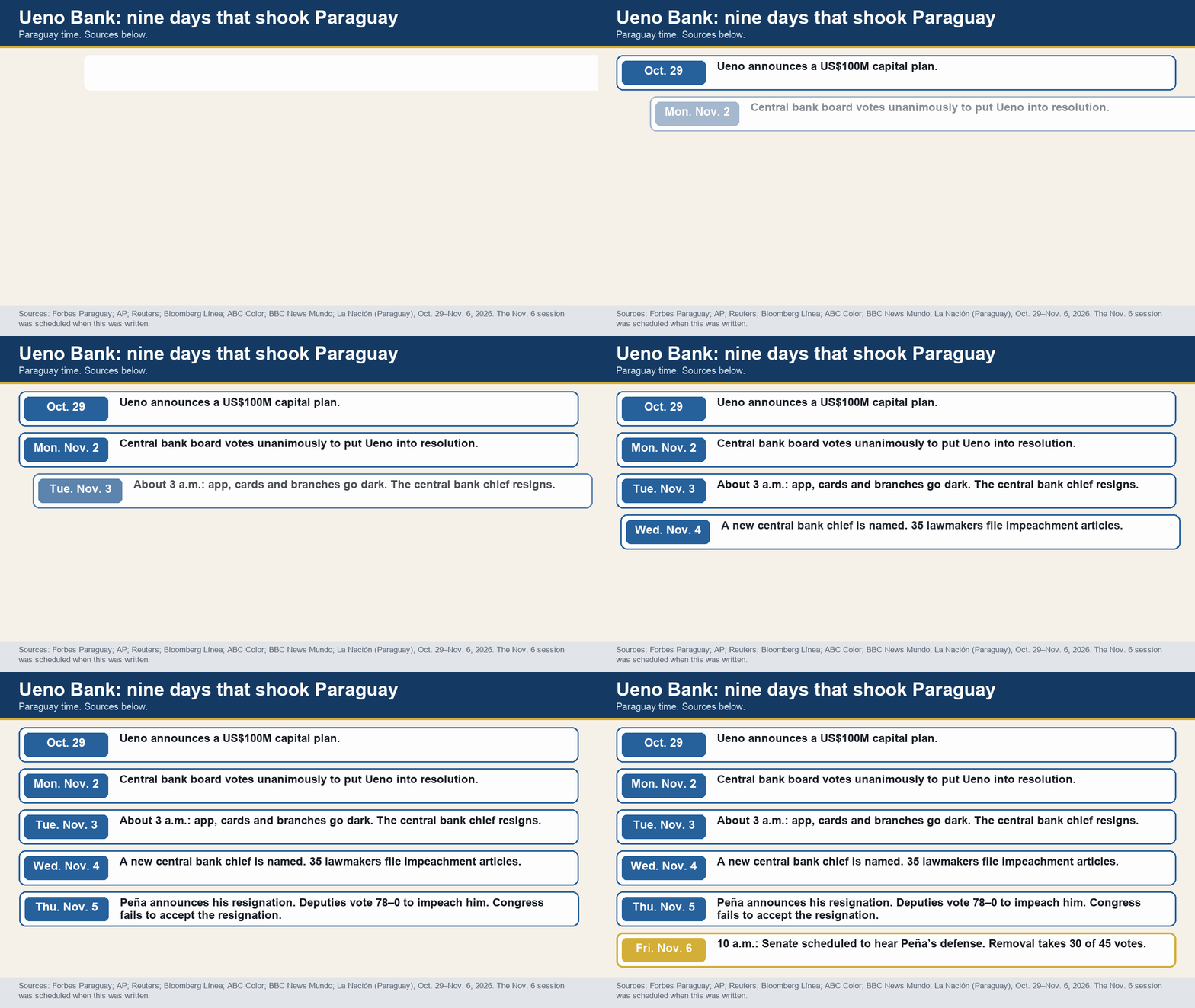
The warning signs were public, but the end came fast. On October 29, Ueno announced a $100 million capital plan.[8] On the night of Monday, November 2, it was still marketing. Customers who deposited new money and kept it until November 7 were offered a 50% refund on a credit card purchase.[3] Hours before the seizure, the bank had put out a statement denying that the deposit guarantee fund applied to it and saying it was operating “normally.”[8]
BioBioChile, drawing on Paraguayan press reports, adds that Ueno had drawn about $70 million from its legal reserve at the central bank and told the regulator on October 29 that it could not put the money back.[9] That is one outlet’s account of the sequence, and we have not seen the underlying filing.
At 3 a.m. the BCP posted its decision. At a press conference, board member Liana Caballero put the result plainly: no service of the institution was active from that date (our translation).[10] The app, cards and transfers went dark and the branches locked their doors.[4]
Video (in Spanish): DW Español, November 5, 2026 — “Paraguay sacudido por la caída de Ueno Bank”. Depositors and pensioners wait for answers while prosecutors seek detention for Ueno executives.
Scale: who was locked out
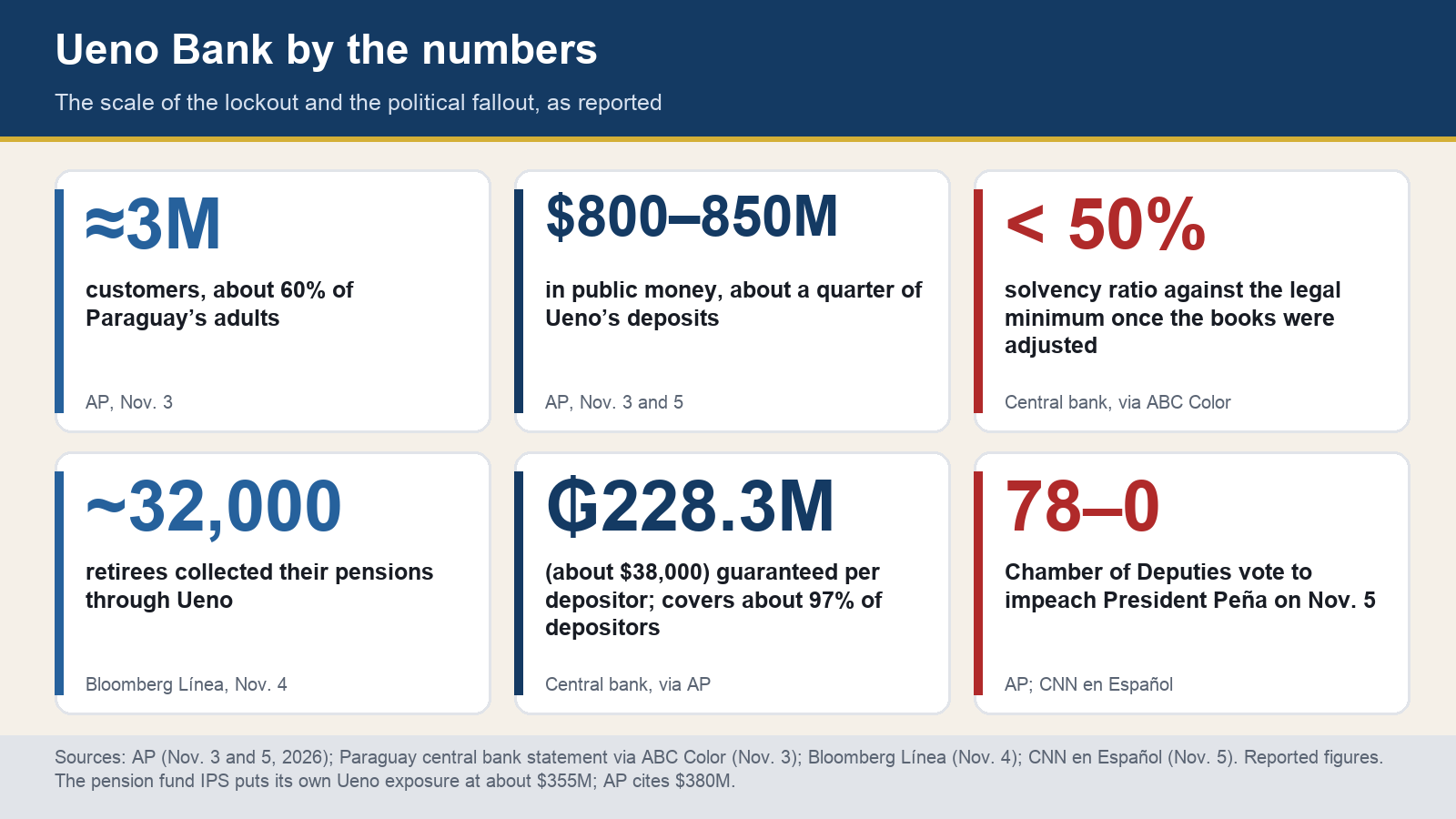
- Customers: About 3 million, roughly 60% of Paraguay’s adults, according to AP.[1] Other outlets measure it differently, such as roughly half of all Paraguayans (BBC Mundo), but all describe a bank that most of the country used.[11]
- Daily commerce: The bank said in June that it processed more than 3 million transactions a day. An association of importers and retailers warned of a “semi-paralysis” of commerce and said two-thirds of electronic transactions at large retailers ran through Ueno accounts.[3]
- Workers: AP reported that 7,000 employees affected by the closure were left with unpaid wages, and that officials were opening new accounts elsewhere for about 280,000 people who had banked only with Ueno.[4]
- Public money: $800 million to $850 million, according to AP. That includes about $380 million from the state pension and health fund IPS, by the fund’s own figure.[1] The IPS finance manager gave a different number, about $355 million, which is about 9% of its portfolio.[12][13] Money from the state power company ANDE and the Itaipú dam was also in the bank.[9]
- Pensions: About 32,000 retirees collected their pensions through Ueno.[3] Some accounts describe their payments as frozen. The sources show something narrower: their Ueno accounts were frozen, while IPS said pensions would be paid as usual, with retirees moved to other banks and the next payment due November 17.[1][12]
- Savers’ protection: The guarantee fund covers up to ₲228.3 million (about $38,000) per depositor per institution, which AP says fully covers about 97% of depositors. By law the money must be paid within 15 days, a deadline that can be extended once.[1][2] The first payment announced was up to ₲10 million. For claims above the guarantee, IPS ranks first, then large savers.[12] The central bank stopped short of promising full repayment for larger balances, saying only that it would seek “the greatest possible protection.”[1]
The rescue strained the rails
Moving millions of accounts to other banks created its own pressure. Reuters reported that the process strained the banking system and contributed to outages at several banking apps.[14]
3. Regulatory Capture & The Political Domino
“Regulatory capture” is our frame, not a finding by any court or agency. What follows is what the sources report, so readers can judge whether the frame fits.
The connections
- Peña and Grupo Vázquez. AP says Peña was a business partner of Grupo Vázquez, which owns Ueno, until March 2025. Reuters says he was a shareholder in the group until then.[1][14] The impeachment accusation, as BBC Mundo summarizes it, says he held shares in Ueno Holding SAECA until 2025.[5] BioBioChile, citing his declaration to the Comptroller, puts the nominal value at ₲6,144 million.[9] Ueno says Peña was never a shareholder or investor in the bank.[1]
- The regulator’s chief. In 2023, Peña appointed Carlos Carvallo, president of Financiera Ueno (the predecessor of Ueno Bank), to run the central bank that supervises it.[4][9] The central bank said Carvallo recused himself from decisions involving Ueno.[1] Ueno completed its conversion into a bank in November 2023, when a BCP led by Carvallo approved it, three months after he took the job.[9] On November 3, Peña asked Carvallo to resign, and he did.[15] A new governor, Raúl Vera Bogado, was named on November 4.[16]
- Public money. Under Peña, state bodies including IPS, ANDE and Itaipú placed deposits and investments in Ueno.[9] Government deposits reached about ₲5 trillion by the end of June, about 29% of Ueno’s deposits, according to Bloomberg.[17] Ueno’s own president put public money at about a quarter.[6] ABC Color, citing Finance Ministry records, reported that Ueno took in about $20 million more in public funds in September, while already under a central bank proceeding over its related-party lending.[18]
- What IPS says. Its finance manager said the Ueno investments met the official solvency, liquidity and risk indicators, and that internal and Comptroller audits found no breach.[13]
- The warnings. In October, senators from the ruling party and the opposition urged Peña to seek the resignation of the BCP’s leadership after a report on Ueno failed to satisfy them.[10] AP reports that as recently as last month Peña defended Ueno and the central bank’s oversight, dismissing the concerns as a smear campaign that was spooking the public.[6]
What the regulator and prosecutors say they found
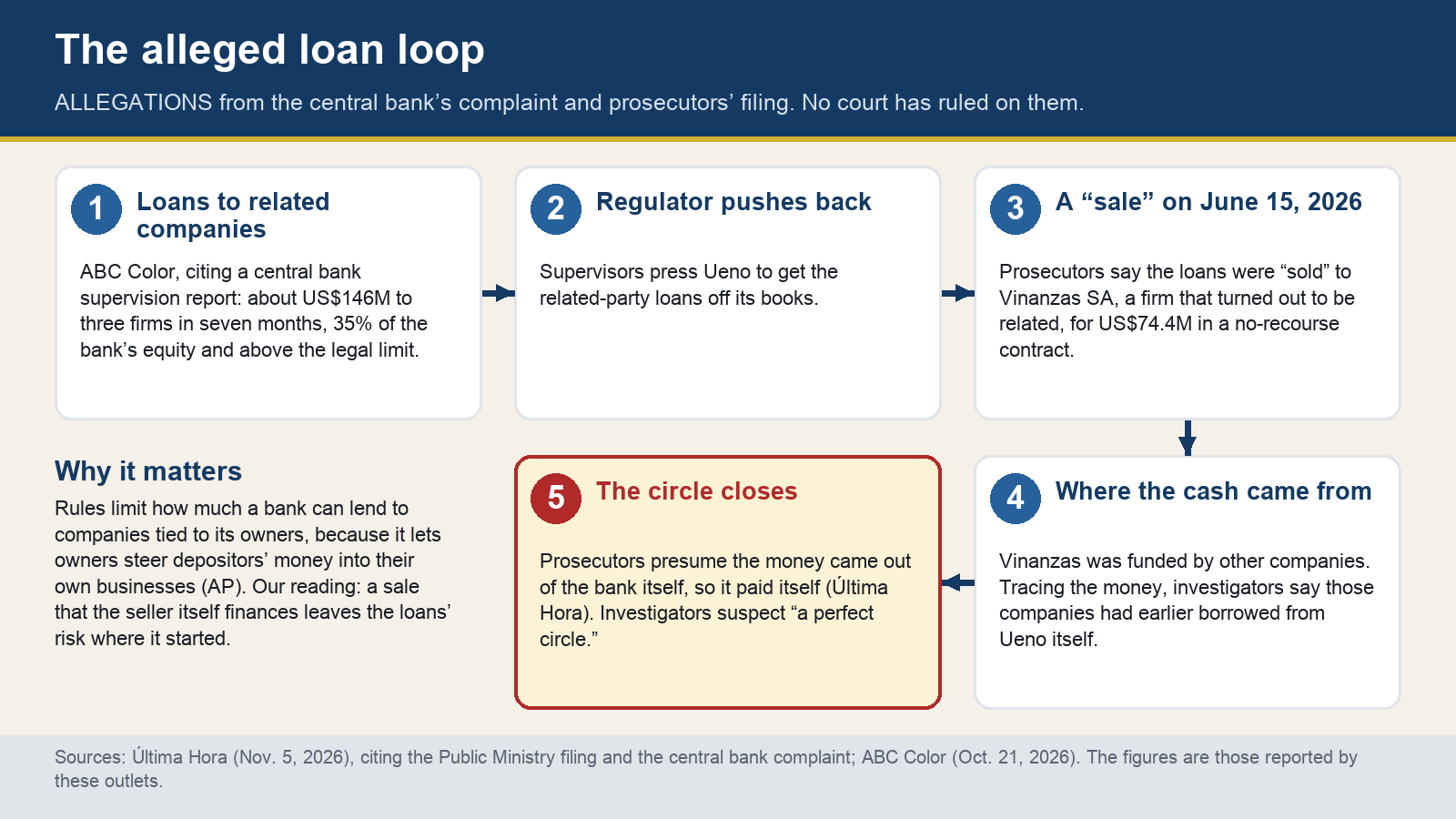
- Lending past the limit. ABC Color, citing a technical supervision report, said Ueno channeled about $146 million to three related firms in seven months. That was 35% of the bank’s effective equity and above the legal limit.[18] BioBioChile reports that the BCP found related-party excesses of more than $140 million that needed immediate capitalization.[9] AP adds that on one day in September 2025, nearly $39 million went to three such companies.[4]
- Loans without cover. AP reports the lending was poorly documented, lacked enough collateral, and that expenses had been wrongly counted as assets. Once the books were corrected, capital fell below half the legal minimum.[4]
- The alleged loop. Prosecutors and the central bank allege that when supervisors pressed Ueno to clear the related-party loans, it “sold” them on June 15, 2026 to Vinanzas SA, itself a related firm, for $74.4 million in a contract with no recourse. Tracing the money, they say, showed the companies that funded Vinanzas had earlier borrowed from Ueno. Última Hora reports that 27 people have been charged, including executives and company representatives.[19] ABC Color had traced similar circular flows earlier.[20] This is an allegation, not a finding.
- Courts and arrests. At the BCP’s request, a judge ordered a preventive embargo of assets of Grupo Vázquez entities, its beneficial owner Federico Miguel Vázquez and Ueno’s directors, up to $70 million plus ₲1.6 trillion. Prosecutors said preliminarily that the facts could fit breach of trust, fraud and conduct leading to bankruptcy.[21] Bloomberg reports arrest orders for at least eight people, including Grupo Vázquez president Miguel Vázquez.[3]
The domino
- November 4: 35 lawmakers filed impeachment articles accusing Peña of conflicts of interest, misuse of pension funds and institutional cover-ups.[22]
- November 5, around 1 p.m.: Peña announced his resignation in a video, saying he was stepping down for “the stability of our country, social peace and the need to preserve our democratic institutions.” He added: “I also want to apologize to the people if I have failed them at any point.”[4][23]
- Minutes later, the Chamber of Deputies approved the accusation unanimously, 78–0.[4][24] BBC Mundo lists five axes: conflict of interest and ties to Ueno Holding; the impact of the collapse; alleged interference in IPS to place funds in Ueno; alleged unjust enrichment, including loans received from the bank; and institutional responsibility. These are accusations, not findings. Deputies rejected a separate impeachment request against Vice President Pedro Alliana, 48 to 30.[5]
- The resignation was not accepted. A joint session lost its quorum when ruling-party legislators left the chamber as the vote began.[25] Opposition lawmakers argued that accepting it would make Peña a senator for life, with immunity.[5] An opposition senator said the count stood at 31 to 26 against accepting; that figure comes from one partisan source.[26] Peña remained formally president.[23]
- The Senate trial opened that evening, and Peña’s defense was set for November 6 at 10 a.m.[27] Peña said he would appear and exercise his right to defense.[28] Removal takes 30 of the Senate’s 45 votes. If he is removed, he would lose his eligibility to become a senator for life and the immunity that comes with it, which would let prosecutors proceed if they file charges.[7]
- The criminal track. The attorney general ordered three criminal investigations, including complaints that involve Peña and other officials.[7]
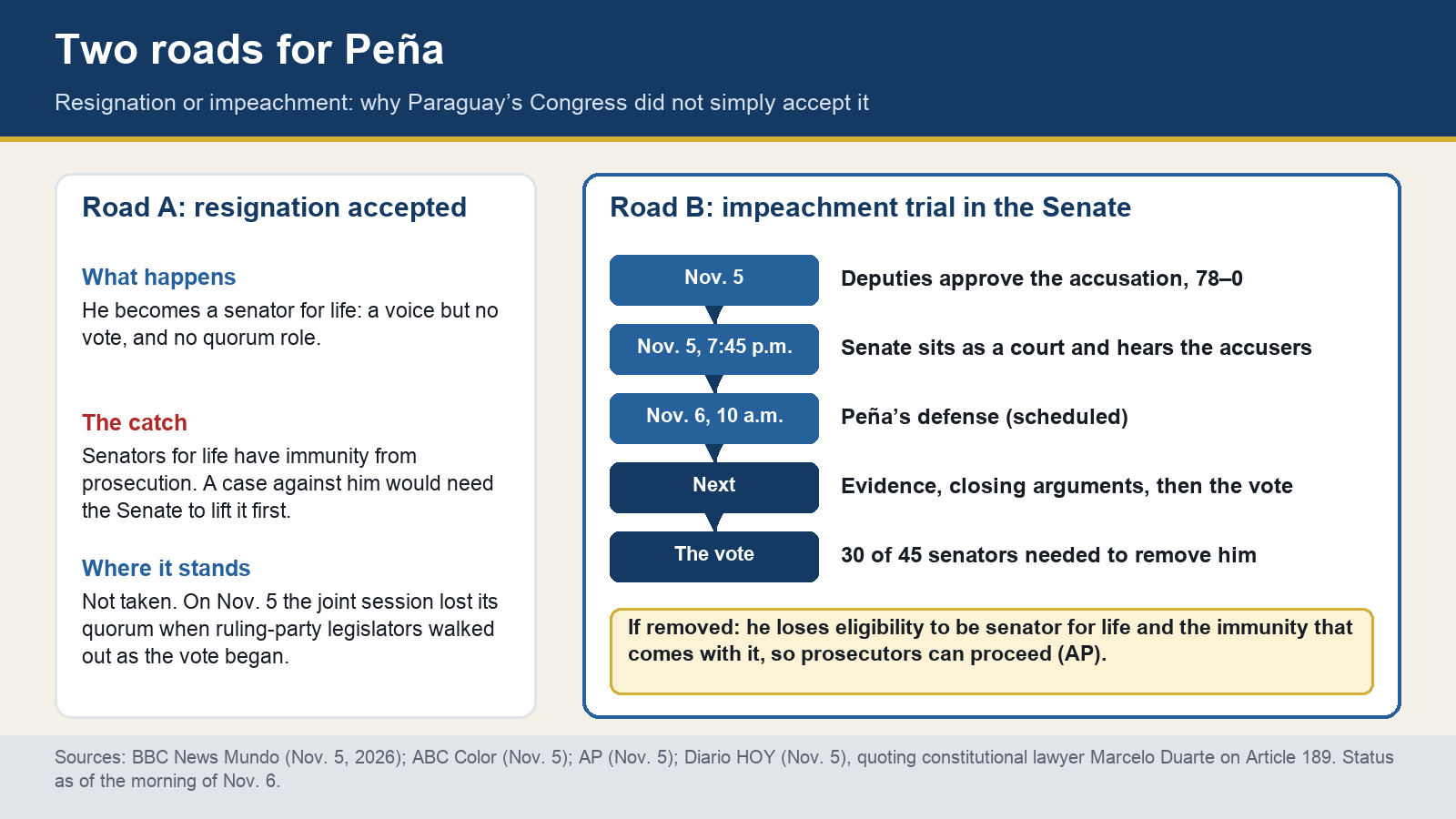
Video (in Spanish): BBC News Mundo, November 5, 2026 — “Crisis de Ueno Bank: las claves de la renuncia de Peña en Paraguay”. BBC Mundo’s short explainer on why Congress pressed ahead with the impeachment despite the resignation.
Video: Al Jazeera English, November 5, 2026 — “Paraguay President Santiago Pena resigns after digital bank collapse”. Al Jazeera’s Lucia Newman reports on the resignation and the central bank’s seizure of the lender.
Why we use the word “capture”
Our reading rests on three structural facts that the sources support. The supervisor’s chief came from the firm he supervised. Public money kept flowing into the bank while the supervisor was investigating it. And the president publicly defended the bank until days before it was seized. None of this proves intent. It does describe a system where the usual checks were thin.
Orkun Saka, a financial economist at City St George’s, University of London, told BBC Mundo: “Let’s be clear about what happened. A bank belonging to a single business conglomerate ended up concentrating the savings of most of the country’s adults, plus hundreds of millions of dollars of pension funds” (our translation).[11] Opposition senator Rafael Filizzola called the case “the biggest scam from political power of the democratic era” (our translation), a charge from a political opponent rather than a finding.[11]
4. The Illusions of Modern Fintech: Growth Hacking vs. Capital Solvency
Growth ran ahead of governance. When Ueno became a bank at the end of 2023, executives said it already had more than 500,000 customers and had brought about 140,000 previously unbanked people into the system. Less than three years later it claimed more than 3 million.[11] AP describes a company that went from an obscure finance firm to a household name in under five years, with a national stadium that once carried its name.[4] Deposit promotions, such as the 50% card refund, were part of the engine.[3]
The ratings narrative and the books. A December 16, 2025 S&P Global Ratings report, posted on Ueno’s own website, listed “rapid expansion and portfolio growth” among the bank’s key risks. It also described the bank as effectively ring-fenced from Grupo Vázquez, which owns nearly 98% of it, and cited regulatory capital of 14.4% as of October 2025 against a 12% minimum. The report says it is not a rating action, and it predates the central bank’s adjustment of the books.[29] Less than a year later, the central bank adjusted the books and found solvency under half the legal minimum.[1] We cannot say what S&P would conclude with the adjusted books. The lesson is how far reported capital and corrected capital can diverge when related-party lending is large.
A mid-sized balance sheet with outsized reach. Bloomberg calls Ueno the sixth-largest bank in Paraguay by deposits.[16] FIX, cited by Montevideo Portal, put its share at 8.9% of system deposits and 5.9% of credit as of December 2025.[30] Yet it served about 60% of adults.[1] In our reading, that gap is the story: the bank was moderate in size but central to everyday payments.
The old problem in a new wrapper. Lending to the owner’s other companies is as old as banking. AP notes that banks face strict limits on it because it lets owners steer customers’ money into their own businesses.[1] What digital delivery adds, in our analysis, is speed of customer acquisition, concentration of payments on one company’s rails, and a failure that is instant and total. In a classic bank run, depositors queue for days. Here, an app screen went blank at 3 a.m. and the whole country woke up locked out.
5. Structural Lessons for Emerging Markets & Digital Sovereignty
The points below are our analysis, drawn from the facts above. They are not claims about what any agency has concluded.
- Cap how much public money sits in any one private bank. IPS held about 9% of its portfolio in Ueno, and government deposits were roughly 29% of Ueno’s.[13][17] IPS says it followed the official indicators, which suggests the indicators lagged the risk.[13]
- Treat related-party lending as the tripwire, and act early. The legal limits already existed.[1] The excess lending is documented from at least September 2025, and a BCP proceeding over it was open by October 2026.[4][18] The distance between detection and action is the real cost.
- Separate the supervisor from the supervised. A cooling-off period before executives of a regulated firm can lead its regulator is a simple rule that would have changed this story. That is our recommendation.
- Plan for the payout, not just the failure. The guarantee covers about 97% of depositors, but the legal window is up to 15 days. A customer told Bloomberg: “With so much technology available today, how can this take 15 days?” (our translation).[3] Digital banks need pre-built partial-access and account-portability plans, and the first payment of up to ₲10 million shows the instrument exists.[12]
- Keep payment rails redundant. When merchants, payroll and pensions lean on one institution, its failure becomes everyone’s failure. The “semi-paralysis” of commerce and the trapped wages of 7,000 workers show the exposure.[3][4] Second acquirers, payroll through two banks and interoperable instant payments are the practical answers.
- Publish public-money exposure in near-real time. Finance Ministry spreadsheets let ABC Color track Ueno’s public deposits month by month.[18] Legislatures and regulators could use the same data as an alarm.
- Test “ring-fenced” as a claim, not a fact. Check it against the related-party loan book, not the corporate structure chart.[18][29]
What “financial sovereignty” means here. It is concrete: can a state keep wages, pensions and commerce moving when one institution goes dark? In Paraguay, for several days, the answer was “only partly.” Pensions were still due to be paid, the guarantee fund began paying, and officials opened new accounts for people who had no other bank.[4][12] But the state’s own pension fund was a creditor, and the country’s president faced impeachment over the case.
6. Final Editorial Takeaway
Ueno Bank is not proof that digital banking is fragile. It is proof that old risks travel faster on new rails. Related-party lending, thin supervision and political proximity are as old as banking. What an app adds is reach and speed: it can bring in a country’s savings in under three years, and it can shut them off in one night. The next test for Paraguay is whether its institutions can finish this story in the open, through the Senate trial, the prosecutions and a fair payout. For everyone else, the question is simple: if your country’s largest payment rail disappeared at 3 a.m., what would still work?
How We Verified This
- Sources: Every figure comes from AP, Reuters, Bloomberg, BBC, EFE or Paraguayan outlets, listed below. Where outlets disagree, we say so.
- Developing story: This was written before Peña’s scheduled November 6 defense in the Senate. Check the latest reporting for the outcome.
- Figures in circulation versus what the sources support:
| Figure you may have seen | What the sources support |
|---|---|
| Peña resigned on Nov. 5 | He announced it. Congress had not accepted it as of the evening, and he remained formally president.[23][25] |
| 28,000–32,000 pensioners with frozen payments | About 32,000 retirees collected pensions through Ueno. Their accounts were frozen, but IPS said pensions would be paid as usual. We found no source for 28,000.[1][3] |
| 63% of adults | AP says roughly 60%.[1] |
| IPS exposure | About $355 million per IPS’s finance manager; about $380 million per AP, citing the fund.[1][13] |
| $140M+ moved to affiliated companies | About $146 million in lending to three related firms above the legal limit, and related-party excesses of more than $140 million. These are reported as lending beyond limits, not as proven diversion of funds.[9][18] |
| Peña as a “shareholder” | Reuters: shareholder in Grupo Vázquez. AP: business partner. Ueno: never a shareholder or investor in the bank. The accusation cites shares in Ueno Holding SAECA.[1][5][14] |
| Impeachment “strips immunity” | If he is removed, he loses eligibility for the senator-for-life immunity. Accepting the resignation would have granted it.[5][7] |
- Not verified: We excluded claims we could not tie to a named report, including any total for the losses to creditors above the guarantee.
References
- AP. “Paraguay seizes major digital bank tied to president, leaving millions of customers in limbo” (Nov. 3, 2026). ↩
- ABC Color. “Ueno Bank: el BCP anuncia ‘procedimiento de resolución’” (Nov. 3, 2026; carries the central bank’s statement). ↩
- Bloomberg Línea. “Cierre de Ueno Bank en Paraguay congela depósitos y afecta pagos, pensiones y operaciones comerciales” (Nov. 4, 2026). ↩
- Los Angeles Times / AP. “Paraguay’s president impeached minutes after resigning following bank collapse” (Nov. 5, 2026). ↩
- BBC News Mundo. “Por qué el Congreso de Paraguay no aceptó la renuncia de Santiago Peña como presidente y qué supone ahora el juicio político en su contra” (Nov. 5, 2026). ↩
- PBS NewsHour / AP. “Paraguay prosecutor will seek charges against embattled president after bank collapse” (Nov. 5, 2026). ↩
- AP (en español). “Presidente de Paraguay renuncia tras colapso bancario e inminente juicio político” (Nov. 5, 2026). ↩
- Forbes Paraguay. “Caso Ueno Bank: el BCP inicia el procedimiento de resolución de la entidad” (Nov. 3, 2026). ↩
- BioBioChile. “Así se habría gestado la crisis bancaria que terminó con la renuncia del presidente en Paraguay” (Nov. 5, 2026). ↩
- EFE. “¿Qué se sabe de la intervención a Ueno Bank que ha desatado una tormenta política en Paraguay?” (Nov. 3, 2026). ↩
- BBC News Mundo. “Qué es Ueno Bank y qué provocó la crisis por la que Santiago Peña renunció como presidente de Paraguay” (Nov. 5, 2026). ↩
- Infobae. “Qué deben hacer los ahorristas y jubilados del Ueno Bank para cobrar el dinero que quedó congelado” (Nov. 4, 2026). ↩
- RDN / ABC Color. “IPS busca recuperar USD 355 millones depositados en Ueno Bank” (Nov. 4, 2026). ↩
- Reuters. “Explainer: What is ueno bank and how did it trigger Paraguay’s political crisis?” (Nov. 5, 2026). ↩
- Reuters. “Paraguay’s central bank chief resigns at president’s request as digital lender crisis deepens” (Nov. 3, 2026). ↩
- Bloomberg Línea. “Paraguay nombra nuevo jefe del Banco Central tras intervención de Ueno Bank” (Nov. 4, 2026). ↩
- Valor Econômico / Bloomberg. “Paraguai nomeia novo presidente para banco central após escândalo de quebra de instituição financeira” (Nov. 4, 2026). ↩
- ABC Color. “Ueno sumó otros US$ 20 millones en fondos públicos al cierre de septiembre” (Oct. 21, 2026). ↩
- Última Hora. “ueno bank usó su propio dinero para simular venta de créditos, según Fiscalía” (Nov. 5, 2026). ↩
- ABC Color. “Empresas ‘salvadoras’ le deben 153 millones de dólares a Ueno Bank” (Oct. 27, 2026). ↩
- Última Hora. “Embargan por USD 70 millones los bienes de directivos de ueno bank y del Grupo Vázquez” (Nov. 3, 2026). ↩
- Reuters. “Paraguay bank crisis spurs lawmakers’ calls to impeach president” (Nov. 4, 2026). ↩
- La Nación (Paraguay). “Peña sigue siendo presidente: dejan sin quórum la sesión” (Nov. 5, 2026). ↩
- CNN en Español. “Santiago Peña renuncia a la Presidencia de Paraguay en medio de la crisis por el cierre de Ueno Bank” (Nov. 5, 2026). ↩
- ABC Color. “Oficialistas dejan sin quórum sesión ante falta de votos para aceptar renuncia de Peña” (Nov. 5, 2026). ↩
- ABC Color. “Prosigue juicio político para Peña, dice Celeste Amarilla” (Nov. 5, 2026). ↩
- La Nación (Paraguay). “Avanza en el Senado el juicio político a Peña pese a renuncia” (Nov. 6, 2026). ↩
- El País. “Peña desafía al Congreso paraguayo y se defenderá en el juicio político en su contra” (Nov. 6, 2026). ↩
- S&P Global Ratings. “Ueno Bank S.A.” (Dec. 16, 2025; “does not constitute a rating action”; posted on Ueno’s website). ↩
- Montevideo Portal. “El Banco Central de Paraguay intervino ueno bank por falta de solvencia: las consecuencias” (Nov. 3, 2026; cites FIX). ↩

Kemetic Minds Editorial Desk
Verified NewsroomPrimary-sourced investigative intelligence on civil rights, voting rights, federal policy, and consumer protection. Sourced from primary legal filings, government statistics, and direct field reporting.