

Consumer Rights · Scam Alert · September 29, 2026, 5:10 PM CDT
Key Facts
- The City of Keller, Texas says scam emails are impersonating its officials and staff.[1]
- Some of the emails use real development project information and ask recipients to pay fees or provide payment confirmation.[1]
- The FBI has warned of the same scheme nationwide: fake permit-fee invoices sent from look-alike addresses, paid by wire transfer, peer-to-peer app or cryptocurrency.[2]
The City of Keller says scammers are pretending to be the City.
“We knew Town Hall had a few fans, but impersonating us to collect money is taking it a little too far,” the city wrote in its alert.[1]
“We’ve been made aware of scam emails impersonating City of Keller officials and staff. Some of these emails use real development project information and ask recipients to pay fees or provide payment confirmation.”[1]
What the Scam Looks Like
Keller has not published the wording of its own emails, so none of Keller’s is shown here. This is a real email of the same kind, sent in 2025 to a contractor with a pending sign application in Minneapolis, whose planning department shared it. The name of the person it was signed with is blacked out in the original.[3]
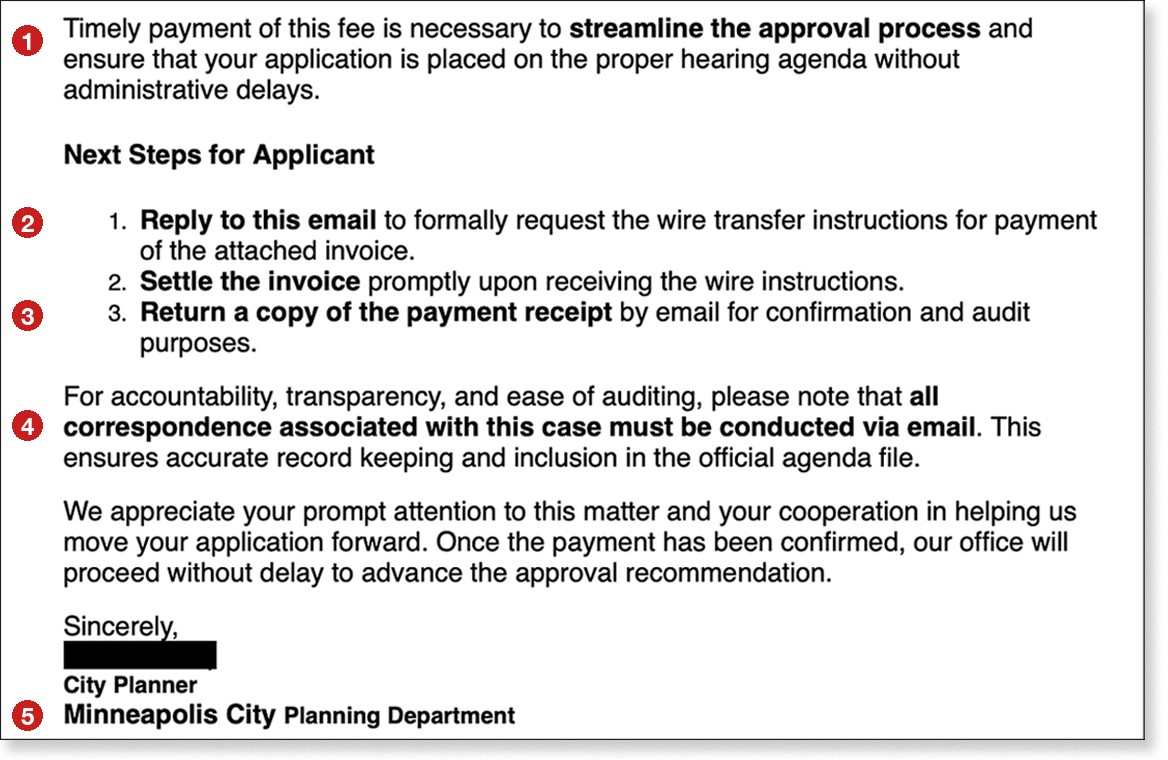
Red flags in this email:
- Urgency. “Timely payment of this fee is necessary… without administrative delays.” The FBI lists a threat of delays if payment is not made immediately as a common indicator.[2]
- Pay by wire transfer. It asks the reader to reply to get wire instructions. The FBI says victims are directed to pay by wire transfer, peer-to-peer payment or cryptocurrency.[2] Minneapolis says its planning fees are paid in person or by credit card over the phone.[3]
- Send back proof. “Return a copy of the payment receipt by email for confirmation.” This matches Keller’s warning about emails that ask for payment confirmation.[1]
- Email only. “All correspondence associated with this case must be conducted via email.” The FBI says this is designed to keep the victim from phoning the city or county to check the fee.[2]
- A real department name and job title. The details are accurate because scammers use public permit records. The FBI says not to trust an email because of letterhead, seals, officials’ names or good spelling and grammar.[2]
How the Sender Gives Itself Away
The FBI says these emails come from usernames similar to a city or county planning department, but from non-government domains such as “@usa.com.”[2] In the Minneapolis case, the real planner’s name was used with the address Planning-Dept.CityOffMinneapolisMN@usa.com.[3] They may also attach a PDF invoice with itemized fees, and the timing can coincide with a real hearing or posting.[2]
How to Protect Yourself
- Do not pay a permit or development fee because of an email. Do not reply to ask for payment instructions.
- Check the sender’s full address. A real Keller email will not come from a free or non-government domain.
- Look up the City’s phone number yourself on its official website and call to ask whether any fee is owed. Do not use a number or link from the email.
- Check the city or county website for notices about impersonation schemes.[2]
- If you already paid, contact your bank right away and ask whether the transfer can be recalled.
How to Verify This Yourself
Read the original alert at Local News Only, the FBI advisory at ic3.gov, and the Minneapolis account at Planning magazine. Those pages are the primary sources for everything above.
References
- Local News Only. Another Scam Alert – City of Keller. September 29, 2026 (statement by the City of Keller). ↩
- FBI Internet Crime Complaint Center. Criminals Impersonating City and County Officials in Phishing Emails for Planning and Zoning Permits (PSA260309). ↩
- Sisson, Patrick. Fraud Alert: How Scammers Are Now Impersonating City Governments. Planning magazine, American Planning Association. ↩
Investigative methodology: this post was first produced automatically from the Local News Only reprint, which carried no example of the scam. It was revised by hand from three primary sources: the City of Keller’s statement, the FBI advisory, and the Minneapolis email as published by the American Planning Association. Quoted text is verbatim from those sources. The email shown was not sent by or to the City of Keller.

Kemetic Minds Editorial Desk
Verified NewsroomPrimary-sourced investigative intelligence on civil rights, voting rights, federal policy, and consumer protection. Sourced from primary legal filings, government statistics, and direct field reporting.