
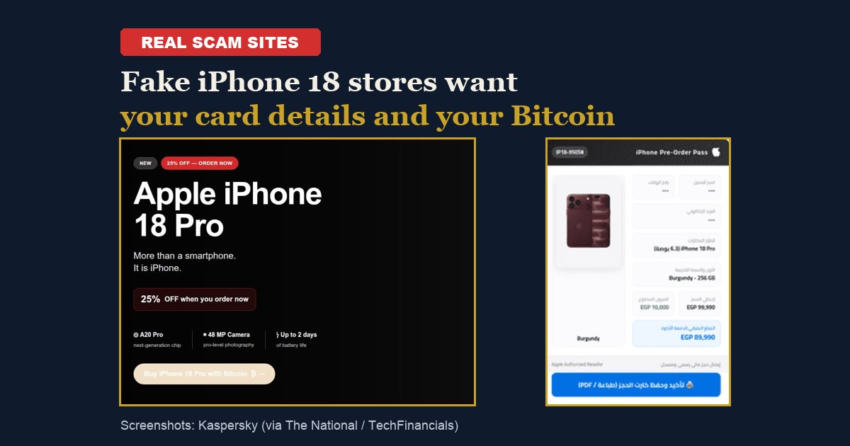
Consumer Rights · Scam Alert · Published September 29, 2026, 9:10 AM CDT · Updated 10:45 AM CT
Key Facts
- What: fake online stores “selling” the new iPhone 18 Pro. The cybersecurity firm Kaspersky found them in English, Arabic, Portuguese and other languages.[1][2]
- The bait: 25% off, pre-orders in colours and storage sizes Apple never announced, pay-later installments, payment in Bitcoin, and a promised “full refund.”[1][2]
- What they take: your full name, phone number, email, city and WhatsApp contact, then your bank card details. Some sites take a down payment, and the money disappears.[1][2]
- The real price: in the UAE the iPhone 18 Pro starts at Dh5,099 ($1,388) and the Pro Max at Dh5,499.[2]
- The safe way: buy only from Apple or a retailer you already know, and reach the site by typing the address yourself.[1]
The new iPhone had been on sale for only days when hundreds of people lined up at Dubai Mall to get one. Online, a quieter line was forming. Kaspersky says it found websites dressed up as iPhone stores, offering the iPhone 18 Pro at a quarter off, letting buyers “reserve” colours Apple doesn’t sell, and asking for payment in Bitcoin. The phones don’t exist. The sites exist to collect your card number, your personal details and your deposit.[1][2]
What the Scam Looks Like: Two Real Fake Stores
These are real screenshots of scam sites, released by Kaspersky. The numbered red markers are ours. They point to the red flags explained under each picture.
1. The English “Buy with Bitcoin” store
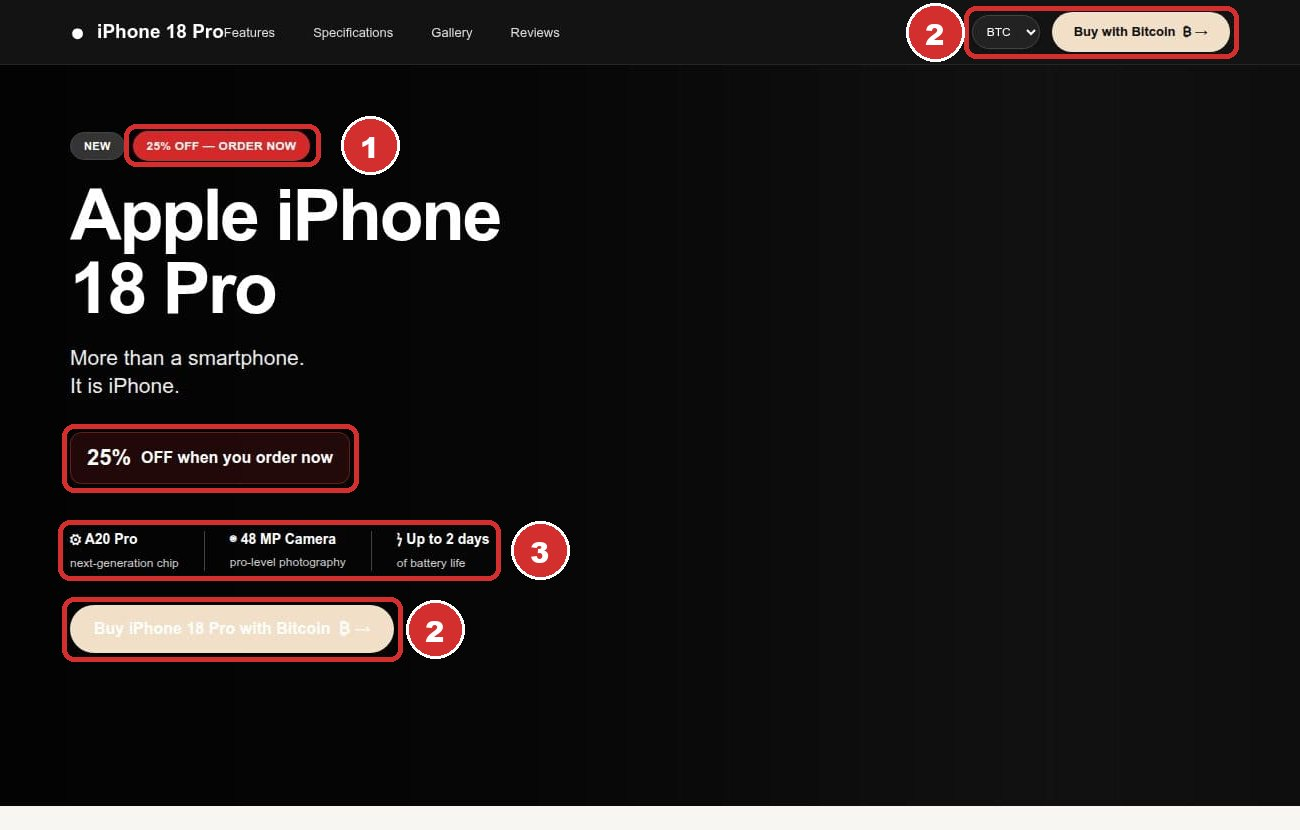
- The discount. “25% OFF — ORDER NOW” appears twice before you’ve scrolled. Apple’s newest phone isn’t sold at a quarter off. Kaspersky’s analyst calls offers “that seem too good to be true” a clear warning sign.[1]
- Bitcoin only. The currency menu is set to BTC, and both buttons say “Buy with Bitcoin.” The FTC warns that “cryptocurrency payments typically are not reversible.” Once it’s sent, you usually get it back only if the person you paid sends it back.[4]
- Borrowed polish. A chip name, a camera spec and a battery claim copy the look of Apple’s own pages. Kaspersky says the site’s “deceptively credible interface” is built to lower your guard.[1]
2. The Arabic-language “pre-order pass”
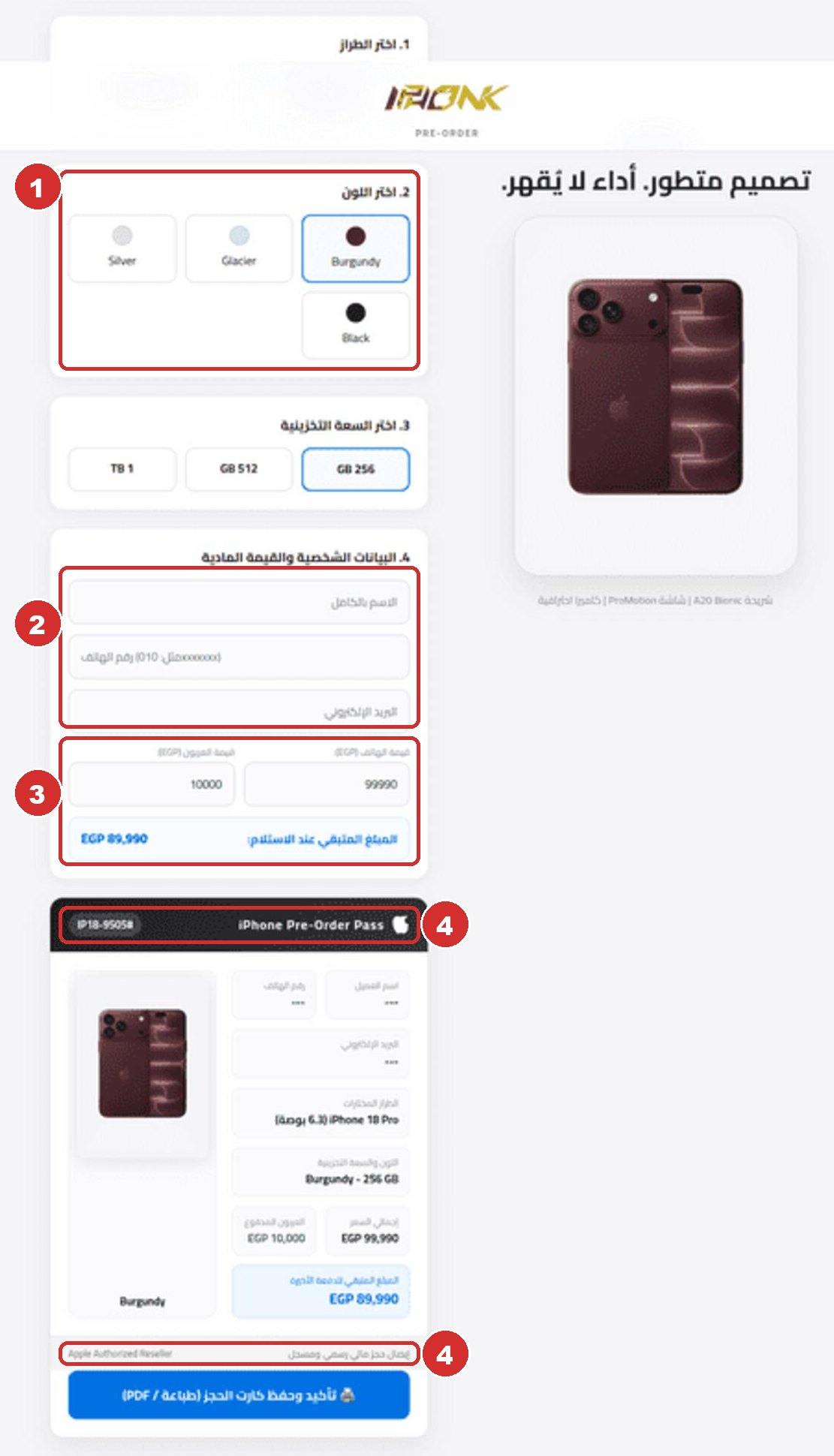
- Pick a colour. The page offers Silver, Glacier, Burgundy and Black. Kaspersky says these fake sites let buyers pre-order colours that differ from the ones Apple officially announced.[1]
- Hand over your details. Step 4 is headed “Personal details and payment amount” and asks for your full name, phone number and email. The sample phone number starts with 010, an Egyptian mobile prefix.
- Pay a deposit now, “the rest on delivery.” Phone price: EGP 99,990. Deposit: EGP 10,000. “Remaining amount on delivery”: EGP 89,990. The deposit is the scam. The National reports that in some cases the scammers “take a down payment for the fake iPhone offer and the money then simply disappears.”[2]
- Fake paperwork. After you fill it in, you get an “iPhone Pre-Order Pass” with an Apple logo and a booking number, the words “Apple Authorized Reseller,” and a button to save your “booking card” as a PDF. It’s there to make the deposit feel official.
| On the page | In English |
|---|---|
| تصميم متطور. أداء لا يُقهر. | Advanced design. Unbeatable performance. |
| 1. اختار الطراز · 2. اختار اللون · 3. اختار السعة التخزينية | 1. Choose the model · 2. Choose the colour · 3. Choose the storage |
| 4. البيانات الشخصية والقيمة المادية | 4. Personal details and payment amount |
| الاسم بالكامل · رقم الهاتف · البريد الإلكتروني | Full name · Phone number · Email |
| قيمة الهاتف · قيمة العربون | Phone price (EGP 99,990) · Deposit (EGP 10,000) |
| المبلغ المتبقي عند الاستلام | Remaining amount on delivery (EGP 89,990) |
| إيصال حجز مالي رسمي ومسجل | Official, registered payment booking receipt |
| تأكيد وحفظ كارت الحجز (طباعة / PDF) | Confirm and save booking card (print / PDF) |
How the Scam Plays Out
Kaspersky’s report walks through the pre-order site one screen at a time. Every step asks for a little more.[1]
- The offer. You find an iPhone 18 Pro “pre-order” with a discount, a choice of colours and storage, and no need to pay the full price upfront. The rest can supposedly be paid later.
- The promise. The “seller” promises a full refund if you cancel. Kaspersky says that claim “should not be trusted.”
- The form. Next the site asks for your full name, phone number, email address, city and WhatsApp contact. Kaspersky warns that criminals can use these later to target you with more scams.
- The card. Then it asks for your bank card details. Kaspersky says every step “is designed to extract as much information as possible,” and your account can be drained.
- The deposit. On some sites you pay a deposit and never hear back.[2]
Real Store vs. Fake Store
| What the fake stores show | What’s real | |
|---|---|---|
| Price | 25% off a phone that just launched | iPhone 18 Pro from Dh5,099 ($1,388) in the UAE; a 25% cut would be about $1,041[2] |
| Colours | Extra or different colours to “reserve” | Only the colours Apple announced; Kaspersky calls a “broader” selection a clear warning sign[1] |
| Payment | Bitcoin, or a deposit with “the rest on delivery” | A card charge can be disputed; crypto “typically” can’t be reversed[4][5] |
| Where | A look-alike site you reached through a link or an ad | Apple, or an official retailer whose address you typed yourself[1] |
Why It’s Happening Now
Scammers didn’t wait for the launch. Forbes reported on September 11 that iPhone 18 Pro phishing pages started appearing at least two weeks before Apple’s September 9 event, according to Alexandre Francois of WhoisXML API’s domain-scams team. Many were flagged by security engines but not yet on the blocklists browsers use. “For most people,” he said, “nothing stops the page from loading.”[3] Kaspersky’s Olga Altukhova put it simply: “Consumer excitement can give cybercriminals an additional advantage.”[1]
Watch: Shopping Online Safely
Public-domain U.S. government video: Federal Trade Commission, “Protect Yourself When Shopping Online.” General advice on online shopping, not about these particular sites.
How to Protect Yourself
- Buy only from Apple or an official retailer you already know. Type the store’s address yourself instead of clicking a link or ad.[1]
- Read the web address before you type anything. Kaspersky says to double-check the URL format and the spelling of the company’s name.[1]
- Never pay a stranger’s store in crypto. The FTC says to research a seller’s reputation before paying with cryptocurrency.[4]
- Keep your main card out of it. Kaspersky recommends a virtual card or a separate payment service for online shopping, so your real card or bank account isn’t exposed.[1]
- Turn on two-step login and watch your statements. Turn it on for your Apple ID and banking apps, and check for charges you don’t recognize.[1]
If You Already Paid
- By card: call your card issuer or bank right away, using the number on the back of your card. Tell them it was fraud and ask them to refund your money.[5]
- In Bitcoin or another crypto: contact the exchange or crypto ATM operator you used right away. Tell them the transaction was fraudulent and ask them to reverse it.[5]
- Then report it: in the U.S., file a report at ReportFraud.ftc.gov.[5] If you gave the site your name, phone number and WhatsApp, expect follow-up scam messages, and don’t answer them.[1]
How to Verify This Yourself
Read The National’s report, which carries Kaspersky’s Arabic-site screenshot, at thenationalnews.com. Kaspersky’s full statement and Bitcoin-store screenshot are reprinted at TechFinancials.
References
- Kaspersky, statement “Scammers ride the iPhone 18 hype with fake deals and stores,” as published by TechFinancials (September 28, 2026). Read it here. Source for the site descriptions, the data collected, the quotes from Olga Altukhova, the protection advice and the Bitcoin-store screenshot. ↩
- Tariq Tahir, The National (September 29, 2026). Warning about scam iPhone 18 deals that leave victims’ bank accounts cleaned out. Source for the down-payment detail, the UAE prices, the Dubai Mall launch and the Arabic-site screenshot. ↩
- Davey Winder, Forbes via Yahoo News (September 11, 2026). Apple iPhone 18 Pro Scam Warning As Pre-Orders Go Live. ↩
- Federal Trade Commission. What To Know About Cryptocurrency and Scams. ↩
- Federal Trade Commission. What To Do if You Were Scammed. ↩
Investigative methodology: this alert was first published automatically from The National’s report at 9:10 AM CT on September 29, 2026, then rewritten by hand at 10:45 AM CT from The National’s full article, Kaspersky’s full statement, Forbes’ earlier report and FTC guidance. Both screenshots are real images released by Kaspersky; only the red numbered markers were added. The Arabic translation is Kemetic Mind’s own.

Kemetic Minds Editorial Desk
Verified NewsroomPrimary-sourced investigative intelligence on civil rights, voting rights, federal policy, and consumer protection. Sourced from primary legal filings, government statistics, and direct field reporting.