
Consumer Rights · Scam Alert · September 26, 2026
Recently, there have been repeated incidents on social networking services (SNS) where accounts impersonating well-known figures such as Hyun-Song Shin, Governor of the Bank of Korea, are used to solicit investments, prompting the need for caution.
Executive Briefing · Key Facts.
- asiae.co.kr issued a new alert: “Claiming to Be Hyun-Song Shin, Bank of Korea Governor: ‘I’ll Teach You How to Invest in Stocks’… SNS Investment Scam Alert”.
- Example below: Impersonating social media account.
- Red flags: A central bank governor courting followers; The next step is a private chat; Promised returns
The Story So Far
There is an account impersonating Shin Hyun-song, Governor of the Bank of Korea, on social networking service (SNS). imageOn September 22 and 23, accounts impersonating Governor Shin appeared on SNS, posting multiple messages claiming to help users read economic trends.[1]
These accounts encouraged users to join group chat rooms by asking them to add as friends or send messages, suggesting there was a 'study group.' Once in the chat room, according to the instructions provided, the impersonators would solicit personal information with promises such as 'providing stocks with double-digit returns,' and sometimes recommended specific stocks to invest in.[1]
Opening interactive channels that offer one-on-one investment advice or real-time conversations with participants is only allowed for officially registered investment advisors. However, these impersonators operated without any legitimate company names or credentials.[1]
The Bank of Korea plans to continuously monitor for impersonating accounts and take action as soon as they are detected.[1]
How to Spot & Avoid This Scam
This is what the approach actually looks like — study it before the list below:
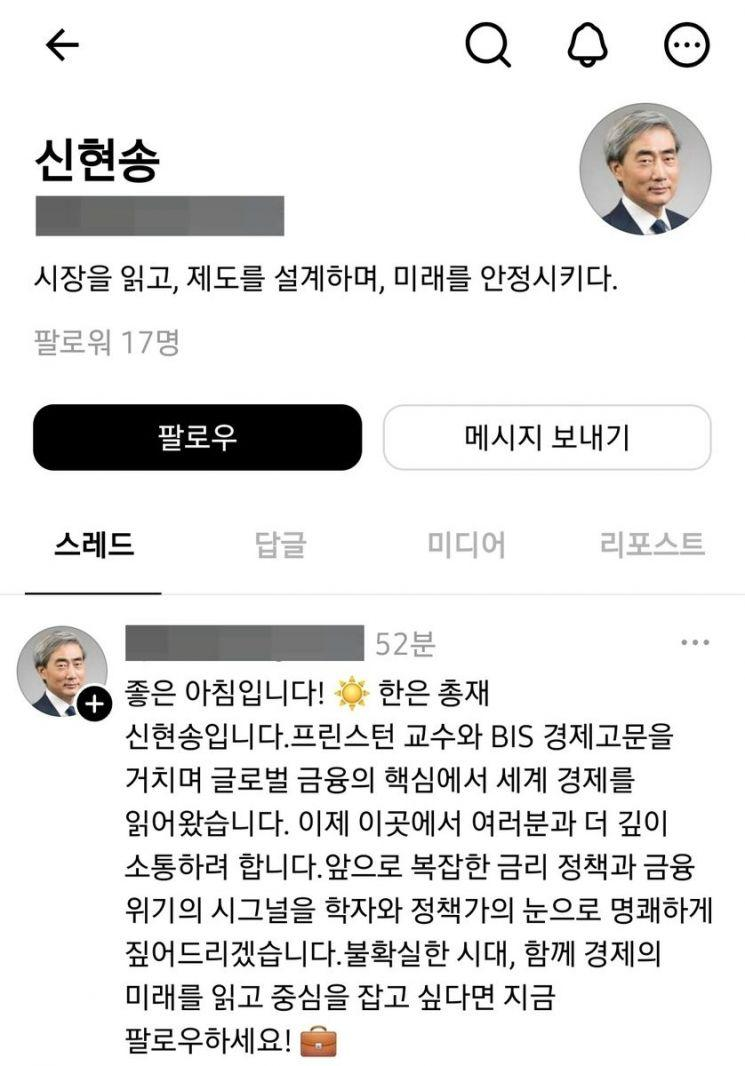
- A central bank governor courting followers. Real officials don’t recruit followers for personal market commentary; this account had 17.
- The next step is a private chat. Asia Economy reports these accounts invite people to a “study group” chat room.
- Promised returns. Inside, impersonators asked for personal information and promised “stocks with double-digit returns.”
Screenshot published by Asia Economy.
How to Protect Yourself
- Verify any unexpected contact through a phone number or website you already know is real — never one the message itself provides.
If You Already Clicked or Replied
Responding to one of these is not the end of the story, and the first hour matters more than the mistake does. Work down this list in order:
- Stop communicating with the sender. Do not send a final message explaining that you know it is a scam — that only confirms the number or address is live.
- If you shared a password, change it everywhere you reused it, starting with email and banking. Reused passwords are how one disclosure becomes several.
- If you shared card or bank details, call the number printed on your card and ask for the account to be flagged and reissued.
- If you sent money by gift card, call the card issuer immediately — some balances can be frozen if the cards have not been drained yet.
- Turn on two-factor authentication where it is offered, so a stolen password alone is not enough to get in.
- Report it (see below). Reports are what let investigators connect one message to a wider campaign.
Where to Report It
- Federal Trade Commission — reportfraud.ftc.gov is the FTC’s own intake for fraud reports.[2]
- FBI Internet Crime Complaint Center — ic3.gov handles internet-enabled crime, including losses already incurred.[3]
- The impersonated organization — most banks and large platforms run their own abuse address; reporting there is what gets a fraudulent number or domain taken down.
What’s Disputed or Unconfirmed
This post reports what asiae.co.kr published and what a fixed detector matched in that text. It does not independently confirm the scale of the campaign, attribute it to anyone, or verify any figure the source reports. The example below the fold is a reconstruction built from the same reporting, not a captured message — so treat its wording as illustrative of the pattern, not as evidence of a specific message anyone received.
Consumer Protection & Settlement Resources
How to Verify This Yourself
Read the original alert directly at asiae.co.kr[1] — that page is the primary source for everything above. For the recovery steps, the FTC publishes its own guidance on what to do after a scam.[4]
Kemetic Minds Analysis
Scam reporting tends to arrive as a list of things not to do, which puts the burden entirely on the person being targeted. The more useful read is structural: every tactic in the table above exists because it reliably beats a specific human default — trusting a familiar logo, acting fast under a deadline, believing a stranger who already seems to know something about you.
None of those defaults are failures of intelligence. They are the same instincts that make ordinary transactions possible. That is why “just be careful” does not work as advice, and why the one habit worth building is mechanical rather than judgmental: when a message asks for money, credentials, or speed, verify it through a channel you chose yourself. That single rule defeats every tactic listed above, without requiring you to spot which one you are looking at.
References
- asiae.co.kr. “Claiming to Be Hyun-Song Shin, Bank of Korea Governor: ‘I’ll Teach You How to Invest in Stocks’… SNS Investment Scam Alert”. — primary source for this alert. ↩
- Federal Trade Commission. Report Fraud. — primary (U.S. government agency). ↩
- FBI Internet Crime Complaint Center (IC3). — primary (U.S. government agency). ↩
- Federal Trade Commission. What To Do if You Were Scammed. — primary (U.S. government agency). ↩
Related Reading
- More Consumer Rights coverage — the running Scam & Cybersecurity Watch archive.
- FTC: What To Do if You Were Scammed — the full official recovery guide.
Investigative methodology: this update was produced by scripts/scam_monitor.py from a real asiae.co.kr alert — not a language model. The quoted text above is verbatim from the source; the mockup, where shown, is a reconstructed illustration built from the same text (see its own caption), not a captured real message. Protection tips, red-flag explanations, and recovery steps are matched from fixed curated tables, not generated per story. The “Kemetic Minds Analysis” section is standing editorial commentary about how these tactics work in general — it is identical on every Scam Watch post and is not reporting about this particular alert.

Kemetic Minds Editorial Desk
Verified NewsroomPrimary-sourced investigative intelligence on civil rights, voting rights, federal policy, and consumer protection. Sourced from primary legal filings, government statistics, and direct field reporting.