
Black News · The Reparations Report · November 24, 2026, 1:36 PM CST
Executive Summary · Empirical Findings & Restorative Policy.Closing the racial wealth divide requires more than symbolic gestures. New data from the Federal Reserve’s 2025 Survey of Consumer Finances show the gap widening. The median net worth of white families is $332,100, while Black families hold just $36,800, a 25 percent drop since 2022. That is a ratio of about nine to one. Economist William Darity Jr. and co-authors estimate that closing the wealth gap would cost at least $16 trillion, based on the 2022 survey. At the same time, Black farmers lost more than 13 million acres of farmland over the past century. In California, state economists calculate cumulative harms exceeding $1.2 million per eligible resident. Below, Kemetic Minds examines the data and recaps the week’s top restorative policy news.
Darity and co-authors’ 2026 estimate of the cost to close the racial wealth gap (2022 survey data), or roughly $400,000 for each of about 40 million eligible descendants.
Black median wealth for every dollar of white median wealth in the Federal Reserve’s 2025 survey, down from 15.7 cents in 2022.
Decline in Black farmland acreage since 1910, representing over $326 billion in lost land wealth.
Calculated economic harm per eligible descendant under California Assembly Bill 3121.
1. The Economics of Inequality: Unpacking the $16 Trillion Racial Wealth Gap
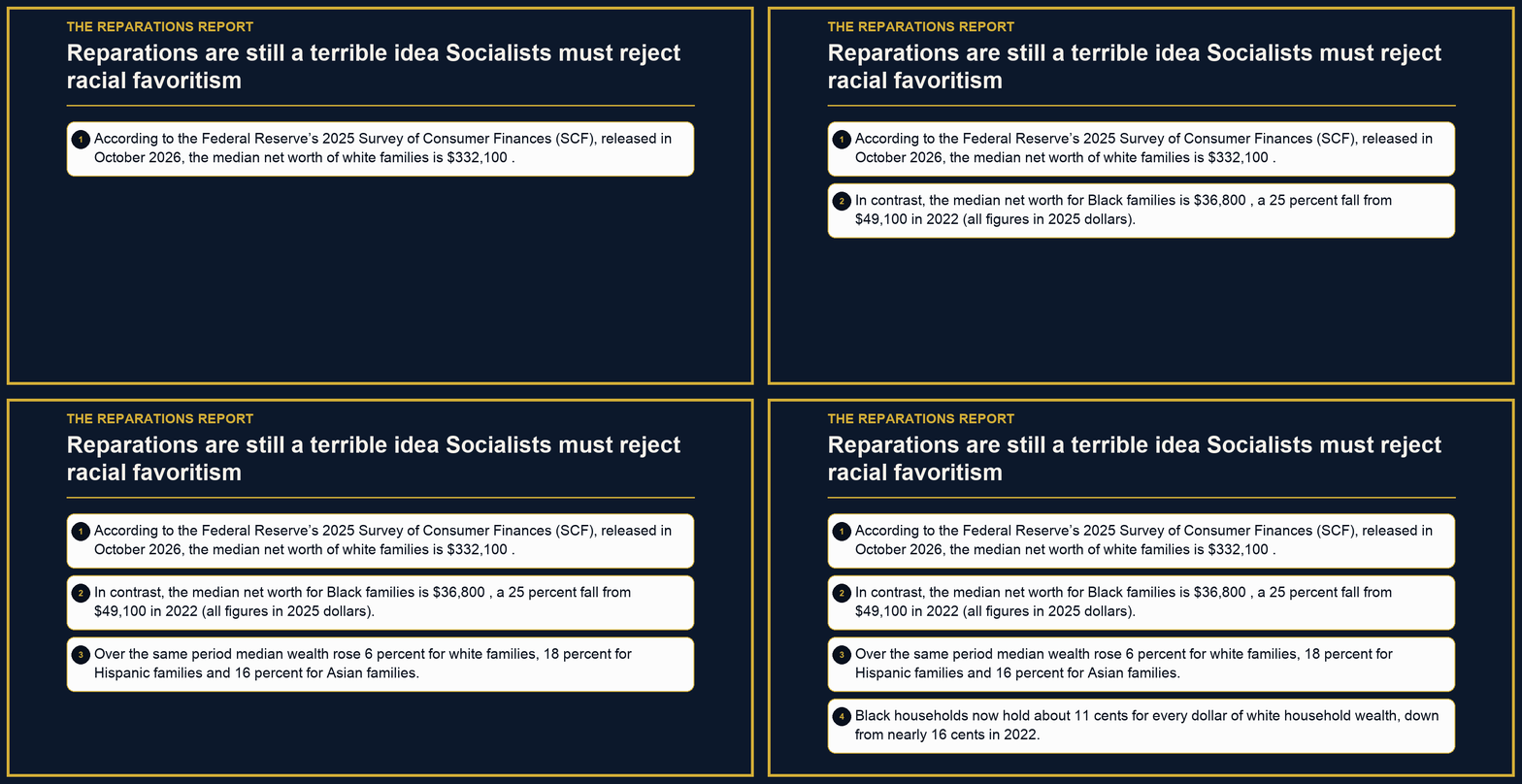
Public debate around reparations often stalls on abstract legal questions. Yet the economic foundation rests on hard, verifiable numbers. According to the Federal Reserve’s 2025 Survey of Consumer Finances (SCF), released in October 2026, the median net worth of white families is $332,100. In contrast, the median net worth for Black families is $36,800, a 25 percent fall from $49,100 in 2022 (all figures in 2025 dollars). Over the same period median wealth rose 6 percent for white families, 18 percent for Hispanic families and 16 percent for Asian families. Black households now hold about 11 cents for every dollar of white household wealth, down from nearly 16 cents in 2022. Pew Research Center’s analysis notes that Black families were the only group whose home equity fell between 2022 and 2025 (down 5.3 percent). This divide persists across all income levels and education brackets.
In a March 2026 plan published in BMJ Global Health, economist William Darity Jr., A. Kirsten Mullen, Eugene Richardson and Mary Bassett estimate that eliminating the racial wealth gap would cost at least $16 trillion, using the 2022 SCF. In a June 2026 Forbes interview, Darity put the gap at about $1.15 million per household, or roughly $400,000 per person across about 40 million Black Americans descended from the enslaved. That is up from the $10 to $12 trillion in Darity and Mullen’s 2020 book From Here to Equality and the roughly $14 trillion they cited from 2019 survey data. These are scholarly estimates, not an enacted price tag. The 2025 data point the same way: the gap in average wealth between white and Black families grew from about $1.26 million in 2022 to about $1.45 million in 2025, in 2025 dollars (Kemetic Minds’ arithmetic from the Federal Reserve’s Table 2). We have not found a Darity–Mullen estimate built on the 2025 survey yet. The disparity stems from generations of blocked wealth accumulation. White families pass down homes, land, and financial gifts that compound over time. Black families, by contrast, were systematically locked out of these wealth-building channels.
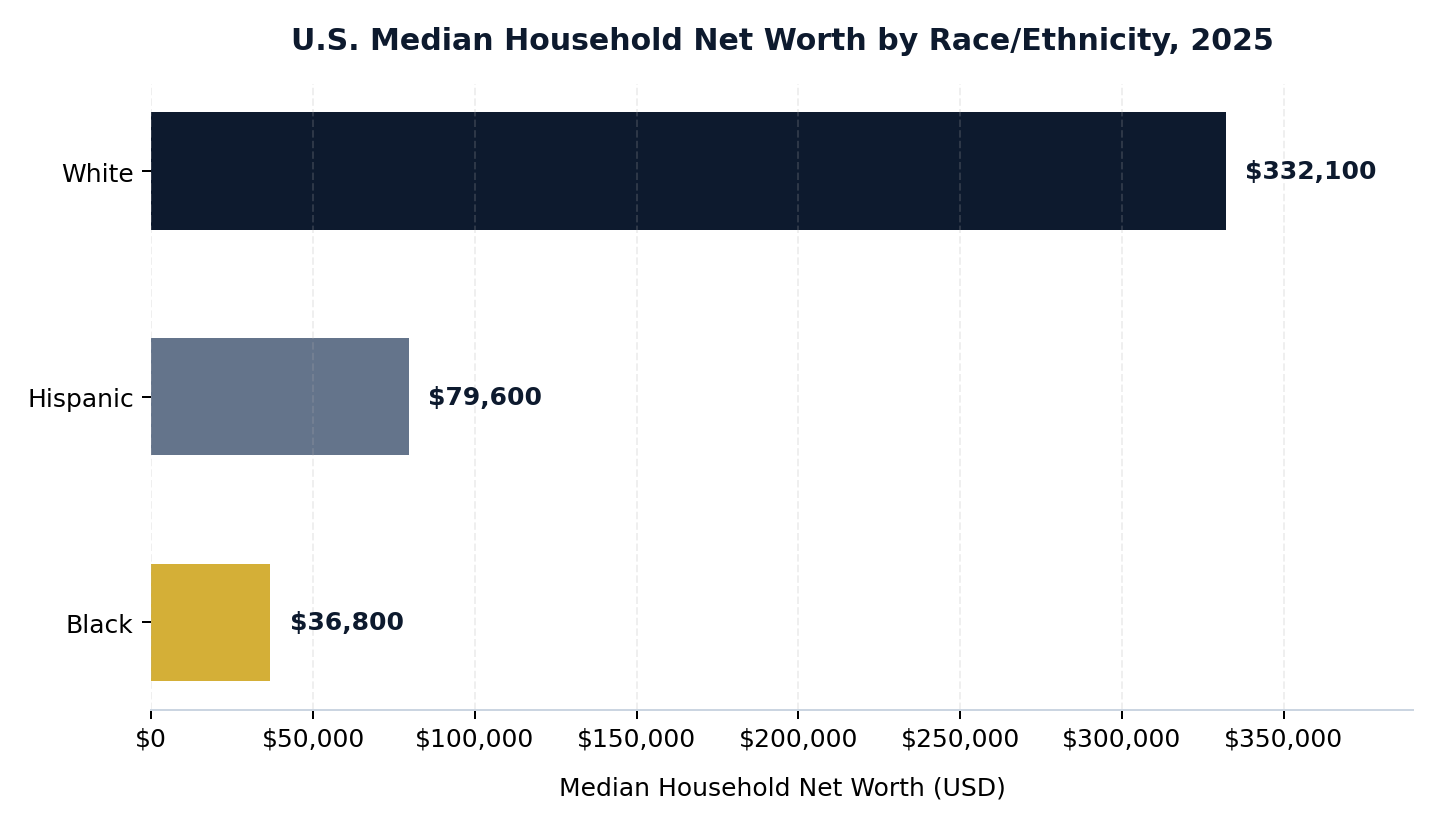
Housing equity forms the core of middle-class net worth. In the 2025 SCF, 74.5 percent of white families owned their primary residence, compared with 46.5 percent of Black families, and the median home owned was worth $390,000 versus $259,000. In addition, research from the Brookings Institution shows that homes in Black neighborhoods are devalued by an average of $48,000 each. This systemic undervaluation costs Black homeowners an estimated $156 billion in cumulative equity.
2. Dispossession by Decree: The Century of Black Agricultural Land Loss
Real property and land ownership represent the most enduring drivers of family security. Yet the twentieth century saw a massive erasure of Black rural land holdings. In 1910, Black farmers owned between 16 and 19 million acres across the United States. Nearly one million Black families operated farms, predominantly across the South. Over the next hundred years, that number plummeted by more than 85 percent.
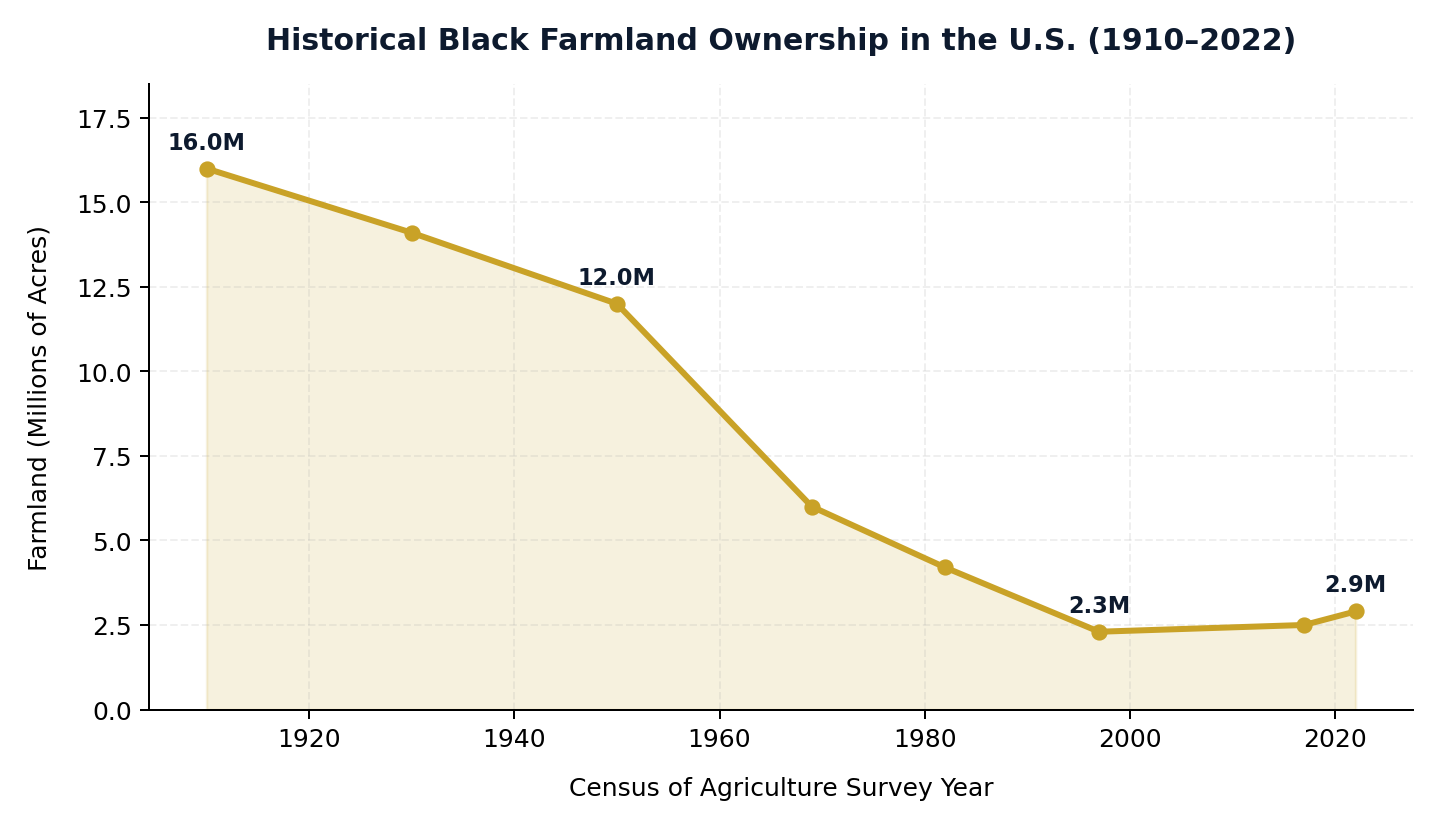
This land loss was not an accident of the free market. It resulted from documented, institutional actions. Local USDA loan committees routinely denied seasonal credit to Black farmers. Emergency disaster relief was withheld or delayed until planting seasons passed. In addition, predatory developers exploited legal loopholes in heir property laws to force partition sales. An economic study in the American Economic Association Papers and Proceedings estimated the compounding value of this lost farmland at $326 billion.
3. Econometric Harms Modeling: California’s AB 3121 Benchmarks
California made legal history by creating the first state-backed task force to study reparations under Assembly Bill 3121. The panel did not rely on arbitrary dollar amounts. Instead, it hired professional economists and statisticians to measure the financial toll of state-sponsored discrimination. Their final report produced clear, category-by-category estimates of economic damages.
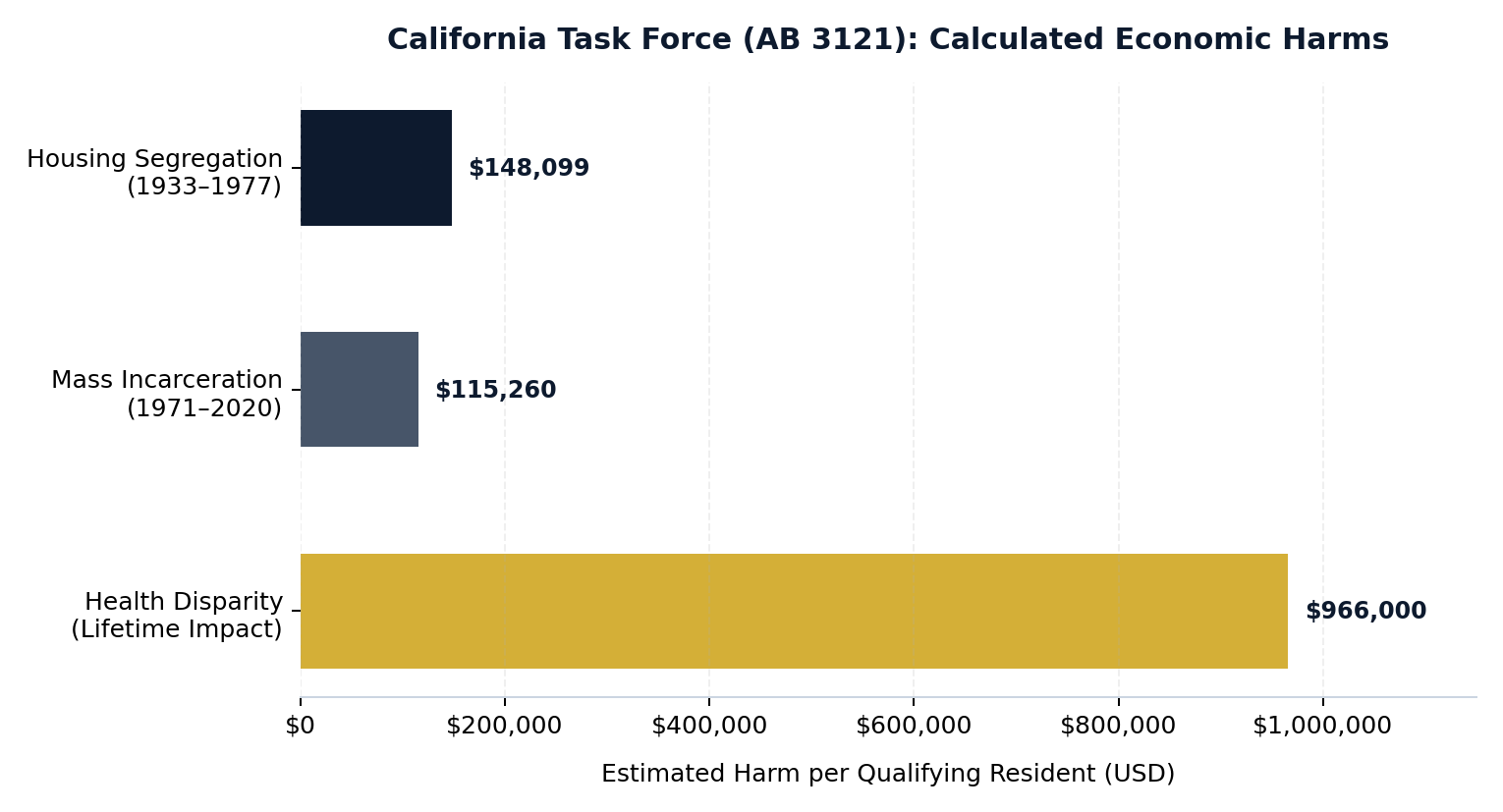
The Task Force quantified three major categories of harm:
- Housing Discrimination and Redlining (1933–1977): Economists estimated this harm at $148,099 per qualifying resident. This breaks down to $3,378 for each year of state residency during the era of racial covenants.
- Mass Incarceration and Over-Policing (1971–2020): The panel calculated damages of $115,260 per eligible person, or $2,352 for every year spent living in California during the drug war.
- Health Inequity and Premature Mortality: The team calculated a disparity cost of $13,579 per year of lost life expectancy. Over a typical 71-year lifespan, that harm totals approximately $966,000.
4. Restorative Justice Models: Lineage-Based vs. Harm-Based Frameworks
As reparations move closer to legislative action, debates have sharpened over who qualifies for compensation. Policy experts and legal scholars broadly divide into two camps:
The Lineage-Based Model (California & Darity Framework)
This model limits eligibility to direct descendants of enslaved persons in the United States or freed Black people residing in the country prior to 1900. Supporters argue this criterion directly remedies the unpaid labor and wealth denial of chattel slavery. It also shields policies against court challenges under the Fourteenth Amendment by relying on ancestry rather than race alone.
The Harm-Based Municipal Model (Evanston Framework)
This model provides remedies based on documented local discrimination. In Evanston, Illinois, the city council created the Local Reparations Restorative Housing Program. It grants $25,000 to Black residents who lived in Evanston between 1919 and 1969 or their descendants to help buy or repair homes.
| Model / Program | Jurisdiction | Eligibility Rule | Core Remedy | Current Status |
|---|---|---|---|---|
| Federal H.R. 40 / S. 40 | National (U.S.) | Descendants of enslaved persons in U.S. | National 13-member study commission | Pending in Congress; Executive order sought |
| California AB 3121 | State (California) | Lineage-based (chattel slavery / pre-1900) | Formal apology, lineage agency, civil codes | Final report issued; legislative bills active |
| Evanston Housing Program | City (Evanston, IL) | Residency 1919–1969 & direct descendants | $25,000 housing and home loan grants | Active disbursement via local cannabis taxes |
| Bruce’s Beach Transfer (SB 796) | County (Los Angeles, CA) | Direct legal heirs of dispossessed owners | Return of beachfront real estate ($20M value) | Completed; Property repurchased by county |
| CARICOM 10-Point Plan | International (Caribbean) | Nations harmed by colonial slave trade | Formal apologies, debt cancellation, capital funds | Diplomatic mobilization ahead of CHOGM summit |
5. The Week in Restorative Justice: News & Field Reports
POLICY CROSS-WALK
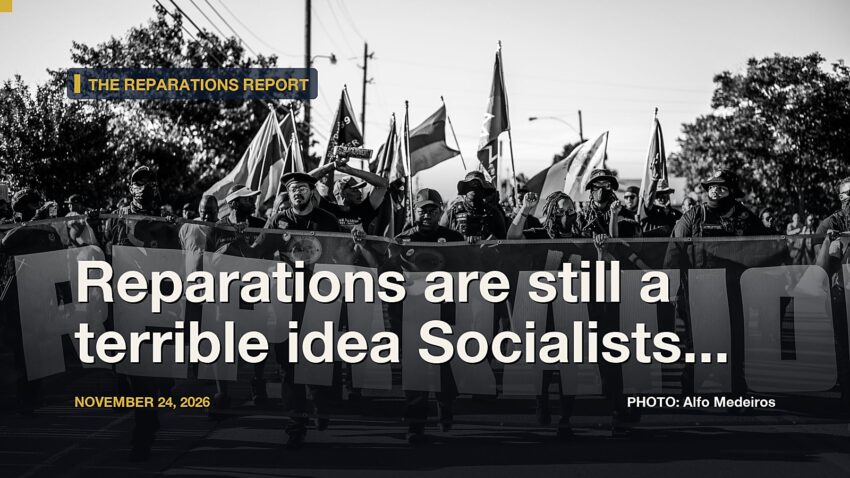
Reparations are still a terrible idea Socialists must reject racial favoritism
November’s blue tsunami was unquestionably good for the Left flank of the Democratic Party.
Six new members of the Democratic Socialists of America were elected to the House. They will be joined by a good number of non-socialist progressives in both chambers who agree with plenty of their short-term goals.[1]
Separately, Thisdaylive reported:
UK Open to Formal Apology for Britain’s Slave Trade Role, Rejects Reparations

UK Open to Formal Apology for Britain’s Slave Trade Role, Rejects Reparations.
British Prime Minister, Andy Burnham has said he is open to calls for a formal apology on behalf of the country for its role in the transatlantic slave trade.[2]
In an OP-ED published at the weekend in The Guardian, Burnham described the slave trade as a “brutal and barbaric violation” against enslaved people.
— as reported by Thisdaylive
Elsewhere, Panafricanvisions added:
Time for Honesty About Slavery Reparations
If Europe and America should pay reparations for slavery then so should the Arab world, India and Turkey.
The historic trade of Africans to India and the Gulf was as large and brutal as the Atlantic one. Yet, Turkish, Arab and Indian scholars are mostly silent on their nations’ guilt.[3]
6. Kemetic Minds Analysis: Moving from Symbolism to Structural Equity
INDEPENDENT AUDIT
The data prove that closing a nine-to-one wealth gap cannot happen through small local grants alone. Municipal programs are valuable testing grounds, but their budgets are limited. Evanston’s program operates on modest local tax revenue. In contrast, Darity and co-authors put the cost of closing the national wealth gap at $16 trillion or more. Meaningful reparations policy requires three structural pillars:
Only the federal government has the budget scale to close a multi-trillion-dollar wealth divide without bankrupting local cities.
Grounding eligibility in direct ancestry from enslaved Americans ties remedies to specific legal harms. This protects programs against court challenges.
Cash payments must be matched with land restoration, commercial banking charters, and community endowments so wealth compounds over generations.
References
- Unherd. Reparations are still a terrible idea Socialists must reject racial favoritism. ↩
- Thisdaylive. UK Open to Formal Apology for Britain’s Slave Trade Role, Rejects Reparations. ↩
- Panafricanvisions. Time for Honesty About Slavery Reparations. ↩
Investigative methodology: All numerical figures in this report come directly from official government surveys and published economic studies, including the Federal Reserve Survey of Consumer Finances, the USDA National Agricultural Statistics Service, the California Department of Justice AB 3121 Final Report, and the American Economic Association. News reporting is cited for current weekly context.

Kemetic Minds Editorial Desk
Verified NewsroomPrimary-sourced investigative intelligence on civil rights, voting rights, federal policy, and consumer protection. Sourced from primary legal filings, government statistics, and direct field reporting.