

Kemetic Minds — Financial Justice Series | June 28, 2026
⚖️ Key Findings
- The Black–white median wealth gap stood at $239,420 per household in 2022 — up from $164,100 in 2019 (Federal Reserve SCF, 2023).
- The United States has paid reparations before: Japanese-American internees received $20,000 each under the 1988 Civil Liberties Act — signed by President Reagan.
- Economic research suggests reparations could narrow the wealth gap by up to 40% within one generation (Darity & Mullen, 2020).
- H.R. 40, a bill to study reparations proposals, has been introduced in every Congress since 1989 but has never received a full floor vote in either chamber.
The Gap That Keeps Growing
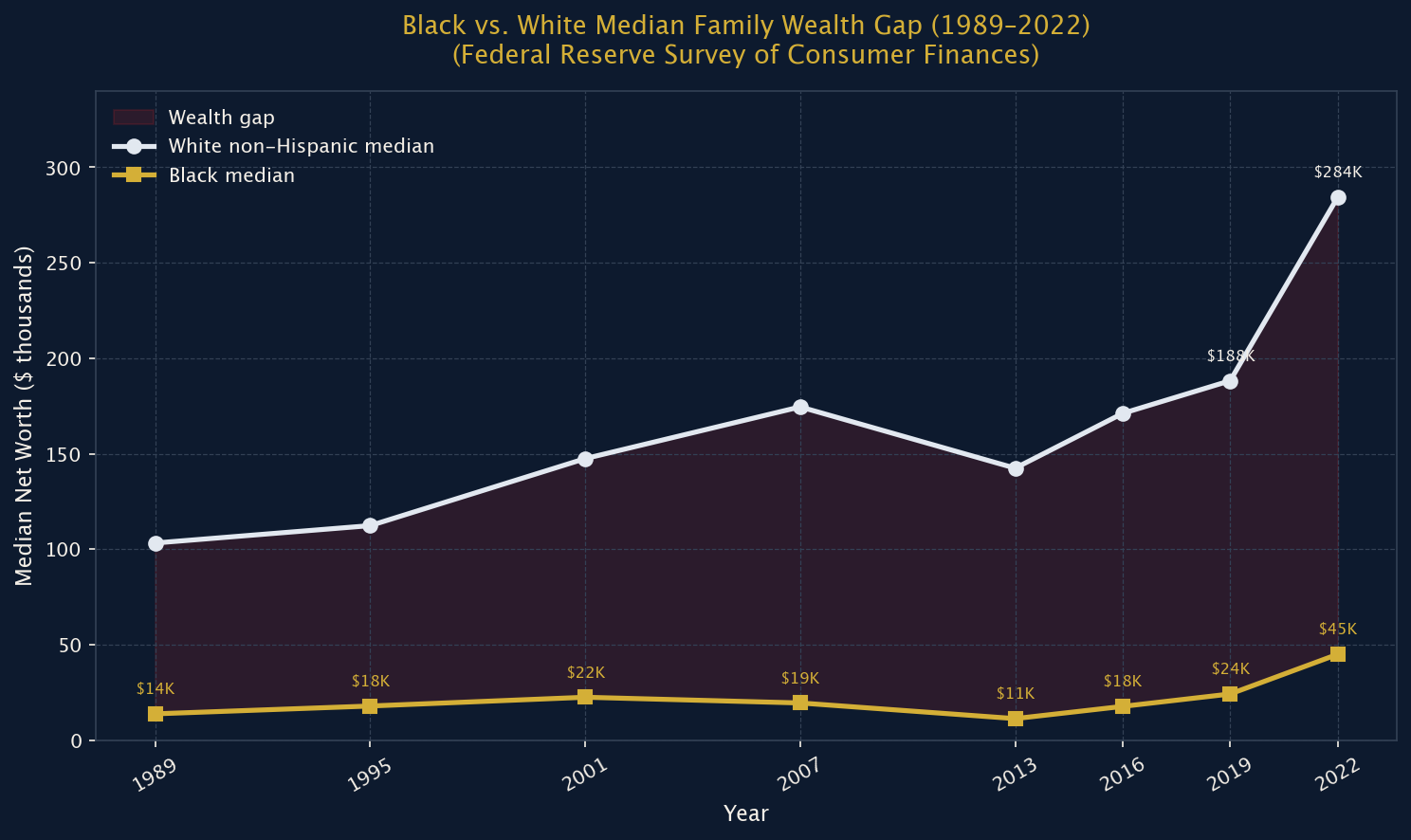
The Federal Reserve’s triennial Survey of Consumer Finances provides the most authoritative picture of American family wealth. In 2022, the median white non-Hispanic family held $284,310 in net worth. The median Black family: $44,890. The gap: $239,420 per household — and it grew by $75,320 between 2019 and 2022 alone, driven largely by the post-pandemic surge in stock and real estate prices that benefited asset-owning (predominantly white) households far more than non-asset-owning households (Bhutta et al., 2023).
This is not a new trend. The chart below traces the Black–white wealth gap from 1989 to 2022 using Federal Reserve data. In 33 years, the median Black family’s wealth grew from roughly $13,700 to $44,890 — an increase of $31,190. The median white family’s wealth grew from $103,200 to $284,310 — an increase of $181,110. The gap widened by $149,920 in three decades.
Figure 1
Black vs. White Median Family Wealth Gap (1989–2022)
The Economic Argument for Reparations
The reparations debate is often framed as a moral one. It is that. But economists make a parallel case that is purely mechanical: the wealth gap is not a natural market outcome — it is the documented result of specific government policies that can be traced and, in principle, remediated.
Economists William Darity Jr. (Duke University) and A. Kirsten Mullen, in their 2020 book From Here to Equality, calculate the total cost of slavery-era wealth extraction and the subsequent systematic denial of Black wealth accumulation through Jim Crow, redlining, urban renewal displacement, and discriminatory GI Bill implementation. Their estimate of reparations owed to Black Americans: approximately $14 trillion — a figure that represents the compounded value of unpaid labor and systematically destroyed wealth (Darity & Mullen, 2020).
A 2021 National Bureau of Economic Research working paper found that targeted wealth transfers to Black households sufficient to close the median wealth gap could increase Black household median wealth by 300% within one generation and narrow the gap substantially on a persistent basis if paired with complementary policies (Chatterji & Seamans, 2021).
It Has Been Done Before: Historical Precedents
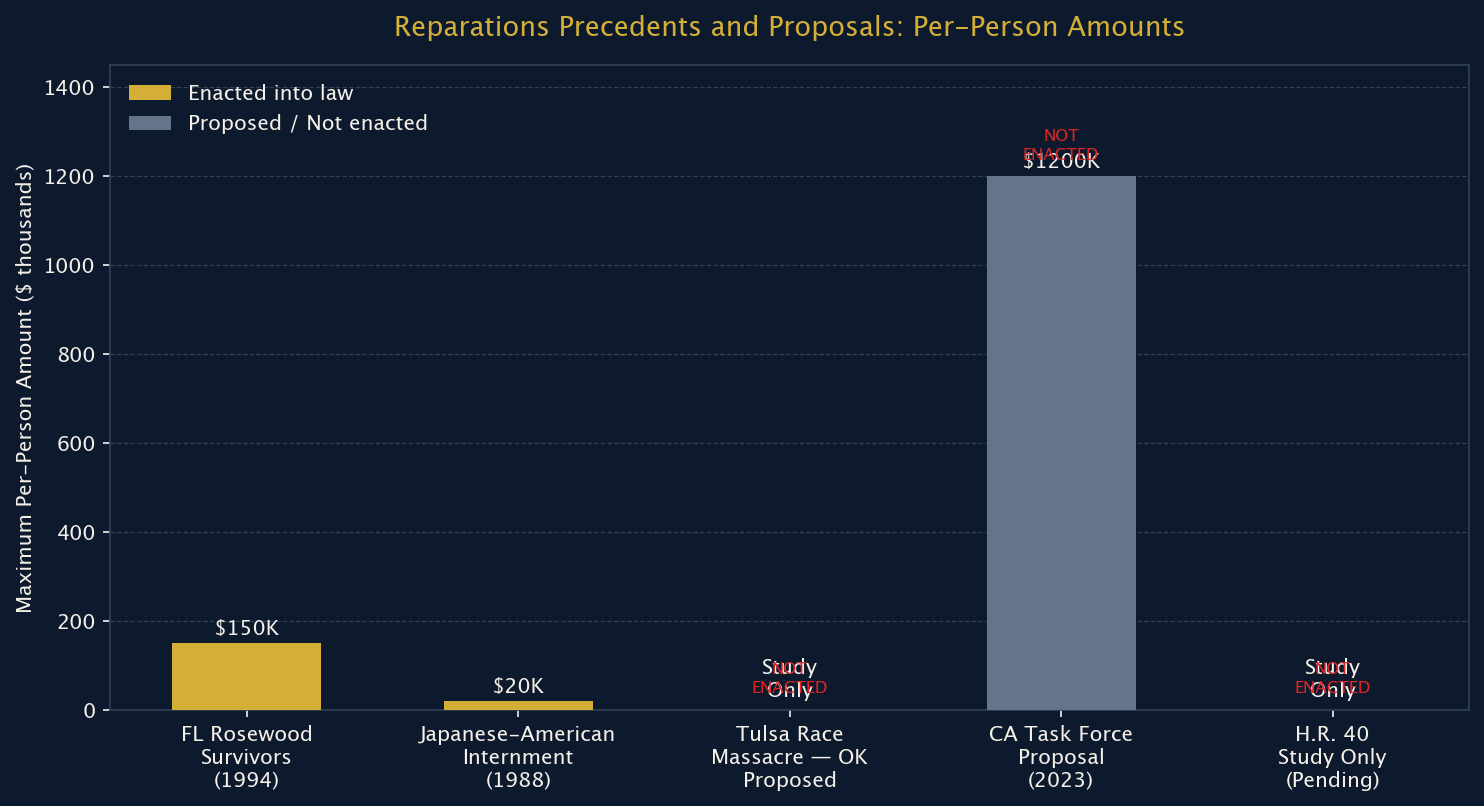
Figure 2
Reparations Precedents and Proposals: Per-Person Maximum Amounts
🇺🇸 Japanese-American Internment Reparations (1988)
The Civil Liberties Act of 1988, signed by President Ronald Reagan, provided $20,000 in tax-free payments to each surviving Japanese-American who was forcibly removed and incarcerated during World War II. The legislation explicitly acknowledged that the internment was “fundamentally unjust” and driven by “racial prejudice, wartime hysteria, and a failure of political leadership.” Approximately 82,000 survivors received payments. Sources: National Archives; Civil Liberties Act of 1988.
🏠 Rosewood, Florida Reparations (1994)
In 1923, a white mob destroyed the entire Black town of Rosewood, Florida, killing an estimated eight or more people and displacing hundreds of survivors. In 1994, the Florida Legislature passed the Rosewood Compensation Act, providing up to $150,000 to each surviving direct victim and smaller amounts to their descendants. The Florida legislature explicitly acknowledged the state’s failure to protect its Black citizens and the direct economic harm done. This is the most direct modern U.S. precedent for community-level reparations for racial violence.
📜 H.R. 40: The Commission to Study Reparation Proposals (2025)
H.R. 40 — named for the unfulfilled “40 acres and a mule” promise of Reconstruction — would establish a commission to study (not implement) reparations proposals for African Americans. It has been introduced in every Congress since Representative John Conyers first filed it in 1989. As of 2025, the bill has passed committee for the first time but has not received a full House or Senate vote. It does not appropriate any funds; it only authorizes a study. Text available at Congress.gov.
🌞 California Task Force on Reparations (2023)
California’s AB 3121 (2020) created the first state-level reparations task force. In its June 2023 final report, the task force recommended a framework including direct payments, with some estimates reaching up to $1.2 million per eligible Black Californian descendant of enslaved people. As of 2026, the California legislature has not enacted the full payment proposal, but several targeted programs (housing, education, and health equity initiatives) have moved forward. Report available from the California Department of Justice.

The Counter-Arguments — and the Responses
The most common objections to reparations and the economic responses to each:
- “No one alive today owned slaves.” — True. But current wealth disparities are not caused only by slavery. They are caused by a documented chain of post-slavery policies: the failure of Reconstruction, Black Codes, Jim Crow, redlining, discriminatory New Deal and GI Bill administration, urban renewal demolition of Black neighborhoods, and ongoing lending discrimination. Many of these policies continued into living memory — redlining was legal until 1968; discriminatory lending is still documented by the CFPB.
- “It would cost too much.” — Darity and Mullen estimate $14 trillion for a full reparations program paid over time. The federal government spent $4.5 trillion on COVID-19 relief in 2020 alone. The question is political will, not fiscal capacity. The Japanese-American program cost approximately $1.6 billion — roughly 0.03% of the current federal budget.
- “Black immigrants would qualify unfairly.” — Most serious reparations proposals, including the California task force framework, define eligibility based on descent from enslaved people in the United States, not simply by current racial identity. This is a technical drafting question, not a fundamental objection to the concept.
What Economic Justice Could Actually Look Like
Economists and policy researchers have proposed several mechanisms beyond direct payments: targeted homeownership grants in formerly redlined areas; student debt cancellation for HBCU graduates; guaranteed business loan access through expanded CDFI funding; and baby bonds — seed accounts provided to all children at birth, larger for lower-wealth families, designed to compound into meaningful wealth by adulthood (Hamilton & Darity, 2010).
Senator Cory Booker and Representative Ayanna Pressley have introduced the American Opportunity Accounts Act, a baby bonds proposal that would provide up to $46,000 by age 18 for children born to families in the lowest wealth quintile. Analysis by the Brookings Institution suggests this could reduce the Black–white wealth gap by over 20% within one generation (Goldstein & Moreno, 2022).
None of these proposals have passed Congress as of 2026. The reparations debate is unresolved. But the economic data documenting the harm — and the mathematical case for remediation — are stronger than they have ever been. The question is no longer whether the gap is real. The question is what will be done about it.
References
Bhutta, N., Blair, J., Dettling, L., & Moore, K. B. (2023). Changes in U.S. family finances from 2019 to 2022: Evidence from the Survey of Consumer Finances. Federal Reserve Bulletin. federalreserve.gov
California Attorney General. (2023). Task Force to Study and Develop Reparation Proposals for African Americans (AB 3121). oag.ca.gov
Darity, W. A., Jr., & Mullen, A. K. (2020). From here to equality: Reparations for Black Americans in the twenty-first century. University of North Carolina Press.
Goldstein, A., & Moreno, C. (2022). Baby bonds and the racial wealth gap. Brookings Institution. brookings.edu
Hamilton, D., & Darity, W. A., Jr. (2010). Can ‘baby bonds’ eliminate the racial wealth gap in putative post-racial America? Review of Black Political Economy, 37(3–4), 207–216.
National Archives and Records Administration. (n.d.). Japanese-American internment records. archives.gov
U.S. Congress. (1988). Civil Liberties Act of 1988 (P.L. 100-383). congress.gov
U.S. Congress. (2025). H.R. 40 — Commission to Study and Develop Reparation Proposals for African Americans Act. congress.gov
Methodology: Wealth gap figures from Federal Reserve SCF 1989–2022. Reparations cost estimates from Darity & Mullen (2020) and cited economic research. Historical precedent details from National Archives and U.S. Code primary sources. This article presents economic research and does not constitute legal or political advice.
📱 Stay Connected

Kemetic Minds Editorial Desk
Verified NewsroomPrimary-sourced investigative intelligence on civil rights, voting rights, federal policy, and consumer protection. Sourced from primary legal filings, government statistics, and direct field reporting.