
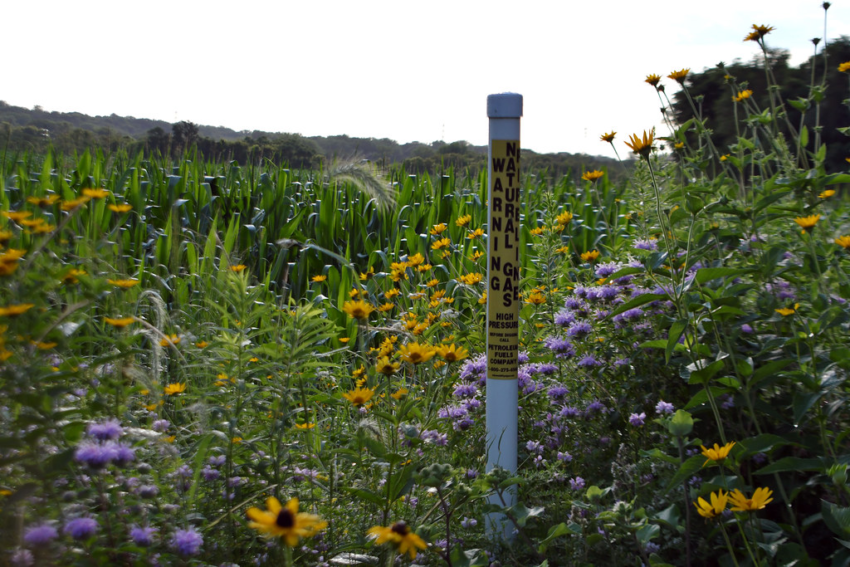
Featured photograph: Natural-gas pipeline infrastructure and pollinator habitat beside a corn field, July 18, 2025. Illustrative infrastructure photograph; this is not the Jennings rupture site. Photo: Mara Koenig / U.S. Fish and Wildlife Service. Public domain. Source and image details.
Infrastructure · Emergency Updates · September 20, 2026
A 16-inch natural gas pipeline ruptured and caught fire west of Jennings, Louisiana, on the morning of September 18, 2026, forcing the evacuation of about 20 homes and a brief lockdown at a junior high school before crews sealed the line and put the fire out within roughly an hour. No injuries were reported. Here’s a minute-by-minute reconstruction of how it unfolded, in Central Daylight Time, plus what pipeline-safety data says about how often this kind of incident happens nationwide.
Key Facts
- A 16-inch pipeline operated by Texas Gas Transmission, LLC (a Boardwalk Pipelines subsidiary) ruptured near Farm Supply Road and U.S. Highway 90, west of Jennings, in Jefferson Davis Parish, Louisiana, starting around 7:40–8:30 a.m. CDT on September 18, 2026.[1][2]
- About 20 homes near Farm Supply Road were evacuated as a precaution; residents were allowed to return within 30 minutes to an hour.[2]
- Texas Gas Transmission: “A fire also occurred and is now extinguished. There have been no injuries associated with the incident.”[1]
- The federal Pipeline and Hazardous Materials Safety Administration (PHMSA) is investigating the cause.[1]
The Story So Far
Jeff Davis Parish’s Office of Homeland Security and Emergency Preparedness got the first call around 7:40 a.m. CDT. “We got a call of some type of explosion,” said Marcus Peterson of that office.[2] Louisiana State Police and parish fire units closed U.S. Highway 90 between Louisiana 395 and Monger Road, and the Jeff Davis Parish Police Jury evacuated roughly 20 homes between North Frontage Road and U.S. 90 around 8:30 a.m. CDT.[3] Welsh-Roanoke Junior High, in the same area, went into a precautionary lockdown that was lifted shortly after 9 a.m. CDT.[1]
Peterson described how the line was brought under control: “Boardwalk Pipeline had a ruptured line. They ended up securing it intact with remote-controlled valves and basically let it bled off.”[2] Jefferson Davis Parish Sheriff Kyle Miers put it more simply: the leak was “sealed off, and the methane gas in the line burned off quickly.”[1] The fire was out within about an hour of the initial call.[2]
Verifying the Air Was Actually Safe to Breathe
Before residents were told they could go home, Louisiana’s Department of Environmental Quality (DEQ) — the state agency responsible for ambient air monitoring — tested the air around the rupture site.
“The air was monitored by DEQ. Advisory was safe and Boardwalk’s said that the pipeline was okay for the residents to return.”[2]
That two-step check — an independent state environmental regulator’s air-quality reading, separate from the pipeline operator’s own statement that the line itself was secure — is what officials pointed to when the all-clear was given. U.S. 90 reopened between Monger Road and Louisiana 395 the same morning, and Farm Supply Road stayed closed longer for repair crews to keep working on the line.[1]
How Common Is This? What National Pipeline-Safety Data Shows
A single rural pipeline rupture that causes no injuries rarely makes national news, and that is itself the point: incidents like this one happen on a near-daily basis across the U.S. pipeline network. FracTracker Alliance’s analysis of PHMSA’s own reporting — pipeline operators are legally required to file an incident report with PHMSA within 30 days of a reportable event — found that 2024 alone saw 530 reported pipeline incidents, an average of 1.45 a day, including 65 fires and 22 explosions.[4]
| Metric | 2024 (1 year) | 2010–2024 (cumulative) |
|---|---|---|
| Reported pipeline incidents | 530 | 9,329 |
| Fatalities | 10 | 183 |
| Injuries | 26 | 797 |
| People evacuated | 2,554 | 51,596 |
| Fires | 65 | — |
| Explosions | 22 | — |
| Property damage | $138.99 million | $8.98 billion |
Source: FracTracker Alliance analysis of PHMSA incident-report data, downloaded January 6, 2025; 2024 figures are described by FracTracker as incomplete because operators have up to 30 days to file.[4]
FracTracker’s researchers also flagged that these totals likely understate the real picture: a spot-check of four 2024 incidents found reporting gaps, and they concluded actual incident counts are “likely higher” than PHMSA’s official tally.[4] Louisiana’s own Jennings incident this week — evacuation, brief lockdown, a fire out within an hour, no injuries — is, in that context, a fairly typical entry in a dataset of well over a thousand incidents a year, not an outlier.
What’s Disputed or Unconfirmed
Local outlets covering the Jennings rupture gave slightly different start times — Acadiana News First reported the first call around 7:40 a.m. CDT, while KPLC and WAFB both cited roughly 8:30 a.m. CDT for the evacuation order — which likely reflects the gap between the initial report of “some type of explosion” and the parish’s formal evacuation announcement, rather than a factual conflict between outlets.[2][1] PHMSA’s investigation into the root cause of the rupture was still open as of this report; what specifically failed on the 16-inch line has not been made public.[1] The national incident statistics above are PHMSA’s own reported figures as compiled by FracTracker Alliance, not this site’s independent tally, and FracTracker itself cautions the real numbers likely run higher due to underreporting.[4]
How to Verify This Yourself
- Original local reporting: KPLC, WAFB, and Acadiana News First.
- The pipeline operator: Texas Gas Transmission, LLC, a Boardwalk Pipelines subsidiary.
- PHMSA’s own national incident and enforcement data: primis.phmsa.dot.gov.
- FracTracker Alliance’s full write-up of 2024 PHMSA data: fractracker.org.
What You Can Do Right Now
- If you live near a natural-gas transmission line, look up its operator’s emergency contact number in advance — Texas Gas Transmission and most interstate operators publish one on their sites — rather than searching for it during an actual incident.
- Call 811 (the national “call before you dig” line) before any digging project on your property; a large share of pipeline strikes nationally are caused by excavation damage, not spontaneous failure.
- If you smell natural gas (often described as a rotten-egg odor) or hear a hissing sound near a pipeline right-of-way, leave the area on foot, avoid anything that could spark (including your car and cellphone), and call 911 and the operator’s emergency line from a safe distance.
Kemetic Minds Analysis
What makes the Jennings rupture a useful case study is exactly how unremarkable it was by the numbers above: no injuries, a fire extinguished within an hour, an independent state air-quality check before residents returned, and a pipeline operator that publicly confirmed the incident and its outcome rather than staying silent. That is what a well-handled pipeline emergency response looks like in practice, and PHMSA’s own data says something like it happens on U.S. pipelines roughly every day. The more important number isn’t this single rupture — it’s the 530 reported incidents in 2024 alone, a figure FracTracker’s own researchers believe undercounts the real total. A network that fails somewhere in the country on a near-daily basis, even when most individual failures end as quietly as this one did, is a maintenance and aging-infrastructure story as much as it is a breaking-news story.
References
- KPLC. (2026, September 18). All clear given after gas pipeline bursts west of Jennings [Secondary]. kplctv.com. ↩
- Acadiana News First. (2026, September 18). All clear given after gas pipeline ruptures west of Jennings [Secondary]. acadiananewsfirst.com. ↩
- WAFB. (2026, September 18). Evacuations ordered after gas pipeline bursts west of Jennings [Secondary]. wafb.com. ↩
- FracTracker Alliance. (2025, April). Pipeline incidents are a daily occurrence, analysis of PHMSA incident-report data [Secondary, analysis of primary government data]. fractracker.org. ↩
Related Reading
- PHMSA’s national pipeline incident-report database, to look up incidents near you.
- This site’s Daily Fuel Price Watch coverage, for the infrastructure side of the U.S. energy supply chain this pipeline is part of.
- Call811.com, the national “call before you dig” service referenced above.
Investigative methodology: every quote and fact above is drawn directly from named officials, the pipeline operator’s own statement, and a state environmental regulator, as reported by three independent Louisiana news outlets covering the same incident; the national pipeline-safety statistics are FracTracker Alliance’s published analysis of PHMSA’s own incident-report filings, cited above with FracTracker’s own caveat about likely underreporting. Nothing in this article is generated by a language model — every sentence is either a direct quote, a cited statistic, or straightforward arithmetic on the cited figures.

Kemetic Minds Editorial Desk
Verified NewsroomPrimary-sourced investigative intelligence on civil rights, voting rights, federal policy, and consumer protection. Sourced from primary legal filings, government statistics, and direct field reporting.