
KEMETIC MINDS
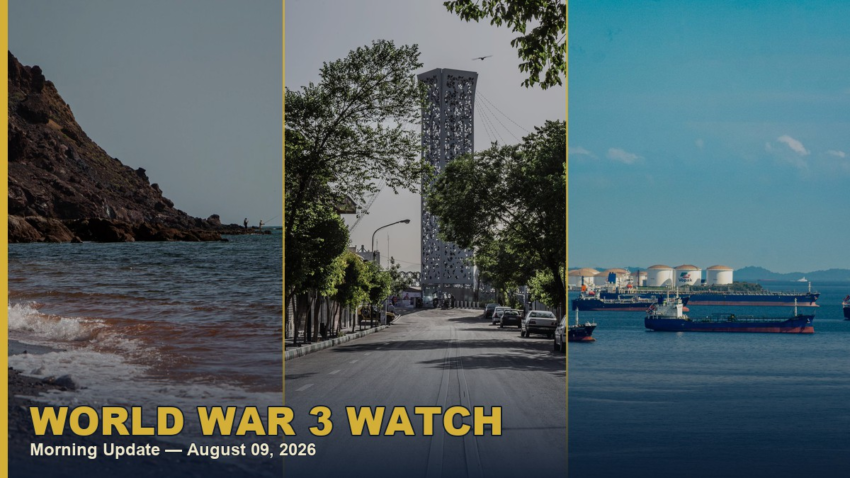
World War 3 Watch — Morning Update — August 09, 2026
- Iran says the Strait of Hormuz will stay closed unless Washington accepts its conditions, even as Oman calls the shipping talks positive (BBC News, 2026, authors’ translation).
- At Minab’s Shajareh Tayyebeh school, a US-made Tomahawk killed 156 people — 120 of them children — on the war’s first day, per the local prosecutor (The Guardian, 2026).
- Israeli media report Netanyahu is keeping a unilateral strike on Iran on the table in case the US exits first (Hindustan Times, 2026; Wenxue City, 2026, authors’ translation).
- The US has burned through nearly 80% of its THAAD interceptors and about half its Patriots; arms firms have 21 days to propose faster output (The Times of Israel, 2026).
- Joint Chiefs Chairman Dan Caine has privately told the White House that air power alone cannot win the war, and that the US needs an exit (Lianhe Zaobao, 2026, authors’ translation).
- English-language coverage clusters around Iranian intransigence and Israeli strike plans; the Chinese-language filings center Washington’s search for a way out (Sky News, 2026; Haibao News, 2026, authors’ translation).
The Story So Far
Five months into the US-Israeli war on Iran, every theater is moving and none is drifting toward a clean end. Tehran keeps the Strait of Hormuz shut, the Houthis are striking Saudi oil, and Israel is weighing a solo strike (Sky News, 2026; MSN, 2026; Hindustan Times, 2026).
The Pentagon is scrambling to restock interceptors the war has drained: nearly 80% of THAAD rounds and about half the Patriot inventory are gone (The Times of Israel, 2026).
America’s top general has privately told the White House that air power alone cannot win what the air war has not won (Lianhe Zaobao, 2026, authors’ translation). On the diplomatic track, Oman reports progress — but Iran says reopening the strait “depends on other conditions” (BBC News, 2026, authors’ translation).
And on the ground in Minab, workers are still pulling bodies — and an eight-year-old’s exercise book — from the rubble of a school where 120 children were killed (The Guardian, 2026).
Video: Iran’s Big Hormuz Demands: U.S. Concessions as Strait of Hormuz Deal With Oman Nears | LIVE. Source: CNN-News18.
1. Minab’s Children Count the Cost of a ‘Limited’ War
The war’s defining symbol is not a bridge or a bunker. It is a school.
At Shajareh Tayyebeh primary school in Minab, an excavator stopped and a worker reached into the rubble, pulling free a child’s exercise book — intact, covered in neat handwriting, with a name on the front: Mahya Salari (The Guardian’s field report, 2026). She was eight years old.
Five months after a missile tore through the building, workers are still clearing the site, searching for the remains of one boy believed buried beneath the debris. According to the Minab prosecutor’s office, 156 people — 120 of them children — were killed here when a US-made Tomahawk struck on the war’s first day (The Guardian, 2026).
Across the city, portraits of the dead cover walls, shopfronts and roadside billboards, turning Minab into one of the defining symbols of civilian suffering (The Guardian, 2026). The war began on 28 February — the day President Donald Trump urged Iranians to “seize control of your destiny.” Instead, the conflict reshaped Iran in ways few expected (The Guardian, 2026).
The overnight train from Tehran to Bandar Abbas runs almost 900 miles, linking Iran’s political heart with the strait of Hormuz and passing the nuclear sites of Natanz and Fordow (The Guardian, 2026). On board are students, footballers, businessmen and families, each carrying their own version of what the war has meant (The Guardian, 2026).
Azadeh, a lawyer, remembers the first days as frightening. “It is in every Iranian’s nature to adapt,” she said. “We tried to continue living our lives, to keep our routines and remain hopeful” (The Guardian, 2026).
Not one of the Chinese-language reports in this roundup carries an equivalent account of the civilian toll; their treatment of the same war is strategic and diplomatic. That divergence is exactly what our narrative-comparison report on how US, Israeli, Iranian, and BRICS media each tell this war maps in detail.
Video: Netanyahu's War Fever Meets Trump's Iran Exit Plan: Is Israel Preparing To Go Rogue & Strike Tehran?. Source: Hindustan Times.
2. Hormuz: Deal or No Deal?
On the surface, the Hormuz story is a he-said-she-said with missiles in the background. Sky News leads with Tehran’s insistence that the strait stays closed while the US breaches the June deal, and the Houthis have claimed a drone strike on a Saudi Aramco facility in Jazan (Sky News, 2026; MSN, 2026).
Oman, meanwhile, says negotiations with Iran over a guaranteed shipping route have been positive. Foreign Minister Abbas Araghchi acknowledges the talks are in their final stage — but insists any reopening “depends on other conditions” (BBC News, 2026, authors’ translation).
Those conditions start with compensation from the United States, which Tehran accuses of breaking the memorandum of understanding signed in June. That deal collapsed within days, sending both sides back into tit-for-tat strikes (BBC News, 2026, authors’ translation).
Iran’s security chief, Mohammad Baqer Zolqadr, lists six demands, including an end to threats, the lifting of the naval blockade on Iranian ports, and the release of frozen assets (BBC News, 2026, authors’ translation).
The Revolutionary Guard’s spokesman, speaking to Tasnim and relayed by Xinhua, goes further: the reopening has nothing to do with the Oman talks. “Once the US accepts Iran’s conditions, the strait will certainly reopen” (Beijing News, 2026, authors’ translation).
A US official counters that Iran and Oman are close to announcing the resumption of commercial shipping — and says Washington will lift its own blockade of Iranian ports “based on actual compliance” (Lianhe Zaobao, 2026, authors’ translation). Iran’s deputy foreign minister, Gharibabadi, describes a “new transit model different from the past 60 years” (Lianhe Zaobao, 2026, authors’ translation).
The shooting has not paused for the talking. Since 20 July the Iran-backed Houthis have imposed another blockade on Saudi ports in the Red Sea (BBC News, 2026, authors’ translation).
The UAE said Saturday that an Iranian missile struck one of its ADNOC tankers, and Britain’s UKMTO logged a vessel hit by an “unknown projectile” off Oman’s coast (BBC News, 2026, authors’ translation). No casualties were reported in either case.
Saudi Arabia, Pakistan and Turkey signed a joint defense pact in Mecca on Friday: an armed attack on any one of them is now an attack on all, with Turkey insisting the pact is purely defensive (Lianhe Zaobao, 2026, authors’ translation).
Vice President JD Vance downplayed reports that Iran plans to charge transiting ships 5-7% of cargo value, saying Tehran told Washington it has no such plan — while conceding, “We’re still at the critical stage — the race isn’t over” (BBC News, 2026, authors’ translation).
Even US Treasury Secretary Bessent is planning for a post-strait world. He predicts more than half — up to 70% — of regional energy transport will shift to underground and land pipelines, making Hormuz “an ordinary waterway” within two years (Lianhe Zaobao, 2026, authors’ translation).
Read the two language families side by side and the framing splits: the English-language wires lead with Iran’s refusal and the Jazan strike, while the Chinese-language press carries the fuller diplomatic traffic in both directions (MSN, 2026; BBC News, 2026, authors’ translation).
Video: US-Iran standoff: Can a lasting deal reopen the Strait of Hormuz? Experts debate. Source: Al Jazeera English.
3. Israel Floats a Solo Strike
Every strand of today’s story loops back to one question: what happens if Washington wants out and Israel doesn’t? Israeli reports say Prime Minister Benjamin Netanyahu is preparing for the possibility of unilateral strikes against Iran even if the United States seeks to end the conflict (Hindustan Times, 2026).
Channel 13’s reporting — relayed by Iranian International and picked up by Chinese-language outlets — says the Israeli military is keeping the option of striking Iran “without US participation” on the table (Wenxue City, 2026, authors’ translation). The reports warn of a major divide between America and Israel if Washington walks away first (Hindustan Times, 2026).
That scenario is exactly what America’s top general has been privately warning against. Joint Chiefs Chairman Dan Caine has told senior Trump advisors that further escalation could backfire and that air power alone is unlikely to achieve the president’s goals (Wenxue City, 2026, authors’ translation).
At a July congressional hearing, Caine put it in one line: “air power has its limits” (Wenxue City, 2026, authors’ translation). He has made the same case privately to CIA Director John Ratcliffe, Secretary of State Marco Rubio and Vice President JD Vance — while assuring Trump that, if ordered, the US military could still “completely destroy Iran” (Wenxue City, 2026, authors’ translation).
Here, unusually, the English- and Chinese-language records converge: both are tracking the same Channel 13 story, and both flag the same risk of a US-Israel rupture. Each is telling its public that the alliance itself is now a fault line in this war (Hindustan Times, 2026; Wenxue City, 2026, authors’ translation).
4. The Pentagon’s Missile Math
Caine’s private warning is not just about strategy — it is about inventory. The US military has used close to 80% of its THAAD anti-missile interceptors and roughly 50% of its Patriot interceptors, levels CNN describes as “dangerously low” (The Times of Israel, 2026).
Last Wednesday, Deputy Defense Secretary Steve Feinberg gave arms companies 21 days to present plans for “significantly faster, more aggressive delivery schedules” and increased production of critical capabilities. “Years-long development cycles are not acceptable,” he wrote, demanding a “willingness to put skin in the game” (The Times of Israel, 2026).
The $1.15 trillion defense spending bill that would pay for it is stuck, with Democrats objecting to the increases; late last month defense executives were summoned to the White House and asked to lobby Congress on its behalf (The Times of Israel, 2026).
Trump denied reports that he is unhappy with Defense Secretary Pete Hegseth over the depleted stockpile (The Times of Israel, 2026). Chinese-language files add that Caine raised the shrinking arsenals directly with the president (Haibao News, 2026, authors’ translation).
The same Chinese report describes a White House trapped in a “fight-talk loop”: Trump threatened late last month to resume large-scale operations, then called off a strike on 1 August after most of his advisors pushed back (Haibao News, 2026, authors’ translation).
University of Chicago political scientist Robert Pape calls the war a strategic failure. Every month brings a new tactic — strikes on the leadership, a six-week bombing campaign, a naval blockade — and none has made Iran yield (Haibao News, 2026, authors’ translation).
“From the moment the first bomb fell on 28 February, the situation began spiraling out of control,” Pape said, “and it is only getting worse” (Haibao News, 2026, authors’ translation).
The two angles form one picture: the arsenal draining at the same moment the generals lose confidence in the plan (The Times of Israel, 2026; Haibao News, 2026, authors’ translation).
5. Washington’s Other Battle: The Midterms
None of this is happening in a political vacuum. With about three months until the November midterms, the most likely outcome is a divided Congress — Democrats favored to take the House, Republicans holding a narrow Senate edge (Israel Hayom, 2026).
Midterms traditionally serve as a referendum on the sitting president, and Israel Hayom notes the Epstein affair, tariffs and the Iran war have driven Trump’s approval ratings to new lows (Israel Hayom, 2026).
A divided Congress would make it harder for the president to advance his agenda — at the precise moment the White House is weighing exits and Israel is weighing entrances (Israel Hayom, 2026).
The same analysis calls the election a crucial battle for Israel, with the Democratic Party split between a moderate establishment and an anti-Israel progressive wing (Israel Hayom, 2026).
Is This Actually World War 3?
By the strict definition — a shooting war between great powers — today’s sources do not show World War 3. They show its larval stage: a regional war that keeps recruiting new members (Haibao News, 2026, authors’ translation).
Pape’s list of combatants runs to seven: the US, Iran, Israel, Hezbollah, the Houthis, Saudi Arabia and Iraqi militias (Haibao News, 2026, authors’ translation).
Add the Saudi-Pakistan-Turkey defense pact, an ADNOC tanker hit, and a closed strait through which roughly a fifth of the world’s oil and gas normally flows, and the escalation ladder still has plenty of rungs (Lianhe Zaobao, 2026, authors’ translation; BBC News, 2026, authors’ translation).
What keeps this short of world war — for now — is what today’s packet does not contain: no direct great-power on-ramp in this morning’s files. The China-Taiwan track this series also watches produced no new reporting in today’s source set; the escalation is running instead through proxies, chokepoints and missile inventories (The Times of Israel, 2026).
One more warning sign lives inside the coverage itself. The English-language packet leads with Iranian intransigence and Israeli strike plans; the Chinese-language packet centers a Washington that cannot bomb its way out and a general who knows it (Sky News, 2026; Haibao News, 2026, authors’ translation).
The honest answer is: not yet. But every ingredient on this morning’s menu — a closed strait, depleted interceptors, a fracturing US-Israel front, and a superpower’s top soldier quietly looking for the door — is a standard ingredient in how wider wars begin.
What You Can Do Right Now
- Watch the gap between what Washington claims and what Tehran demands: the space between “deal close” and “the strait will certainly reopen” is where the next escalation will come from (Lianhe Zaobao, 2026, authors’ translation; Beijing News, 2026, authors’ translation).
- Roughly a fifth of the world’s oil and gas moves through a strait Iran has closed, so expect energy-price shocks to travel faster than diplomacy; review household budgets and supply-chain exposure now (BBC News, 2026, authors’ translation).
- Practical preparation beats prediction. Our survival skills and preparedness guide covers water, power, medical and communications readiness for prolonged disruptions.
Kemetic Minds Analysis
This roundup pulled directly from the day’s English- and Chinese-language wires side by side, because the gap between what each side chooses to report is often as informative as any single strike count. Treat the Key Takeaways above as the verified factual floor, and the framing differences noted in the sections above as the more interesting, harder-to-fake signal about where this war is actually headed next.
References
- The Guardian. (2026, August 8). Travelling through Iran reveals mixed narratives about the US-Israel war. theguardian.com
- Sky News. (2026, August 9). Iran war latest: Tehran says Strait of Hormuz to stay closed while US breaches deal – as Houthis attack Saudi oil facility. news.sky.com
- Hindustan Times. (2026, August 9). Netanyahu's war fever meets Trump's Iran exit plan: Is Israel preparing to go rogue and strike Tehran? | Hindustan Times. hindustantimes.com
- The Times of Israel. (2026, August 9). Pentagon said to ask US arms firms to speed up output as Iran war exhausts supply. timesofisrael.com
- www.israelhayom.com. (2026, August 8). Could Trump become a lame duck? Why the Midterms matter for Israel. israelhayom.com
- MSN. (2026, August 9). Houthis hit Saudi oil site as Iran hardens Strait of Hormuz conditions. msn.com
- BBC. (2026, August 9). 霍尔木兹海峡:阿曼称会谈进展顺利,伊朗则警告协议不会打通海峡 [The Strait of Hormuz: Oman says negotiations are proceeding smoothly, while Iran warns that an agreement will not unblock the strait]. bbc.com
- 新京报. (2026, August 8). 伊朗:同阿曼的谈判与霍尔木兹海峡能否重开无关 [Iran: Negotiations with Oman unrelated to potential reopening of the Strait of Hormuz]. bjnews.com.cn
- 联合早报. (2026, August 8). 美官员:伊朗阿曼即将谈妥霍尔木兹海峡通行协议 [US officials: Iran and Oman are close to reaching an agreement on a Hormuz Strait passage deal]. zaobao.com
- 文学城. (2026, August 9). 以色列不排除单方面攻击伊朗,美伊战争结束后出手 [Israel does not rule out unilateral attack on Iran, may take action after US-Iran war]. wenxuecity.com
- 海报新闻. (2026, August 8). 消息人士:美军高层寻找摆脱伊朗战事的途径 [Sources: Senior US military brass seek a way out of Iran conflict.]. hb.dzwww.com
Investigative Methodology: This roundup is generated on a fixed schedule (noon and evening, America/Chicago) from live English- and Chinese-language wire sources. Every claim is grounded in fetched source text with an APA7 in-text citation; translated Chinese-language quotes are marked “authors’ translation.” Every video embed is verified to be a real, existing video via YouTube’s oEmbed endpoint before publication — none are written by the drafting model. No Wikipedia sources are used.
Stay Connected

Kemetic Minds Editorial Desk
Verified NewsroomPrimary-sourced investigative intelligence on civil rights, voting rights, federal policy, and consumer protection. Sourced from primary legal filings, government statistics, and direct field reporting.