KEMETIC MINDS
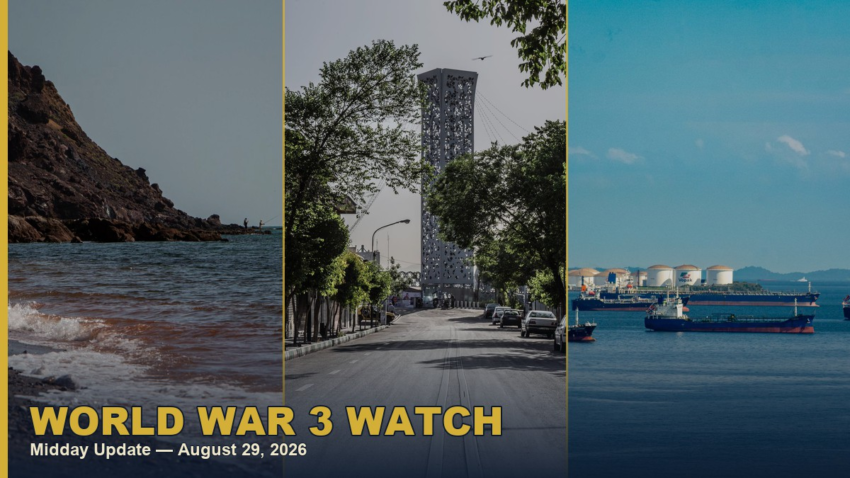
World War 3 Watch — Midday Update — August 29, 2026
- Iran’s supreme leader admitted economic hardship while President Pezeshkian said foreign trade has shrunk by one-third under sanctions and blockades (Fox News, 2026; MSN, 2026).
- The U.S. Treasury launched Operation Economic Outcast against Tehran as the war enters its sixth month (Fox News, 2026; MSN, 2026).
- Iran transferred US$7.5 billion (RM31.6 billion) in oil revenues from the first four months of its year to the central bank (Malaymail, 2026).
- Shipping through the Strait of Hormuz remains disrupted (MSN, 2026).
- Iran’s president said that if Hormuz reopens, the United States must fulfill its obligations (Beijing News, 2026, authors’ translation).
- Chinese outlets frame the war through cognitive warfare, a U.S. “backyard” gain for Iran, and Beijing’s oil reserves — angles absent from today’s English coverage (Sohu, 2026, authors’ translation; Investing.com, 2026, authors’ translation).
The Story So Far
The Iran-U.S. war entered its sixth month with the economic front dominating the headlines (MSN, 2026). Tehran’s leader conceded hardship in public as President Pezeshkian put a number on the cost: foreign trade down a third (Fox News, 2026; MSN, 2026).
The squeeze has a name — Operation Economic Outcast — and a countermove: Iran shifted US$7.5 billion in oil earnings to its central bank (Fox News, 2026; Malaymail, 2026). It all orbits the Strait of Hormuz, where shipping stays disrupted (MSN, 2026).
Chinese-language outlets are narrating a different war: a president conditioning Hormuz reopening, a supreme leader banning cohesion-breaking behavior, and Beijing sitting on vast oil reserves (Beijing News, 2026, authors’ translation; Sohu, 2026, authors’ translation; Investing.com, 2026, authors’ translation).
Video: US IRAN WAR LIVE | Trump: ‘I’m Not In A Hurry’ | No Timeline For Iran To Return To Talks. Source: Firstpost.
1. Tehran Admits the Pain: Trade Down a Third
For six months, Iran’s leadership answered American pressure with defiance (MSN, 2026). Today’s reporting shows that posture cracking at the edges: Supreme Leader Mojtaba Khamenei described economic hardships and called on the government to address them (Fox News, 2026; Reuters, 2026).
President Pezeshkian supplied the number: foreign trade has shrunk by one-third under sanctions and blockades (MSN, 2026). Even as leaders vow to keep resisting, the admission itself is the news (MSN, 2026).
Video: US Intensifies Economic Pressure on Iran With New Sanctions Campaign. Source: DD India.
2. Operation Economic Outcast Bites Deeper
The squeeze has a name and an owner. The U.S. Treasury Department launched Operation Economic Outcast, a sanctions campaign aimed at Tehran’s finances (Fox News, 2026).
It lands as the war enters its sixth month (MSN, 2026). Washington is pressing hardest on the ledger as the war grinds on (MSN, 2026).
Tehran’s counter-move is visible in the ledgers. Iran transferred US$7.5 billion (RM31.6 billion) in oil revenues from the first four months of its year to the central bank (Malaymail, 2026).
The scale of the transfer shows how central energy revenue remains, and Malaymail’s headline ties it directly to the U.S. blockade (Malaymail, 2026). Reuters frames the bottom line: war weighs on Iran’s economy as U.S. sanctions intensify (Reuters, 2026).
3. Hormuz: Closed Gate, Open Leverage
This war has a single geography: the Strait of Hormuz. Shipping through the strait remains disrupted, a fact English-language briefs report without elaboration (MSN, 2026).
Iranian leadership, in contrast, is negotiating with the strait’s fate. Beijing News quotes the president saying that if the Strait of Hormuz reopens, the United States must fulfill its obligations (Beijing News, 2026, authors’ translation).
The phrasing makes any reopening conditional — a chokepoint turned bargaining chip (Beijing News, 2026, authors’ translation). Where English coverage reports the strait’s fate as damage, Iranian framing treats it as an obligation Washington owes (MSN, 2026; Beijing News, 2026, authors’ translation).
4. Beijing’s Quiet Leverage: Oil Reserves and Tough Talk
Oil is the connective tissue between the strait, the sanctions, and the great-power shadows. Investing.com reports that China’s vast oil reserves give Beijing strategic leverage in the Iran war (Investing.com, 2026, authors’ translation).
Le Monde’s coverage, relayed by RFI, adds the diplomatic layer: Washington tightens sanctions on Iran while China shows toughness toward the United States — “but” (RFI, 2026, authors’ translation). The dangling conjunction captures Western uncertainty about Beijing’s posture (RFI, 2026, authors’ translation).
None of today’s English-language briefs mention China’s reserves at all. The leverage story is being told in Chinese and French, not English (Investing.com, 2026, authors’ translation; RFI, 2026, authors’ translation).
5. Beyond Missiles: Cognitive Warfare and a ‘Backyard’ Gambit
Chinese coverage insists the war has a front Western briefs barely register. Sohu reports that the United States and Israel have shifted toward cognitive warfare and intelligence warfare (Sohu, 2026, authors’ translation).
Tehran treats that as a domestic threat: the supreme leader has prohibited behavior that undermines national cohesion (Sohu, 2026, authors’ translation). The report’s framing — war as a contest of narratives, not just missiles — has no counterpart in today’s English sources (Sohu, 2026, authors’ translation).
There is also a diplomatic subplot. Sohu reports that Iran has pried an ally out of America’s own backyard, a move it describes as checkmating Washington and provoking an agitated response from Trump (Sohu, 2026, authors’ translation).
The headline names no country, and the claim cannot be verified from this source alone. Its presence in Chinese coverage still signals what Beijing believes is moving beneath the surface (Sohu, 2026, authors’ translation).
6. Two Media Universes, One War
English briefs make the war a siege: sanctions shrinking trade, a leader admitting hardship, a strait disrupted (Fox News, 2026; Reuters, 2026; MSN, 2026). Chinese briefs make it a chessboard: a president setting conditions, a leader policing unity, an ally stolen, reserves in hand (Beijing News, 2026, authors’ translation; Sohu, 2026, authors’ translation; Investing.com, 2026, authors’ translation).
The gaps tell you more than either list of facts. English coverage reports Iran’s weakness; Chinese coverage reports Iran’s agency and America’s headaches (Reuters, 2026; Sohu, 2026, authors’ translation).
Both are describing the same war; neither is describing all of it. We mapped exactly this divergence in our narrative-comparison report on how U.S., Israeli, Iranian, and BRICS media each tell this war.
Is This Actually World War 3?
Today’s sources support a hard truth and a caution. The truth: the United States and Iran are at war, in its sixth month, with Hormuz disrupted and sanctions at maximum pressure (MSN, 2026; Fox News, 2026).
The caution: nothing here shows the great-power mobilization that “World War 3” implies. China appears as a reserve-holder and a tough talker — not as a combatant (Investing.com, 2026, authors’ translation; RFI, 2026, authors’ translation).
The accurate label remains a regional war with global economic shockwaves, fought through blockades, sanctions, and narratives as much as weapons (Reuters, 2026; Sohu, 2026, authors’ translation). That is why this series keeps watching — and keeps refusing the hype.
What You Can Do Right Now
- Follow the strait, not the spin: Hormuz shipping remains disrupted while Tehran ties any reopening to U.S. concessions — watch that chokepoint first (MSN, 2026; Beijing News, 2026, authors’ translation).
- Prepare for extended economic friction: our survival skills and preparedness guide covers the practical basics for riding out supply and price shocks.
- Read the same war in two languages: the divergence between English and Chinese coverage is itself a data point (Sohu, 2026, authors’ translation; Investing.com, 2026, authors’ translation).
SUPPORT KEMETIC MINDS
Enjoying this coverage? Back the work and find every way to connect with us in one place.
Support the Page →Kemetic Minds Analysis
This roundup pulled directly from the day’s English- and Chinese-language wires side by side, because the gap between what each side chooses to report is often as informative as any single strike count. Treat the Key Takeaways above as the verified factual floor, and the framing differences noted in the sections above as the more interesting, harder-to-fake signal about where this war is actually headed next.
References
- Fox News. (2026, August 29). Iran’s supreme leader admits economic hardships as US sanctions campaign takes toll. foxnews.com
- Malaymail. (2026, August 29). Iran transfers US$7.5b in oil revenues to central bank amid US blockade. malaymail.com
- Reuters. (2026, August 29). War weighs on Iran's economy as US intensifies sanctions. reuters.com
- MSN. (2026, August 29). War weighs on Iran's economy as US intensifies sanctions. msn.com
- MSN. (2026, August 29). US-Israel-Iran war latest news: US tightens sanctions on Iran as war takes economic toll, Hormuz shipping remains disrupted. msn.com
- 新京报. (2026, August 28). 伊朗总统:若霍尔木兹海峡重开 美国必须履行其义务 [Iranian President: If Strait of Hormuz Reopens, US Must Fulfill Its Obligations]. bjnews.com.cn
- 搜狐网. (2026, August 28). 美以转向认知战情报战 伊朗最高领袖:禁止有损凝聚力行为 [US, Israel Shift to Cognitive and Intelligence Warfare; Iran's Supreme Leader: Forbids Acts That Undermine Cohesion]. m.sohu.com
- 搜狐网. (2026, August 28). 伊朗撬走美国后院盟友,将了美国一军,果然特朗普急眼了 [Iran poaches a US ally in its own backyard, checkmating Washington — and sure enough, Trump is fuming.]. m.sohu.com
- RFI. (2026, August 28). 法国世界报 – 伊朗:美国加大制裁压力,中国对美表现强硬,但是…… [Le Monde – Iran: US escalates sanctions pressure, China takes a hard line, but…]. rfi.fr
- 英为财情 Investing.com. (2026, August 29). 中国庞大石油储备为北京在伊朗战争中提供战略筹码 提供者 Investing.com [China's Massive Oil Reserves Give Beijing Strategic Leverage in Iran War — Investing.com]. cn.investing.com
Investigative Methodology: This roundup is generated on a fixed schedule (noon and evening, America/Chicago) from live English- and Chinese-language wire sources. Every claim is grounded in fetched source text with an APA7 in-text citation; translated Chinese-language quotes are marked “authors’ translation.” Every video embed is verified to be a real, existing video via YouTube’s oEmbed endpoint before publication — none are written by the drafting model. No Wikipedia sources are used.
Stay Connected

Kemetic Minds Editorial Desk
Verified NewsroomPrimary-sourced investigative intelligence on civil rights, voting rights, federal policy, and consumer protection. Sourced from primary legal filings, government statistics, and direct field reporting.