
KEMETIC MINDS
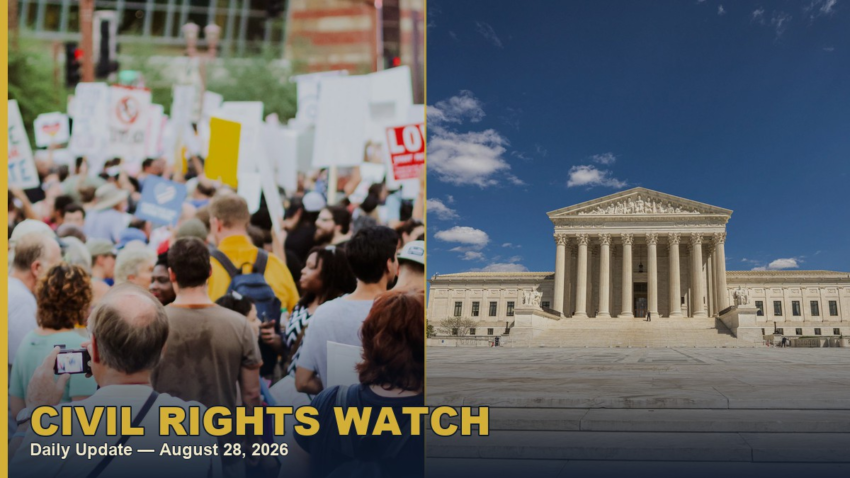
Civil Rights Watch — Daily Update — August 28, 2026
Good evening — welcome to Civil Rights Watch. Tonight’s briefing is led by a federal judge’s second halt of President Donald Trump’s executive order restricting mail voting, a ruling that lands days before midterm ballots go out even as 24 states and the District of Columbia sue over the new U.S. Postal Service rule behind it. We’re also tracking a Georgia redistricting case kicked back to the lower courts and four new Department of Justice lawsuits over in-state tuition for undocumented students.
Here are tonight’s key facts:
- A federal judge on Thursday halted — at least for now — attempts to implement Trump’s executive order limiting mail voting, stalling the directive for a second time (MSN, 2026).
- The block comes days before ballots go out for the midterms, and the ruling will likely be quickly appealed (MSN, 2026).
- Democratic officials in 24 states and the District of Columbia filed a new federal lawsuit over the final USPS vote-by-mail rule published Aug. 21, after the Supreme Court struck down a similar suit as premature (News Tribune, 2026).
- The 11th Circuit sent Georgia’s 2021 congressional maps case back to District Judge Steve Jones after the Supreme Court required plaintiffs to prove lawmakers intended to discriminate (WSBTV, 2026).
- The Justice Department sued New Mexico, Arizona, Oregon, and Washington over in-state tuition for undocumented students, bringing the total to 21 states (Yahoo News, 2026; MSN, 2026).
“A federal judge on Thursday halted — at least for now — attempts to implement President Donald Trump’s executive order limiting mail voting.”
MSN —
Read the full report →
1. Mail-Voting Order Blocked Again as 24 States Sue
A federal judge on Thursday halted — at least for now — attempts to implement Trump’s executive order limiting mail voting, according to MSN. The move stalled the directive for a second time (MSN, 2026).
The order comes days before ballots go out for the midterms, and the ruling will likely be quickly appealed (MSN, 2026).
Monday’s Supreme Court decision set the stage for the latest round of litigation. With the three liberal justices dissenting, the Court said states had not had the right to challenge Trump’s March 31 executive order because no corresponding enforceable final rule existed (News Tribune, 2026).
A federal judge then lifted a nationwide pause on the policy, a procedural win for the administration, and Democrat-led states and voting rights groups re-filed lawsuits Wednesday to block the new regulation (News Tribune, 2026).
Democratic officials in 24 states and the District of Columbia launched a new federal lawsuit challenging the U.S. Postal Service rule establishing federal vote-by-mail standards as unconstitutional, while a coalition of voting rights advocates filed a supplemental complaint against the same rule after the Supreme Court struck down a similar suit as premature (News Tribune, 2026).
The final USPS rule, published Aug. 21, hews closely to the March executive order, the groups say. It establishes new ballot-design requirements, mandates that states collect information from voters and voting-age citizens and transmit that information to the federal government, and forbids the Postal Service from delivering or collecting mail-in ballots from people who have not been confirmed as eligible voters (News Tribune, 2026).
“As recently as August 12, 2026, USPS told the Supreme Court that there was significant ‘uncertainty concerning the government’s future actions,'” the voting rights groups wrote. “That uncertainty is now gone” (News Tribune, 2026). Their filing adds: “The Final Rule now makes concrete what Defendants previously called speculative” (News Tribune, 2026).
“Circuit Court of Appeals is sending a lawsuit over Georgia’s 2021 congressional maps back to a lower court after the U.S.”
Wsbtv —
Read the full report →
2. Georgia Congressional Maps Head Back to Lower Court
The 11th U.S. Circuit Court of Appeals is sending a lawsuit over Georgia’s 2021 congressional maps back to a lower court, WSBTV reports, after the U.S. Supreme Court’s decision on the Voting Rights Act (WSBTV, 2026).
Georgia’s Republican-controlled legislature approved the new district maps in 2021 on a party-line vote, shifting the Republican edge in the congressional delegation from 8-6 to 9-5. A series of lawsuits followed, arguing that the redrawn maps “illegally discriminate against minorities and take away their voting power” (WSBTV, 2026).
In 2023, federal District Judge Steve Jones issued a massive 516-page ruling declaring that the maps violated the Voting Rights Act, and the state appealed to the 11th Circuit (WSBTV, 2026).
Since then, a decision by the U.S. Supreme Court — described by WSBTV as controversial — diluted a section of the Voting Rights Act, holding that plaintiffs must now prove lawmakers intended to discriminate against minorities when they drew district lines. Under that standard, the 11th Circuit said it had no choice but to send the case back to Jones (WSBTV, 2026).
The Georgia Secretary of State’s office, the governor’s office, the Attorney General’s Office, and the American Civil Liberties Union declined to comment as the case remains pending litigation (WSBTV, 2026).
3. DOJ Sues Four More States Over In-State Tuition
The U.S. Department of Justice filed lawsuits Thursday against New Mexico, Arizona, Oregon, and Washington for providing in-state tuition to undocumented students, Yahoo News reports. In total, 21 states have now been sued for similar reasons (Yahoo News, 2026; MSN, 2026).
The New Mexico complaint names the state Higher Education Department and Secretary Stephanie Rodriguez as defendants, and the DOJ seeks to strike down the state law at issue. The department contends that allowing undocumented residents to pay in-state tuition is unconstitutional discrimination against U.S. citizens living in other states (Yahoo News, 2026).
Assistant Attorney General Brett A. Shumate said in a news release: “This is a simple matter of federal law: colleges cannot provide benefits to illegal aliens that they do not provide to U.S. citizens.” He added that the Justice Department “will not tolerate American students being treated like second-class citizens in their own country” (Yahoo News, 2026).
New Mexico’s Higher Education Department said it was aware of the suit but had not yet received official court documents. Spokesperson Auriella Valles said eligibility requirements across the state’s aid programs are “consistently grounded in residency and academic participation within the state,” and that the agency remains committed to “supporting students, strengthening our workforce and advancing educational opportunity across the state” (Yahoo News, 2026).
The challenged New Mexico policy dates to Senate Bill 582 (2005), which grants in-state tuition to undocumented students — who are not eligible for federal student loans or financial aid — if they attended a New Mexico middle or high school for at least one year, graduated from a New Mexico high school, or received a GED in the state, regardless of immigration status (Yahoo News, 2026).
In Arizona, MSN reports the department’s suit targets Proposition 308 and alleges that in-state tuition for immigrants without legal status cost Arizona State University $10.5 million last year (MSN, 2026).
What’s Disputed or Unconfirmed
- The DOJ’s tuition suits rest on the government’s allegation that residency-based tuition policies unconstitutionally discriminate against U.S. citizens in other states. New Mexico officials say they had not yet received official court documents, and the state’s education agency defended the program as grounded in residency (Yahoo News, 2026).
- The $10.5 million cost figure attached to Arizona’s Proposition 308 is the DOJ’s allegation, not an independently verified accounting (MSN, 2026).
- The sourcing does not fully reconcile the lifted nationwide pause on the mail-voting policy with Thursday’s renewed judicial block; MSN reports the new ruling will likely be quickly appealed (MSN, 2026; News Tribune, 2026).
- In the Georgia maps case, the central question of whether the 2021 districts actually discriminate against minority voters remains unresolved pending the lower court’s review under the Supreme Court’s new discriminatory-intent standard (WSBTV, 2026).
How to Verify This Yourself
- Read the final USPS vote-by-mail rule in the Federal Register, published Aug. 21, 2026, and pull the judge’s Thursday order and the new 24-state complaint from PACER.
- Download the DOJ complaints against New Mexico, Arizona, Oregon, and Washington on the Justice Department’s website, and compare them with the text of New Mexico’s Senate Bill 582 and Arizona’s Proposition 308.
- Follow the remanded Georgia maps case on the docket of the U.S. District Court for the Northern District of Georgia, alongside Judge Jones’ 2023 ruling and the Supreme Court’s new intent standard.
SUPPORT KEMETIC MINDS
Enjoying this coverage? Back the work and find every way to connect with us in one place.
Kemetic Minds Analysis
Today’s verified reporting covered: Civil Rights & Voting Rights; States’ Rights & Federalism. Every claim above traces back to a specific, dated, fetched source — treat the Key Takeaways as the verified factual floor, and the ‘What’s Disputed or Unconfirmed’ section as the honest boundary of what today’s sourcing actually supports versus what’s still allegation or one-sided claim.
References
- MSN. (2026, August 28). Trump’s mail ballot executive order blocked in ruling that will likely be quickly appealed. msn.com
- MSN. (2026, August 28). US judge repeats block on Trump’s bid to limit voting by mail. msn.com
- Wsbtv. (2026, August 27). Lawsuit over Georgia congressional maps kicked back to lower court after SCOTUS ruling. wsbtv.com
- Newstribune. (2026, August 28). New challenges to Trump mail-in voting order arrive after Supreme Court ruling. newstribune.com
- Yahoo. (2026, August 27). Trump administration sues New Mexico over in-state tuition for undocumented students. yahoo.com
- MSN. (2026, August 27). Arizona sued by DOJ over in-state tuition for immigrants without legal status. msn.com
- MSN. (2026, August 27). Justice Department sues New Mexico over in-state tuition for undocumented students. msn.com
Investigative Methodology: This roundup is generated once daily at 6:00 PM America/Chicago from live news sources published within the prior 24 hours, plus primary-source civil-rights monitoring feeds (SPLC, ADL, ProPublica). Every claim is grounded in fetched source text with an APA7 in-text citation; nothing is written from the model’s general knowledge. Every video embed is verified to be a real, existing video via YouTube’s oEmbed endpoint before publication — none are written by the drafting model. Pull-quotes are extracted verbatim from the cited article, never composed. No Wikipedia sources are used, and social-media posts (TikTok/X/Instagram) are only referenced when a real, working link to that post appears directly in a cited news source — this post does not auto-embed unverified social content, since a fabricated post link would be worse than no embed at all.
Stay Connected

Kemetic Minds Editorial Desk
Verified NewsroomPrimary-sourced investigative intelligence on civil rights, voting rights, federal policy, and consumer protection. Sourced from primary legal filings, government statistics, and direct field reporting.