KEMETIC MINDS
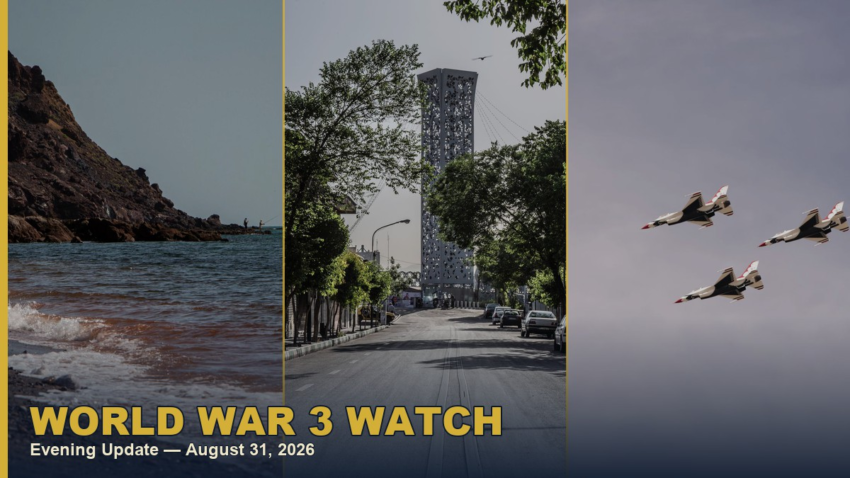
World War 3 Watch — Evening Update — August 31, 2026
- The US and Iran exchanged fire for the first time in a month, with Washington striking rocket launchers on Larak Island and Tehran targeting US bases in Jordan (The Guardian, 2026).
- President Trump vowed “We’re going to hit them hard. There will be a response,” after the Iranian attacks (Time Magazine, 2026).
- US Central Command said the strike was “limited, precise action against IRGC minelaying forces posing an imminent threat” to the strait (Time Magazine, 2026).
- The IRGC claimed it targeted US-operated King Hussein and al-Azraq airbases in Jordan with ballistic missiles, causing “heavy damage” (The Guardian, 2026).
- Chinese media framed the escalation as part of a US military-financial dual-pressure campaign to force Iran back to negotiations (RFI, 2026, authors’ translation).
- Maritime incidents continued, with a tanker hit by three projectiles near Oman and Iranian media reporting a Saudi oil tanker stopped in the strait (Haaretz, 2026).
The Story So Far
The seven-month US-Israel war on Iran snapped back into active combat on Sunday night, ending a roughly month-long pause that had raised hopes of de-escalation. US forces struck two Iranian rocket launchers on Larak Island in the Strait of Hormuz, and the Islamic Revolutionary Guard Corps (IRGC) retaliated with ballistic missiles against US bases in Jordan.
By Monday evening, President Trump was back on television promising to “hit them hard,” while simultaneously declaring Iran “officially a Failed Nation” with no navy, air force, or currency (Al Jazeera, 2026). The exchange marks the first publicly confirmed firefight between the two countries since July 29, when the US announced a “heavy wave of strikes” on IRGC targets (Time Magazine, 2026).
Across the Pacific, the parallel China-Taiwan flashpoint remains quiet by comparison, but Chinese-language coverage of the Gulf crisis is notably more focused on the economic dimensions of the conflict. This evening’s update tracks the military timeline, the maritime war, and what each side’s media chose to tell its readers.
Video: Trump says new strikes on Iran are part of a ‘very limited’ campaign. Source: NBC News.
1. Renewed Fire at Hormuz: The Larak Island Strike
The US military acted late Sunday after detecting that Iranian forces were planning to deploy fresh mines in the Strait of Hormuz, according to US Central Command (The Guardian, 2026). CENTCOM spokesperson Capt. Tim Hawkins confirmed that IRGC forces “were observed preparing to launch rockets with sea mines” into the strait (Time Magazine, 2026).
Washington described the action as “limited, precise action against IRGC minelaying forces posing an imminent threat” to the waterway, pushing back against Tehran’s characterization of a broader assault (Time Magazine, 2026). The strike targeted two rocket launchers on Larak Island, an Iranian island in the strait that has become a focal point of the conflict (Time Magazine, 2026).
Iran responded within hours. The IRGC said it had launched ballistic missiles at the US-operated King Hussein and al-Azraq airbases in Jordan, targeting “technical infrastructure, maintenance facilities and enemy fighter jet positions” and causing “heavy damage” (The Guardian, 2026). Jordan’s armed forces said they intercepted eight missiles that entered the country’s airspace early Monday morning (Time Magazine, 2026).
Video: Trump Warns Iran: ‘We Might Smack Them’ As War Escalates | US IRAN WAR LIVE. Source: Firstpost.
2. Trump’s Response: Rhetoric Versus Escalation Risk
President Trump reacted to the Iranian reprisals with characteristic bravado, telling Fox News’ Trey Yingst: “We’re going to hit them hard. There will be a response” (Time Magazine, 2026). This promise came even as the White House had signaled just last week that it was shelving military measures in favor of an economic campaign of sanctions enforcement (The Guardian, 2026).
In a social media post, Trump wrote that “Iran is officially a Failed Nation” and “IT IS DEAD!” citing a lack of navy, air force, and currency, inflation at 300%, and leadership in “total disarray” (Al Jazeera, 2026). He also called for Iran’s leaders to be prosecuted for “war crimes against humanity” (Al Jazeera, 2026).
But the regime has remained standing without any major defections, with the IRGC spearheading the war effort, and Monday’s strike on Jordan demonstrated Tehran’s continued ability to hit back when attacked (Al Jazeera, 2026). The pattern of escalation and response risks prolonging the clashes, according to Al Jazeera’s analysis (2026).
Video: BREAKING | U.S. PREPARES MASSIVE STRIKE ON IRAN | ALL-OUT WAR ERUPTS. Source: Steve Ram.
3. The Shipping War: Mines, Tankers, and the ‘Unauthorized’ Route
The military strikes are only one front in the battle over the Strait of Hormuz, which before the war carried a fifth of the world’s seaborne energy supply (The Guardian, 2026). Iranian state TV claimed the military exchanges escalated Sunday after a tanker caught fire when hitting two naval mines while attempting to pass through the southern side of the strait close to Oman (The Guardian, 2026).
Officials later said Iran had targeted three ships trying to navigate the southern route that Tehran says is unauthorised (The Guardian, 2026). The UK Maritime Trade Operations agency reported a tanker struck by three projectiles while sailing out of the strait, 17 nautical miles east of Oman’s Khasab, with no casualties or environmental impact reported (Haaretz, 2026).
Iranian media also reported that a Saudi oil tanker was stopped while transiting the southern corridor, though there was no immediate Saudi confirmation (Haaretz, 2026). The IRGC warned that other ships violating the strait’s new rules would face consequences, keeping commercial shipping on edge (The Guardian, 2026).
4. Mixed Signals: Economic Pressure vs. Military Action
The resumption of strikes comes at an awkward moment for the Trump administration’s stated strategy. Last week, President Trump claimed the US navy had cleared the strait of mines for the first time since the conflict started on 28 February, a claim the Iranians rejected as lies (The Guardian, 2026).
Chinese media have been closely watching this pivot. RFI’s analysis frames the US approach as “军事金融双施压” — a dual military and financial pressure campaign designed to force Iran back to the negotiating table (RFI, 2026, authors’ translation). The Chinese coverage emphasizes the economic warfare dimension more heavily than US outlets, which have focused on the immediate military exchange.
Meanwhile, a Chinese financial news outlet reported that Iran has called on the US to return to a ceasefire memorandum, and that Vice President Vance characterized Trump’s release of a video showing the bombing of Kharg Island as “传递信息” — sending Iran a message (华尔街见闻, 2026, authors’ translation). This suggests that even as Washington talks about economic pressure, military signaling continues at the highest levels.
5. What Chinese Media Reported That US Outlets Didn’t
The Chinese-language coverage adds several dimensions absent from the English-language wire reports. Among the most significant is a report that Treasury Secretary Bessent denied the Trump administration is unwilling to confront China over the Iran issue, saying “所有选项都在桌上” — all options are on the table (RFI, 2026, authors’ translation).
This framing ties the Hormuz crisis directly to great-power competition with China in a way that US outlets, focused on Trump’s threats and IRGC strikes, have not. Chinese media are also more attentive to the “regular action” angle, with one outlet reporting that Trump is considering “定期动手” — striking on a regular schedule — against Hormuz targets (观察者网, 2026, authors’ translation).
The contrast is instructive. English-language coverage presents the conflict as a series of escalatory exchanges with a dominant focus on Trump’s rhetoric, while Chinese coverage steps back to analyze the strategy beneath the strikes and its implications for the broader US-China rivalry. For a deeper look at how media in different blocs narrate this same war, see our narrative-comparison report on how US, Israeli, Iranian, and BRICS media each tell this war.
Is This Actually World War 3?
Today’s sources describe a regional war that is intensifying, but not yet a multi-theater great-power conflict. The US and Iran are trading direct fire, the shipping lane at the heart of global energy supply is contested, and Trump is promising more strikes to come (Time Magazine, 2026).
But the China-Taiwan flashpoint remains separate, and the Bessent statement about China is the only link between the two theaters in today’s sources (RFI, 2026, authors’ translation). The conflict is more accurately described as a grinding, expanding regional war with global economic consequences — not yet the multi-front great-power conflagration that “World War 3” implies.
The danger is that the patterns visible today — attacks on Iranian islands, responses on Jordanian bases, a promise of further retaliation — are the mechanics by which a regional war becomes something larger. The White House’s own mixed signals, shelving military action one week and threatening it the next, make the trajectory unpredictable (The Guardian, 2026).
What You Can Do Right Now
- Track the maritime situation if you rely on shipped goods: the Strait of Hormuz disruption directly affects global energy prices and supply chains (The Guardian, 2026).
- Prepare for extended disruption in fuel and goods pricing, as both military strikes and the IRGC’s targeting of “unauthorised” shipping routes continue (Haaretz, 2026). For practical steps, see our survival skills and preparedness guide.
SUPPORT KEMETIC MINDS
Enjoying this coverage? Back the work and find every way to connect with us in one place.
Support the Page →Kemetic Minds Analysis
This roundup pulled directly from the day’s English- and Chinese-language wires side by side, because the gap between what each side chooses to report is often as informative as any single strike count. Treat the Key Takeaways above as the verified factual floor, and the framing differences noted in the sections above as the more interesting, harder-to-fake signal about where this war is actually headed next.
References
- France24. (2026, August 31). Trump threatens to ‘hit Iran hard’ as strikes resume after month-long lull. france24.com
- Al Jazeera. (2026, August 31). Iran war updates: Trump says US could still ‘smack’ Iran. aljazeera.com
- theguardian.com. (2026, August 31). Trump threatens further action as US and Iran exchange fire in new flare-up. theguardian.com
- Al Jazeera. (2026, August 31). Trump says Iran is ‘dead’, vows to respond after renewed clashes. aljazeera.com
- Time Magazine. (2026, August 31). Trump Vows to Hit Iran ‘Hard’ After First Fresh Strikes in a Month. time.com
- Haaretz. (2026, August 31). Live updates • Sara Netanyahu amplifies October 7 conspiracies, refuses to rule out 'betrayal'. haaretz.com
- RFI. (2026, August 31). 要闻分析 – 霍尔木兹海峡:美国军事金融双施压逼伊朗重回谈判桌 – RFI [News Analysis — Strait of Hormuz: U.S. Military and Financial Pressure Pushes Iran Back to the Negotiating Table — RFI]. rfi.fr
- 观察者网. (2026, August 31). 特朗普又盯上霍尔木兹,这次想“定期动手” [Trump sets sights on Hormuz again, this time eyeing 'regular strikes]. guancha.cn
- 华尔街见闻. (2026, August 31). 伊朗喊话美国重返停火备忘录,万斯称特朗普发轰炸哈尔克岛视频在向伊“传递信息” [Iran urges US to return to ceasefire memorandum; Vance says Trump's video of bombing Kharg Island is "sending a message" to Iran.]. wallstreetcn.com
- 美国之音. (2026, August 31). 特朗普总统表示美国将对伊朗的导弹袭击做出回应 [President Trump says US will respond to Iran's missile attack]. voachinese.com
- RFI. (2026, August 31). 贝森特否认特朗普政府不愿就伊朗问题与中国对抗 称“所有选项都在桌上” [Bessent denies Trump administration is unwilling to confront China over Iran, says 'all options are on the table]. rfi.fr
Investigative Methodology: This roundup is generated on a fixed schedule (noon and evening, America/Chicago) from live English- and Chinese-language wire sources. Every claim is grounded in fetched source text with an APA7 in-text citation; translated Chinese-language quotes are marked “authors’ translation.” Every video embed is verified to be a real, existing video via YouTube’s oEmbed endpoint before publication — none are written by the drafting model. No Wikipedia sources are used.
Stay Connected

Kemetic Minds Editorial Desk
Verified NewsroomPrimary-sourced investigative intelligence on civil rights, voting rights, federal policy, and consumer protection. Sourced from primary legal filings, government statistics, and direct field reporting.