
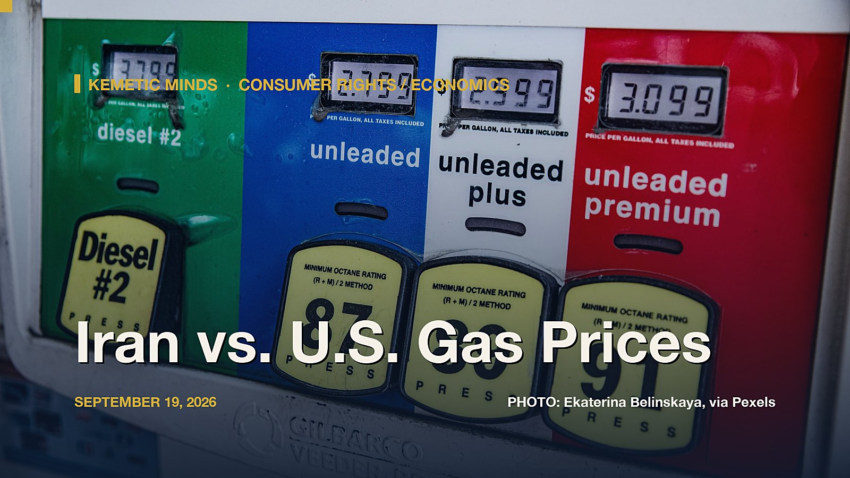
Economics · Consumer Rights · September 19, 2026
An American driver paying today’s U.S. national average of $4.48 a gallon is paying somewhere between roughly 27 and 180 times more per gallon than an Iranian driver pays for gasoline within Iran’s government fuel quota — the exact multiple depends entirely on which of Iran’s three price tiers, and which of its two wildly different currency exchange rates, you use. Iran doesn’t publish one simple, transparent price the way AAA or a station sign does, so getting a real number takes triangulating multiple independent sources across several countries. Below is that math, shown fully, plus a calculator so you can run your own numbers instead of taking any single outlet’s word for it.
Key Facts
- U.S. national average, regular gasoline, today: $4.4759/gallon ($1.18/liter).[1]
- Iran’s gasoline is rationed into three price tiers: 15,000 rials/liter for the first 60 liters/month, 30,000 rials/liter for the next 50 liters, and 100,000 rials/liter beyond that — the last tier doubled from 50,000 rials on September 8, 2026.[2]
- Iran’s rial trades at two very different rates: an official rate of roughly 1.6 million rials per dollar, and a free-market rate ordinary transactions actually use of roughly 2.3 million rials per dollar — the rial has lost about 60% of its value against the dollar since March 2026 alone.[3][4]
- At today’s live free-market rate, Iran’s base tier works out to about $0.0065/liter (0.65 cents) — independent of which source’s dollar estimate you start from, the tiered-rial math lands in the same place.[4][2]
The Story So Far
On September 8, 2026, Iran’s government doubled the price of gasoline purchased beyond the monthly subsidized quota, from 50,000 to 100,000 rials per liter — the second increase since December 2025.[2] Parliamentary speaker Mohammad Bagher Ghalibaf framed it as a supply problem, not just a budget one: “If we consume it properly, we can manage with the amount of gasoline we produce in the country.”[5] Videos circulating on social media showed long queues forming at Tehran petrol stations within hours of the announcement, and the government is visibly aware of the political risk: a 2019 gasoline price hike triggered nationwide antigovernment protests.[5]
Iran is dealing with sanctions, a U.S. naval blockade imposed in July 2026, and reduced oil revenue and production — all of which are squeezing the state budget that funds the fuel subsidy in the first place, even as the rial’s collapse in the free market makes the subsidized price look more extreme in dollar terms every week.[3] Notably, Iran’s own subsidy crunch and the U.S. retail price above both trace back to the same global commodity: crude oil. The U.S. Energy Information Administration’s own benchmark, West Texas Intermediate crude, settled at $107.02/barrel on September 15, 2026[8] — Iran is a crude producer squeezed by sanctions on exporting it, while the U.S. price above reflects a market where crude is freely traded and taxed, not subsidized.
Why Iran Doesn’t Have “One Price” — And Why That Makes Sourcing Harder
Two independent international price-tracking sites, pulling from different methodologies, illustrate exactly why a single quoted number is misleading. Trading Economics, sourcing from Iran’s National Iranian Oil Products Distribution Company (NIOPDC) and using an official-adjacent conversion, listed Iran’s gasoline price at $0.36/liter for August 2026 — before the September 8 hike.[6] GlobalPetrolPrices.com, converting the same rial figures at the free-market rate instead, listed $0.029/liter as of September 14, 2026 — more than 12 times lower for what is nominally the same commodity.[7] Neither site is wrong; they’re answering different questions (“what does the government say gasoline costs” versus “what would it cost you if you actually had to buy dollars with rials on the street”).
“[GlobalPetrolPrices.com uses] the market exchange rate… its actual use in the economy is limited [for the official rate].”[7]
That single methodological choice — which exchange rate to apply — is the entire reason estimates of “Iran’s gas price in dollars” swing by an order of magnitude across different outlets. It is not a sign that any one source is fabricating numbers.
The Real Math, Shown in Full
| Tier / country | Local price | Exchange rate used | USD per liter | USD per gallon |
|---|---|---|---|---|
| Iran — Tier 1 (first 60 L/month) | 15,000 IRR/L | 2,307,000 IRR/$1 (free market, live)[4] | $0.0065 | $0.0246 |
| Iran — Tier 2 (next 50 L/month) | 30,000 IRR/L | 2,307,000 IRR/$1 | $0.0130 | $0.0492 |
| Iran — Tier 3 (beyond quota) | 100,000 IRR/L | 2,307,000 IRR/$1 | $0.0434 | $0.1642 |
| Iran — Tier 1, at the official rate | 15,000 IRR/L | 1,624,371 IRR/$1 (official, Sept. 9)[3] | $0.0092 | $0.0350 |
| United States — national average, regular | — | — | $1.1826 | $4.4759 |
U.S. price: AAA Daily Fuel Gauge Report, today.[1] Iran tier structure: Iran International.[2] Free-market rate: live rate as of today, via pashizi.com’s Iranian free-market currency tracker.[4] Official rate: reported by Euronews, September 9, 2026.[3]
However you slice it, U.S. regular gasoline costs roughly 27 times more per liter than Iran’s uncapped, non-quota tier (100,000 IRR), and roughly 180 times more than Iran’s base subsidized tier (15,000 IRR) at today’s free-market rate. Even using Iran’s officially stronger, state-pegged exchange rate — which most ordinary Iranians cannot actually access for real transactions — the base tier is still about 128 times cheaper than U.S. gas.
Do the Math With Your Own Numbers
Don’t take the table above on faith — the calculator below runs the same arithmetic live, so you can plug in your own local gas price, a different exchange rate, or check today’s numbers again next week when they’ve changed.
INTERACTIVE
At this rate, that Iran tier works out to $0.0065/liter ($0.0246/gallon-equivalent).
Your price of $4.4759/gallon is 181.8x more per liter than that Iran tier.
Filling a 12-gallon tank: $53.71 at your price vs. the dollar-equivalent of $0.30 at that Iran tier.
For what you pay for ONE gallon at your price, an Iranian driver at that tier could buy about 688 liters (181.8 gallons’ worth).
What’s Disputed or Unconfirmed
Iran does not publish a single official retail price the way AAA or the EIA do, and its subsidy math is politically sensitive, so every dollar-denominated figure in this article — including the ones in the calculator above — depends on which exchange rate is applied, and exchange-rate-tracking sites for Iran’s free market (which the government does not officially sanction) can differ from each other by a few percent hour to hour. The 27x/180x headline comparison is directionally robust across every source checked here, but treat the second decimal place of any dollar-per-liter figure as an estimate, not a government-audited statistic. Iran’s own official inflation and subsidy accounting is not independently verifiable from outside the country given current press restrictions.
How to Verify This Yourself
- AAA’s live national and state-by-state U.S. prices: gasprices.aaa.com.
- Iran’s live free-market rial exchange rate: pashizi.com or bonbast.com.
- Global gasoline price comparisons across many countries at once: globalpetrolprices.com and tradingeconomics.com.
- Ongoing reporting on Iran’s fuel-subsidy policy: Iran International and Al Jazeera’s Iran coverage.
What You Can Do Right Now
- Use the calculator above with this week’s numbers again next month — both the rial’s exchange rate and Iran’s tier pricing have changed twice since December 2025 and are likely to change again.
- When you see a single “Iran gas costs $X” headline anywhere, check which exchange rate it assumes before treating it as comparable to a U.S. price quoted at the real market rate you actually pay.
- If you’re budgeting around your own fuel costs, fueleconomy.gov’s real driving-habit data (see this site’s Daily Fuel Price Watch coverage) has verified, cited ways to reduce consumption regardless of what the price itself does.
Kemetic Minds Analysis
The headline “Iran’s gas is basically free” and the headline “Iran’s gas costs $0.36/liter, barely below the global norm” are both technically sourced from real data — which is exactly the problem with reporting a single number out of context. The 12x gap between Trading Economics’ and GlobalPetrolPrices’ figures isn’t a factual dispute about the price of gasoline; it’s a dispute about which of Iran’s two currencies you’re allowed to actually use, and only one of them (the free-market rate) reflects what an ordinary Iranian household can actually convert their earnings into. That is itself the more important story here: a fuel subsidy priced in a currency most citizens can’t access at its official value tells you less about affordability than it first appears to.
None of that changes the basic shape of the comparison. Even granting Iran’s government the most favorable, least-realistic exchange rate available, a U.S. driver is still paying well over a hundred times more per liter for the same commodity. What the multiple exchange-rate math actually shows is that the size of that gap is somewhat uncertain — the fact of the gap is not.
References
- AAA. (2026, September 19). Daily Fuel Gauge Report [Primary]. gasprices.aaa.com. ↩
- Iran International. (2026, September 8). Iran’s gasoline price hike may add to revenues, but can it ease fuel shortage? [Secondary]. iranintl.com. ↩
- Euronews. (2026, September 2). Iranian rial in freefall as dollar breaks 2.1 million mark [Secondary]. euronews.com. ↩
- Pashizi. (2026, September 19). USD to IRR — live free-market rate [Tertiary, live data aggregator]. pashizi.com. ↩
- Al Jazeera. (2026, September 8). As fuel prices rise again, Iran’s government urges citizens to cut back [Secondary]. aljazeera.com. ↩
- Trading Economics. (2026, August). Iran Gasoline Prices, sourced from Iran’s National Iranian Oil Products Distribution Company [Tertiary, data aggregator]. tradingeconomics.com. ↩
- GlobalPetrolPrices.com. (2026, September 14). Iran Gasoline prices, liter [Tertiary, data aggregator]. globalpetrolprices.com. ↩
- U.S. Energy Information Administration. (2026, September 15). Cushing, OK WTI Spot Price FOB [Data set; Primary]. eia.gov — primary source. ↩
Related Reading
- Background on Iran’s earlier gasoline-rationing crises, for historical context on how far back this subsidy system goes.
- This site’s Daily Fuel Price Watch coverage for ongoing U.S. price tracking, three times a day.
- GlobalPetrolPrices.com’s full country ranking to see how both the U.S. and Iran compare to everywhere else.
Investigative methodology: the U.S. price is read directly from AAA’s published national table on the day of publication. Iran’s rial-denominated tier prices are drawn from Iran International’s reporting on the September 8, 2026 policy change; every dollar conversion in this article is computed directly from those rial figures using an exchange rate that is itself cited (either the live free-market rate or the officially reported state rate), not taken as a pre-converted dollar figure from any single aggregator, specifically because those aggregators were found to disagree with each other by more than 10x depending on their own methodology. The calculator performs the identical arithmetic client-side and is not connected to any live pricing feed — its default values are today’s figures, but it will not update itself after publication, which is why every input is editable.

Kemetic Minds Editorial Desk
Verified NewsroomPrimary-sourced investigative intelligence on civil rights, voting rights, federal policy, and consumer protection. Sourced from primary legal filings, government statistics, and direct field reporting.