
KEMETIC MINDS
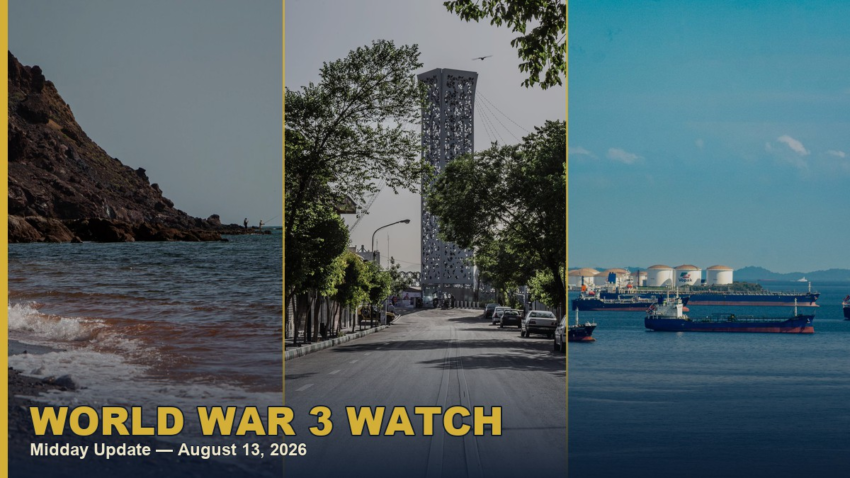
World War 3 Watch — Midday Update — August 13, 2026
- Iran’s Basij chief Hossein Taeb declared the Strait of Hormuz “under Iran’s control and management” on Thursday, one day after President Trump claimed U.S. “total control” and wrote “I THINK WE WILL KEEP IT” (Yahoo News, 2026; CBS News, 2026).
- Iran’s Khatam al-Anbiya command calls U.S. transit claims “nothing more than lies and falsehoods,” and Iran’s Persian Gulf Strait Authority says the strait stays closed until Tehran’s conditions are met (Yahoo News, 2026; China News Service, 2026, authors’ translation).
- Tehran’s reopening conditions: an end to the war and blockade, release of Iran’s frozen assets, and a regional ceasefire covering Lebanon and Gaza, plus compensation for war-related damage and sanctions losses (Times of India, 2026).
- The first U.S. blockade cost Iran about $4.8 billion in oil revenue, while the world rapidly burns through oil stockpiles with no end to the deadlock in sight (MSN, 2026; CNN, 2026).
- Salvage crews boarded the grounded Russian tanker Caroline Bezengi off Oman as its oil spread hundreds of square kilometers toward a marine protected area (CBS News, 2026).
- China completed a rare joint live-force drill with Indonesia east of Taiwan — an exercise Jakarta insists was a non-combat “Passing Exercise” (DW, 2026, authors’ translation).
The Story So Far
The war that began with U.S.-Israeli strikes on Iran on February 28 has narrowed to a single question: who actually controls the Strait of Hormuz (Yahoo News, 2026)?
On Thursday, both capitals answered at once — Trump claimed “total control” and said he might “keep it,” while Tehran’s Basij chief declared the strait “under Iran’s control and management” (CBS News, 2026; Yahoo News, 2026).
Behind the rhetoric, the costs are compounding: billions in lost Iranian oil revenue, draining global stockpiles, and an oil slick creeping toward Omani waters (MSN, 2026; CNN, 2026; CBS News, 2026).
And in the Pacific theater, China finished a rare joint exercise with Indonesia east of Taiwan, drawing condemnation from Taipei and a warning from Washington (DW, 2026, authors’ translation).
Each side’s press is telling a different war — this roundup reads them side by side.
Video: ‘Unconscionable’: Trump uses press and his own staff as decoys amid Iran threat. Source: MS NOW.
1. Hormuz: Two ‘Total Controls,’ One Strait
The rhetorical duel escalated Wednesday night when Trump wrote on Truth Social: “I THINK WE WILL KEEP IT” (CBS News, 2026).
Hossein Taeb, the newly appointed head of Iran’s Basij paramilitary unit, countered that the United States had launched another war in the strait and been defeated (Yahoo News, 2026).
Taeb answered directly: “Today you see that the Strait of Hormuz is under the management and control of the Islamic Republic” (Yahoo News, 2026).
Iran’s joint military command, Khatam al-Anbiya Central Headquarters, called U.S. claims of normal passage “nothing more than lies and falsehoods” — no vessel can transit without Tehran’s permission (Yahoo News, 2026).
Beijing’s China News Service relays the same message without hedging: the strait “remains closed,” and U.S. officials repeating otherwise “cannot change the facts” (China News Service, 2026, authors’ translation).
Chinese financial media add a market-facing detail — strait transit volume has fallen to a three-month low (East Money, 2026, authors’ translation).
Mohsen Rezaei, Iran’s newly appointed Supreme National Security Council chief, has spelled out the reopening conditions (Times of India, 2026).
Tehran wants an end to the war and blockade, release of its frozen assets, and a region-wide ceasefire covering Lebanon and Gaza (Times of India, 2026).
Iran has also reportedly sought compensation for war-related damage and losses linked to sanctions (Times of India, 2026).
Video: US IRAN WAR UPDATES LIVE: US, Tehran Exchange Opposing Claims Amid Talks | Trump Claims Hormuz. Source: Firstpost.
2. The Blockade’s Bill: Oil, Transits, and a Spreading Spill
The numbers behind the rhetoric are stark. A Pentagon assessment puts Iran’s lost oil revenue from the first U.S. blockade at about $4.8 billion (MSN, 2026).
With the deadlock unresolved, CNN reports the world is rapidly burning through oil stockpiles with no end in sight (CNN, 2026).
Before the war, a fifth of the world’s oil and liquefied natural gas passed through the strait; Tehran effectively shut it after the February 28 strikes (Yahoo News, 2026).
U.S. Central Command says its blockade forces have redirected 59 commercial vessels, disabled three, and boarded two (Times of India, 2026).
The June interim ceasefire — which promised a permanent truce and a swift return to freedom of navigation — unravelled within weeks (Yahoo News, 2026).
Iran resumed limited attacks on vessels it said were sailing contrary to the deal, and U.S. strikes on Iran’s southern provinces restarted (Yahoo News, 2026).
Now the environment is a second battlefield. Iran has demanded compensation for oil pollution washing up on Qeshm Island, pointing at a foreign bulk carrier as the source (CBS News, 2026).
Iranian official Baqaei cited the pollution and argued those benefiting from commercial shipping should share responsibility (Times of India, 2026).
Farther east, British firm Ambrey has boarded the grounded Russian shadow-fleet tanker Caroline Bezengi off Oman, with help from the Omani air force (CBS News, 2026).
Satellite images show its oil spreading over hundreds of square kilometers toward a marine protected area (CBS News, 2026). The tanker, grounded after an early-June explosion, holds more than 800,000 barrels (CBS News, 2026).
Ambrey’s Ed Wollaston describes “an extremely challenging situation, compounded by adverse weather conditions associated with the Khareef monsoon” (CBS News, 2026).
Video: LIVE: Strait of Hormuz vessel traffic as Iran, US make competing claims over control. Source: Reuters.
3. A Missile Plot, a Red Sea Attack, and a Gaza Strike
The war has reached for the president himself.
CBS News has learned the context for last month’s elaborate ruse — Trump secretly leaving Air Force One via a catering truck (CBS News, 2026).
It came within a day of U.S. and Turkish intelligence detecting an Iranian plot to fire a missile at the presidential jet (CBS News, 2026).
Tehran, meanwhile, vows to prolong the war until Trump leaves office (MSN, 2026).
The conflict is spreading to other chokepoints. A Houthi attack on a ship in the Red Sea killed six people, including three Pakistanis (Times of India, 2026).
Pakistan, which lost citizens in that attack, is now trying to revive negotiations between Iran and the United States (Times of India, 2026).
A Pentagon review adds a grim accounting: three U.S. strikes on Houthi targets in Yemen in April 2025 killed 153 civilians and injured 243 (Times of India, 2026).
In Gaza, Israel carried out a targeted drone strike against a suspected Hamas commander, despite calls to halt such attacks (Times of India, 2026).
4. China-Taiwan Flashpoint: A Rare Drill East of Taiwan
While the Gulf commands the headlines, the parallel China-Taiwan flashpoint moved this week.
On Tuesday, China’s Defense Ministry, via state news agency Xinhua, said the 054A frigate Honghe would exercise with Indonesia’s frigate Lai in waters east of Taiwan in mid-August — without publishing dates, coordinates, or routes (DW, 2026, authors’ translation).
A day later, the PLA Eastern Theater Command announced the exercise had concluded that morning, saying it “successfully completed all scheduled subjects,” from maritime communications and formation linkage to replenishment and a departure ceremony (DW, 2026, authors’ translation).
Indonesia insists the exercise was not what it looked like: navy spokesperson Tunggul called it a “Passing Exercise” (Passex), a customary, non-combat goodwill gesture between navies passing through shared waters, consistent with Jakarta’s independent foreign policy (DW, 2026, authors’ translation).
Indonesia’s account adds context missing from Western framing: its ship was returning from an exercise in Russia’s Vladivostok (DW, 2026, authors’ translation).
Taipei is not buying it. Taiwan’s Mainland Affairs Council condemned the drill as “military provocation” — “fake exercise, real expansion” — and Taiwan’s foreign ministry called it malicious unilateral conduct (DW, 2026, authors’ translation).
Washington urged Beijing to stop military pressure on Taiwan and engage in meaningful dialogue, while calling on other countries to encourage peace rather than “amplifying Beijing’s destabilizing rhetoric” (DW, 2026, authors’ translation).
Reuters, cited in the DW report, notes how unusual this is: China rarely stages exercises with foreign navies around Taiwan (DW, 2026, authors’ translation).
The drill overlapped with U.S. Under Secretary for Policy Elbridge Colby’s visit to Jakarta, where Indonesia’s defense minister said expanding cooperation with Washington does not mean hosting U.S. bases (DW, 2026, authors’ translation).
5. Two Language Universes, Two Different Wars
Read today’s English and Chinese coverage side by side and they describe two different realities.
English-language outlets frame the story as a competition: Trump’s “WALL OF STEEL” blockade versus Tehran’s “control and management” (Times of India, 2026; Yahoo News, 2026).
Chinese-language headlines are categorical — “Trump claims control of Hormuz, Iran firmly denies” and “Strait of Hormuz remains closed” (East Money, 2026, authors’ translation; China News Service, 2026, authors’ translation).
Where U.S. media report the blockade as enforcement success, Chinese media report the counter-blockade’s measurable cost: transit volume at a three-month low (East Money, 2026, authors’ translation).
One Chinese analysis goes further, arguing the struggle over temporary control may escalate into a blockade-and-counter-blockade fight over jurisdiction — and ultimately pricing power (Wyzxwk, 2026, authors’ translation).
The China-Indonesia exercise is a mirror image: Chinese-language outlets give it prominent coverage, while the English wires focus almost entirely on Hormuz (DW, 2026, authors’ translation; IDN Financials, 2026, authors’ translation).
We mapped these divergent tellings earlier in our narrative-comparison report on how US, Israeli, Iranian, and BRICS media each tell this war.
Is This Actually World War 3?
Honest answer from today’s sources: not yet — but the definition keeps bending.
The U.S.-Iran war is real, regional, and expensive: an alleged missile plot against the president’s plane, a naval blockade and counter-blockade, and a vow from Tehran to fight until Trump leaves office (CBS News, 2026; MSN, 2026).
The China-Taiwan flashpoint is escalating in parallel, with Beijing normalizing foreign-navy exercises east of Taiwan — a step Reuters flags as rare (DW, 2026, authors’ translation).
But nothing in today’s sources shows direct U.S.-China combat, and the U.S.-Iran fight remains confined to the Gulf and its maritime approaches.
What pushes this closer to a great-power war is the oil math: with stockpiles draining and no end to the Hormuz deadlock, the pressure for direct intervention only rises (CNN, 2026).
For now, call it a multi-front regional war with great-power shadows — and watch the oil numbers, not the rhetoric.
What You Can Do Right Now
- Map your fuel and supply exposure now: global oil stockpiles are draining fast and the Hormuz deadlock shows no end in sight (CNN, 2026).
- Read both language universes before judging the war: U.S. outlets report blockade enforcement, Chinese outlets report transit-volume drops and closed-strait declarations — each omits much of what the other emphasizes (East Money, 2026, authors’ translation; Yahoo News, 2026).
- Assume the crisis is long, not short: the June ceasefire already collapsed once, Iran says the strait stays shut until Tehran’s conditions are met, and Tehran vows to fight until Trump is out of office (Yahoo News, 2026; China News Service, 2026, authors’ translation; MSN, 2026). For practical steps, see our survival skills and preparedness guide.
SUPPORT KEMETIC MINDS
Enjoying this coverage? Back the work and find every way to connect with us in one place.
Support the Page →Kemetic Minds Analysis
This roundup pulled directly from the day’s English- and Chinese-language wires side by side, because the gap between what each side chooses to report is often as informative as any single strike count. Treat the Key Takeaways above as the verified factual floor, and the framing differences noted in the sections above as the more interesting, harder-to-fake signal about where this war is actually headed next.
References
- Yahoo. (2026, August 13). Iran, US make competing claims over control of Strait of Hormuz. yahoo.com
- Cbsnews. (2026, August 13). Live Updates: Tehran says Strait of Hormuz "under Iran's control" after Trump threatens U.S. might "keep it". cbsnews.com
- Times of India. (2026, August 13). US Iran War News Live Updates: 'No ship can safely pass without Iran's approval': IRGC issues Hormuz warning. timesofindia.indiatimes.com
- MSN. (2026, August 13). Iran updates: Tehran vows to prolong war until Trump is out of office. msn.com
- CNN. (2026, August 13). World rapidly burns through oil stockpiles with no end in sight to Hormuz deadlock. cnn.com
- 东方财富. (2026, August 13). 特朗普声称掌控霍尔木兹、伊朗坚决否认 海峡通行量跌至三个月最低 [Trump claims control of the Strait of Hormuz, Iran strongly denies it, as traffic through the waterway hits a three-month low]. wap.eastmoney.com
- chinanews.com.cn. (2026, August 12). 伊朗“波斯湾海峡管理局”:霍尔木兹海峡仍关闭 [Iran's "Persian Gulf Strait Management Bureau" says the Strait of Hormuz remains closed]. chinanews.com.cn
- wyzxwk.com. (2026, August 13). 伊朗战争发展到美伊争夺霍尔木兹海峡暂时控制权或许发展为管辖权(定价权)的封锁与反封锁博弈 [The Iran war escalates into a US-Iran contest for temporary control of the Strait of Hormuz, potentially becoming a blockade-and-counter-blockade struggle over jurisdiction (pricing power).]. wyzxwk.com
- DW.com. (2026, August 13). 中国称完成联合实兵演练 印尼海军:非作战性质 [China completes joint live-fire drill, Indonesian Navy says exercise was non-combat in nature]. dw.com
- idnfinancials.com. (2026, August 13). 印度尼西亚称与中国的军事演习并非战争演习 [Indonesia says military exercises with China are not war drills]. idnfinancials.com
Investigative Methodology: This roundup is generated on a fixed schedule (noon and evening, America/Chicago) from live English- and Chinese-language wire sources. Every claim is grounded in fetched source text with an APA7 in-text citation; translated Chinese-language quotes are marked “authors’ translation.” Every video embed is verified to be a real, existing video via YouTube’s oEmbed endpoint before publication — none are written by the drafting model. No Wikipedia sources are used.
Stay Connected

Kemetic Minds Editorial Desk
Verified NewsroomPrimary-sourced investigative intelligence on civil rights, voting rights, federal policy, and consumer protection. Sourced from primary legal filings, government statistics, and direct field reporting.