
KEMETIC MINDS
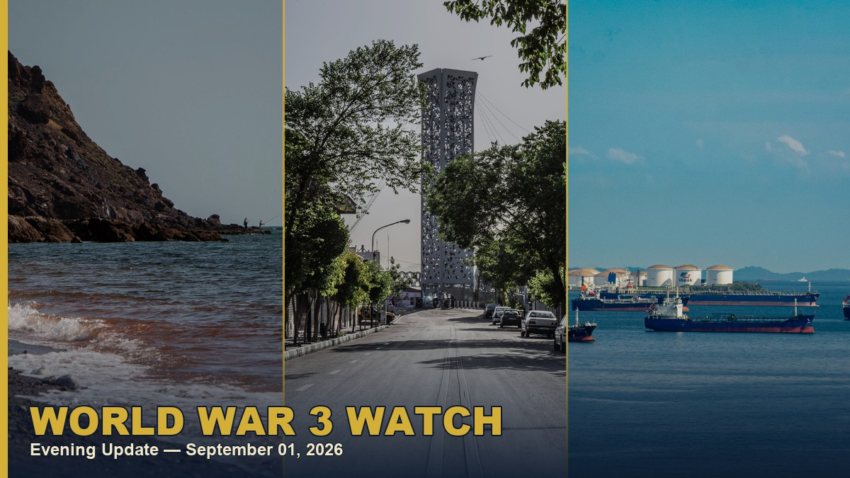
World War 3 Watch — Evening Update — September 01, 2026
- The U.S. and Iran traded a second round of strikes in three days, with Washington hitting IRGC sites and Tehran claiming a heavy missile strike on a U.S. Marines barracks in Jordan (Yahoo News, 2026; Al Jazeera, 2026).
- Jordan’s military intercepted 10 of 13 Iranian missiles; three fell in open areas, and no injuries were recorded (Al Jazeera, 2026).
- Strait of Hormuz shipping traffic fell by half on Monday after tanker attacks, and Iran vows to block U.S. rerouting through the strait’s southern lane (VOA Chinese, 2026, authors’ translation; CCTV, 2026, authors’ translation).
- Trump threatens a “much harder and higher level” response, with a larger attack “waiting in the wings” — and Tehran is readying a reply “several times larger” (Yahoo News, 2026).
- Chinese-language coverage alone reports an Iranian shootdown of a U.S. drone and Israel’s claim of control over the head of Hamas’s security agency (Voc.com.cn, 2026, authors’ translation).
- Qatar says efforts to end the war and reopen the Strait of Hormuz are under way (Al Jazeera, 2026).
The Story So Far
The United States and Iran traded a second round of strikes in three days on Tuesday, and the battlefield is widening faster than the diplomacy (chinanews.com.cn, 2026, authors’ translation; Yahoo News, 2026).
Washington bombed Islamic Revolutionary Guard Corps targets inside Iran, and Tehran answered with ballistic missiles aimed at a U.S. Marines base in Jordan plus drones targeting Kuwait and Bahrain (MSN, 2026; Al Jazeera, 2026).
The fight pivots on the Strait of Hormuz, where tanker attacks cut shipping traffic by half on Monday and commercial traffic remains far below normal (VOA Chinese, 2026, authors’ translation; MSN, 2026).
Both capitals are promising more: Trump warns of a “much harder and higher level” response, while Tehran pledges retaliation “several times larger” (Yahoo News, 2026).
Chinese-language coverage of the same hours adds a downed U.S. drone, an Israel-Hamas field claim, and Xi’s regional diplomacy — one frame, several wars (Voc.com.cn, 2026, authors’ translation; Al Jazeera, 2026).
Video: Trump vows to hit Iran ‘hard’ despite US military war warning | Iran: the Latest news. Source: The Telegraph.
1. Washington and Tehran Trade Missiles and Ultimatums
The day opened with U.S. Central Command striking Islamic Revolutionary Guard Corps sites inside Iran (Yahoo News, 2026). CENTCOM said the raids followed “attempted attacks by the IRGC against commercial shipping in the Strait of Hormuz and against American service members deployed to the region” (Al Jazeera, 2026).
Washington did not say exactly what it was trying to destroy, only that the attacks were aimed at the IRGC (The New York Times, 2026). Iran’s semiofficial Tasnim news agency reported explosions in the south, including in Konarak (Al Jazeera, 2026).
Iran’s answer was fast and public. The IRGC Aerospace Force said it launched a heavy ballistic missile attack on a U.S. Marines barracks in Jordan, known as Camp Titin, claiming hits on troops, installations, and an attack helicopter (Al Jazeera, 2026). The IRGC said it struck in response to a U.S. attack on a wedding in the southern city of Sirik that, it says, killed several people including a child (Al Jazeera, 2026).
Jordan’s military gave a far cooler accounting: it intercepted 10 of 13 Iranian missiles, the remaining three fell in open areas, and no injuries were recorded (Al Jazeera, 2026).
President Donald Trump warned that if Iran retaliated it would “be hit again at a much harder and higher level,” with an even larger American attack “waiting in the wings” (Al Jazeera, 2026; Yahoo News, 2026). IRGC spokesman Ebrahim Zolfaghari said Iran’s response had begun and that Tehran would no longer exercise restraint toward U.S. interests and forces (Yahoo News, 2026). Iranian media report a response “several times larger” than the latest U.S. strikes is in preparation (Yahoo News, 2026).
Video: Trump Dismisses ‘Little War’ With Iran, Global Bond Selloff Returns | The Opening Trade 9/1/2026. Source: Bloomberg Television.
2. The Strait of Hormuz Becomes the Battleground
The exchange is anchored to the Strait of Hormuz, one of the world’s most important energy chokepoints (Yahoo News, 2026). Tanker attacks on Monday cut the strait’s shipping traffic by half, and commercial traffic remains far below normal (VOA Chinese, 2026, authors’ translation; MSN, 2026).
Iran is pressing that advantage. Tehran says it will not allow U.S. attempts to move vessels through the strait’s southern lane, and it threatens to hinder oil exports if American aggression continues (CCTV, 2026, authors’ translation; MSN, 2026).
Those threats have raised concern about oil-supply disruptions from the Gulf (MSN, 2026). CNBC reported that the latest U.S. strikes followed new Iranian attacks in the waterway (Yahoo News, 2026).
Diplomacy is running far behind the violence. Qatar says efforts are under way to end the Iran-U.S. war and reopen the Strait of Hormuz (Al Jazeera, 2026).
Video: U.S. launches new strikes against Iran, CENTCOM says. Source: CBS News.
3. The Regional Front Widens: Russia, Israel, and China
By Tuesday evening, the U.S.-Iran exchange was no longer the only thread in the wire copy. Chinese-language coverage of the same day pairs the Gulf fight with an Israeli field report: Israel says it controls the head of Hamas’s security agency, while Iran claims to have shot down a U.S. drone (Voc.com.cn, 2026, authors’ translation).
Great-power alignments are hardening around the edges of the conflict. Iran and Russia have vowed to stand together against U.S. “unilateralism,” according to Al Jazeera’s related coverage of the war (Al Jazeera, 2026).
China is moving too, though with delegations rather than ordnance. Xi Jinping is making his first visit to Egypt in a decade amid the regional turmoil (Al Jazeera, 2026).
4. Two Media Lenses on the Same War
Read the English and Chinese-language coverage side by side and you get two different wars. The English set lingers on strike mechanics — CENTCOM’s targets, Jordan’s intercepts, Trump’s red lines — while the Chinese set leads with logistics and the widening cast (Al Jazeera, 2026; Yahoo News, 2026; chinanews.com.cn, 2026, authors’ translation).
VOA’s Chinese service alone reports that Hormuz shipping halved on Monday, and CCTV alone reports Iran’s refusal to let U.S. vessels use the strait’s southern lane (VOA Chinese, 2026, authors’ translation; CCTV, 2026, authors’ translation). The Sirik wedding claim and Jordan’s precise 10-of-13 intercept count appear only in the English set (Al Jazeera, 2026).
The drone shootdown and Israel’s claim over the Hamas security chief appear only in Chinese-language wires (Voc.com.cn, 2026, authors’ translation). Even the escalation framing differs: Sina Finance headlines “U.S.-Iran conflict escalates again,” while chinanews.com.cn warns of a U.S. “ultimate strike” poised to launch (Sina Finance, 2026, authors’ translation; chinanews.com.cn, 2026, authors’ translation).
For a deeper read on how each capital tells this war, see our narrative-comparison report on how US, Israeli, Iranian, and BRICS media each tell this war.
Is This Actually World War 3?
Not yet. Today’s sources describe a regional war between two states, the United States and Iran, with allies still posturing rather than fighting (Yahoo News, 2026).
The tripwires are real, though. The Strait of Hormuz is one of the world’s most important energy chokepoints, its traffic has already halved, and Tehran threatens to hinder exports (Yahoo News, 2026; VOA Chinese, 2026, authors’ translation; MSN, 2026).
Russia has vowed to stand with Iran against U.S. “unilateralism,” and China’s president is touring Egypt as the strikes land (Al Jazeera, 2026). Those are the alignments that could pull a regional war into a great-power one.
This series also tracks the China-Taiwan flashpoint. None of today’s sources report fresh movement on that axis, and we won’t invent any — but the silence itself is a signal, with Beijing’s press fixed on the Gulf and the Israel-Hamas thread (Voc.com.cn, 2026, authors’ translation).
What You Can Do Right Now
- If you live in or travel through the Gulf, Jordan, Kuwait, or Bahrain, review evacuation and communication plans tonight — missiles reached Jordan and drones targeted Kuwait and Bahrain in this cycle (Al Jazeera, 2026; MSN, 2026).
- Expect oil-price and supply-chain volatility in the weeks ahead; Hormuz traffic has halved and Iran threatens to hinder exports (VOA Chinese, 2026, authors’ translation; MSN, 2026).
- Build practical resilience with our survival skills and preparedness guide — a fight over the world’s key energy chokepoint is exactly the scenario it is built for.
SUPPORT KEMETIC MINDS
Enjoying this coverage? Back the work and find every way to connect with us in one place.
Support the Page →Kemetic Minds Analysis
This roundup pulled directly from the day’s English- and Chinese-language wires side by side, because the gap between what each side chooses to report is often as informative as any single strike count. Treat the Key Takeaways above as the verified factual floor, and the framing differences noted in the sections above as the more interesting, harder-to-fake signal about where this war is actually headed next.
References
- MSN. (2026, September 1). Iran fires missiles at US forces in Jordan, drones target Kuwait and Bahrain as war escalates. msn.com
- MSN. (2026, September 1). US strikes Iran again as Hormuz battle puts oil traffic and American forces at risk. msn.com
- Yahoo. (2026, September 1). US, Iran Trade Strikes as Risk of Wider War Grows. yahoo.com
- The New York Times. (2026, September 1). U.S. Launches Intense New Wave of Attacks in Iran. nytimes.com
- MSN. (2026, September 1). US launches more strikes on Iran as state media reports explosions. msn.com
- Al Jazeera. (2026, September 1). Iran says it responded with missiles to US attack despite Trump’s threats. aljazeera.com
- 美国之音. (2026, September 1). 油轮遭遇袭击,霍尔木兹海峡航运量星期一减少一半 [Oil Tanker Attack Halves Strait of Hormuz Shipping Monday]. voachinese.com
- 央视网. (2026, September 1). 伊朗:不允许美国让船只从霍尔木兹海峡南线通过的企图 [Iran: We Will Not Allow US Attempts to Route Ships Through the Southern Passage of the Strait of Hormuz]. news.cctv.com
- chinanews.com.cn. (2026, September 1). 三天内第二轮袭击 特朗普威胁伊朗终极打击蓄势待发 伊方誓言报复 [Second round of strikes in three days: Trump threatens ultimate blow against Iran as Tehran vows retaliation]. chinanews.com.cn
- 华声在线. (2026, September 1). 美持续打击 伊击落美军无人机 以称控制哈马斯安全机构负责人 [US presses strikes as Iran downs US drone; Israel says it detained Hamas security chief.]. m.voc.com.cn
- finance.sina.com.cn. (2026, September 1). 美伊冲突再升级:美军空袭伊朗,伊朗誓言导弹无人机报复 [US-Iran conflict escalates: US carries out airstrikes on Iran, Iran vows missile and drone retaliation]. finance.sina.com.cn
Investigative Methodology: This roundup is generated on a fixed schedule (noon and evening, America/Chicago) from live English- and Chinese-language wire sources. Every claim is grounded in fetched source text with an APA7 in-text citation; translated Chinese-language quotes are marked “authors’ translation.” Every video embed is verified to be a real, existing video via YouTube’s oEmbed endpoint before publication — none are written by the drafting model. No Wikipedia sources are used.
Stay Connected

Kemetic Minds Editorial Desk
Verified NewsroomPrimary-sourced investigative intelligence on civil rights, voting rights, federal policy, and consumer protection. Sourced from primary legal filings, government statistics, and direct field reporting.