
KEMETIC MINDS
Food & Self-Sufficiency | Week of July 20, 2026
Grocery prices are up 3.0% year over year and a Cyclospora outbreak tied to iceberg lettuce has now sickened nearly 2,000 people across nine states. At the same time, over 43% of American households are now growing at least some of their own food, up sharply from just a few years ago, with the average home garden producing roughly $600 worth of food a year. This week’s roundup: what’s happening in food news right now, what the CDC’s actual foodborne-illness numbers say, and a practical, no-fluff guide to starting your own food garden — why the seed you pick matters as much as the soil you plant it in.
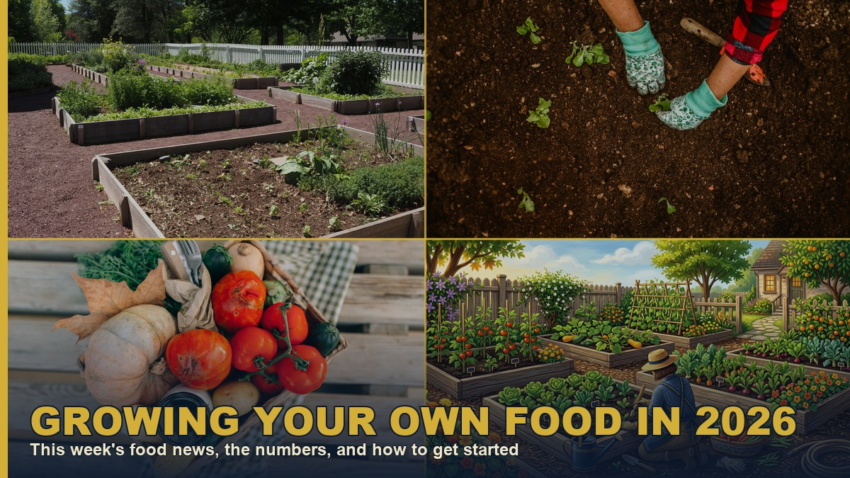
Photo by Gene Samit via Pexels · Photo by Helena Lopes via Pexels · Photo by Nataliya Vaitkevich via Pexels · AI image generated with Google Gemini
This Week in Food News
- Grocery prices keep climbing. The all-food CPI rose 0.2% from May to June 2026 and is now 3.0% higher than a year ago; food-at-home prices are up 2.7% year over year[1]. USDA’s own outlook expects beef, pork, and several other categories to keep climbing through the rest of 2026[2].
- Cattle trade is reopening. USDA is set to reopen the Douglas, Arizona port of entry to restart U.S.-Mexico cattle trade after more than a year of closures driven by the New World screwworm[1] — a sign of continued pressure on the beef supply chain that’s been feeding into those higher prices.
- An active multistate outbreak. The CDC and FDA are investigating a Cyclospora outbreak linked to iceberg lettuce from Taylor Farms de Mexico, now up to 1,947 illnesses and at least 98 hospitalizations across nine states (Illinois, Indiana, Kansas, Kentucky, Michigan, Ohio, Oklahoma, Pennsylvania, and West Virginia)[3][4]. Taylor Farms de Mexico recalled all iceberg lettuce sourced from central Mexico on July 17, 2026.
The Foodborne Illness Numbers You Should Know
The lettuce outbreak above isn’t an outlier — it’s one entry in a much larger, ongoing pattern. The CDC estimates that 48 million Americans get sick, 128,000 are hospitalized, and 3,000 die from foodborne illness every single year[5]. That’s roughly 1 in 7 people in the country affected annually, from sources ranging from produce contamination (like this month’s lettuce) to improperly handled meat, poultry, and eggs.
We built a live, self-updating tracker that pulls recall and outbreak alerts as they’re issued, so you can check what’s actually been recalled before you shop rather than finding out after the fact: Kemetic Minds Food Recall Tracker →
Why More Americans Are Growing Their Own Food in 2026
Given both the price pressure and the recall headlines, it’s no surprise that home food-growing keeps climbing. Over 43% of U.S. households now grow some of their own food[6], and among people who’ve taken up homesteading-style habits, 86% say rising grocery prices directly influenced that decision[7]. The average home garden produces around $600 worth of food a year[6] — real savings, plus direct control over what actually touches your food before it reaches your table. If you’re thinking about starting, here’s what actually matters.
Getting Started, Part 1: The Seed You Pick Matters
It’s tempting to grab whatever seed packet is on the shelf, but the seed you choose determines most of your outcome before you ever put a shovel in the ground:
- Match seeds to your USDA hardiness zone. The USDA Plant Hardiness Zone Map divides the country into zones based on average annual minimum winter temperature[8] — look up your zone, then only choose varieties rated hardy to your zone or colder. Your zone alone won’t tell you everything (summer heat, growing-season length, and wind exposure all matter too)[9], so also check your local frost dates before picking a planting date.
- Pay attention to “days to maturity.” Every seed packet lists how many days a variety needs from planting to harvest — if that number is longer than your remaining frost-free growing season, that variety simply won’t finish in time no matter how well you tend it.
- Consider heirloom vs. hybrid intentionally, not by accident. Heirloom seeds let you save seed year to year and tend to have more distinct flavor; hybrids are often bred for higher yield and disease resistance. Neither is universally “better” — pick based on whether you want to save seed or want maximum first-year output.
- Buy from a source that states germination rate and packed-for-year. Old, poorly stored seed simply won’t come up at the same rate, wasting a season’s worth of planning.
Getting Started, Part 2: Soil Is the Other Half of the Equation
Good seed in bad soil still fails. Before you plant anything:
- Test your soil’s pH first. Most vegetables want a pH in the roughly 6.0–7.0 range; your local extension office typically offers low-cost soil testing that reports pH and nutrient levels plus tailored fertilizer recommendations[9].
- Build organic matter before you build anything else. Working compost and other organic matter into your soil improves drainage and structure and gives roots room to establish[9] — this matters even more in naturally alkaline, low-organic-matter soils common in drier regions, where raised beds with a purpose-built soil mix often outperform planting directly into native ground.
- Don’t skip drainage. Waterlogged roots rot regardless of how good your seed or your pH is — if water pools after rain, raised beds or amended drainage should come before anything else on your list.
Gear Up Without Overspending
Once your seeds and soil plan are sorted, you still need the physical gear — grow totes/fabric planting bags, hand tools, watering cans, trellising, shade cloth, and more — and that’s exactly where a lot of new gardeners overspend. Temu carries genuinely affordable fabric grow totes (great for patios, balconies, and anyone without in-ground space), along with hand tools, seed-starting trays, and irrigation basics at a fraction of big-box garden-center prices. It’s where we personally shop first before paying full price anywhere else.
🌱 Shop Affordable Grow Totes & Garden Supplies on Temu →
Affiliate disclosure: this is our Temu affiliate link — we may earn a small commission on purchases made through it, at no extra cost to you.
Kemetic Minds Analysis
The math here is straightforward: grocery prices are up nearly 3% year over year, a lettuce recall just sickened almost 2,000 people, and the CDC’s baseline foodborne-illness numbers (48 million sick, 3,000 dead, every single year) haven’t gone anywhere. Growing even a portion of your own food doesn’t eliminate risk, but it does put you back in control of two things you currently have very little say over: what’s actually on your food, and what it costs you. Start small — match your seed to your zone, get your soil tested, and build from there. You don’t need a farm to make it worth doing.
References
- Farmers Advance. (2026, July 22). Price increases across most food and beverage categories are tightening household budgets. farmersadvance.com ↩a ↩b
- U.S. Department of Agriculture, Economic Research Service. (2026). Food Price Outlook – Summary Findings. ers.usda.gov ↩
- Centers for Disease Control and Prevention. (2026, July). Cyclospora Outbreak Linked to Iceberg Lettuce in 9 States. cdc.gov ↩
- U.S. Food and Drug Administration. (2026, July). Investigation of 9-State Outbreak of Cyclospora Illnesses: Iceberg Lettuce. fda.gov ↩
- Centers for Disease Control and Prevention. Facts About Food Poisoning. cdc.gov ↩
- Today’s Homeowner. (2026). Top 35 Gardening Statistics. todayshomeowner.com ↩a ↩b
- The Pig Site. (2026). 2026 Homesteading report shows increase in Americans choosing self-sufficiency. thepigsite.com ↩
- U.S. Department of Agriculture, Agricultural Research Service. (2023). USDA Plant Hardiness Zone Map. planthardiness.ars.usda.gov ↩
- University of Maine Cooperative Extension. USDA Plant Hardiness Zone Map — Garden and Yard. extension.umaine.edu ↩a ↩b ↩c
Methodology: Food-price and outbreak data current as of publication (week of July 20, 2026) via USDA ERS and CDC/FDA outbreak investigation pages; gardening/homesteading statistics from 2026 industry surveys as cited above. No figures were estimated or sourced from Wikipedia.
📱 Stay Connected

Kemetic Minds Editorial Desk
Verified NewsroomPrimary-sourced investigative intelligence on civil rights, voting rights, federal policy, and consumer protection. Sourced from primary legal filings, government statistics, and direct field reporting.