
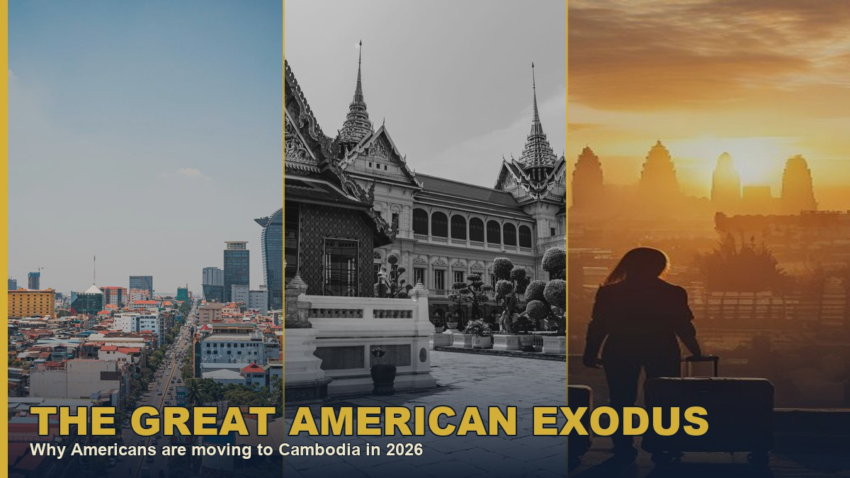
An estimated 180,000 Americans emigrated in 2025 — the largest single-year outbound migration in decades[1]. For the first time since the Great Depression, more people left the country than arrived to stay[2]. This is what that looks like up close: one country drawing real interest from American expats, what it actually costs to build a life there, what Black American expats specifically say about it, and how people are paying for the move.
The numbers behind “exodus”
This isn’t a fringe trend anymore. By November 2025, one in five Americans told Gallup they’d like to move abroad permanently — and among women aged 15–44, that number was 40%, up from just 10% in 2014[2]. An estimated 4–9 million Americans now live abroad, depending on how the State Department’s count is scoped[3]. Citizenship renunciations hit nearly 5,000 in 2025, the highest since 2020, with consulate appointment queues now exceeding 30,000 people worldwide[4]. That queue got a little shorter to act on in April 2026, when the State Department cut its renunciation fee 81%, from $2,350 to $450[5] — though renunciation is a permanent, irreversible step that most people weighing a move abroad don’t actually need to take. Long-term residency and dual citizenship, where available, get most of the benefit without giving up a U.S. passport.
The reasons people give are consistent across the polling: cost of living, safety, healthcare costs, and political climate[4]. Mexico remains the top destination by raw numbers, with Portugal posting the fastest growth of any country[3]. But Southeast Asia is pulling a specific kind of mover — people chasing a dramatically lower cost of living without giving up much in the way of infrastructure or safety. Cambodia is one of the clearest examples of that trade.
Why Cambodia, specifically
Cambodia has one of the most accessible visa systems in Southeast Asia. An ordinary E-class visa is available on arrival for $35 and can be extended locally into a one-year business, retirement, or general visa[6]. The retirement extension (ER) is open to anyone 55 or older who isn’t working, with no minimum income requirement and no bank deposit — unusually low barriers for a retirement visa in Asia, renewable indefinitely for roughly $275–$300/year through a local agent[7]. For remote workers, the country now has a dedicated digital nomad visa pathway alongside the more common business-visa-plus-work-permit route, running roughly $400–$600/year all in[8].
Cost of living is the real draw. One American expat in Phnom Penh, writing for International Living, put his full monthly budget — food, transport, going out, travel — at $1,316, on top of a wife’s housing allowance covering rent[9]. His own words on it: “I can grab a bottle of soy milk or some tropical fruit for a fraction of the cost you’d find in North America,” and “I rarely cook because eating out is so inexpensive — often costing less than groceries”[9]. On adapting to the culture itself, he was blunt that it isn’t effortless, but: “Cambodia’s warm and friendly people make the transition easier”[9].
The Black American expat experience, in their own words
More than 655,000 African Americans are currently living abroad, a number that keeps climbing as people look for places where they say they’re not constantly reminded of their race in the worst way[10]. Writer and traveler Sonari Rhodes Glinton, who has lived across Asia, Australia, Europe, and Central America, put it plainly: “nothing, nothing, compares to the racism I’ve faced in America”[10] — not a claim that racism doesn’t exist elsewhere, but a comparison of degree.
On Cambodia specifically, a Black American family who relocated to Siem Reap after nearly four years in the UAE documented their day-to-day experience in detail. Their account, in full: “Cambodians are indeed, very warm and welcoming people…We received smiles and kind words where ever we went,” and on how they were treated as a family, “Not once have we, as a Black American family, felt threatened, belittled or unjustly treated, while living here”[11]. They were careful not to overclaim it — racism exists in Cambodia as it does everywhere — but wrote that, in their experience, “it doesn’t necessarily encompass every aspect of life to the level that we have seen it in the U.S.”[11] That distinction — not a utopia, but a measurable difference in daily weight — is the same theme that shows up across most published Black expat testimonials, in Cambodia and elsewhere.
How people actually pay for the move
Cambodia isn’t a country you typically move to for a huge local salary — it’s a country where a modest, portable income stretches further than it does at home. Four paths show up again and again:
- Teaching English. Private language centers pay $800–$1,200/month, unlicensed international-school roles run $1,200–$1,800/month, and licensed international-school teachers can earn $2,500–$4,000+/month[12]. Against a comfortable Phnom Penh or Siem Reap budget of roughly $500–$1,200/month, even entry-level teaching pay leaves real savings on the table[12].
- Remote work, on a digital nomad or business visa. Most digital nomads in Cambodia report a comfortable monthly “sweet spot” between $800 and $1,200[8] — a target a single remote US salary, freelance contract, or online business can usually clear with room to save.
- Retirement income. Cambodia’s ER retirement visa has no minimum income or deposit requirement at all[7], which means a modest, fixed monthly income — Social Security, a pension, or both — can fully fund the move for anyone 55 or older.
- NGO and international-organization work. Cambodia hosts a large, established NGO and international-development sector, which is a common entry point for people who want a structured job and built-in community rather than freelancing their way in[9].
The honest trade-offs
None of the sourcing above found a published account describing outright hostility toward Black American expats in Cambodia specifically — but that’s a thin base of documented testimony, not proof the experience is uniform, and it shouldn’t be read as a guarantee. The broader, well-documented trade-offs of the move apply here just as much as anywhere else: healthcare infrastructure is real but not U.S.-grade outside the major private hospitals in Phnom Penh, the legal and visa system runs on annual renewals through local agents rather than a permanent-residency track, and U.S. citizens still owe U.S. federal income tax on worldwide income no matter where they live, which means an annual U.S. filing obligation doesn’t go away just because the cost of living did.
The Bottom Line
The exodus is real by the numbers — 180,000 people left in 2025 alone, and net migration went negative for the first time since the Great Depression. Cambodia is one of the more accessible, lower-cost places to actually do it: cheap visas, no-deposit retirement extensions, and a cost of living that turns a modest teaching, remote-work, or retirement income into a comfortable one. The Black American expats who’ve documented their time there describe real relief, not a perfect place — the honest version of this decision weighs that relief against real logistics: visas, healthcare, and a U.S. tax obligation that follows you no matter where you land.
Have you looked into moving abroad, to Cambodia or anywhere else? What’s the biggest question holding you back — tell us in the comments and we may cover it in a future post.
References
- Wall Street Journal, as cited in Tovima. (2026, June). Americans are leaving the U.S. in record numbers. https://www.tovima.com/wsj/americans-are-leaving-the-u-s-in-record-numbers/ ↩
- ClickOrlando. (2026, July 9). Americans are leaving the U.S. in record numbers. Here’s why. https://www.clickorlando.com/news/2026/07/09/americans-are-leaving-the-us-in-record-numbers-heres-why/ ↩a ↩b
- GetWhereNext. (2026, July). AmerExit by the numbers: 4-9 million Americans now live abroad. https://getwherenext.com/blog/amerexit-by-the-numbers ↩a ↩b
- Boston Globe. (2026, May 12). A record number of Americans are leaving the country and seeking to renounce citizenship. https://www.bostonglobe.com/2026/05/12/lifestyle/record-number-of-americans-leaving-us/ ↩a ↩b
- 1040 Abroad. (2026, April). U.S. renunciation fee drops to $450 in April 2026. https://1040abroad.com/blog/u-s-renunciation-fee-drops-to-450-in-april-2026/ ↩
- Cambodia Expats Online. (2026, July). The complete guide to Cambodia visas, extensions & work permits in 2026. https://cambodiaexpatsonline.com/visa-guide ↩
- AG Cambodia. (2026, July). Retiring in Cambodia: A guide for expats. https://www.agcambodia.com/retiring-in-cambodia-a-guide-for-expats/ ↩a ↩b
- Citizen Remote. (2026, July). Cambodia digital nomad visa in July 2026. https://citizenremote.com/visas/cambodia-digital-nomad-visa/ ↩a ↩b
- International Living. (2026, July). Living in Cambodia for $1,316 a month: My expat life in Phnom Penh. https://internationalliving.com/living-in-cambodia-my-expat-life-in-phnom-penh/ ↩a ↩b ↩c ↩d
- Vanilla Is Black. (2026, July). Get out, for real: The rise of Black Americans moving abroad. https://vanillaisblack.substack.com/p/get-out-for-real-the-rise-of-black ↩a ↩b
- The Jacksons Visit. (2020, July 25). What is it like being Black in Cambodia? https://thejacksonsvisitblog.wordpress.com/2020/07/25/what-its-like-being-black-in-cambodia/ ↩a ↩b
- TEFL Heaven. (2026, July). English teacher salary in Cambodia 2026: What teachers actually earn. https://teflheaven.com/teach-english-cambodia-salary/ ↩a ↩b
Photo by Nara Tsitra via Pexels · Photo by Kirandeep Singh Walia via Pexels · AI image generated with Sana (via pollinations.ai)

Kemetic Minds Editorial Desk
Verified NewsroomPrimary-sourced investigative intelligence on civil rights, voting rights, federal policy, and consumer protection. Sourced from primary legal filings, government statistics, and direct field reporting.