
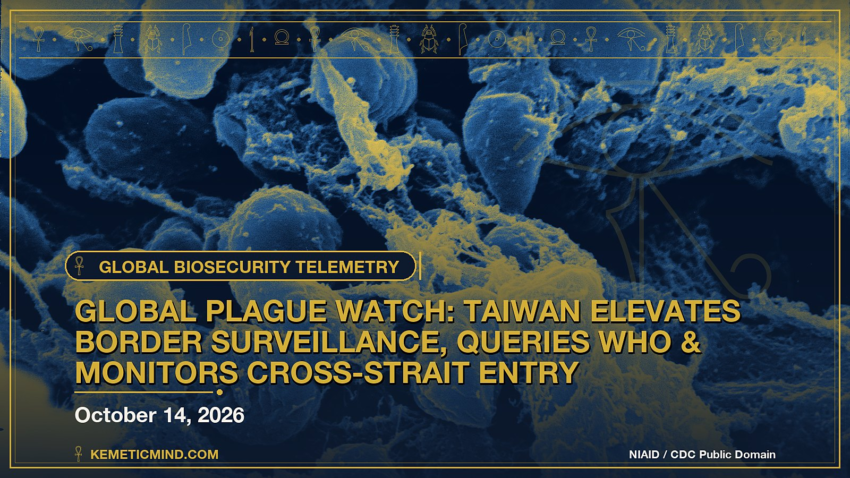
Health authorities across East Asia are intensifying border biosecurity measures following high-level discussions in Taipei. Taiwan Premier Cho Jung-tai confirmed the government is “highly, highly concerned” regarding cross-border biosecurity telemetry following a fatal incident at a Siberian anti-plague laboratory and subsequent surveillance notices across northern China. The Taiwan Centers for Disease Control has formally activated International Health Regulations channels with the World Health Organization while reinforcing port-of-entry fever screening and reviewing Mini Three Links transit corridors.
Key Transit Nodes: Taoyuan International Airport (TPE), Mini Three Links Ferries
Pathogen Under Watch: Yersinia pestis (Pneumonic / Bubonic)
Taiwan Domestic Status: Zero Indigenous Cases Since 1953
Public health and national security officials across Taiwan have escalated border monitoring protocols in response to regional biological surveillance reports and cross-border intelligence.
The heightened vigilance centers on international inquiries surrounding the October 2 fatality of a 28-year-old biological technician at the Irkutsk Scientific Research Anti-Plague Institute of Siberia and the Far East in Russia, which triggered quarantines of nearly 200 hospital staff in Shelekhov.
Simultaneously, seasonal wildlife warnings issued by municipal health bureaus in Inner Mongolia, China—including advisories in the border city of Hulunbuir—have prompted Taiwanese authorities to verify transmission dynamics through formal diplomatic and epidemiological channels.
Taipei Official Response: Premier Cho Jung-tai & Taiwan CDC Actions
During legislative proceedings at the Legislative Yuan in Taipei, Taiwanese Premier Cho Jung-tai addressed government countermeasures regarding potential biological hazards.
Premier Cho emphasized that the Executive Yuan is maintaining close oversight over regional disease rumors and cross-border health surveillance:
“The government is highly, highly concerned about cross-strait public health developments and international reports. The Ministry of Health and Welfare and our border quarantine agencies have already activated heightened vigilance. We are carefully reviewing information streams and will adjust our point-of-entry screening and travel controls as required to protect public safety.”
Health Minister Shih Chung-liang clarified that the Taiwan Centers for Disease Control (Taiwan CDC) moved proactively to obtain direct verification through the World Health Organization’s International Health Regulations (IHR) network.
Minister Shih noted that international communication channels confirmed Russian health authorities have reported no laboratory-confirmed regional outbreak among contacts:
“Our IHR focal point inquired directly with the World Health Organization regarding the incident in eastern Siberia. The WHO indicated that Russian counterparts have not confirmed positive plague test results in the deceased technician or her immediate contacts, categorizing the case as severe acute pneumonia under ongoing investigation. While we must avoid unfounded panic, our diagnostic and border defenses remain fully alert.”
Border Screening Protocols: Airports, Harbors & The Mini Three Links
Taiwan’s disease control apparatus has reinforced surveillance across all primary entry corridors connecting the island with mainland China and regional transit hubs:
Point-of-Entry Biosecurity Architecture
- Infrared Thermal Fever Screening: 100% automated thermal gate scanning remains operational for all arriving passengers at Taoyuan International Airport (TPE), Taipei Songshan Airport (TSA), and Kaohsiung International Airport (KHH). Arriving travelers displaying elevated body temperatures or acute respiratory distress undergo immediate clinical evaluation.
- Mini Three Links Maritime Inspection: Quarantine inspection is heightened along the passenger ferry terminals connecting Kinmen and Matsu with coastal Fujian Province (Xiamen and Quanzhou ports). Inbound passengers are questioned regarding travel history near northern border areas.
- Maritime Vessel Vector Deratting: Harbor health inspection units at Keelung, Taichung, and Kaohsiung enforce strict rodent containment, requiring international commercial vessels to maintain active rat guards on mooring lines and valid Ship Sanitation Certificates.
- Strategic Antimicrobial Reserves: Taiwan CDC verified domestic stockpiles of primary plague therapeutics, including intravenous gentamicin, streptomycin, oral doxycycline, and ciprofloxacin, sufficient for national emergency distribution.
The Taiwan CDC emphasized that Taiwan has not registered an indigenous case of human plague since 1953, reflecting more than seven decades of rigorous port sanitation and vector surveillance.
Cross-Border Context: Siberia, Inner Mongolia & Wildlife Epizootics
To evaluate why East Asian authorities are on high alert, epidemiologists point to the shared geographic ecology spanning eastern Siberia, Mongolia, and northern China.
The Russian Federal Service for Surveillance on Consumer Rights Protection and Human Wellbeing (Rospotrebnadzor) confirmed the isolation of 198 healthcare workers at Shelekhov District Hospital after technician Darya Shipilova succumbed to rapid bilateral lung consolidation on October 2.
While official Russian notices maintain that preliminary polymerase chain reaction (PCR) tests showed negative results for Yersinia pestis, local authorities distributed full post-exposure antibiotic prophylaxis to all close contacts.
Across the border in China’s Inner Mongolia Autonomous Region, disease prevention teams in Hulunbuir and the Manzhouli international land port issued seasonal circulars reminding herders and transit workers of endemic wildlife reservoirs:
Regional health commissions enforce the strict “Three Don’ts” protocol: do not hunt wild marmots (tarbagans), do not skin or butcher sick rodents, and do not transport wild game from grassland plague surveillance zones. Travelers returning from northern grassland regions with unexplained fever or swollen lymph nodes must report to fever clinics immediately.
Clinical Reality: Differentiating Sylvatic Foci from Secondary Spread
Leading infectious disease specialists reiterate the vital medical difference between natural rural rodent cycles and secondary human-to-human transmission.
According to guidance from the World Health Organization and the U.S. Centers for Disease Control and Prevention, Yersinia pestis typically presents in three forms:
- Bubonic Plague: Transmitted via bites from infected rodent fleas (such as Xenopsylla cheopis). Causes acute fever and painfully swollen lymph nodes (buboes). It does not spread person-to-person through the air.
- Septicemic Plague: Occurs when bacteria multiply directly in the bloodstream, either primarily or secondary to untreated bubonic infection.
- Pneumonic Plague: The most lethal and contagious manifestation. When bacteria infect the lungs, respiratory droplets can spread airborne between humans in close contact, requiring therapeutic antibiotic intervention within 24 hours of onset.
Because primary pneumonic plague carries a case-fatality rate approaching 100% without rapid antibiotic therapy, public health agencies worldwide enforce aggressive quarantine even for unverified rumors.
Taiwan’s current proactive stance demonstrates international best practice: verifying field data through WHO liaison channels while ensuring domestic stockpiles and border thermal gates operate without disruption.
Kemetic Minds Public Health Intelligence
Real-Time Pathogen Tracking & Verified Crisis Telemetry
Our international intelligence desk tracks verified health bulletins, WHO IHR dispatches, and emergency communications worldwide to separate verified epidemiology from sensationalism.
Verified Primary Sources & Official References
- Taiwan Centers for Disease Control (Taiwan CDC). Official Briefing on International Health Regulations Inquiries and Port Quarantine Protocols. Taipei, Taiwan.
- Executive Yuan of the Republic of China (Taiwan). Premier Cho Jung-tai Remarks to the Legislative Yuan on Cross-Strait Public Health Vigilance. Taipei, Taiwan.
- World Health Organization (WHO). Plague Surveillance, Treatment Guidelines, and IHR Telemetry. Geneva, Switzerland.
- Federal Service for Surveillance on Consumer Rights Protection and Human Wellbeing (Rospotrebnadzor). Infectious Disease Containment and Epidemiological Oversight in Irkutsk Oblast. Moscow, Russian Federation.
- Irkutsk Scientific Research Anti-Plague Institute of Siberia and the Far East. Laboratory Safety and Epizootic Monitoring Monographs. Irkutsk, Russia.
- Centers for Disease Control and Prevention (CDC). Plague Resources for Health Care Providers and Travelers. Atlanta, GA.
- Taipei Times. Government Monitoring International Disease Reports and Border Screening Measures. Taipei, Taiwan.

Kemetic Minds Editorial Desk
Verified NewsroomPrimary-sourced investigative intelligence on civil rights, voting rights, federal policy, and consumer protection. Sourced from primary legal filings, government statistics, and direct field reporting.