
Emergency Updates · Economics · Published September 29, 2026, 3:22 PM CDT · Updated 3:57 PM CT
Key Facts
- What: a statewide state of emergency for “petroleum supply disruptions,” Executive Order 09.28.26.01, signed September 28.[1]
- When: 12:01 a.m. Tuesday, September 29, through 11:59 p.m. Thursday, October 29, unless renewed.[1][2]
- Gas tax: 33.3 cents a gallon on gasoline and 37.3 cents on diesel, suspended.[2]
- Also in the order: heavier trucks allowed on state roads, a tax break on railroad fuel, and a ban on price gouging.[1]
- Cost to the state: about $200 million a month, the AJC estimates.[6]
At 12:01 Tuesday morning, Georgia stopped charging its gas tax.
This emergency isn’t about a storm. It’s about the price of fuel.
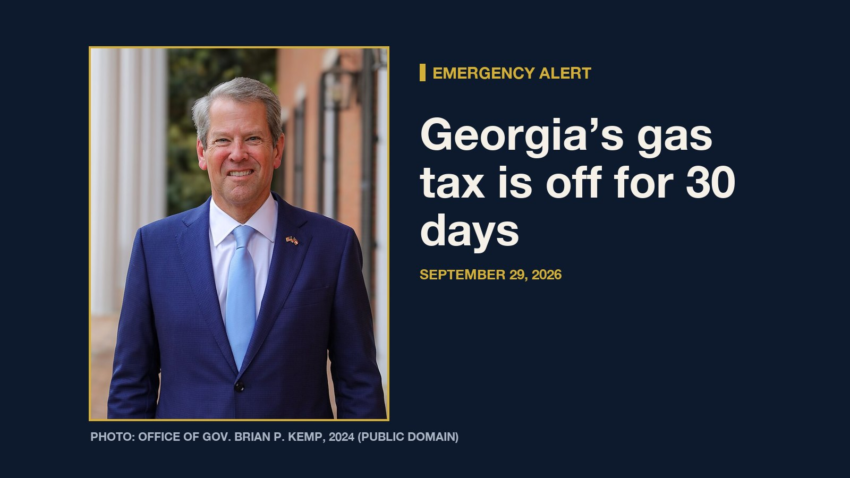
On Monday, Gov. Brian Kemp signed an executive order declaring a state of emergency over what it calls “petroleum supply disruptions.”[1]
“Global markets remain unstable and are subjecting Georgians to unpredictable price shocks on basic goods and services, including but not limited to gasoline and diesel fuel prices,” the order begins.[1]
Gov. Brian Kemp declared a state of emergency over fuel prices and suspended Georgia’s 33.3-cent gas tax through Oct. 29, along with truck weight limits, and switched on the state’s price-gouging law.[1][2] It runs through 11:59 p.m. on Thursday, October 29, unless Kemp renews it.[1]
Video: Atlanta News First, September 28, 2026 — “Gov. Kemp suspends state’s gas tax amid surging fuel prices”
What the Order Actually Does
Most coverage stopped at the gas tax. The five-page order does more than that.
Here is each thing it orders, in plain words.[1]
- A statewide emergency. A state of emergency exists in Georgia “due to petroleum supply disruptions and the resulting volatile prices for everyday goods and services, including, but not limited to, gas and diesel fuel.”
- The gas tax stops. The state does not collect its motor fuel and diesel excise taxes (Code Section 48-9-3) while the emergency lasts.
- Distributors are covered. No fuel distributor can be found in violation of Code Section 48-9-17 for following the order.
- Railroads get a break too. The state stops collecting sales tax (Code Section 48-8-30) on fuel bought by railroads regulated by the federal Surface Transportation Board for their own use.
- Price gouging is banned. Gouging on goods and services needed to respond to the emergency, “including motor and diesel fuel,” is prohibited under Georgia’s price-gouging law (Code Section 10-1-393.4).
- Heavier trucks on state roads. On state-maintained roads, but not interstates, a truck with five axles and an outer bridge span of at least 51 feet may weigh up to 95,000 pounds, and loads may be up to 10 feet wide and 100 feet long. With proper escorts, they may travel around the clock.
- Escorts after dark. Loads wider than 8 feet 6 inches that travel between 30 minutes before sunset and 30 minutes after sunrise need escort vehicles with amber lights: front and rear on two-lane roads, rear on four-lane highways.
- Permits for anything bigger. Trucks outside those limits need a permit from the Georgia Department of Public Safety. Posted bridge weight limits still apply, and the order waives no other law.
- The clock. Everything takes effect Tuesday, September 29, and expires at 11:59 p.m. Thursday, October 29, 2026, unless the governor renews it.
Kemp acted under Georgia’s emergency-powers law, Code Section 38-3-51, the order says. Among its reasons, it points to the national energy emergency President Trump declared on January 20, 2025 (Executive Order 14156), which has been continued through January 20, 2027.[1]
It also cites a September 16, 2026, federal waiver of truck drivers’ hours-of-service limits, issued for “the critical need for timely and efficient distribution and delivery of gasoline and diesel fuel.”[1]
“We’ve remained committed to helping them and our small businesses fight through the tough times, and that’s why I’m taking this action today to give further relief.”
Gov. Brian Kemp, September 28[2]
What It Means at the Pump
AAA put Georgia’s average for regular at $4.19 a gallon on Monday. The national average was $4.47.[3]
A month ago, Georgians paid about $3.79. A year ago, it was about $2.87.[5][3]
Diesel is worse. The governor’s office puts Georgia’s diesel average at $6.24 a gallon.[2]
“This announcement means immediate relief for Georgia families struggling to afford gas and groceries and Georgia farmers facing diesel prices that have more than doubled in recent weeks,” Agriculture Commissioner Tyler Harper said.[2]
The math on one fill-up
The tax on 15 gallons of gas is about $5.00 (15 × 33.3 cents).
The Georgia Recorder figured Monday’s 15-gallon fill-up would drop from $62.85 to $57.90 with the tax off.[3]
For a truck taking on 100 gallons of diesel, the tax comes to $37.30 (100 × 37.3 cents).
Don’t expect the full drop right away.
The state collects the tax from fuel distributors, not at the pump. Gas already in a station’s tanks was taxed at the old rate, so prices come down as new loads arrive.[3][5]
During an earlier suspension, Georgia’s attorney general said that could take “days and weeks,” FOX 5 Atlanta reported. Other costs can move at the same time, so the posted price may never fall the full 33 cents.[5]
Video: News4JAX, September 29, 2026 — “Kemp suspends gas tax for Georgia drivers through end of October”
Who Pays for It
The gas tax isn’t small money. It brought in just under $193 million in August alone, according to the state Department of Revenue.[3]
That money maintains Georgia’s roads and bridges.[3] The AJC estimates the suspension will cost about $200 million a month, and Kemp is likely to cover it from the state’s surplus.[6]
He has done this before. Kemp suspended the tax in 2022 after the war in Ukraine sent oil prices up, in the fall of 2023 as inflation spiked, and in 2024 after Hurricane Helene.[3][4]
The last time was this March, after the Iran war began. That suspension ran through Memorial Day.[3][4]
Why Now
Gas prices have climbed for months as uncertainty in the Strait of Hormuz continues.[3] The AJC ties this suspension directly to “the war with Iran.”[6]
It also comes five weeks before an election. Georgia picks a new governor on November 3.[3]
Both candidates had already weighed in. Democrat Keisha Lance Bottoms called on Kemp last week to pause the tax. Republican Rick Jackson’s economic platform calls for suspending the fuel tax automatically when prices rise past a certain rate.[3]
“Families, businesses and farmers across our state are feeling the pressure of skyrocketing costs at the pump,” House Speaker Jon Burns said in the governor’s release.[2]
Georgia Isn’t Alone
Georgia is at least the third Southern state in a week to declare an emergency over fuel.
Louisiana Gov. Jeff Landry declared a diesel emergency on September 22, letting farm and timber trucks run on cheaper dyed diesel. Read our breakdown of Louisiana’s diesel emergency order.
On the same day as Kemp, Texas Gov. Greg Abbott issued a statewide disaster proclamation over diesel. It covers all 254 Texas counties, allows dyed diesel on the roads, and lets fuel, crop and timber loads weigh up to 95,000 pounds.[8]
But Texas’s order “does not waive the state fuel tax,” The Center Square reported.[8] Of the three, only Georgia suspended its fuel tax for every driver.
For the national picture, our Fuel Price Watch tracks gas and diesel prices twice a day.
Where It Applies

The whole state is covered; the pin marks the State Capitol in Atlanta, where the order was signed. Map data: OpenStreetMap contributors. Street photo (2015): Marc Merlin, Wikimedia Commons, CC BY-SA 4.0.
If You Live in Georgia
Price gouging is illegal right now. During a declared emergency, sellers can raise prices on covered goods only to match their own higher cost for new stock or shipping, plus the markup they charged in the 10 days before the declaration.[7]
The attorney general’s Consumer Protection Division investigates complaints. Fines run from $2,000 to $15,000 per violation.[7]
To file a complaint, call (404) 651-8600, or (800) 869-1123 toll-free in Georgia, or use the form at consumer.georgia.gov.[9] Keep your receipt and a photo of the posted price.
Truckers and haulers: oversize permits come from the Department of Public Safety’s Commercial Vehicle Enforcement at 844-837-5500, weekdays during business hours, or online at gaprospermits.com.[1]
Mark the date. The tax comes back after 11:59 p.m. on October 29 unless the governor renews the emergency.[1] Officials have not said whether they will extend it.[5]
References
- Office of the Governor of Georgia. Executive Order 09.28.26.01, “State of Emergency for Petroleum Supply Disruptions” (PDF, 5 pages), September 28, 2026.
- Office of the Governor of Georgia. “Gov. Kemp Suspends Gas Tax, Provides Relief to Hardworking Georgians,” September 28, 2026.
- Ross Williams, Georgia Recorder. “Kemp temporarily suspends the state fuel tax as prices at the pump continue to soar,” September 28, 2026.
- CBS News Atlanta. “Gov. Kemp suspends Georgia gas tax, declares state of emergency as fuel costs surge,” September 28, 2026.
- FOX 5 Atlanta. “Kemp suspends Georgia gas tax. When will pump prices drop?” September 28, 2026.
- The Atlanta Journal-Constitution. “Brian Kemp suspends Georgia’s gas tax as Iran war squeezes drivers,” September 28, 2026.
- Georgia Department of Law, Consumer Protection Division. “Price Gouging.”
- The Center Square. “Abbott issues disaster declaration for diesel fuel crisis, waives restrictions,” September 28, 2026.
- Georgia Department of Law, Consumer Protection Division. Contact and complaint information.
How this report was made: the site’s Emergency Alert Scanner flagged Georgia’s declaration after six news outlets reported it, and matched it to the governor’s own release. The story was then written from the full five-page executive order, the governor’s announcement and the reporting cited above. Quotes are verbatim; the fill-up math is ours.

Kemetic Minds Editorial Desk
Verified NewsroomPrimary-sourced investigative intelligence on civil rights, voting rights, federal policy, and consumer protection. Sourced from primary legal filings, government statistics, and direct field reporting.