
Explainer, updated through Nov. 11, 2026. Every date and figure below is checked against a saved copy of its source; proposals and secondhand reports are labeled.
Executive summary
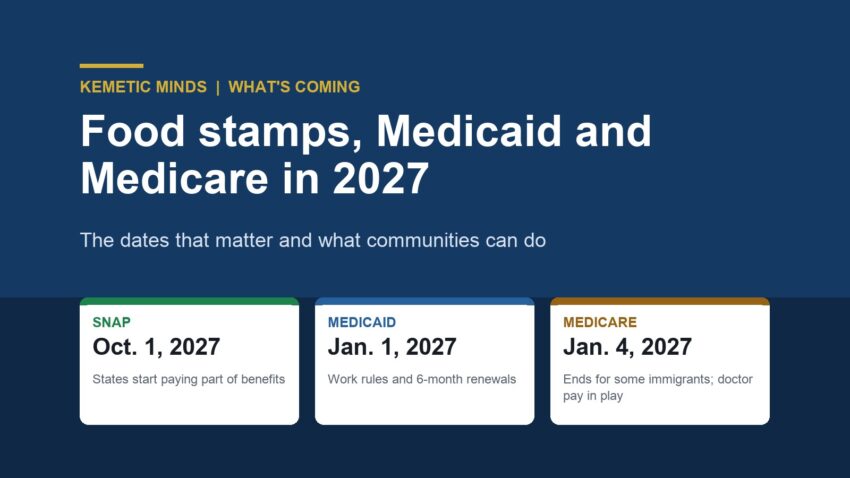
- SNAP (food stamps): since Oct. 1, 2026 states pay 75% of administrative costs, up from about 50%. [1] From Oct. 1, 2027, states whose payment error rate is 6% or higher start paying 5% to 15% of benefit costs. [1][5]
- Medicaid: work requirements must be running in applicable states no later than Jan. 1, 2027, at 80 hours a month for adults 19 to 64. [3] Forty-four states are on that date. [4] Expansion adults must also be re-checked at least every six months. [5]
- Medicare: coverage ends no later than Jan. 4, 2027 for some lawfully present immigrants, including refugees, asylees and people with Temporary Protected Status. [6] Doctors’ one-year 2.5% payment increase expires, and a 2% sequester reduction begins April 1, 2027. [7][8]
- Your voice: public comment on USDA’s proposed SNAP work-rule changes closes Dec. 10, 2026. [9]
- Already happened: more than five million people have lost SNAP benefits since the law passed. [10][11]
What is changing, and what is not
“Food stamps” is the old name for the Supplemental Nutrition Assistance Program, SNAP. Most of the 2027 changes come from one law, Public Law 119-21, called H.R. 1 or the One Big Beautiful Bill Act in most coverage and the Working Families Tax Cut legislation by the Centers for Medicare & Medicaid Services (CMS). [1][3]
The word “Medicare” is doing a lot of work in the headlines. Three different things are described that way, and only one changes who is covered:
- Eligibility: some lawfully present immigrants lose Medicare. [6]
- Doctor pay: a one-year payment increase for clinicians ends. [7]
- Sequester: a standing 2% reduction in payments begins its next cycle. [8]
The largest coverage change in 2027 is in Medicaid, a separate, state-run program for low-income people. Medicare generally covers people 65 and older and some people with disabilities. [6] This report keeps the programs apart.
Food stamps (SNAP)
Rules already changed. H.R. 1 widened the work requirement for able-bodied adults without dependents from ages 18 to 54 to ages 18 to 64, and it now reaches adults with a dependent child aged 14 or older. It ended the exemptions for veterans, people experiencing homelessness and former foster youth. States can seek a waiver of the time limit only in areas where unemployment is above 10%, with exceptions for Alaska and Hawaii. [1] On Nov. 10, 2026, USDA published a proposed rule, “Modification to Work Requirements for Able-Bodied Adults,” that would write the law’s changes to the time-limit exceptions and waivers into federal regulation. Comments are due Dec. 10, 2026. [9]
The toll so far. PBS NewsHour reported on Oct. 13 that more than five million people have lost SNAP benefits since the law passed last year, and that many are turning to food banks. [10] The Guardian reported the same figure on Oct. 25. [11]
Video from PBS NewsHour’s original report, one of this story’s cited sources — “Cuts to SNAP benefits push many Americans to seek help from food banks”.
Administrative costs moved to states first. The federal government used to pay about half of SNAP’s administrative costs. Under H.R. 1 it pays 25% and the non-federal share is 75%, starting in federal fiscal year 2027. [1] USDA estimated the change will cost states $3.4 billion a year over the next five years. As of Sept. 30, 40 states had appropriated some or all of the money needed. In New York and North Carolina, where counties run social services, counties carry the higher cost, and Minnesota counties are reportedly considering property tax increases. [2] Illinois put $70 million into a new state food program called FRESH for people who lost SNAP. [2][12]
Then benefits themselves. Since 1964 the federal government has paid SNAP benefits in full. [1] Starting in fiscal year 2028, which begins Oct. 1, 2027, states with a payment error rate of 6% or more pay a share of benefit costs: 5% at 6% to 8%, 10% at 8% to 10%, and 15% at 10% or more. A state can use either its fiscal 2025 or fiscal 2026 error rate for the first year. [1][5] A state whose fiscal 2025 rate multiplied by 1.5 is 20% or more starts a year later. [1] Maryland’s fiscal 2025 rate was 13.08%, which would put it in the top tier with no delay, according to the state’s legislative analysts. [5]
An error rate counts payment mistakes in both directions. USDA says it is not a measure of fraud. [11] Congressional Democrats sought a two-year delay of the October 2027 date during Farm Bill talks. Republicans have not agreed. [2]
Medicaid
The deadline is Jan. 1, 2027. CMS’s interim final rule requires certain adult applicants and enrollees to meet an 80-hours-a-month requirement through employment, education, work programs or community service, and it applies to adults 19 through 64. The rule exempts people for health-related needs and other qualifying circumstances. [3] Maryland’s analysts add two other changes on the same date: expansion adults can instead earn at least $580 a month, and states must redetermine their eligibility at least every six months rather than every year. Retroactive coverage of bills from before enrollment shrinks from three months to one for expansion adults. Parents and caretakers of a child 13 or younger are among the groups states must exempt. [5]
Who is on the clock. A Nov. 6 legal analysis says the requirement takes effect in 44 states on Jan. 1, 2027 and affects about 30% of the Medicaid population. [4] Some states started early: Nebraska on May 1, 2026, with Arkansas and Montana planning July 1, 2026. [13]
A court narrowed the rule. On Oct. 29, a federal court decision, Massachusetts v. Oz, partly vacated CMS’s rule. People in any of the five statutory medical-frailty categories cannot be required to prove an added functional impairment to qualify for an exemption. The court left in place the rule’s limits on self-attestation and its 12-month data-review requirement, and states must update their notices. [4]
Delay requests are open but unused. Five governors wrote to the Department of Health and Human Services on Oct. 1 asking to delay the requirements to test their systems and protect enrollees from avoidable coverage disruption. As of the Medicaid and CHIP Payment and Access Commission’s October update, no state had formally requested the “good faith effort” exemption, and states were still waiting for CMS to issue the request template. [14]
What an early test looked like. The AFRO reported that Georgia’s Pathways to Coverage program, which has a work requirement, enrolled fewer than 7,500 of an estimated 300,000 eligible adults in its first year and spent more than $40 million, mostly on administration. [15] That is one state’s result, reported secondhand, and not a forecast for any other.
Video: LOCAL 12, November 8, 2026 — “Medicaid work requirements begin in 2027: What to know”. Matched to this story by shared names and terms in its title; watch the original for full context.
Who is most exposed
Nearly 11.3 million Black people were enrolled in Medicaid in 2023, according to the Joint Center for Political and Economic Studies. [16] The AFRO reports that almost 26% of SNAP participants, about 10.2 million people, are Black, and that participants receive an average of $187 a month. [15]
The documented risk is paperwork, not only eligibility. A KFF review found that Black and Hispanic adults who lost Medicaid coverage in the post-pandemic unwinding were about twice as likely as White adults to report that they lost it because they could not complete the enrollment process. [17] The Nov. 6 legal analysis likewise names administrative burdens, digital-literacy challenges and confusion over reporting and exemptions as barriers likely to contribute to coverage losses among eligible people. [4]
Medicare
Immigrant eligibility. KFF reports that Medicare is now limited to certain immigration categories, and that lawfully present immigrants outside them, such as refugees, asylees and people with Temporary Protected Status, are no longer eligible. Anyone in that group who has Medicare will lose it no later than Jan. 4, 2027. [6] Justice in Aging notes that older immigrants who lose Medicare may still be lawfully present and eligible for Social Security benefits. [18] Its summary of a CMS proposal says the Social Security Administration would send a second notice at the end of December 2026, with termination effective Feb. 1, 2027. [19] Check that date against the final rule. Anyone who gets a termination notice has the right to appeal and can follow the instructions on the notice or call 1-800-MEDICARE. [20]
Doctor pay. The 2026 law gave clinicians a one-year 2.50% increase in Medicare’s physician fee schedule for 2026. It expires for 2027, which CMS says means current law requires a 2.50% reduction from the 2026 level. CMS’s July 14 proposal sets 2027 conversion factors of $33.17 for clinicians in qualifying alternative payment models (down 1.19%) and $32.84 for others (down 1.68%). [7] These are payment rates for clinicians, not a change to what Medicare covers. The rule was a proposal in the version checked; confirm the final numbers.
The sequester. The Congressional Research Service says the 2% sequester applies to Medicare and certain other health programs under the fiscal 2027 order, with Medicare reductions starting April 1, 2027. OMB estimated $27.37 billion in reductions for those programs. [8] A separate, larger cut that providers had feared, up to 4% from the deficit effect of the 2025 law, was wiped off the books by a provision in the November 2025 funding law, according to the law firm Reed Smith. The 2% Budget Control Act reduction, in place since 2013, continues. [21]
Key dates
| Date | Program | What happens |
|---|---|---|
| Oct. 1, 2026 | SNAP | States pay 75% of administrative costs [1] |
| Dec. 10, 2026 | SNAP | Comments due on USDA’s proposed work-rule changes [9] |
| End of Dec. 2026 | Medicare | Proposed second SSA notice to affected immigrants [19] |
| Jan. 1, 2027 | Medicaid | Work requirements, six-month renewals begin [3][5] |
| Jan. 1, 2027 | Medicare | Doctors’ 2.5% one-year increase ends [7] |
| Jan. 4, 2027 | Medicare | Coverage ends for some lawfully present immigrants [6] |
| Apr. 1, 2027 | Medicare | 2% sequester reductions begin [8] |
| Oct. 1, 2027 | SNAP | States begin paying part of benefit costs [1] |
Dates can move. States may request Medicaid delays [14], rules can be finalized with changes, and Congress is arguing over the SNAP cost-share date. [2]
What communities can do
1. Make notices impossible to miss. The most common failure is a missed letter. The American Medical Association’s guide for non-citizens advises opening every letter promptly, keeping your address and phone number current with each agency, and answering every request by its deadline. For Medicaid or CHIP, you can ask for a fair hearing within 10 days of the notice date to keep coverage during the appeal. You can still appeal later, but coverage may end while the case is reviewed. [20]
2. Run paperwork help, not just information sessions. Because the documented barrier is completing the process [4][17], the most direct help is sitting with a neighbor to gather proof of work hours, school enrollment or an exemption, and to submit it. Churches, libraries, barbershops, tenant groups and community centers can host sign-up and renewal nights. This is our suggestion, drawn from where the sources say people fall out.
3. Help people claim the exemptions that exist. Medically frail people, parents and caretakers of young children, and others are exempt in the Medicaid rule. [3][5] After the Oct. 29 ruling, people in the five medical-frailty categories do not have to prove an added functional limit. [4] Help people ask the state which exemption applies to them.
4. File a comment by Dec. 10. Anyone can comment on USDA’s proposed SNAP rule on regulations.gov, docket FNA-2025-0368. [9] Groups with local numbers on food costs, waiver areas or lost benefits can add them.
5. Connect people to food now. Search for a pantry on Feeding America’s locator, call 2-1-1 for local services, and find your state’s SNAP office in USDA’s state directory. Food banks are reporting more demand. [10] Pantries often need volunteers, donations and delivery help for homebound seniors.
6. Get one-on-one Medicare counseling. State Health Insurance Assistance Programs (SHIPs) offer one-on-one assistance, counseling and education to Medicare beneficiaries, their families and caregivers. The federal Administration for Community Living describes the program and lists shiphelp.org and 877-839-2675 as its contact points. You can also call 1-800-MEDICARE or use Medicare’s “talk to someone” page. [20]
7. Ask local and state officials direct questions. What is our state’s SNAP payment error rate and plan to lower it? Who pays the higher administrative costs, the state or the counties? Has the state asked for a Medicaid delay? Is there state money for people who lose food aid, as Illinois created? [2][12][14]
What we could not confirm
This report relies on published rules, agency pages, a court-decision summary and news coverage, all checked against saved copies. It cannot say how many people in any single state will lose coverage, because those estimates are not in the sources. Several items are proposals or summaries, and they are flagged where they appear. Check with your state agency for the date and rule that apply to you.
References
- National Association of Counties. “H.R. 1 and the Supplemental Nutrition Assistance Program (SNAP): What Counties Should Know.” ↩
- NCAN. “Bracing for Impact: An Update on How States Have Responded to OBBBA.” ↩
- Centers for Medicare & Medicaid Services. “CMS Launches Nationwide Framework to Implement Medicaid Work Requirements” (June 1, 2026). ↩
- Morgan Lewis. “Medicaid Work Requirements Remain on Track Despite Partial Vacatur” (Nov. 6, 2026). ↩
- Maryland Department of Legislative Services. “Impact of the Federal One Big Beautiful Bill Act on Health and Human Services Programs,” presentation to the House Appropriations Committee (Oct. 27, 2026). ↩
- KFF. “Can immigrants enroll in Medicare?” (Oct. 9, 2026). ↩
- Centers for Medicare & Medicaid Services. “Calendar Year (CY) 2027 Medicare Physician Fee Schedule Proposed Rule” (July 14, 2026). ↩
- Congressional Research Service. “The FY2027 Mandatory Spending Sequester,” IN12683 (April 27, 2026). ↩
- Federal Register. “Modification to Work Requirements for Able-Bodied Adults,” 91 FR 72439 (Nov. 10, 2026). ↩
- PBS News. “Cuts to SNAP benefits push many Americans to seek help from food banks” (Oct. 13, 2026). ↩
- The Guardian. “Trump administration has pushed 5m Americans off food stamps” (Oct. 25, 2026). ↩
- Capitol News Illinois. “Illinois launches new program to provide food benefits to people who lost SNAP” (Aug. 1, 2026). ↩
- Families USA. “Medicaid Work Reporting Requirements: Implementation Update After CMS' Interim Final Rule” (June 2026). ↩
- Medicaid and CHIP Payment and Access Commission. “Medicaid Work Requirements Monitoring: Updates on State Implementation” (October 2026). ↩
- AFRO News. “A year in, No. 47’s spending cuts hit hardest in Black communities” (July 4, 2026). ↩
- Joint Center for Political and Economic Studies. “Budget Reconciliation Cuts to the Social Safety Net and Their Impact on Black Households” (July 22, 2025). ↩
- KFF. “Medicaid Efforts to Address Racial Health Disparities” (July 1, 2024). ↩
- Justice in Aging. “Older Immigrants and Medicare.” ↩
- Justice in Aging. “Template Comments: Medicare Eligibility for Immigrants, Physician Fee Schedule.” ↩
- American Medical Association. “Changes to Medicaid, Medicare and Marketplace Coverage for Non-U.S. Citizens: Tips for Navigating Eligibility Changes and Maintaining Access to Care.” ↩
- Reed Smith. “Government Reopens . . . What Now?” (Nov. 13, 2025). ↩

Kemetic Minds Editorial Desk
Verified NewsroomPrimary-sourced investigative intelligence on civil rights, voting rights, federal policy, and consumer protection. Sourced from primary legal filings, government statistics, and direct field reporting.