
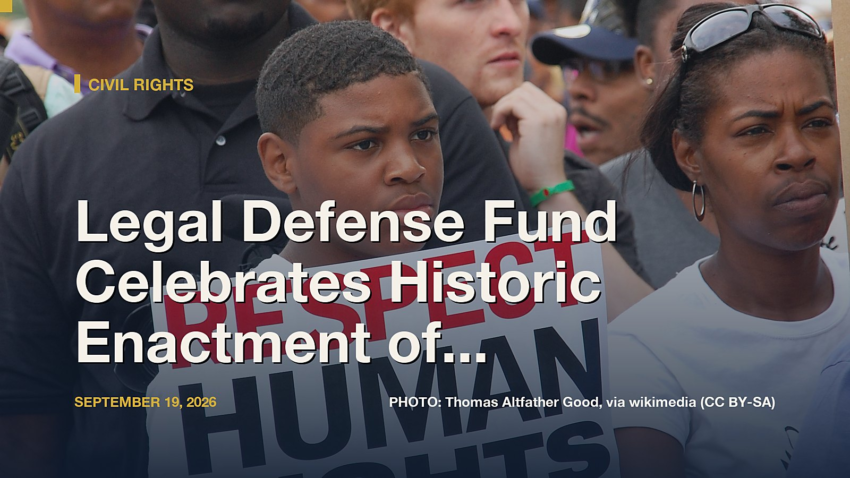
Civil Rights · September 19, 2026
California became the fourth state in a single year to enact its own Voting Rights Act, a pace with no precedent since Section 2 of the federal Voting Rights Act was gutted by the U.S. Supreme Court in April. The NAACP Legal Defense Fund calls the run of new state laws — Maryland in April, New Jersey in July, Delaware in August, and now California — a direct response to that ruling, and says four in one calendar year has never happened before.
Key Facts
- California’s SB 1164 and SB 1360 — together the California Voting Rights Act of 2026 — were signed into law September 19, 2026.
- Before 2026, no state had enacted more than one State VRA in a single calendar year; four have now passed in this one.
- 11 states now have State VRA protections on the books, with nearly a dozen more bills pending in other legislatures.
- The wave follows the Supreme Court’s April 2026 ruling in Louisiana v. Callais, which raised the bar for challenging a voting map under the federal Voting Rights Act.
The Story So Far
State Voting Rights Acts exist to do at the state level what the federal Voting Rights Act has done since 1965: let voters sue over election rules or maps that dilute or suppress their vote, without having to first prove a legislature intended to discriminate. That federal law took a serious hit on April 29, 2026, when the Supreme Court ruled 6–3 in Louisiana v. Callais that a federal Section 2 claim now requires plaintiffs to show “intentional discrimination” — a far higher bar than the “results” test civil rights lawyers had relied on for decades. The Court’s ruling struck down one of Louisiana’s majority-Black congressional districts in the process.
States began moving to fill that gap almost immediately. Maryland went first in April, New Jersey followed in July, Delaware in August, and California’s SB 1164/SB 1360 package cleared the legislature and was signed by Governor Newsom on September 19 — the fourth enactment inside twelve months, according to the NAACP Legal Defense Fund (LDF), which tracks and litigates under these laws nationally.
What California’s New Law Actually Does
The California Voting Rights Act of 2026 gives voters new tools to challenge election systems and maps that weaken the voting power of specific communities, sets up processes meant to catch discriminatory rules before an election happens rather than after, expands language assistance for voters with limited English proficiency beyond what federal law requires, and directs state courts to interpret ambiguous provisions in favor of voters.
“State VRAs are a powerful, popular, and practical solution to address voting discrimination with 78% of voters supporting these bills nationwide. To enact four in one year is emblematic of the extraordinary momentum Californians and others across the country are creating in the fight to restore, expand, and protect the foundational right to the franchise.”
— Janai Nelson, President and Director-Counsel, NAACP Legal Defense Fund[1]
California state Senator Sabrina Cervantes, the bill’s author, framed the law as a state-level backstop against federal retrenchment: “States are the first line of defense between voters and federal attacks on our democracy.”[2] Julia Gomez of the ACLU of Southern California, one of the coalition partners that pushed the bill, added that “the CVRA of 2026 will strengthen voters’ ability to participate in our democracy and defend their rights.”[2]
Governor Newsom signed the CVRA as part of a larger, 13-bill election-protection package. He framed the signing in explicitly adversarial terms: “Donald Trump won’t stop until he can exert dictatorial control over your free vote and disenfranchise millions of people this November. California will stop him at every opportunity.”[4] Secretary of State Shirley Weber said the package ensures “California voters will not be silenced or intimidated,” and Attorney General Rob Bonta said the state “refuses to stand idly by” against what he called “an all-out assault on our elections and voting rights.”[4]
Why This Wave Started: Watch
The Louisiana ruling that triggered this year’s run of state laws was itself closely watched. This PBS News Hour segment from the day of the decision walks through what changed and who it affects.[3]
What’s Disputed or Unconfirmed
Whether these state laws can actually substitute for the weakened federal standard is contested. State VRAs only bind elections and maps drawn under state and local authority — they don’t reach congressional redistricting fights like the one at the center of Callais itself, which is governed by federal law regardless of what any state legislature does. Critics of the state-VRA strategy, including some Republican lawmakers who opposed California’s bill, argue it invites a wave of state-court litigation with inconsistent outcomes across the country rather than a uniform national standard. Neither claim is resolved by anything in the record so far; both are worth tracking as the 11 existing state laws get tested in court.
How to Verify This Yourself
- NAACP Legal Defense Fund’s own release: naacpldf.org.
- The bill text and legislative history for SB 1164 and SB 1360: Sen. Cervantes’ official bill page.
- The Supreme Court’s own opinion in Louisiana v. Callais: available via PBS NewsHour’s case coverage, which links the opinion directly.
- The Governor’s own signing statement, with the full 13-bill package: gov.ca.gov.[4]
- CalMatters’ nonpartisan Digital Democracy tracker has the bill’s full legislative history and every vote: calmatters.digitaldemocracy.org.[5]
- The ACLU California Action coalition’s own bill tracker: aclucalaction.org.[6]
What You Can Do Right Now
- If you live in one of the 11 states with a State VRA (or the roughly dozen considering one), contact your state legislators to ask where a pending bill stands.
- Register to check your own voting district and registration status well before any election, since map challenges under these laws can change district lines between cycles.
- If you believe an election rule or map in your area dilutes a community’s vote, LDF and the ACLU’s Voting Rights Project both accept public tips and complaints through their websites.
Kemetic Minds Analysis
The headline number here — four states in one year, versus at most one in any prior year — is real, but it’s worth separating the trend from the substitute. A State VRA is a meaningful tool only within a state’s own elections; it cannot restore what Callais took from federal congressional-map litigation, which is precisely the terrain where the most consequential redistricting fights (like Louisiana’s own) actually happen. What this wave really shows is that the states most willing to legislate on voting rights are also, not coincidentally, states where Democratic majorities control both chambers and the governorship — Maryland, New Jersey, Delaware, California. The harder test for this strategy is whether it can spread to swing or Republican-controlled legislatures, where the same 78% voter-approval number LDF cites hasn’t translated into legislative votes. Until it does, “11 states now protected” is an accurate count of law on the books, not a description of how many Americans it actually covers.
References
- NAACP Legal Defense Fund. (2026, September 19). Legal Defense Fund Celebrates Historic Enactment of Four State Voting Rights Acts in One Year as California Bill Is Signed Into Law [Primary]. naacpldf.org. ↩
- Office of California State Senator Sabrina Cervantes. (2026). Cervantes’ California Voting Rights Act of 2026 Heads to Governor’s Desk [Primary]. sd31.senate.ca.gov. ↩
- PBS NewsHour. (2026, April 29). How the Supreme Court’s Louisiana districting decision weakens the Voting Rights Act [Secondary]. pbs.org/newshour. ↩
- Office of Governor Gavin Newsom. (2026, September 19). Governor Newsom Signs New Laws to Protect California Elections from Trump Interference [Primary]. gov.ca.gov. ↩
- CalMatters Digital Democracy. (2026). SB 1164: Elections [Tertiary, nonpartisan bill-tracking database]. calmatters.digitaldemocracy.org.
- ACLU California Action. (2026). California Voting Rights Act of 2026 (SB 1164 and SB 1360) [Tertiary, advocacy bill tracker]. aclucalaction.org.
Related Reading
- LDF’s Voting Rights 2026 hub — tracks every pending state VRA bill.
- Kemetic Minds: South Dakota’s proof-of-citizenship lawsuit — the restrictive side of this same post-Callais pattern.
Investigative methodology: every quote above is verbatim from the named source’s own press release or official page, linked and cited. The Louisiana v. Callais characterization is drawn from PBS NewsHour’s reporting on the ruling. The “Kemetic Minds Analysis” section above is this newsroom’s own interpretation, clearly separated from the sourced reporting it follows.

Kemetic Minds Editorial Desk
Verified NewsroomPrimary-sourced investigative intelligence on civil rights, voting rights, federal policy, and consumer protection. Sourced from primary legal filings, government statistics, and direct field reporting.
2 thoughts on “Civil Rights · Sep 19, 2026Legal Defense Fund Celebrates Historic Enactment of Four State Voting Rights Acts in On…”