
Bill Watch · The 13th Amendment Loophole, Part 3 of 3 · October 17, 2026, 9:00 AM CDT
- Part 1: The bounty hunter blueprint · Oct 15
- Part 2: Life sentences and the 13th Amendment loophole · Oct 16
- Part 3: Who profits, and how to fight back (you are here)
- Companion page: Controversial Bills Tracker and action plans
Every stage of the pipeline has someone getting paid.
Part 1 traced how Mississippi’s HB 1484 would have moved a person from a phone tip to a prison cell. Part 2 showed why a life sentence matters under the 13th Amendment.
This last part asks three questions. Who profits? What protections are being taken away? And what can people do about it?
- The GEO Group expects $2.95 to $3.05 billion in revenue in 2026, up from $2.43 billion in 2024.
- ICE detainees at a GEO center in Colorado say they were paid $1 a day. In February 2026 the Supreme Court let their lawsuit go forward, 9-0.
- Project 2025 calls for deleting “diversity, equity, and inclusion” from every federal rule and ending disparate-impact civil rights liability.
- In September 2025, the Supreme Court let immigration agents in Los Angeles resume stops that challengers said relied on apparent ethnicity, language and job.
- You can act: track the bills, ask your sheriff for the county’s 287(g) agreement, know your rights, and support the Abolition Amendment.
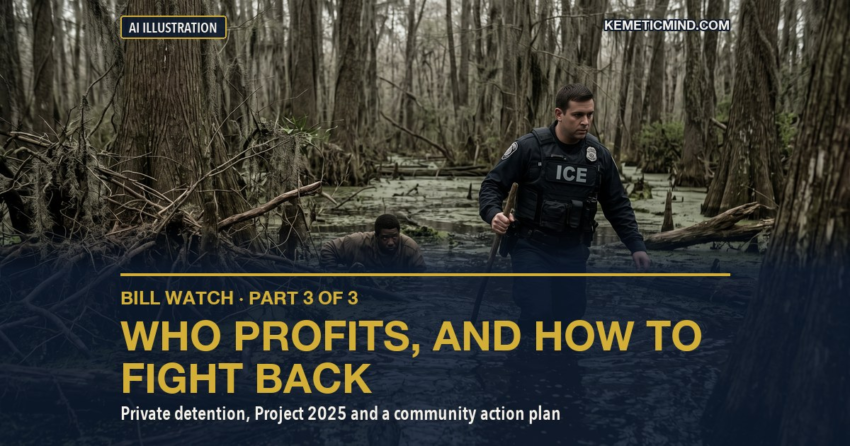
The featured image is an AI-generated illustration commissioned for this series. It does not show real people or a real event.
1. Follow the money
The biggest winners are the companies that run detention centers. The GEO Group reported $2.6 billion in revenue in 2025. CoreCivic reported $2.2 billion, up 13%.[1]
GEO now expects $2.95 to $3.05 billion in 2026. In its second-quarter report, it announced two new ICE contracts expected to bring in about $85 million and $80 million a year.[2]
The public money behind it is enormous. The 2025 budget law set aside about $45 billion for immigration detention, enough, by the American Immigration Council’s count, to hold more than 100,000 people a day.[3]
Now go back to HB 1484 and look at who it would have paid.
| Stage | Who gets paid | How |
|---|---|---|
| Tip | Anyone who calls the hotline | $1,000 if the report leads to arrest and imprisonment (HB 1484) |
| Capture | Bail bond and surety recovery agents | Certified as state bounty hunters for four years (HB 1484) |
| Detention | Private prison companies | Per-person federal contracts; GEO forecasts up to $3.05 billion in 2026 |
| Prison | The state | Mississippi pays nothing for most prison jobs (ACLU) |
| Detention labor | Contractors | ICE’s “voluntary work program” at $1 a day, now the subject of a federal lawsuit |
That last row is in court. Detainees at GEO’s Aurora, Colorado, center say they were made to clean without pay or face solitary confinement, and were paid $1 a day for other work. On February 25, 2026, the Supreme Court ruled 9-0 that GEO could not stop the case with an early appeal.[6] The detainees have not won yet; they have won the right to keep going.
2. The guardrails Project 2025 targets
A pipeline like this is only as dangerous as the checks around it. Civil rights law is one of those checks. Project 2025 aims at several of them directly.
| Mandate page | What Project 2025 says | What has happened |
|---|---|---|
| pp. 4-5 | Delete “diversity, equity, and inclusion (‘DEI’)” and related terms “out of every federal rule, agency regulation, contract, grant, regulation, and piece of legislation.” | Federal DEI programs were ordered ended in January 2025. |
| p. 583 | “Eliminate disparate impact as a valid theory of discrimination.” | Executive Order 14281 (April 23, 2025) told agencies to drop disparate-impact enforcement “to the maximum degree possible.”[7] |
| p. 562 | “Reorganize and refocus the DOJ’s Civil Rights Division.” | The division’s priorities were redirected (see our Project 2025 Tracker). |
| p. 142 | Rescind every ICE memo naming “sensitive zones” where agents may not operate. | DHS rescinded the protected-areas guidance for schools, hospitals and churches in January 2025.[8] |
| p. 133 | Break up DHS and fold ICE, CBP and immigration courts into one Cabinet-level agency. | Not done; ICE’s budget grew instead. |
Why does disparate impact matter here? It is the legal theory that lets people challenge a policy that falls hardest on one race, even when no one can prove intent.
Racial profiling rarely comes with a written confession. Disparate-impact data is often the only way to show it.
The courts have already loosened one limit. In Noem v. Vasquez Perdomo, the Supreme Court on September 8, 2025, paused a lower-court order that had barred Los Angeles immigration stops based on apparent race or ethnicity, language, location and type of work.[10] The stay was 6-3.
3. The action plan
Facts matter most when they lead somewhere. Here is a plan in three parts: protect yourself, pressure the system, and build community defense.
Download the one-page checklist: Bill Watch Action Plan (PDF).
Protect yourself and your family
- You have the right to remain silent. You do not have to say where you were born or how you entered the country.
- Do not open your door unless agents show a warrant signed by a judge. An ICE administrative warrant (Form I-200 or I-205) is signed by an immigration officer, not a judge.
- Do not sign anything you do not understand. Ask for a lawyer.
- Keep a lawyer’s number and a family plan written down, including who will pick up the children.
- Carry proof of status if you have it. Citizens have been detained too.
Pressure the system
- Ask your sheriff. Under SB 2114, every Mississippi county that runs a jail had to try to sign a 287(g) agreement by Oct. 1, 2026. Ask your sheriff and board of supervisors whether they signed, which model, and for a copy. ICE posts many signed agreements on its 287(g) page; if yours is missing, request it in writing under the Mississippi Public Records Act.
- Watch the 2027 session. Mississippi lawmakers return in January 2027. Bills like HB 1484 are referred to committee and can die there. Call the Judiciary committee members before committee deadlines.
- Push the federal fixes. Ask your U.S. representative and senators to cosponsor the Abolition Amendment (H.J.Res. 216 / S.J.Res. 214) and H.R. 7161, the No Private Bounty Hunters for Immigration Enforcement Act.
- Vote. The federal midterm election is Tuesday, Nov. 3, 2026. Check your registration now.
- Follow every bill in one place on our Controversial Bills Tracker.
H.R. 7161 would bar private bounty hunters from immigration enforcement. It was introduced on January 20, 2026, and sits in the House Judiciary Committee.[11]
Build community defense
- Connect with groups already doing this work in Mississippi, such as the Mississippi Immigrants Rights Alliance (MIRA, 601-968-5182)[12] and the ACLU of Mississippi.[13]
- Join or start a rapid-response network: trained volunteers who document arrests, connect families with lawyers and track where people are taken.
- Film from a safe distance. The Fifth Circuit recognized a First Amendment right to film police in public in Turner v. Driver (2017), subject to reasonable limits. Do not touch or block officers.
- Show up at county board and city council meetings when 287(g) agreements or jail contracts are on the agenda.
- Talk to your church, lodge or block club. The Black Codes and convict leasing were fought by organized communities, not by individuals alone.
The bottom line
HB 1484 died. But the template it came from is still circulating, SB 2114 is the law in Mississippi, and the 13th Amendment’s exception is still in the Constitution.
Slavery was legal in this country. The government has never fully reckoned with that, and the clause that kept forced labor legal for the convicted is still there.
That is why bills like this have to be taken seriously, read closely, and fought in the open.
Check it yourself: the sources
Primary sources are the documents and agencies themselves. Secondary sources are reporting and research built on them. Tertiary sources are reference works.
- Secondary TIME, ICE’s largest prison contractors post record revenue (Feb. 12, 2026). time.com
- Primary The GEO Group, Form 8-K exhibit 99.1: second-quarter 2026 results and full-year 2026 guidance (SEC filing). sec.gov
- Secondary American Immigration Council, What’s in the Big Beautiful Bill? Immigration and Border Security Unpacked. americanimmigrationcouncil.org
- Primary Mississippi Legislature, House Bill 1484 (2025 Regular Session), as introduced by Rep. Justin Keen. billstatus.ls.state.ms.us
- Secondary ACLU and University of Chicago Law School Global Human Rights Clinic, Captive Labor: Exploitation of Incarcerated Workers (2022). aclu.org
- Secondary Associated Press via NY1, Supreme Court rules against private prison firm facing forced-work suit from immigration detainees (Feb. 25, 2026). ny1.com
- Primary Executive Order 14281, Restoring Equality of Opportunity and Meritocracy (Apr. 23, 2025), Daily Compilation of Presidential Documents. govinfo.gov
- Secondary American Immigration Lawyers Association, DHS rescinds guidelines for enforcement actions in or near protected areas (Jan. 2025). aila.org
- Primary The Heritage Foundation, Mandate for Leadership: The Conservative Promise (Project 2025), full text. Page numbers in this series are the book’s printed page numbers. static.heritage.org
- Primary Supreme Court of the United States, Noem v. Vasquez Perdomo (2025), order granting stay (text via FindLaw). caselaw.findlaw.com
- Primary Congress.gov, H.R. 7161 (119th Congress), No Private Bounty Hunters for Immigration Enforcement Act, introduced Jan. 20, 2026. congress.gov
- Secondary Mississippi Immigrants Rights Alliance (MIRA), mission and contact information. yourmira.org
- Secondary ACLU of Mississippi, statement on SB 2114. aclu-ms.org
Investigative methodology: this series was written by a person from the documents cited above. Bill language is quoted from the legislature’s own copies. In Part 1, Mississippi’s 287(g) counts were tallied row by row from ICE’s participating-agencies spreadsheet dated Oct. 14, 2026 (rows where the state is Mississippi), and custody deaths were counted from ICE’s death-reporting page as updated Sept. 23, 2026. Where Project 2025 is compared with what has happened since, the comparison shows that the two line up; it does not show that the book caused any particular law.

Kemetic Minds Editorial Desk
Verified NewsroomPrimary-sourced investigative intelligence on civil rights, voting rights, federal policy, and consumer protection. Sourced from primary legal filings, government statistics, and direct field reporting.