
Bill Watch · The 13th Amendment Loophole, Part 2 of 3 · October 16, 2026, 9:00 AM CDT
- Part 1: The bounty hunter blueprint · Oct 15
- Part 2: Life sentences and the 13th Amendment loophole (you are here)
- Part 3: Who profits, and how to fight back · Oct 17
- Companion page: Controversial Bills Tracker and action plans
Slavery is still legal in the United States, as punishment for a crime. The Constitution says so in one clause.
“Neither slavery nor involuntary servitude, except as a punishment for crime whereof the party shall have been duly convicted, shall exist within the United States, or any place subject to their jurisdiction.”
— 13th Amendment to the U.S. Constitution, Section 1 (1865)
Read the middle again: except as a punishment for crime.[1] Once a person is convicted, the ban on involuntary servitude no longer protects them.
Yesterday’s Part 1 looked at Mississippi’s HB 1484, which would have made being undocumented a felony with life without parole. This part asks what that combination means: a crime of presence, a sentence that never ends, and a Constitution that allows forced labor for the convicted.
- The 13th Amendment bans slavery “except as a punishment for crime.” Mississippi’s own constitution has the same exception.
- About 800,000 people in U.S. prisons work. Mississippi is one of seven states that pay nothing for most prison jobs.
- Black Mississippians are 61.9% of the state’s prisoners and about 37% of its residents.
- Being in the U.S. without status is generally a civil matter under federal law. HB 1484 would have made it a life sentence.
- Eight states have removed the slavery exception from their constitutions. Mississippi is not one of them. A federal amendment to remove it was filed Sept. 15, 2026.
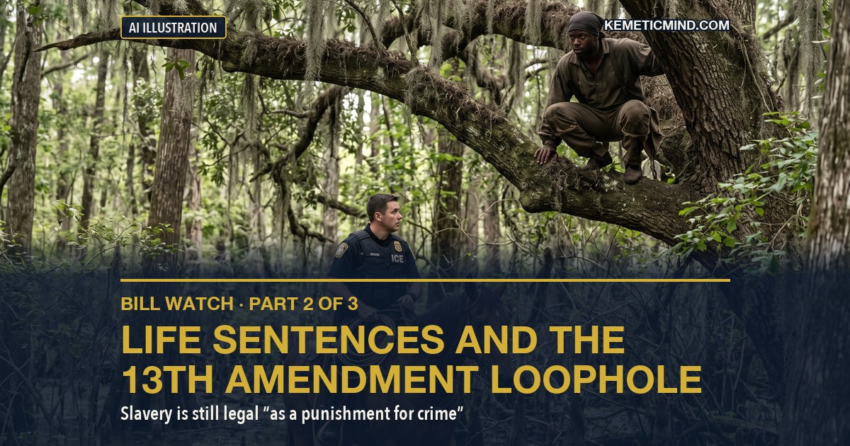
The featured image is an AI-generated illustration commissioned for this series. It does not show real people or a real event.
1. The clause, and the work it still does
Mississippi’s constitution repeats the federal exception in Article 3, Section 15: “There shall be neither slavery nor involuntary servitude in this state, otherwise than in the punishment of crime, whereof the party shall have been duly convicted.”
This is not a dead letter. A 2022 report by the ACLU and the University of Chicago Law School found that nearly 800,000 incarcerated people work. They produce more than $2 billion a year in goods and more than $9 billion a year in services.[2]
They earn, on average, between 13 and 52 cents an hour. In seven states, including Mississippi, most prison jobs pay nothing at all.[2]
More than 76% of incarcerated workers surveyed said they were required to work or faced punishment, such as solitary confinement or losing a chance at a shorter sentence.[2]
2. Why a life sentence for presence changes the math
Under federal law, simply being in the U.S. without status is usually not a crime at all. The Supreme Court said in 2012 that “as a general rule, it is not a crime for a removable alien to remain present in the United States.” The consequence is deportation, through civil court.
Crossing the border outside a port of entry is a federal misdemeanor, with up to six months for a first offense.
Now line those up against Mississippi’s two bills.[3][4]
| Situation | Federal law | MS SB 2114 (in force) | MS HB 1484 (died) |
|---|---|---|---|
| Living here without status | Civil; the remedy is removal | Not a crime by itself | Felony: life without parole |
| Entering outside a port of entry | Misdemeanor, up to 6 months (first offense) | Misdemeanor, at least 6 months in state custody, if entering Mississippi directly from a foreign nation | Covered by the same life sentence |
| Convicted of another crime while undocumented | Separate federal penalties | Extra felony: at least 2 years (3-5 for violent or sex crimes) | Life sentence for presence on top of it |
| Way out | Deportation | Judge can order the person returned to their country | Only if ICE agrees to deport within 24 hours; otherwise death or a governor’s act |
| Parole | Not applicable | None, per the bill title | Never |
Here is the pipeline in plain terms.
Deportation ends the state’s hold on a person. A life sentence does the opposite. It keeps the person in state custody for good, and under Section 15 of Mississippi’s constitution, a convicted person can be made to work.
HB 1484 would have built a legal route from a phone tip to a lifetime of unpaid, compulsory labor. Nothing in the bill orders anyone to work. It doesn’t have to. The Constitution already allows it, and Mississippi already pays nothing for most prison jobs.
Maybe not. Federal immigration law usually overrides state law, and a life sentence for presence would face an Eighth Amendment challenge. But the Supreme Court has upheld mandatory life without parole for a first-time drug possession conviction (Harmelin v. Michigan, 1991), and in the Fifth Circuit, which covers Mississippi, Texas’s state immigration crime can be enforced after the main challenge was dismissed on standing.[5][6]
3. Mississippi has walked this road before
None of this is new to Mississippi. Every piece of the HB 1484 pipeline has a historical match.
In November 1865, Mississippi became the first state to pass Black Codes.[7] Any Black person without a written labor contract two weeks after New Year’s Day could be jailed as a vagrant, without a jury.
“To keep jails from bursting at the seams, state legislators gave sheriffs the right to ‘hire out’ imprisoned African Americans. The people who ‘hired’ vagrants would pay the sheriffs, not the workers…”
— Mississippi Encyclopedia, “Black Codes”
Then came convict leasing. In the late 1860s, Southern prisons began leasing prisoners to plantations and industries “bereft of the cheap labor formerly supplied by slaves.” Public outrage forced Mississippi to end it in 1890, the first state to do so.[8]
What replaced it was Parchman Farm, which the Mississippi Encyclopedia describes as “a profitable and self-sustaining penal cotton plantation located on twenty thousand acres in the Yazoo Delta.” It dates Parchman to 1904.[8] It is still the Mississippi State Penitentiary.
4. It was legal. The country has never truly apologized.
Chattel slavery was not a crime in America. It was the law. The Constitution counted enslaved people as three-fifths of a person and required free states to return people who escaped.
Convict leasing was legal too. So were the Black Codes, until Reconstruction-era laws and amendments pushed back.
In 2008 the House of Representatives passed a resolution apologizing for slavery and Jim Crow.[10] It was a simple House resolution, which carries no force of law.
In 2009 the Senate passed its own apology. It ended with a disclaimer:[11]
“Nothing in this resolution—(A) authorizes or supports any claim against the United States; or (B) serves as a settlement of any claim against the United States.”
— S. Con. Res. 26, as passed by the Senate June 18, 2009
The House and Senate passed different resolutions in 2008 and 2009. No president has signed an apology into law. Congress has never passed H.R. 40, the bill to study reparations first filed in 1989.
That history matters for one reason. A government that has never formally reckoned with legal slavery has never closed the legal door it came through. The exception clause is that door.
5. Who ends up in Mississippi’s prisons
Mississippi’s own numbers show who already lives inside that exception. On October 1, 2026, the state held 21,994 people in custody. 13,624 of them were Black.[12]
HB 1484 and SB 2114 are written about immigrants. But the machinery they use is the same machinery Black Mississippians already know: county sheriffs, jails and the Department of Corrections, all of which are now signing up with ICE.
Black immigrants are caught in both. And citizens are not safe from it: ProPublica found that nearly all of the more than 100 Americans held after agents questioned their citizenship were people of color.[14]
6. Could slavery come back? Here is what is possible
The honest answer is that the legal opening never closed. What changes is who gets pushed through it. Three things to watch:
And one thing that would close it.
| Year | State | What happened |
|---|---|---|
| 2018 | Colorado | Removed its slavery exception |
| 2020 | Nebraska, Utah | Removed |
| 2022 | Alabama, Oregon, Tennessee, Vermont | Removed |
| 2024 | Nevada | Removed (Question 4, 60.6% yes) |
| 2024 | California | Proposition 6 failed, 47% to 53% |
| — | Mississippi | Exception still in Article 3, Section 15 |
In Washington, the Abolition Amendment would strike the exception from the 13th Amendment. It was filed again on September 15, 2026, as H.J.Res. 216 in the House, led by Rep. Nikema Williams of Georgia with 54 cosponsors, and S.J.Res. 214 in the Senate, led by Sen. Jeff Merkley of Oregon. Both sit in the Judiciary committees.[17][18]
What comes next
Every stage of this pipeline has someone getting paid. Part 3 follows the money, looks at the guardrails Project 2025 would remove, and ends with a plan you can use.
The Controversial Bills Tracker follows SB 2114, HB 1484 and the Abolition Amendment, with an action plan for each.
Check it yourself: the sources
Primary sources are the documents and agencies themselves. Secondary sources are reporting and research built on them. Tertiary sources are reference works.
- Primary National Archives, 13th Amendment to the U.S. Constitution: Abolition of Slavery (1865). archives.gov
- Secondary ACLU and University of Chicago Law School Global Human Rights Clinic, Captive Labor: Exploitation of Incarcerated Workers (2022). aclu.org
- Primary Mississippi Legislature, House Bill 1484 (2025 Regular Session), as introduced by Rep. Justin Keen. billstatus.ls.state.ms.us
- Primary Mississippi Legislature, Senate Bill 2114 (2026 Regular Session), as sent to the governor. billstatus.ls.state.ms.us
- Secondary The Texas Tribune, Federal court lets Texas immigration law take effect (Apr. 24, 2026). texastribune.org
- Secondary FOX 7 Austin, Texas can enforce controversial immigration law, US appeals court decides (May 29, 2026). fox7austin.com
- Secondary Mississippi Encyclopedia (Center for Study of Southern Culture), Black Codes. mississippiencyclopedia.org
- Secondary Mississippi Encyclopedia, Convict Leasing and Chain Gangs. mississippiencyclopedia.org
- Secondary Jackson State University’s The Flash, Finally, Mississippians are free at last (Feb. 28, 2013), on the state’s 1995 ratification being filed in 2013. sites.jsums.edu
- Primary U.S. House of Representatives, H. Res. 194 (110th Congress), apologizing for slavery and Jim Crow, as agreed to July 29, 2008. govinfo.gov
- Primary U.S. Senate, S. Con. Res. 26 (111th Congress), as passed by the Senate June 18, 2009, including its disclaimer. govinfo.gov
- Primary Mississippi Department of Corrections, Monthly Fact Sheet as of October 1, 2026 (inmates by race and sex). mdoc.ms.gov
- Primary U.S. Census Bureau, QuickFacts: Mississippi. census.gov
- Secondary Democracy Now!, headline on ProPublica’s count: 500+ U.S. citizens have been detained by ICE (Oct. 7, 2026). democracynow.org
- Tertiary Ballotpedia, Nevada Question 4 (2024), and the list of states that removed their slavery exceptions. ballotpedia.org
- Tertiary Ballotpedia, California Proposition 6 (2024). ballotpedia.org
- Primary Congress.gov, H.J.Res. 216 (119th Congress), proposing an amendment to prohibit slavery and involuntary servitude as a punishment for crime. congress.gov
- Primary Congress.gov, S.J.Res. 214 (119th Congress), the Senate companion. congress.gov
Investigative methodology: this series was written by a person from the documents cited above. Bill language is quoted from the legislature’s own copies. In Part 1, Mississippi’s 287(g) counts were tallied row by row from ICE’s participating-agencies spreadsheet dated Oct. 14, 2026 (rows where the state is Mississippi), and custody deaths were counted from ICE’s death-reporting page as updated Sept. 23, 2026. Where Project 2025 is compared with what has happened since, the comparison shows that the two line up; it does not show that the book caused any particular law.

Kemetic Minds Editorial Desk
Verified NewsroomPrimary-sourced investigative intelligence on civil rights, voting rights, federal policy, and consumer protection. Sourced from primary legal filings, government statistics, and direct field reporting.