KEMETIC MINDS
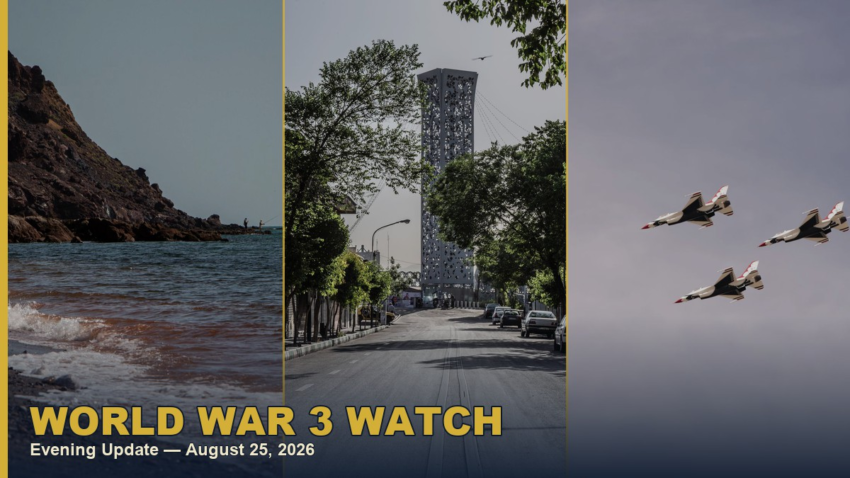
World War 3 Watch — Evening Update — August 25, 2026
- Trump claims all mines in the Strait of Hormuz’s “international waters” have been cleared or detonated, and warns Iranian mine-laying ships will be destroyed (Cnbctv18, 2026; 美国之音, 2026a, authors’ translation).
- Rubio has told foreign counterparts the U.S. is not expected to launch new strikes on Iran “for the time being” (MSN, 2026a; MSN, 2026b).
- Tehran says it has a “two-year plan” to withstand the “Economic D-Day” sanctions push (Fox News, 2026).
- Iran and Oman are proposing a “joint temporary navigational corridor” and joint mine-clearance work in the strait (Boston Herald, 2026).
- U.S. sanctions on Iran already involve Chinese and Hong Kong companies, but have not yet touched China’s large financial institutions (美国之音, 2026b, authors’ translation).
The Story So Far
Tonight’s Iran war briefing is a study in two tracks. Washington is declaring the Strait of Hormuz’s “international waters” demined while simultaneously telling allies it will pause new strikes and lean harder on sanctions (Cnbctv18, 2026; MSN, 2026a).
Rubio has told several foreign counterparts that “for the time being” the U.S. is not expected to initiate new strikes (MSN, 2026a). Iran is answering with a “two-year plan” for what it calls an “Economic D-Day” sanctions push (Fox News, 2026).
Diplomacy is moving, too: Iranian and Omani foreign ministers met in Tehran on Tuesday to discuss a phased approach to managing ship traffic through the largely shut strait (Boston Herald, 2026).
For a deeper look at how these same theaters are narrated, see our narrative-comparison report on how US, Israeli, Iranian, and BRICS media each tell this war.
Video: Canada Doubles Tariffs on US Steel Products up to 50% | Balance of Power 08/25/2026. Source: Bloomberg Television.
1. Strait of Hormuz: Trump Declares “International Waters” Demined
Three Chinese-language dispatches all lead with the same Trump claim today. Beijing News says Trump asserts all mines in the strait’s “international waters” have been cleared (新京报, 2026a, authors’ translation).
Voice of America’s Chinese service goes further, carrying Trump’s warning that Iranian mine-laying ships “will be destroyed” (美国之音, 2026a, authors’ translation). 21财经 phrases the same claim as “cleared or detonated” (21财经, 2026, authors’ translation).
English-language coverage carries the same claim in a slightly different frame. Cnbctv18’s headline says the strait “has been demined” and that Trump “warns Iran not to plant more” (Cnbctv18, 2026).
The difference in emphasis is visible: Chinese-language dispatches give the mine-clearance claim its own headline, while English outlets pair it with the new sanctions pivot (MSN, 2026a; MSN, 2026b).
Video: BREAKING: 20 Killed, Dozens Injured As Ships Come Under Attack In Hormuz Amid Iran-U.S. War. Source: Times Of India.
2. Rubio’s Strike Pause and the Sanctions Escalation
Rubio has told allies this week that “for the time being” the U.S. is not expected to initiate new strikes (MSN, 2026a). A second MSN report frames the same message as a pause “in lieu of economic war” (MSN, 2026b).
The economic track already has a name. Cnbctv18’s live blog describes “Operation Economic Outcast,” targeting Iran’s oil networks and five key economic sectors (Cnbctv18, 2026).
MSN notes Iran’s top trade partners include China, Iraq, Turkey and the UAE — but the administration has not said who new sanctions would target, or how (MSN, 2026c).
Beijing News also carried Rubio’s message, reporting that the U.S. “does not plan for now” to launch a new round of strikes against Iran (新京报, 2026b, authors’ translation).
3. Tehran’s Two-Year Plan vs “Economic D-Day”
Iran is presenting the sanctions push as a test it expects to pass. According to Fox News, Tehran says Trump’s “Economic D-Day” will result in “another defeat” for the U.S. (Fox News, 2026).
The same report carries Iran’s claim of a “two-year plan” to manage the sanctions (Fox News, 2026). The framing is explicitly military, even though the weapon is economic.
Rubio’s “for the time being” language leaves the military option on the table (MSN, 2026b). Tehran’s two-year timeline suggests preparation for a long siege rather than a short shock.
4. Iran and Oman Propose a Temporary Shipping Corridor
On the diplomatic track, Omani Foreign Minister Badr al-Busaid met Iranian counterpart Abbas Araghchi in Tehran on Tuesday (Boston Herald, 2026).
A joint statement proposes a “joint temporary navigational corridor” in the strait, with both countries working to clear mines (Boston Herald, 2026). Technical talks toward a permanent corridor and an agreement on future administration of the waterway are to continue.
The talks follow a Monday-night attack off Oman that disabled an oil tanker’s engine. The British military’s United Kingdom Maritime Trade Organization reported all crew safe, with no immediate reports of environmental impact (Boston Herald, 2026).
The context is stark: roughly a fifth of the world’s traded oil passed through the strait before the U.S. and Israel attacked Iran on Feb. 28, and the waterway remains largely shut down nearly six months later (Boston Herald, 2026).
Whether Washington accepts the emerging deal is unknown (Boston Herald, 2026). Trump threatened last week to bomb Oman if it “gets in the way” of American efforts to reopen the strait.
A Pakistani military delegation left Tehran on Tuesday after talks on reviving negotiations to end the Iran-U.S. conflict (Boston Herald, 2026). Iran periodically fires at vessels attempting to transit the strait to enforce its control, the same report notes.
5. Beijing Watches Sanctions Creep Toward Its Banks
The China thread in today’s sources runs through sanctions, not the Taiwan Strait. Voice of America’s Chinese service reports that U.S. sanctions on Iran already involve Chinese and Hong Kong companies — but asks why they have not yet touched China’s large financial institutions (美国之音, 2026b, authors’ translation).
That question matters because China is one of Iran’s top trade partners (MSN, 2026c). If Washington’s next tranche names a major Chinese bank, the economic war gains a second front.
English-language coverage treats China mainly as a trade partner whose exposure is still unspecified (MSN, 2026c). Chinese-language coverage is asking a sharper question: when do the sanctions reach the big banks?
No source in today’s dispatch reports such a designation. The absence of that news, for now, is the story.
Is This Actually World War 3?
The honest read of today’s sources is that the military front is cooling rather than widening. Rubio’s “for the time being” caveat keeps the door open, but the fastest-moving news is in sanctions, corridor diplomacy and shipping management (MSN, 2026b; Boston Herald, 2026).
That is still a war, just one fought through oil revenue, blacklists and bank exposure instead of airstrikes. Whether it earns the “World War 3” label depends on whether Beijing’s financial institutions get pulled in (美国之音, 2026b, authors’ translation).
Today they have not been. That is the most important non-event in this evening’s dispatch.
What You Can Do Right Now
- Watch for Washington’s response to the Iran-Oman “joint temporary navigational corridor” proposal — the clearest near-term signal of whether Hormuz shipping reopens (Boston Herald, 2026).
- Track the next U.S. sanctions tranche for a major Chinese bank; Chinese-language coverage is already asking why that hasn’t happened yet (美国之音, 2026b, authors’ translation).
- Re-read our survival skills and preparedness guide while this war is fought with blacklists, not bombs — basics are easier to sort out in a quiet week.
SUPPORT KEMETIC MINDS
Enjoying this coverage? Back the work and find every way to connect with us in one place.
Support the Page →Kemetic Minds Analysis
This roundup pulled directly from the day’s English- and Chinese-language wires side by side, because the gap between what each side chooses to report is often as informative as any single strike count. Treat the Key Takeaways above as the verified factual floor, and the framing differences noted in the sections above as the more interesting, harder-to-fake signal about where this war is actually headed next.
References
- MSN. (2026, August 25). Rubio tells allies US shifting from strikes to sanctions on Iran. msn.com
- Cnbctv18. (2026, August 25). US-Iran War highlights: Trump says Strait of Hormuz has been demined, warns Iran not to plant more. cnbctv18.com
- Bostonherald. (2026, August 25). Iran and Oman hold talks on managing the Strait of Hormuz and other news from around the Middle East. bostonherald.com
- Fox News. (2026, August 25). Iran says it has '2-year' plan to withstand Trump 'Economic D-Day' sanctions. foxnews.com
- MSN. (2026, August 25). Rubio says US strikes on Iran paused ‘for the time being’ in lieu of economic war. msn.com
- MSN. (2026, August 25). The US is escalating its economic war on Iran. Here's what that means.. msn.com
- 新京报. (2026, August 25). 特朗普称霍尔木兹海峡“国际水域”水雷均已清除 [Trump claims all mines cleared from Strait of Hormuz 'international waters]. bjnews.com.cn
- 美国之音. (2026, August 25). 特朗普总统:霍尔木兹海峡所有水雷都被清除,伊朗布雷船只将被击毁 [President Trump: All mines cleared from Strait of Hormuz, Iranian mine-laying vessels will be destroyed.]. voachinese.com
- 21财经. (2026, August 25). 特朗普:霍尔木兹海峡国际水域内的所有水雷均已被清除或引爆 [Trump: All mines in international waters of the Strait of Hormuz have been cleared or detonated.]. m.21jingji.com
- 新京报. (2026, August 25). 鲁比奥称美国暂不计划对伊朗发动新一轮打击 [Rubio says US currently has no plans for new strikes on Iran]. bjnews.com.cn
- 美国之音. (2026, August 25). 美国对伊朗制裁涉及中国和香港企业,但为什么还没有触及中国的大型金融机构? [US sanctions on Iran implicate Chinese and Hong Kong firms, but why have China's major financial institutions yet to be targeted?]. voachinese.com
Investigative Methodology: This roundup is generated on a fixed schedule (noon and evening, America/Chicago) from live English- and Chinese-language wire sources. Every claim is grounded in fetched source text with an APA7 in-text citation; translated Chinese-language quotes are marked “authors’ translation.” Every video embed is verified to be a real, existing video via YouTube’s oEmbed endpoint before publication — none are written by the drafting model. No Wikipedia sources are used.
Stay Connected

Kemetic Minds Editorial Desk
Verified NewsroomPrimary-sourced investigative intelligence on civil rights, voting rights, federal policy, and consumer protection. Sourced from primary legal filings, government statistics, and direct field reporting.