KEMETIC MINDS
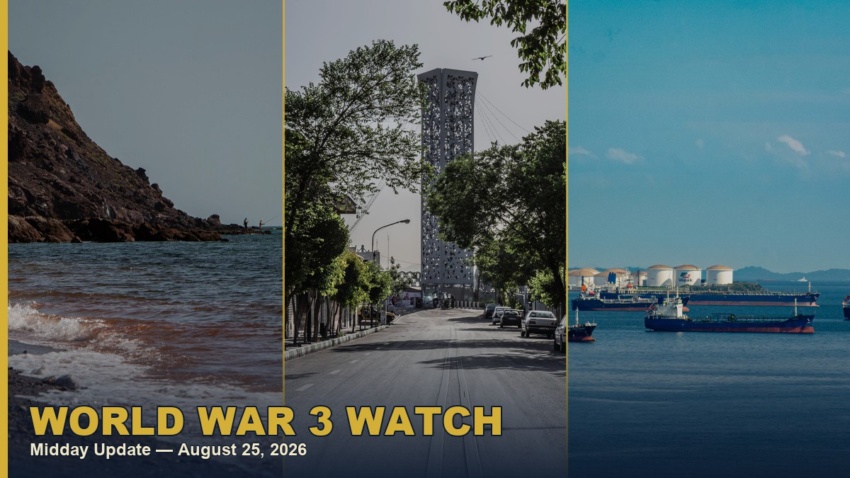
World War 3 Watch — Midday Update — August 25, 2026
- A tanker was struck by an unknown projectile off Oman’s coast, its engine room damaged and the vessel left not under command (MSN, 2026; VOA Chinese, 2026, authors’ translation).
- Iran and Oman are edging toward an interim agreement on managing Strait of Hormuz shipping — the first diplomatic progress in weeks (FT, 2026).
- Washington launched “Operation Economic Outcast,” a financial blitz Treasury Secretary Scott Bessent called an “economic D-Day” (BBC, 2026, authors’ translation).
- Gas lines in Tehran now stretch past two hours as inflation runs double-digit and the rial hits record lows (Newsday, 2026).
- Analysts tie Washington’s decision not to sanction China to Xi Jinping’s Sept. 24 U.S. visit, and say Iran can survive without China pressure (BBC, 2026, authors’ translation; MSN, 2026).
- English coverage leads with mines and missiles; Chinese-language coverage leads with finance and the Beijing factor (Moneycontrol, 2026; BBC, 2026, authors’ translation).
The Story So Far
The Strait of Hormuz recorded a fresh tanker strike early this week even as Iran and Oman edged toward the first diplomatic agreement on the waterway in weeks (MSN, 2026; FT, 2026).
Washington has shifted from bombs to balance sheets, with Treasury Secretary Scott Bessent unveiling an “economic D-Day” meant to sever Tehran from the global financial system (BBC, 2026, authors’ translation).
In Tehran, drivers queue for hours at gas stations, and the rial is at a record low (Newsday, 2026).
The war’s biggest unanswered question is Beijing: analysts in both the English- and Chinese-language press agree the sanctions may not work without China on board (MSN, 2026; BBC, 2026, authors’ translation).
Video: Strait Of Hormuz On Edge! Oil Tanker Hit By Missile Near Oman | Iran In Focus | World News | ET Now. Source: ET Now.
1. New Tanker Strike Hits Hormuz as Diplomacy Creeps Forward
A tanker was struck by an unknown projectile off the coast of Oman, Britain’s UKMTO reported, leaving the engine room damaged and the vessel not under command (MSN, 2026; VOA Chinese, 2026, authors’ translation).
Crew members were safe, and the environmental impact was still unclear at the time of reporting (VOA Chinese, 2026, authors’ translation).
Trump responded by declaring that U.S. forces have cleared all mines from the Strait and warning Iran against any fresh attempt to block the waterway (Moneycontrol, 2026).
He has also said the U.S. has no plans to negotiate and that American forces control the Strait — and will keep controlling it (VOA Chinese, 2026, authors’ translation).
The strike landed as Tehran vowed retaliation for the U.S. economic offensive (MSN, 2026).
Yet the same 24 hours produced the war’s first hint of diplomatic movement: Iran and Oman edged toward an interim agreement on managing shipping through the Strait (FT, 2026).
Omani Foreign Minister Badr Albusaidi went to Tehran on Tuesday for talks with Iranian Foreign Minister Abbas Araghchi, with both sides confirming they are negotiating the Strait’s management (VOA Chinese, 2026, authors’ translation).
Kpler data shows why the diplomacy matters: traffic through the Strait ticked up last week, but loaded vessels fell while sanctioned vessels rose (VOA Chinese, 2026, authors’ translation).
Qatar’s Foreign Ministry spokesman called for navigation to return to its pre-crisis state and backed mediation, while Pakistan’s interior minister said talks with Tehran had made “significant progress” (VOA Chinese, 2026, authors’ translation).
Video: US IRAN WAR LIVE: Iran 'Strikes Enemy Ship' After Trump Unleashes Economic War Against Tehran. Source: Firstpost.
2. “Economic Outcast”: The Anatomy of America’s Financial Blitz
Bessent’s Monday announcement, branded Operation Economic Outcast, was billed as the largest financial offensive in Iran’s history — a campaign to cut off revenue that funds the Islamic Revolutionary Guard Corps (BBC, 2026, authors’ translation).
He compared it to the Normandy landings as an “economic D-Day,” promising a zero-loophole policy: “We will not give this regime any minimum breathing space” (BBC, 2026, authors’ translation).
The Chinese-language press maps the offensive in three moves: squeezing Iran’s international financial space, cutting non-oil foreign-exchange channels in aviation, shipping, gold, digital assets and technology, and sanctioning roughly 60 entities, individuals and vessels (Sichuan Online, 2026, authors’ translation).
The same reporting notes Washington suspended licenses covering educational activities, personal remittances, sports and academic exchanges — severing civilian as well as military ties (Sichuan Online, 2026, authors’ translation).
Gulf states are watching warily, weighing support for the sanctions against the risk of escalation on their own doorsteps (MSN, 2026).
Video: Breaking News: Trump's Big Declaration Amid Hormuz Standoff, Says 'All Mines Removed Or Detonated'. Source: India Today.
3. Tehran’s Lines, Tehran’s Resolve
In Tehran, the blockade is visible at the pump: lines outside gas stations have stretched for two hours or more as drivers fill up whenever their tanks drop to half (Newsday, 2026).
“I rush to the filling stations whenever my tank is down to half or so,” said Hashem Abadi, a 34-year-old barber (Newsday, 2026).
Double-digit inflation and a record-low rial are squeezing even basic groceries, with one shopkeeper reporting that regular customers “buy now and pay later” (Newsday, 2026).
Bessent has vowed to fully sever Iran from the global economy, and Iranian officials are now discussing cuts to heavy fuel subsidies (Newsday, 2026).
So far, the report finds, there is no sign the pain has brought Iran’s leaders to their knees — nor reignited the January protests (Newsday, 2026).
President Masoud Pezeshkian accused the United States of resorting to economic pressure, while Trump countered on Truth Social that Tehran is killing protesters while unable to pay its own military (Newsday, 2026; VOA Chinese, 2026, authors’ translation).
Trump’s claim — that Iran has killed more than 52,000 protesters in four months — is an allegation by the president, not an independent finding (VOA Chinese, 2026, authors’ translation).
Chinese-language analysis argues Iran has four supports: a sanctions-forged “resistance economy” of shadow fleets and underground exchange networks, the Hormuz choke-point itself, residual military options against U.S. oil interests, and flexible Gulf diplomacy that has won Iraq and Oman special shipping arrangements (Sichuan Online, 2026, authors’ translation).
4. The China Question: Why Beijing Got a Pass
China is Iran’s largest oil buyer, and Bessent’s sanctions list conspicuously did not name Beijing, even as he warned that no country stands outside the scope of U.S. action (BBC, 2026, authors’ translation).
“If they facilitate transactions and are part of the ecosystem that turns Iranian oil into money and then into repression, they will become targets,” Bessent said (BBC, 2026, authors’ translation).
Analysts read the omission politically: former White House official Peter Harrell said it is hard to imagine truly severe sanctions on China in the coming weeks, with Xi Jinping’s Sept. 24 visit to Washington looming (BBC, 2026, authors’ translation).
The list did strike at Hong Kong, naming Sweet Ocean Industrial, a procurement network accused of helping Iran’s UN-sanctioned Malek Ashtar University of Technology obtain laser optics and other sensitive goods (BBC, 2026, authors’ translation).
China’s Foreign Ministry spokesman Lin Jian called the measures illegal unilateral sanctions and said Beijing “will take all necessary measures to firmly safeguard its own rights and interests” (BBC, 2026, authors’ translation).
English-language analysts reached a blunt conclusion: without meaningful sanctions on China, Iran will likely survive this round of financial punishment (MSN, 2026).
The Chinese-language BBC dispatch adds that some tankers carrying Iranian oil remain parked near Singapore, but the naval blockade has choked off most new oil flows to China and elsewhere (BBC, 2026, authors’ translation).
5. Two News Cycles, One War
The same 24 hours produced strikingly different front pages. English-language coverage led with mines, missiles and maritime strikes — Trump’s cleared-waterway claim, the tanker hit and Gulf unease (Moneycontrol, 2026; MSN, 2026).
Chinese-language coverage led with finance and great-power math: the economic D-Day framing, Iran’s four support pillars and the question in its own headlines — why Washington spared Beijing (BBC, 2026, authors’ translation; Sichuan Online, 2026, authors’ translation).
Only the Chinese press carried the numbers that put the sanctions in context: Trump’s approval rating at 33 percent, the U.S. national debt past $40 trillion, and a calculation that closing Hormuz for one quarter would add 0.6 percentage points to U.S. inflation (Sichuan Online, 2026, authors’ translation).
Only the Chinese press foregrounded the Sept. 24 Xi-Trump summit as the reason the sanctions were calibrated around China (BBC, 2026, authors’ translation).
Where the two news cycles agree is on outcome: neither finds evidence that the sanctions will break Tehran’s leadership (Newsday, 2026; Sichuan Online, 2026, authors’ translation).
For a deeper look at how U.S., Israeli, Iranian and BRICS outlets are each narrating this same war, see our narrative-comparison report.
Is This Actually World War 3?
Today’s sources describe something real and brutal: a war nearly six months old, launched by President Donald Trump and Israel, with a naval blockade, a financial offensive and a fresh maritime strike on top of it (Newsday, 2026; MSN, 2026).
China hovers over every dispatch as the economic arbiter — yet none of today’s reporting shows major-power armies engaged against each other (BBC, 2026, authors’ translation).
What these sources document is a world war fought by other means: tankers, mines, gas lines, dollar clearance and shuttle diplomacy, with the Strait of Hormuz as the global economy’s jugular (FT, 2026; Sichuan Online, 2026, authors’ translation).
Whether that widens into direct great-power conflict is, on today’s evidence, unresolved — but the economic front lines are already drawn.
What You Can Do Right Now
- Track Hormuz daily: a one-quarter closure could add roughly 0.6 percentage points to U.S. inflation, with global fuel and food prices following (Sichuan Online, 2026, authors’ translation).
- Review our survival skills and preparedness guide for practical steps on fuel, food and cash reserves in a supply-shock scenario.
- Read across languages: the gap between what English and Chinese outlets report — the Xi summit, U.S. debt, approval ratings — shapes where this war goes next (BBC, 2026, authors’ translation; MSN, 2026).
SUPPORT KEMETIC MINDS
Enjoying this coverage? Back the work and find every way to connect with us in one place.
Support the Page →Kemetic Minds Analysis
This roundup pulled directly from the day’s English- and Chinese-language wires side by side, because the gap between what each side chooses to report is often as informative as any single strike count. Treat the Key Takeaways above as the verified factual floor, and the framing differences noted in the sections above as the more interesting, harder-to-fake signal about where this war is actually headed next.
References
- Ft. (2026, August 25). Iran and Oman edge towards deal on Strait of Hormuz. ft.com
- MSN. (2026, August 25). New tanker strike in Hormuz as Iran vows retaliation for US economic offensive. msn.com
- Moneycontrol. (2026, August 25). Trump says US has cleared all mines from Strait of Hormuz, warns Iran against any fresh attempt to block the waterway. moneycontrol.com
- MSN. (2026, August 25). Sanctions or missiles? Why Gulf may not relish Trump’s new Iran approach. msn.com
- Newsday. (2026, August 25). There are gas lines in Iran, but no sign yet that its leaders will bow to US sanctions. newsday.com
- MSN. (2026, August 25). Will the US sanctions against Iran work if they don't include China?. msn.com
- BBC. (2026, August 25). 美国制裁伊朗经济新措施 为何对中国“松手”? [Why Did the U.S. Go Easy on China in Its New Iran Sanctions?]. bbc.com
- 四川在线. (2026, August 25). 美国“经济战”使出3招,伊朗自有4大支撑丨夜观天下 [US 'Economic War' Uses 3 Tactics, Iran Has 4 Pillars of Its Own | Night View of the World]. focus.scol.com.cn
- 美国之音. (2026, August 25). 特朗普总统:伊朗无力支付军饷,在制裁加剧之际杀害抗议者 [President Trump: Iran Unable to Pay Military Salaries, Kills Protesters Amid Intensifying Sanctions]. voachinese.com
Investigative Methodology: This roundup is generated on a fixed schedule (noon and evening, America/Chicago) from live English- and Chinese-language wire sources. Every claim is grounded in fetched source text with an APA7 in-text citation; translated Chinese-language quotes are marked “authors’ translation.” Every video embed is verified to be a real, existing video via YouTube’s oEmbed endpoint before publication — none are written by the drafting model. No Wikipedia sources are used.
Stay Connected

Kemetic Minds Editorial Desk
Verified NewsroomPrimary-sourced investigative intelligence on civil rights, voting rights, federal policy, and consumer protection. Sourced from primary legal filings, government statistics, and direct field reporting.