
KEMETIC MINDS
Voting & Elections — August 24, 2026
Voting by mail just got a new federal layer of paperwork. On Monday, the Supreme Court, divided 6-3 along ideological lines, let the Trump administration start enforcing an executive order that requires states to attach a tracking barcode to every mail ballot and log basic voter information in a federal portal before that ballot goes out[1][2]. The court did not rule the policy legal — it said the states that sued moved too fast, and the fight over whether the rule itself survives is “far from over,” in the words of one of the officials challenging it[1].
Key Takeaways
- The Supreme Court ruled 6-3 to let the administration begin implementing the barcode/ID-portal rule for mail ballots ahead of the November 2026 midterms[2].
- The ruling was procedural, not a final word on legality — the justices said the lawsuit was filed too early, leaving the door open to future challenges[2].
- Nationwide, 1.2% of mail ballots were rejected in the 2024 election, the highest raw rejection count since 2016[3].
- Nearly 41% of 2024 mail-ballot rejections were for a signature that didn’t match the one on file[3].
- Peer-reviewed research has found no evidence that voting by mail itself increases voter fraud[4], and separate research points to inconsistent human review, not the voters themselves, as a driver of unequal signature rejections[5].
What’s Changing
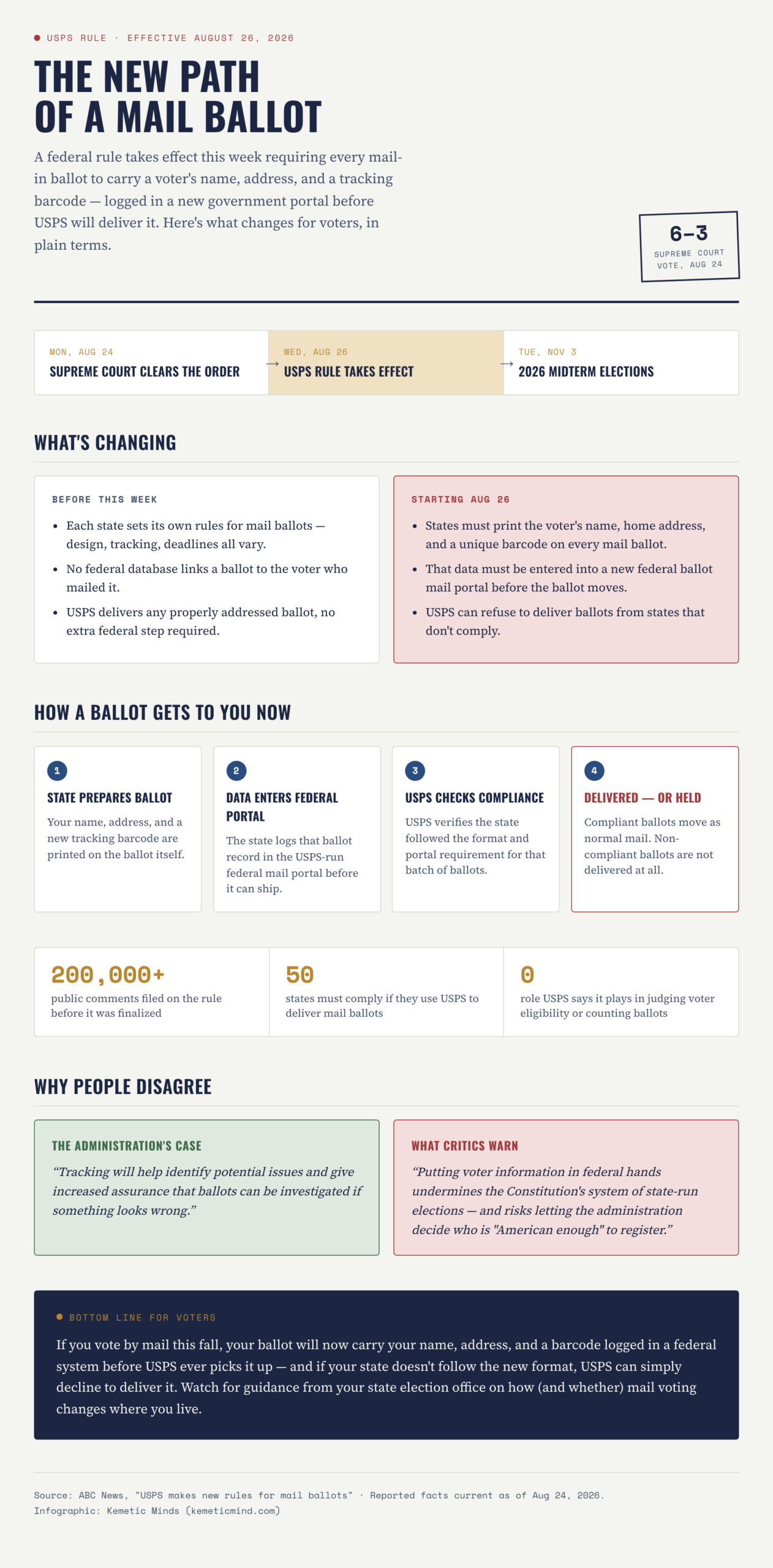
The executive order directs the Department of Homeland Security to compile “state citizenship lists” of eligible voters and orders the Postal Service to deliver mail ballots only to people on that list, with a barcode tying each ballot to a tracked, verified record[1][2]. The White House called the measures “commonsense,” saying they “protect the security of mail-in ballots and ensure only Americans are electing American leaders”[2].
New York Attorney General Letitia James, one of the officials who sued to block the order, called Monday’s ruling “a painful setback” but said “it will not be the final word”[1]. California Gov. Gavin Newsom said his state would file a new legal challenge to the policy[1].
How a Ballot Gets to You Now
Under the new rule, a state must first log a voter’s name and address in the federal portal, generate a unique barcode tied to that record, and only then have the Postal Service release the ballot for delivery[6]. Roughly 22 states plus California had gotten a court order blocking the rule for this year’s elections before Monday’s ruling lifted it[1]; a separate nationwide block on other parts of the same order, issued by the same judge, is still in effect for now, though the Justice Department is expected to argue Monday’s decision applies there too[1].
What the Numbers Actually Show
The federal government’s own election-administration data offers the clearest baseline for judging claims about mail-ballot security. The U.S. Election Assistance Commission (EAC) — the independent federal agency that collects data directly from state and local election officials — released its 2024 Election Administration and Voting Survey in June[7]. Nationwide, 1.2% of mail ballots were rejected in 2024, up from the 2016 and 2020 presidential cycles but below the 2018 and 2022 midterms[3].
Rejection rates vary enormously by state. Arkansas rejected 8.8% of mail ballots in 2024, the highest in the country and up from 6.4% in 2020[3]. Delaware and Oklahoma followed. Vermont, Maine, and Indiana each rejected just 0.2%[3].
Figure 1
2024 Mail-Ballot Rejection Rate, Highest vs. Lowest States
Note. Rejection rate as a share of all mail ballots returned, by state, 2024 general election. Source: U.S. Election Assistance Commission, 2024 EAVS, via Ballotpedia analysis.
Nationwide, the single biggest reason a ballot got tossed out wasn’t fraud — it was a signature that didn’t match the one on file, which accounted for about 41% of all rejections[3].
Figure 2
Why Mail Ballots Got Rejected Nationwide in 2024
Note. Share of all rejected mail ballots by stated reason, 2024 general election. Source: U.S. Election Assistance Commission, 2024 EAVS, via Ballotpedia analysis.
What the Research Says
Two peer-reviewed studies bear directly on the two competing arguments in this debate: does mail voting increase fraud, and are signature-matching rules applied fairly?
A 2021 study in Statistics and Public Policy examined what happened to reported voter fraud in states that switched to voting by mail, and found no evidence that the shift increased fraud risk overall — the authors estimated Washington State would have seen only about 80 more fraud cases without vote-by-mail, out of millions of ballots cast[4].
Meanwhile, a 2026 study in Political Research Quarterly examined why signature-based mail-ballot rejections fall unevenly across racial groups, testing whether the gap comes from voter-side factors or from inconsistency in how election officials evaluate signatures — concluding that evaluator-side review, not voters themselves, is the primary driver of the disparity[5]. That finding is directly relevant to a rule that leans even more heavily on identity verification: if the review process itself is inconsistent, adding a new verification layer doesn’t fix that on its own.
Why People Disagree
Supporters of the rule argue that ballot tracking and identity verification are basic security measures that most other forms of voting already have, and that the administration is well within its authority to require them[2].
Critics, including the states that sued and the three dissenting justices, argue the Constitution gives states — not the president — the primary authority to run their own elections, and that the ruling only delays that fight rather than resolving it[2][1].
“Today’s decision does not address whether the President’s attempts to interfere with States’ administration of the November 2026 elections are lawful. Nor does it suggest that the Executive Branch has any constitutional or statutory authority to implement the President’s directives.”
Justice Sonia Sotomayor, dissenting — joined by Justice Elena Kagan — Read the full report →
Video: Supreme Court clears way for Trump's mail-in voting order. Source: ABC News.
SUPPORT KEMETIC MINDS
Enjoying this coverage? Back the work and find every way to connect with us in one place.
Support the Page →References
- Hurley, L. (2026, August 24). Supreme Court hands preliminary win to Trump on mail-in ballots executive order. NBC News. ↩a ↩b ↩c ↩d ↩e ↩f ↩g ↩h
- CBS News. (2026, August 24). Supreme Court allows Trump to implement key parts of order restricting mail voting ahead of midterms. ↩a ↩b ↩c ↩d ↩e ↩f ↩g
- Ballotpedia News. (2025, August 18). Nationwide mail-in ballot rejection rate was 1.2% in 2024, higher than in 2016 and 2020. ↩a ↩b ↩c ↩d ↩e ↩f
- Auerbach, J., & Pierson, S. (2021). Does voting by mail increase fraud? Estimating the change in reported voter fraud when states switch to elections by mail. Statistics and Public Policy, 8(1), 18–41. ↩a ↩b
- Herndon, M., Oskooii, K. A. R., & Rios, M. (2026). Bureaucratic bias or voter-side factors? Testing competing explanations for racial gaps in vote-by-mail ballot signature rejections. Political Research Quarterly. ↩a ↩b
- ABC News. (2026, August). USPS makes new rules for mail ballots. ↩
- U.S. Election Assistance Commission. (2025, June 30). U.S. Election Assistance Commission releases 2024 Election Administration and Voting Survey (EAVS) report. ↩
Reporting Methodology: This explainer is grounded in reporting from ABC News, NBC News, and CBS News on the August 24, 2026 Supreme Court ruling; official 2024 election administration data from the U.S. Election Assistance Commission (via Ballotpedia’s state-by-state analysis); and two peer-reviewed studies (Auerbach & Pierson, 2021; Herndon, Oskooii & Rios, 2026). Every factual claim and chart is tied to a numbered footnote citation, and nothing is written from the model’s general knowledge. The infographic is hand-built HTML/CSS, not AI-generated imagery; both charts are built from the EAC’s own published 2024 EAVS figures.
Stay Connected

Kemetic Minds Editorial Desk
Verified NewsroomPrimary-sourced investigative intelligence on civil rights, voting rights, federal policy, and consumer protection. Sourced from primary legal filings, government statistics, and direct field reporting.