KEMETIC MINDS
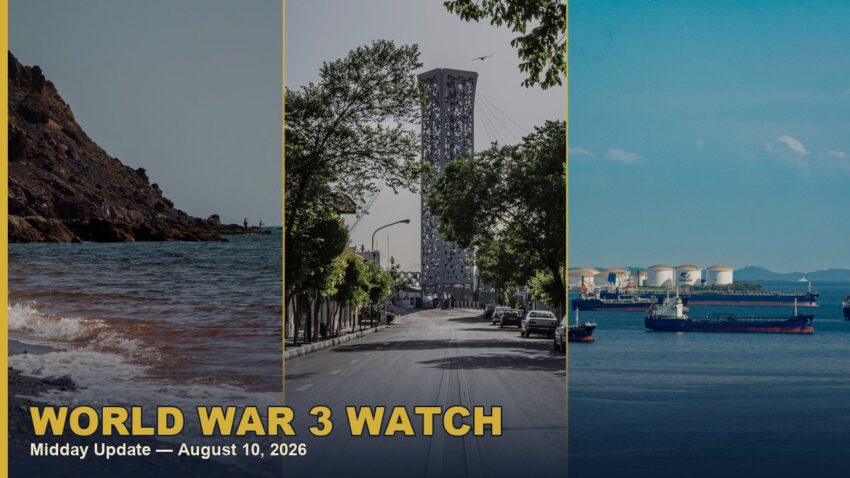
World War 3 Watch — Midday Update — August 10, 2026
Key Takeaways
- Iran’s foreign ministry said the Strait of Hormuz will not reopen while the US blockade continues, demanding sanctions relief, reparations, reconstruction funding, and an end to military threats (ABC News, 2026; Somasekhar, 2026; Cailianshe, 2026, authors’ translation).
- Brent crude broke $86 a barrel and WTI topped $81 as doubts grew over a US-Iran deal; US strategic reserves fell to 298.7 million barrels, the lowest since January 1983 (Cailianshe, 2026, authors’ translation).
- More than 20 US warships are enforcing the blockade, and CENTCOM says 55 commercial vessels have been redirected (Outlook India, 2026).
- Chinese commentary targeted a story US wire coverage barely touched: depleted US missile stocks, with Patriot inventory under 1,000 and THAAD down 80% (Guancha, 2026, authors’ translation).
- On the parallel Taiwan flashpoint, Beijing’s embassy in Tokyo said Taiwan is “not a country” and that no “national dignity” exists (NetEase, 2026, authors’ translation).
1. The Story So Far
Iran kept the Strait of Hormuz shut Monday and tied any reopening to US concessions — and oil markets repriced within hours (ABC News, 2026; Somasekhar, 2026).
Brent crude broke $86 a barrel for the first time since July 31, while US strategic reserves hit a 40-year low (Cailianshe, 2026, authors’ translation).
It is the latest convulsion from a war that began with US-Israeli “major combat operations” against Iran on February 28 (ABC News, 2026).
June talks produced a memorandum of understanding that has since collapsed, and the two sides have kept exchanging strikes (ABC News, 2026; Cailianshe, 2026, authors’ translation).
Washington now says it is “low-keying it”; Tehran says it is playing chess (MSN, 2026).
On the second flashpoint this series tracks, Beijing’s embassy in Tokyo answered a Taiwanese official’s “national dignity” complaint with a single blunt line (NetEase, 2026, authors’ translation).
Video: Iran demands US concessions to open Strait of Hormuz. Source: KVUE.
2. Hormuz Stays Shut: Reparations, Sanctions, and a New Sea Lane
Iran’s Foreign Ministry spokesperson Esmaeil Baqaei opened Monday’s press conference by ruling out direct talks — there are “no direct negotiations ongoing between Iran and the US,” only message exchanges through intermediaries (ABC News, 2026).
Tehran’s focus, he said, is “on advancing negotiations with Oman to determine the final destination of the shipping route,” with Iran nearing a final pact with Oman on new shipping lanes (ABC News, 2026; Abdallah et al., 2026).
“According to the agreements, the previous traffic routes will be replaced by a middle and safe route… until a new traffic separation plan is reached,” Baqaei said (ABC News, 2026).
He was equally firm about the waterway itself: “Management and security of the Strait of Hormuz is Iran’s responsibility” (ABC News, 2026).
Reopening requires US concessions on reconstruction funding, the lifting of sanctions, and other demands (ABC News, 2026).
Reuters added reparations to the list, and Chinese coverage specified “an end to military threats” as well (Somasekhar, 2026; Cailianshe, 2026, authors’ translation).
“As long as the American maritime blockade continues, the preconditions for reopening the Strait of Hormuz do not exist,” Baqaei said (Cailianshe, 2026, authors’ translation).
The same bottom line ran through US and Chinese coverage alike — no concessions, no reopened waterway (Twincities, 2026; Cailianshe, 2026, authors’ translation).
The Chinese wire filled in the backstory the English updates compressed: the June 17 memorandum of understanding that was to reopen Hormuz collapsed when the sides split over which routes ships could use (Cailianshe, 2026, authors’ translation).
Iran then attacked tankers along the Omani side and demanded vessels enter its territorial waters; the US answered with airstrikes and the blockade now in force (Cailianshe, 2026, authors’ translation).
Foreign Minister Araghchi went further on Sunday: no negotiations are underway, and none can restart until the US stops violating the memorandum and remedies its breaches (China.com, 2026, authors’ translation).
The tone remains theatrical. Trump says he is “low-keying it” and compares the talks to chess; Iran’s spokesperson shot back that Iranians “have shown they are professional chess players” (MSN, 2026).
In an Axios interview reported Sunday, Trump added: “Things will work out. It always works out. This is like playing chess” (China.com, 2026, authors’ translation).
Video: Hormuz Shutdown: Can Iran’s Economy Survive US Naval Pressure?. Source: Al Jazeera English.
3. Twenty Warships, 55 Redirected Vessels: The Blockade Tightens
While diplomats trade chess metaphors, the US Navy is tightening a noose. More than 20 warships are deployed to enforce the blockade, and CENTCOM says 55 commercial vessels have already been redirected (Outlook India, 2026).
Images released by CENTCOM show sailors standing watch on the bridge of USS Ross (DDG 71), part of the force holding the line (Outlook India, 2026).
The pressure extends past Hormuz. Iran-aligned Houthi rebels used drones to strike the Red Sea port of Mocha on Sunday (ABC News, 2026).
At least four Yemeni soldiers and three civilians were killed and more than 30 wounded, the Yemeni Armed Forces said (ABC News, 2026).
The Houthis also said they hit Saudi Aramco’s Jazan refinery, which has now delayed restart of its 400,000-barrel-a-day plant to August 30 after two attacks in recent weeks (Cailianshe, 2026, authors’ translation).
In Washington, Vice President Vance described a conflict “clearly no longer in the opening phase, but in the middle-game phase” (China.com, 2026, authors’ translation).
Iran’s Revolutionary Guard deputy commander answered from Tehran: Israel “has no strength to confront Iran” and “must wait for Iran’s response” (China.com, 2026, authors’ translation).
Video: US-Iran War Live Updates: Donald Trump May Trade Nuclear Deal for Hormuz Reopening | Iran War. Source: India Today.
4. Oil at $86: Markets Price a Longer Fight
The oil market moved first and fast. Reuters had Brent up 3% by mid-morning Monday (Somasekhar, 2026).
By the day’s end, Chinese financial coverage reported Brent through $86 a barrel — up 4%, the first time since July 31 — with WTI above $81 (Cailianshe, 2026, authors’ translation).
The surge reversed part of last week’s 7% slide, which had followed Treasury Secretary Bessent’s signal that a Hormuz deal was close (Cailianshe, 2026, authors’ translation).
Now traders are recalibrating. “As Iran raises these additional demands, most traders believe the supply-tightening phase may last longer than previously expected,” said Dennis Kissler of BOK Financial (Cailianshe, 2026, authors’ translation).
Kissler also pointed to a second supply front: Ukraine’s continued strikes on Russian refineries and Black Sea tankers, compounding the Hormuz disruption (Cailianshe, 2026, authors’ translation).
The US cushion is thinner than in four decades. The strategic petroleum reserve fell 6.1 million barrels last week to 298.7 million — the lowest since January 1983 (Cailianshe, 2026, authors’ translation).
That follows Trump’s March order to release 172 million barrels as part of a coordinated IEA action to steady global markets (Cailianshe, 2026, authors’ translation).
Trump’s own framing, from the Axios interview: oil had fallen to just above $75 a barrel, easing the pain for US consumers — a snapshot taken before Monday’s spike (China.com, 2026, authors’ translation).
5. The Ammunition Taboo: A Chinese Analyst Reads a US Weak Spot
The sharpest divergence in Monday’s coverage is what each side chose to report. English-language wires led with diplomacy and markets (Somasekhar, 2026; Abdallah et al., 2026).
The Chinese outlet Guancha ran a military analysis arguing the US has violated a cardinal wartime taboo by letting ammunition shortages become visible (Guancha, 2026, authors’ translation).
Columnist Chen Feng, citing US press reports, lays out the numbers: Patriot interceptors consumed exceed 1,500, leaving under 1,000 in inventory (Guancha, 2026, authors’ translation).
THAAD is down 80%; ATACMS and PrSM tactical ballistic missiles are essentially exhausted; Tomahawks are more than half gone (Guancha, 2026, authors’ translation).
Replacement is the bottleneck. Roughly 15 new Tomahawks and 20 new Patriots arrive per month (Guancha, 2026, authors’ translation).
PAC-3 assembly carries a 24-month lead time and its solid rocket motors 30 months (Guancha, 2026, authors’ translation).
The Pentagon wants PAC-3 output tripled and THAAD quadrupled — up to 14,000 interceptors long-term — and has even asked to restart the discontinued PAC-2 GEM-T line (Guancha, 2026, authors’ translation).
CSIS estimates restoring THAAD stocks could take three years or more (Guancha, 2026, authors’ translation).
Chen’s argument: no one can say for certain whether Trump’s halt of “the most violent attack since World War II” was caused by ammunition shortages (Guancha, 2026, authors’ translation).
“But once this becomes something the adversary suspects, it is a great taboo in wartime — and it is in fact already shaping Iran’s countermeasures and its asking price” (Guancha, 2026, authors’ translation).
That is a reading of the same day’s news that none of the English-language sources in this roundup surfaced — a gap we examined in detail in our narrative-comparison report on how US, Israeli, Iranian, and BRICS media each tell this war.
6. Taiwan’s “National Dignity” Claim Gets a One-Line Answer
The China-Taiwan flashpoint surfaced Monday through a consular door. Taiwan’s so-called representative in Japan claimed that his “national dignity” and status had been deliberately belittled, and said he had lodged a “solemn protest” (NetEase, 2026, authors’ translation).
The Chinese Embassy in Tokyo answered in a single line: “Taiwan is not a country; there is no such thing as ‘national dignity.’ Overestimating one’s own strength and scrambling to gain attention everywhere will only bring humiliation upon oneself” (NetEase, 2026, authors’ translation).
Beijing added a footnote for the record: the United Nations’ designation for Taiwan is “China’s Taiwan Province” (中国台湾省) (NetEase, 2026, authors’ translation).
Notably, none of the English-language sources in today’s set carried the exchange — the Taiwan thread appeared only in Chinese-origin coverage, a reminder that the second great-power flashpoint is being tracked most closely by Beijing’s own press (NetEase, 2026, authors’ translation).
Is This Actually World War 3?
By the strict definition, no. No source in today’s set shows US forces in combat with China or Russia; the fighting is a US-Iran regional war, and the Taiwan front is currently a war of words (ABC News, 2026; NetEase, 2026, authors’ translation).
By the economic definition, the picture is less comforting: 20-plus warships blockading the world’s most vital oil chokepoint, 55 commercial vessels diverted, and US strategic reserves at a 40-year low (Outlook India, 2026; Cailianshe, 2026, authors’ translation).
Both main actors are, for now, choosing chess over checkmate: Washington says it is “low-keying” negotiations while tightening economic pressure, and Tehran is extracting maximum concessions while reopening nothing (MSN, 2026; ABC News, 2026).
The ammunition math in the Chinese analysis points to the deeper constraint: if US stocks are as depleted as reported, neither side can afford the escalation its rhetoric implies (Guancha, 2026, authors’ translation).
That may be exactly why the fight has moved to shipping lanes and bank accounts — and why the honest verdict is a widening regional war with a global economic front, not a formal great-power war (Guancha, 2026, authors’ translation).
What You Can Do Right Now
- Treat oil headlines as supply-chain warnings: today’s 3-4% crude jump and the 55 redirected commercial vessels are early signals of moves at the pump and on store shelves in the weeks ahead (Somasekhar, 2026; Outlook India, 2026).
- Keep a practical cushion for disruption — water, food, cash, and communications — for periods when fuel and goods move unpredictably. Our survival skills and preparedness guide covers the basics.
- Follow both theaters, not one. Hormuz and the Taiwan flashpoint move on different timetables, and today’s Chinese-language coverage shows Beijing’s messaging cadence is its own (NetEase, 2026, authors’ translation).
Kemetic Minds Analysis
This roundup pulled directly from the day’s English- and Chinese-language wires side by side, because the gap between what each side chooses to report is often as informative as any single strike count. Treat the Key Takeaways above as the verified factual floor, and the framing differences noted in the sections above as the more interesting, harder-to-fake signal about where this war is actually headed next.
References
- MSN. (2026, August 10). 'Chess player' Iran says Hormuz stays shut until US pays up. msn.com
- Twincities. (2026, August 10). Iran won’t reopen Strait of Hormuz without US concessions and other Mideast developments. twincities.com
- MSN. (2026, August 10). Iran ties Hormuz reopening to US concessions on several demands. msn.com
- Outlook India. (2026, August 10). US Tightens Iran Blockade With Over 20 Warships; 55 Commercial Ships Redirected. outlookindia.com
- AOL. (2026, August 10). Iran live updates: US 'low-keying' negotiations with Iran, Trump says. aol.com
- MSN. (2026, August 10). Oil rises 3% as Iran tempers hopes of Hormuz reopening. msn.com
- 财联社. (2026, August 10). 霍尔木兹海峡重启预期降温 美国战略石油储备创40多年新低 国际油价大涨4% [Hormuz Strait reopening prospects cool down, US strategic oil reserves hit 40-year low, international oil prices surge 4%]. cls.cn
- 观察者. (2026, August 10). 伊朗战场上,美国犯了个大忌-晨枫-观察者网 [On the Iranian battlefield, the US made a major taboo]. guancha.cn
- 中华网. (2026, August 10). 美媒:特朗普倾向对伊朗经济施压而非军事打击 [US media: Trump inclined to impose economic pressure on Iran rather than military strikes]. news.china.com
- 网易新闻客户端. (2026, August 10). 中国驻日本大使馆:台湾不是国家 没有“国格” [Chinese Embassy in Japan: Taiwan is not a country and has no "statehood]. c.m.163.com
Investigative Methodology: This roundup is generated on a fixed schedule (noon and evening, America/Chicago) from live English- and Chinese-language wire sources. Every claim is grounded in fetched source text with an APA7 in-text citation; translated Chinese-language quotes are marked “authors’ translation.” Every video embed is verified to be a real, existing video via YouTube’s oEmbed endpoint before publication — none are written by the drafting model. No Wikipedia sources are used.
Stay Connected

Kemetic Minds Editorial Desk
Verified NewsroomPrimary-sourced investigative intelligence on civil rights, voting rights, federal policy, and consumer protection. Sourced from primary legal filings, government statistics, and direct field reporting.