KEMETIC MINDS
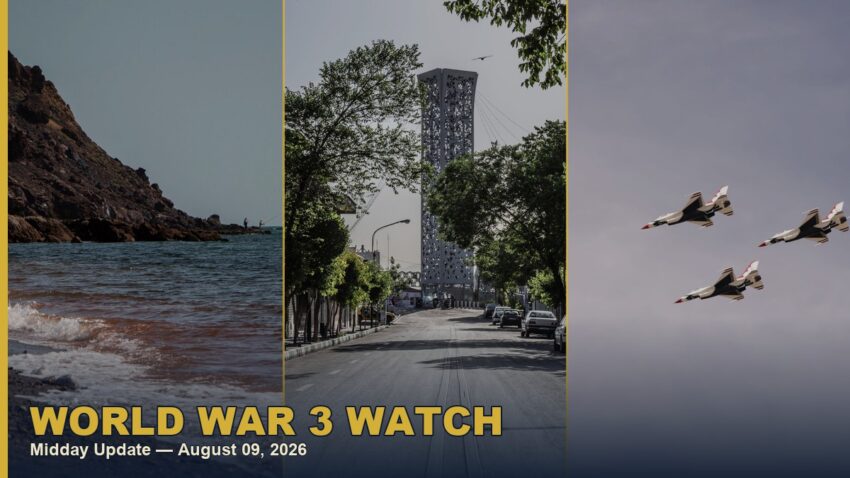
World War 3 Watch — Midday Update — August 09, 2026
- Iran says it is “very close” to an agreement with Oman on a temporary shipping route — but that does not mean the Strait of Hormuz will reopen (Sina Finance, 2026, authors’ translation).
- Tehran’s reopening conditions: a permanent end to aggression, lifting the naval blockade, US troop withdrawal from Iran’s periphery, lifting sanctions, and compensation for war damages (Sina Finance, 2026, authors’ translation; The Independent, 2026).
- US Central Command has forced 53 merchant ships to reroute and disabled two vessels under the blockade, while allowing more than 30 humanitarian ships through (Sina Finance, 2026, authors’ translation).
- Abu Dhabi’s state oil company says 15 of its vessels have been attacked since the war began — one crew member killed, 20 injured (Sina Finance, 2026, authors’ translation).
- By one count, Trump has used the same ultimatum-climbdown tactic seven times in five months of war (The Guardian, 2026b).
- Taiwan’s cabinet will propose a 2027 defense budget up 16% year-on-year, the first to top NT$1 trillion, about US$31 billion (RFI, 2026, authors’ translation).
The Story So Far
Five months into a war of choice against Iran, Washington is pressing for a deal at the Strait of Hormuz — and Tehran is raising its price (The Guardian, 2026b).
The waterway that carried a fifth of global oil and liquefied natural gas before the war stays shut, even as Iran and Oman describe their talks as close (MSN, 2026; Sina Finance, 2026, authors’ translation).
On the water, tankers keep getting hit; on land, Yemen’s Houthis are rehearsing city fighting against US and Israeli flags (Sina, 2026, authors’ translation).
Across Asia, Taipei is preparing a record defense budget against Beijing’s near-daily military pressure (RFI, 2026, authors’ translation).
Video: Bloomberg This Weekend | Iran’s New Hormuz Demands, How OpenAI Agents Broke Out, PR’s Water Crisis. Source: Bloomberg Podcasts.
1. Iran Sets Its Price for Reopening Hormuz
The diplomatic lane is busy, but it leads somewhere Tehran controls. Foreign Minister Abbas Araghchi said talks with Oman are ongoing, “we are determining a temporary route,” and “I think we are very close to reaching an agreement” (Sina Finance, 2026, authors’ translation).
His caveat landed harder than his optimism: the agreement “does not mean the Strait of Hormuz will reopen” (Sina Finance, 2026, authors’ translation). Reopening depends on other conditions, including compensation for the United States violating the memorandum of understanding (Sina Finance, 2026, authors’ translation).
Iran’s Islamic Revolutionary Guard Corps went further, saying the strait’s fate is “unrelated” to the Oman talks; full US acceptance of Iran’s conditions is what reopens the waterway (Sina Finance, 2026, authors’ translation).
Secretary of the Supreme National Security Council Zolghadr listed the terms: a permanent end to aggression against Iran and its regional allies, lifting the naval blockade, withdrawing US forces from Iran’s periphery, and lifting “illegal and unjust” sanctions (Sina Finance, 2026, authors’ translation).
“The Strait of Hormuz will remain closed until the United States corrects its behavior” (Sina Finance, 2026, authors’ translation). Tehran is also demanding compensation to reopen the strait (The Independent, 2026), and CNN reads the posture as Iran toughening its terms rather than capitulating (CNN, 2026).
Video: BREAKING | Iran Declares U.S. Defeat!! Demands Pay for War Damages. Source: Steve Ram.
2. Tankers Under Fire as the Blockade Bites
While diplomats negotiate, the blockade is doing real work. US Central Command says its forces have forced 53 merchant ships to reroute, disabled two vessels, and boarded two more, while allowing more than 30 humanitarian vessels through (Sina Finance, 2026, authors’ translation).
Crews on the USS Lincoln were shown maintaining F/A-18 Super Hornets to keep the carrier strike group battle-ready (Sina Finance, 2026, authors’ translation).
Attacks continue regardless. Abu Dhabi National Oil Company confirmed a vessel was hit by a missile while transiting the strait early on 8 August, with no injuries (Sina Finance, 2026, authors’ translation).
The company’s toll since the war began: 15 ships struck by missiles and drones, three of them this week — one crew member killed, 20 wounded (Sina Finance, 2026, authors’ translation).
The UAE Foreign Ministry condemned the “hostile act” — a detail today’s English-language briefs omit (Sina Finance, 2026, authors’ translation).
Britain’s UKMTO separately logged a ship hit by an “unknown projectile” 18 nautical miles east of Hasab in the Sea of Oman; the fire was put out and the crew is safe (Sina Finance, 2026, authors’ translation).
Iran’s Health Ministry deputy claims evidence that US bombing of Lamerd in Fars province used phosphorus-containing munitions, with similar findings studied in Bushehr province; Tehran plans to publish the research internationally (Sina Finance, 2026, authors’ translation).
Video: LIVE: Netanyahu Rejects Gaza Plan as Israel Says It Can Stand Up to Trump | Israel-Palestine. Source: India Today Global.
3. Trump’s Groundhog Day: Ultimatums, Backdowns, and the Munitions Squeeze
The Guardian’s assessment of the war’s rhythm is blunt: the ultimatum-climbdown sequence has taken on a “Groundhog Day quality,” with one count finding the same tactic used seven times since the war began with Israel on 28 February (The Guardian, 2026b).
Last weekend Trump told reporters he called off “a massive” attack that would have been “the biggest since world war two” because allies appealed and “I think there’s a deal” (The Guardian, 2026b). No deal has materialized, and the strait remains closed.
In April he warned that Iranian “civilization will die tonight” unless Tehran capitulated, then retreated at the 11th hour to a ceasefire; a CNN montage has compiled 14 clips since March of Trump insisting Iran’s leaders “want to make a deal” (The Guardian, 2026b).
Commentator Andrew Neil mocked the boasts as worthy of the Nobel Peace Prize Trump is known to covet (The Guardian, 2026b). Trump denies the US is running low on munitions; his Pentagon’s production push tells a different story.
Deputy Defense Secretary Steve Feinberg has ordered defense firms to accelerate delivery schedules and increase production, with plans due within 21 days, warning “years-long development cycles are not acceptable” (The Guardian, 2026a).
4. Gaza: Netanyahu Rejects the 15-Point Plan
The parallel Gaza track hardened today. Prime Minister Benjamin Netanyahu rejected the US-endorsed 15-point plan that Hamas endorsed in late July, telling his cabinet: “Israel rejects the 15-point document” (The Guardian, 2026a).
He vowed the military “will not carry out any withdrawal until Hamas is genuinely disarmed” and that Israel would keep thwarting threats to its forces and citizens (The Guardian, 2026a).
Under the plan, part of the October US-led ceasefire, Hamas would surrender weapons to a nascent Palestinian governing body and Israel would withdraw in tandem; Israel instead demands Hamas destroy its own arsenal (The Guardian, 2026a).
“We are talking about real disarmament, not fictitious disarmament,” Netanyahu said, adding that Washington’s ideas include “some of them are acceptable to us and some are not” (The Guardian, 2026a).
5. Houthis Aim at US and Israeli Flags as a Second Front Looms
Yemen’s Houthis published video of special forces firing live rounds at US and Israeli flags set up in an underground tunnel environment that appears to simulate street combat — a warning signal, a morale-builder, and, in the Chinese commentary’s reading, a test of American resolve (Sina, 2026, authors’ translation).
The immediate friction is with Saudi Arabia. A Houthi leadership delegation returning from Iran had its aircraft landing blocked, and the Houthis blamed Riyadh and announced countermeasures (Sina, 2026, authors’ translation).
Iran treats the Houthis as indispensable allies; if Washington escalates against Iran, the analysis says, the Houthis could answer by trying to block the Bab el-Mandeb, leaving the US with “two closed straits” and enormous political pressure (Sina, 2026, authors’ translation).
English-language headlines today also register Houthi attacks on Saudi Arabia (MSN, 2026). But the Chinese-language report goes deeper into Riyadh’s dilemma: renewed war threatens its energy exports, neutrality could draw pressure from Washington and Israel, and siding with them would inflame Iran (Sina, 2026, authors’ translation).
6. Taiwan: A $31 Billion Signal to Beijing
On the other side of Eurasia, the second flashpoint is quietly rearming. Taiwan’s cabinet will propose a 2027 defense budget 16% higher than this year’s — the first to exceed NT$1 trillion, about US$31 billion — according to a Reuters report citing Taiwan’s Central News Agency (RFI, 2026, authors’ translation).
The bill, to be announced on 20 August, tops NT$1.1 trillion and, like this year, will exceed 3% of GDP (RFI, 2026, authors’ translation).
Taipei faces concurrent pressure: Beijing’s near-daily military activity around the island, and Washington’s insistence that Taiwan spend more on defense — a request President Lai Ching-te has met with a military-modernization push that includes indigenous submarines (RFI, 2026, authors’ translation).
Beijing, which refuses dialogue with Lai and calls him a “separatist,” has raised its own defense budget 7% this year to 1.91 trillion yuan, about US$283 billion (RFI, 2026, authors’ translation).
Taiwan’s Han Kuang exercises are underway; Lai watched them in Taoyuan on Sunday and said “every bit of preparation done in peacetime adds to the stability and strength of our country,” while the east coast ran a nuclear-biological-chemical decontamination drill (RFI, 2026, authors’ translation).
Is This Actually World War 3?
Today’s sources describe three overlapping conflicts — Hormuz, Gaza, and the Taiwan Strait. They do not, on this evidence, describe a single formally declared world war.
Iran insists it is not holding negotiations with the US, only exchanging messages through intermediaries, while “efforts under way” aim to create grounds for talks (Al Jazeera, 2026). Tehran’s posture is conditions-setting, not escalation for its own sake (Sina Finance, 2026, authors’ translation).
The theaters still compound each other: Houthi action could close a second strait, and Gaza’s truce politics sit inside the same US-Iran confrontation (Sina, 2026, authors’ translation; The Guardian, 2026a).
Taiwan’s record arms budget shows a third front preparing for possible conflict (RFI, 2026, authors’ translation).
The language split in today’s coverage is itself a story. English outlets focus on Washington’s maneuvering and Trump’s political exposure (The Guardian, 2026b); Chinese-language reports add the tactical ledger — 53 ships diverted, 15 ADNOC vessels hit, one sailor dead — plus the Taiwan budget story absent from the English set (Sina Finance, 2026, authors’ translation; RFI, 2026, authors’ translation).
For a closer look at how each side narrates the war, read our narrative-comparison report on how US, Israeli, Iranian, and BRICS media each tell this war.
Washington’s own vice president called the conflict a “mid-game,” not an endgame (Sina Finance, 2026, authors’ translation). Nothing in today’s sources suggests the end is closer than it was yesterday.
What You Can Do Right Now
- If you or your employer rely on Gulf or Red Sea shipping, track UKMTO advisories and rerouting alerts; 53 merchant ships have already been forced to change course (Sina Finance, 2026, authors’ translation).
- Check your household’s fuel, water, and food buffers; a strait that moved a fifth of the world’s oil and LNG before the war is still closed (MSN, 2026). For practical prep steps, see our survival skills and preparedness guide.
- Read across language lines, not just headlines in one; today’s Taiwan defense-budget news appeared in the Chinese-language brief while English outlets focused on Hormuz (RFI, 2026, authors’ translation; The Guardian, 2026b).
Kemetic Minds Analysis
This roundup pulled directly from the day’s English- and Chinese-language wires side by side, because the gap between what each side chooses to report is often as informative as any single strike count. Treat the Key Takeaways above as the verified factual floor, and the framing differences noted in the sections above as the more interesting, harder-to-fake signal about where this war is actually headed next.
References
- MSN. (2026, August 9). Iran says Oman deal is in 'final stages,' US must act to open Hormuz, Houthis attack Saudi Arabia. msn.com
- CNN. (2026, August 9). Rather than capitulating to the US, Iran toughens its demands over the vital Strait of Hormuz. cnn.com
- The Guardian. (2026, August 9). Middle East crisis live: Netanyahu rejects Trump’s Gaza plan and vows no withdrawal until Hamas disarms. theguardian.com
- Al Jazeera. (2026, August 9). Iran war live: Tehran seeks ‘to create grounds’ for talks with US. aljazeera.com
- The Independent. (2026, August 9). Iran-US war latest: Tehran demands compensation from Trump to reopen Strait of Hormuz. independent.co.uk
- The Guardian. (2026, August 9). Bluster and backdown have turned Iran war into Trump’s own Groundhog Day. theguardian.com
- 新浪网. (2026, August 9). 霍尔木兹海峡,有突发情况!美伊冲突,最新消息 [Breaking situation in the Strait of Hormuz: US-Iran conflict, latest updates]. finance.sina.cn
- 新浪网. (2026, August 9). 伊朗等来帮手,美以成“打击目标”?沙特或选边站,胡塞开始备战 [Iran Gains Reinforcements, Making US and Israel Strike Targets? Saudi Arabia May Pick a Side as Houthis Gear Up for War]. sina.cn
- RFI. (2026, August 9). 媒体报道台湾2027年国防开支将增16% [Media: Taiwan's defense spending to rise 16% in 2027]. rfi.fr
Investigative Methodology: This roundup is generated on a fixed schedule (noon and evening, America/Chicago) from live English- and Chinese-language wire sources. Every claim is grounded in fetched source text with an APA7 in-text citation; translated Chinese-language quotes are marked “authors’ translation.” Every video embed is verified to be a real, existing video via YouTube’s oEmbed endpoint before publication — none are written by the drafting model. No Wikipedia sources are used.
Stay Connected

Kemetic Minds Editorial Desk
Verified NewsroomPrimary-sourced investigative intelligence on civil rights, voting rights, federal policy, and consumer protection. Sourced from primary legal filings, government statistics, and direct field reporting.