KEMETIC MINDS
Spirituality & Kemetic Wisdom | August 7, 2026
Tomorrow, August 8, is the peak of what modern astrology calls the “Lion’s Gate Portal” — an annual window built on one real, checkable astronomical event: the heliacal rising of Sirius, the brightest star in the night sky[1]. Ancient Egyptians tracked that same event thousands of years before it had a New Age name, worshipping it as the goddess Sopdet and using it to mark the Nile flood and the start of their New Year[2]. This piece separates what’s actually in the sky from what’s spiritual tradition layered on top of it — and lays out both.
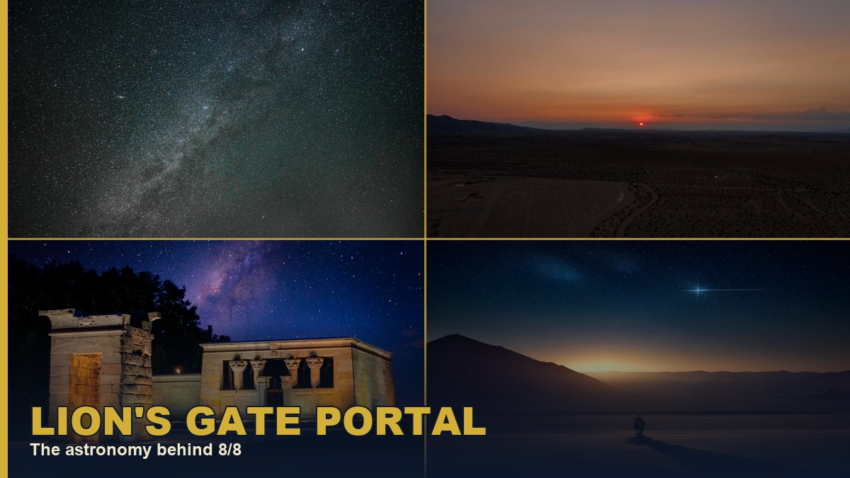
Photo by Aarin Husain via Pexels · Photo by K via Pexels · Photo by Julio García Photos via Pexels · AI image generated with Sana (via pollinations.ai)
What Is the Lion’s Gate Portal?
The Lion’s Gate Portal is an annual window centered on August 8 (8/8), running roughly from late July through mid-August this year, that draws its timing from two overlapping events: the Sun’s transit through the constellation Leo, and the heliacal rising of Sirius — the star’s first reappearance in the pre-dawn sky after weeks hidden behind the Sun’s glare[1]. In 2026, the window runs from about July 29 through August 12, with August 8 marking its peak[3].
The name is modern spiritual shorthand, not an ancient Egyptian term. But the astronomy underneath it is genuinely old: Sirius’s heliacal rising is a fixed, predictable event that astronomers and ancient cultures alike have tracked for millennia[1].
The Real Astronomy: Sirius’s Heliacal Rising
Sirius is the brightest star in Earth’s night sky (excluding the Sun). For weeks every summer it sits too close to the Sun in the sky to be seen, washed out by daylight. Its “heliacal rising” is the first morning it becomes visible again, low on the eastern horizon just before sunrise[1]. The exact date shifts with a viewer’s latitude and drifts slowly across centuries, so August 8 functions as a fixed cultural anchor for the season rather than a precise, universal 24-hour astronomical event[1].
That distinction matters: the star’s reappearance is measurable science. The idea that it “opens a portal” pouring extra luck or energy into people’s lives is modern spiritual tradition layered on top of that fact, not a claim astronomy makes[1].
Sopdet, Isis, and the Kemetic Roots of This Date
Long before “Lion’s Gate” was a phrase, ancient Egyptians built their entire civil calendar around this same star. They called Sirius Sopdet — a goddess depicted as a woman crowned with a five-pointed star, sometimes carrying a vessel of water tied to the Nile’s life-giving flood[2]. Sopdet’s heliacal rising announced both the Nile’s annual inundation and the Egyptian New Year, Wepet-Renpet, making her reappearance the single most important celestial event in the agricultural calendar[2]. A leading academic study of Sirius in ancient Egyptian sources confirms the mechanism directly: the star’s first visible appearance at dawn coincided with the start of the Nile flood and anchored the civil New Year, a link precise enough that Egyptologists still use it to help date ancient events today[4].
By the New Kingdom, Sopdet had become closely identified with Isis — an inscription at the Dendera temple reads, “Isis in the heavens, Sopdet is her name” — while her consort star, Orion, was read as Osiris[2]. Because the 365-day Egyptian civil year ran slightly short of the true solar year, Sopdet’s rising slowly drifted across the calendar and back into alignment roughly every 1,460 years — the “Sothic Cycle” that Egyptologists still use as a chronological anchor point[4].
How People Mark the Day
In the modern astrological tradition built on top of this astronomy, Sirius is treated as a “spiritual sun” associated with wealth, abundance, and fame, arriving during Leo season’s themes of confidence and creative self-expression[3]. Common practices during the window include writing down or speaking intentions, repeating them until they feel settled, and then releasing attachment to the outcome; some practitioners pair this with sunlight meditation or yellow-toned stones like citrine and amber, echoing Leo’s solar association[3].
None of that is a scientific claim, and it isn’t presented as one here. What is real is the star, its rising, and the fact that people have been marking this exact moment in the sky for well over four thousand years — just under different names and for different reasons.
Kemetic Minds Analysis
What makes this date worth writing about isn’t the “portal” framing — it’s the continuity. A star reappearing at dawn told Egyptian farmers the Nile was about to flood and their year had turned over; the same reappearance now gets read by modern astrology as a moment for setting intentions. Both readings sit on top of the identical, verifiable fact: Sirius vanishes into the Sun’s glare every summer and comes back. Whether you mark August 8 as a spiritual practice or simply as the day named after an ancient goddess who once ran Egypt’s entire calendar, the sky itself isn’t doing anything mystical — it’s doing exactly what it has done every year for thousands of years.
References
- Farmers’ Almanac. (2026). What is the Lion’s Gate Portal? Meaning, dates, and the 8/8 astronomy. farmersalmanac.com ↩a ↩b ↩c ↩d ↩e ↩f
- Egypt Museum. (n.d.). Sopdet: The goddess Sirius. egypt-museum.com ↩a ↩b ↩c ↩d
- Steiber, M. (2026, July 8). What you need to know about the Lion’s Gate Portal in 2026. RUSSH. russh.com ↩a ↩b ↩c
- Gautschy, R. (2011). Der Stern Sirius in Ägypten. Zeitschrift für Ägyptische Sprache und Altertumskunde, 178(2), 116–131. Summary available at gautschy.ch ↩a ↩b
Methodology: The astronomical claims in this piece (Sirius’s heliacal rising, its link to the ancient Egyptian civil calendar and the Sothic Cycle) are drawn from a peer-reviewed Egyptology source and a mainstream almanac explainer; the spiritual/astrological claims (energetic “portals,” manifestation practices, gemstone associations) are reported as modern tradition, not scientific fact, and are clearly attributed to the astrology press covering them. No figures were sourced from Wikipedia.
📱 Stay Connected

Kemetic Minds Editorial Desk
Verified NewsroomPrimary-sourced investigative intelligence on civil rights, voting rights, federal policy, and consumer protection. Sourced from primary legal filings, government statistics, and direct field reporting.