
Special Report, Part 4 of 7 — Mid-Century Transformation. Published Wednesday, Nov. 11, 2026. Every quotation and statistic below is checked against a saved copy of its source.
Executive summary
- Charles Taze Russell died on October 31, 1916. Joseph F. Rutherford was elected president at the January 6, 1917 annual meeting, and by the Society’s own account four directors who opposed him were removed that July. [1]
- In 1918 eight Society officers were convicted under the Espionage Act: seven were sentenced to 20 years, one to 10. On May 14, 1919 the Second Circuit reversed because they “did not have the temperate and impartial trial to which they were entitled,” while saying the evidence was sufficient to go to the jury. [2]
- The Society’s own reports count 3,868 publishers in 1918, 47,143 in 1938 and a peak of 2,179,256 in 1975. These are self-reported figures. [3][4]
- The 1931 name Jehovah’s Witnesses was followed in 1932 by an end to elected elders, and in 1938 by the statement that “Jehovah’s organization is in no wise democratic.” [5]
- The Supreme Court upheld a compulsory flag salute in Gobitis (1940) and overruled it in Barnette (1943); Witnesses lost Jones, Cox, Falbo and Prince, and won Cantwell, Murdock and Martin. [6][7]
- The United States Holocaust Memorial Museum estimates at least 3,000 Witnesses were sent to Nazi concentration camps. For the 1951 Soviet deportation, estimates run from about 8,500 to 9,793. [8][9][10]
Scope and sources
This part covers Rutherford’s presidency (1916-1942) and Nathan H. Knorr’s (1942-1977). Three kinds of source are used and labelled. The Watch Tower Society’s own histories and service reports are primary evidence of what it taught, did and reported, not independent proof that its claims were true. Court opinions record what judges held. The Holocaust Museum and an Estonian historian are secondary.
Many Watchtower passages are held only as quoted in the Society’s later book Jehovah’s Witnesses: Proclaimers of God’s Kingdom; the text says so where that applies.
1916-1917: A succession and a split
Russell “died on a train at Pampa, Texas” on October 31, 1916. [1] The Society’s history says the next president would be chosen at the annual meeting on January 6, 1917. At that meeting a proxy-holder, Pierson, cast votes for Rutherford, and “Brother Rutherford was declared the unanimous choice of the Convention as President.” The quotation is from The Watch Tower of January 15, 1917, as reproduced by the Society. [1]
Opposition followed. The Finished Mystery, a seventh volume of Studies in the Scriptures prepared after Russell’s death, was released to the headquarters staff on July 17, 1917. At the same event it was announced that four opposing directors had been removed and Rutherford had appointed four others. [1]
Primary source excerpt. “On August 8, the disgruntled ex-directors and their supporters left the Bethel family; they had been asked to leave because of the disturbance they had been creating.” (Proclaimers of God’s Kingdom, chapter “A Time of Testing (1914-1918)”, the Society’s account) [1]
That is one side. Our saved sources contain neither the removed directors’ account nor the charter provisions on removal, so we cannot say whether the removal followed the Society’s rules.
1918-1919: The Espionage Act case
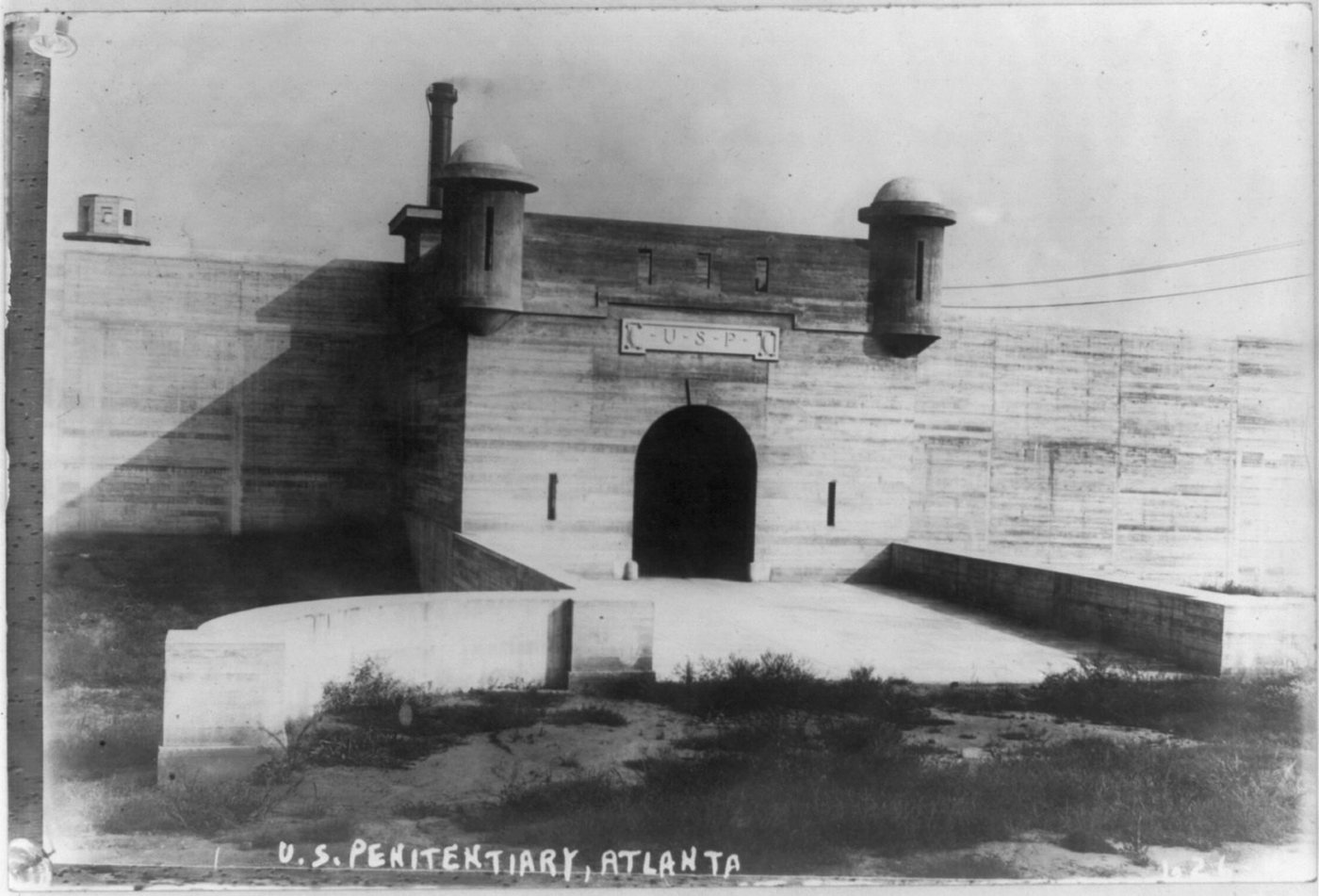
Rutherford v. United States, 258 F. 855 (2d Cir. May 14, 1919), is the primary record of the prosecution. Eight defendants were indicted under sections 3 and 4 of the Espionage Act of June 15, 1917. “Seven of the defendants were sentenced to terms of 20 years and the eighth to a term of 10 years in the federal penitentiary at Atlanta.” [2] The Society’s history dates the sentences to June 21, 1918 and calls the convictions false. [1]
The majority described the defendants as members of religious organizations: the International Bible Students’ Association, the People’s Pulpit Association and the Watch Tower Bible & Tract Society. It wrote that one of their doctrines “is an absolute prohibition of the killing of human beings, and so of taking any part at all in war.” [2]
The majority did not clear the defendants on the merits. Judge Ward wrote: “We think there was sufficient evidence upon which to submit the case to the jury, and that none of the errors assigned is ground for reversal, except in respect to the matters now to be considered.” Those matters were the trial judge’s handling of three government witnesses, all Bible Students. [2]
Primary source excerpt. “The defendants in this case did not have the temperate and impartial trial to which they were entitled, and for that reason the judgment is reversed.” (Rutherford v. United States, 258 F. 855, 2d Cir., May 14, 1919, majority opinion of Circuit Judge Ward) [2]
Circuit Judge Manton dissented: “The guilt of the defendants is plain.” He objected that the judgment was reversed “because of the alleged adverse attitude of the court in regard to the testimony of three witnesses.” [2] The Society says the eight men left Atlanta for Brooklyn on March 25, 1919, after release on bail. [11] The fate of the indictment after the reversal is not in our saved sources, so it is not stated here.
1931-1938: A name, and the end of elected elders
The name Jehovah’s Witnesses was adopted by resolution at a convention in Columbus, Ohio, held July 24-30, 1931. Rutherford’s discourse on Sunday, July 26 cited Isaiah 43:8-12, and the resolution adopted that day said the delegates desired “to be known as and called by the name, to wit, Jehovah’s witnesses.” [12]
Internal governance changed in the same decade. Russell’s circle had read Acts 14:23 as saying “they had elected them elders by a show of hands.” [5] The Society’s history says that in the 1920s and early 1930s “Democratically elected elders were often quite vocal in disagreeing with what The Watch Tower said about the responsibility to preach to people outside the congregation.” Measures were taken in 1932, after which “the annual congregational election of men to be elders and deacons was eliminated.” Some former elders left, which the Society described as “a thinning out of the ranks but a toning up of the entire organization.” [5]
Primary source excerpt. “Jehovah’s organization is in no wise democratic. Jehovah is supreme, and his government or organization is strictly theocratic.” (The Watchtower, June 1 and 15, 1938, article “Organization,” as quoted in Proclaimers of God’s Kingdom, chapter “Development of the Organization Structure”) [5]
| Period | How congregation oversight was chosen | Source |
|---|---|---|
| 1904 text | Elders chosen by congregational vote (Acts 14:23 read as election by show of hands) | [5] |
| After 1919 | Appointed “service director,” not subject to yearly election, alongside elected elders and deacons | [5] |
| 1932 | Annual election of elders and deacons eliminated; congregations voted for a service committee, chairman, secretary and treasurer | [5] |
| 1938 | Society chronology: “Theocratic arrangements for selecting overseers in congregations replace democratic procedures” | [13] |
| 1945 | Society’s board no longer selected by voters qualified by monetary donations | [13] |
| 1971 | Governing Body enlarged beyond the seven directors who had served as a governing body; 11 members | [5] |
In the Society’s own words, authority over local oversight moved from congregation votes to appointments tied to the central organization and to participation in house-to-house preaching. The Society presents this as bringing practice into line with the Bible. Our saved sources include no independent analysis of the change.
Publishing as a system: reports, records and radio
Reporting was part of the change. The Society’s 1975 Yearbook says that in 1920 participants “turned in a weekly report of activity,” and that “Prior to 1918 only colporteurs made field service reports.” [14] The numbers that resulted are the main long-run evidence of growth, and they are the Society’s own.
For the United States the Society’s history gives an average of 2,712 weekly participants in 1922, 2,034 in 1924 and 2,261 in 1926, with a peak of 5,937 in one week of special activity. [15] A different Society history gives 1,064 for 1924. [14] The saved texts do not reconcile the two.
Rutherford gave his first radio broadcast on February 26, 1922, and the Society’s station WBBR began broadcasting on February 24, 1924. By 1933 a peak of 408 stations carried its programs. [11] In 1934 it began producing portable phonographs for 78-rpm discs carrying 4 1/2-minute lectures; it produced “more than 47,000 phonographs.” [11]
| Year | Figure reported | Label in the source | Source |
|---|---|---|---|
| 1918 | 3,868 | “persons announcing the King and the Kingdom in all the world” | [3] |
| 1938 | 47,143 | publishers | [3] |
| 1941 | 109,371 | peak of active Witnesses | [13] |
| 1949 | 317,877 | peak publishers | [3] |
| 1952 | 456,265 | “Kingdom preachers” (1947: 207,552) | [16] |
| 1963 | 1,040,836 | peak of publishers | [13] |
| 1969 | 1,336,112 | peak (average: 1,256,784) | [17] |
| 1974 | 2,021,432 | peak publishers | [13] |
| 1975 | 2,179,256 | peak | [4] |
By our calculation the 1938 figure is about twelve times the 1918 figure. The sources use different labels (peak, average, “preachers”), and no independent count is saved.
The courts and the flag, 1938-1944
Society lawyer Hayden C. Covington appears as counsel in the reports of Cantwell, Murdock, Martin and Barnette. [18][19][20][7] The Society’s history says Rutherford argued Gobitis. [21]
Minersville School District v. Gobitis, decided June 3, 1940, held children who would not salute the flag liable to expulsion from public schools. Justice Frankfurter wrote for the Court; Justice McReynolds concurred in the result and Justice Stone dissented alone. [6] The Society’s account calls this an “8-to-1 decision.” [22]
Primary source excerpt. “We are dealing with an interest inferior to none in the hierarchy of legal values. National unity is the basis of national security.” (Minersville School District v. Gobitis, 310 U.S. 586, June 3, 1940, opinion of Justice Frankfurter) [6]
The Society says the decision led to “a nationwide outburst of violence,” and that from 1940 to 1944 “more than 2,500 violent mobs assaulted Jehovah’s Witnesses in the United States.” [22] That count is the Society’s; no independent tally is in our saved sources.
The Court also sustained the Witnesses on narrower grounds. Cantwell v. Connecticut (May 20, 1940) held that Connecticut’s licensing statute, as applied, deprived the Cantwells of liberty without due process, because “The fundamental concept of liberty embodied in that Amendment embraces the liberties guaranteed by the First Amendment.” [18] Lovell v. Griffin (1938) had struck a ban on distributing literature without a permit as “invalid on its face.” [23]
On June 8, 1942, Jones v. Opelika affirmed convictions under municipal license-tax ordinances applied to Witnesses selling religious literature. Chief Justice Stone dissented. Justices Black, Douglas and Murphy added a statement. [24]
Primary source excerpt. “Since we joined in the opinion in the Gobitis case, we think this is an appropriate occasion to state that we now believe that it was also wrongly decided.” (Jones v. City of Opelika, 316 U.S. 584, June 8, 1942, statement of Justices Black, Douglas and Murphy) [24]
On May 3, 1943, Murdock v. Pennsylvania and Martin v. Struthers went the other way. Murdock reversed convictions under a license-tax ordinance for door-to-door sale of Society literature and said “Freedom of press, freedom of speech, freedom of religion are in a preferred position.” [19] Martin held an ordinance restricting door-to-door circular distribution “invalid because in conflict with the freedom of speech and press.” [20]
West Virginia State Board of Education v. Barnette (June 14, 1943), opinion by Justice Jackson, overruled Gobitis. Justices Black and Douglas, who had joined Gobitis, explained their change of view; Justices Roberts and Reed adhered to Gobitis, and Justice Frankfurter dissented. By our count of the opinions, three of nine justices dissented. [7]
Primary source excerpt. “If there is any fixed star in our constitutional constellation, it is that no official, high or petty, can prescribe what shall be orthodox in politics, nationalism, religion, or other matters of opinion or force citizens to confess by word or act their faith therein.” (West Virginia State Board of Education v. Barnette, 319 U.S. 624, June 14, 1943, opinion of Justice Jackson) [7]
| Case | Decided | Outcome | Written by |
|---|---|---|---|
| Lovell v. Griffin | Mar. 28, 1938 | Permit ordinance invalid | Hughes |
| Cantwell v. Connecticut | May 20, 1940 | Convictions reversed | Roberts |
| Minersville v. Gobitis | June 3, 1940 | Flag salute upheld | Frankfurter |
| Cox v. New Hampshire | Mar. 31, 1941 | Parade license law upheld | Hughes |
| Jones v. Opelika | June 8, 1942 | License taxes upheld | Reed |
| Murdock v. Pennsylvania | May 3, 1943 | License tax invalid | Douglas |
| Martin v. Struthers | May 3, 1943 | Door-to-door ordinance invalid | Black |
| West Virginia v. Barnette | June 14, 1943 | Gobitis overruled | Jackson |
| Falbo v. United States | Jan. 3, 1944 | Conviction affirmed | Black |
| Prince v. Massachusetts | Jan. 31, 1944 | Conviction affirmed | Rutledge |
Cox v. New Hampshire (1941) held that a license requirement for parades was “only the exercise of local control over the use of streets.” [25] The Society says the Court ruled against Witnesses in 19 cases in the three years after Gobitis. [21]
Conscientious objection and child preaching
In Falbo v. United States (January 3, 1944), a Witness claimed to be a minister exempt from service. His board had classified him as a conscientious objector instead and ordered him to report for work of national importance. He refused. The Court held he could not challenge the classification in the criminal case. Justice Rutledge concurred in the result; Justice Murphy dissented. [26]
Primary source excerpt. “The narrow question therefore presented by this case is whether Congress has authorized judicial review of the propriety of a board’s classification in a criminal prosecution for wilful violation of an order directing a registrant to report for the last step in the selective process. […] We think it has not.” (Falbo v. United States, 320 U.S. 549, January 3, 1944, opinion of Justice Black) [26]
The Society’s chronology says that in the seven years to 1946 “over 4,000 of Jehovah’s Witnesses in the United States and 1,593 in Britain have been arrested and sentenced to prison terms” because of neutrality. [13] Prince v. Massachusetts (January 31, 1944) upheld the conviction under child-labor law of an aunt and custodian who took a child to distribute Watchtower magazines at night, writing that “Parents may be free to become martyrs themselves.” Justice Murphy dissented. [27]
Knorr and the Brooklyn headquarters
Rutherford died on January 8, 1942. On January 13 the boards of the two Society corporations unanimously elected Knorr president and Covington vice president. [16] In 1971 the Governing Body was enlarged beyond the seven directors who had been serving as one; it had 11 members, and the following year’s preparations moved congregations to appointed elders. [5]
Persecution abroad: Nazi Germany and the USSR
The United States Holocaust Memorial Museum says that by April 1, 1935 the Reich and Prussian interior minister ordered local officials to dissolve the Watchtower Society, and that conscription, reintroduced in March 1935, escalated the conflict. Of the 25,000 to 30,000 Germans who were Witnesses in 1933, it estimates 20,000 remained active; about half of those still active were convicted. At least 3,000 were sent to concentration camps, where they wore purple triangular patches. It estimates 1,000 German Witnesses died, plus 400 from other countries, and that at least 273 were executed after military-court death sentences for refusing service. [8]
The Society’s chronology gives different totals for Germany: 6,262 arrested and 2,074 sent to camps. [13] The scopes differ (the museum’s 3,000 includes non-Germans), so the figures do not compare directly.
On the 1951 Soviet deportation, historian Olev Liivik of the Estonian Institute of Historical Memory writes that Operation North was deployed on April 1 and 2, 1951, and that “about 9,000” Witnesses from the Baltic states, Moldova, western Ukraine and Belarus were deported to Russia. [9] The same article elsewhere says “about 8,500.” Liivik writes that Soviet officials viewed Witnesses as anti-Soviet because they refused to vote or perform military service and were accused of distributing anti-Soviet leaflets and of foreign ties. [9] He also notes that Witnesses’ 1948-49 letters threatened to appeal to the United Nations and said God would destroy the Soviet Union, and adds that “One can argue that these letters” prompted the deportation; that is his inference, not a documented Soviet finding. [9]
The Society’s 2026 news item reports 9,793 deported from Ukraine and five other republics to Siberia, beginning in Ukraine on April 8, 1951. [10] Ukraine’s State Service for Ethnic Policy and Freedom of Conscience says “more than 9,000” were relocated. [28]
What the record does and does not show
- Established: Eight Society officers were convicted under the Espionage Act in 1918 and the convictions were reversed in 1919 for an unfair trial. The reversal did not find the evidence insufficient. [2]
- Established by the Society’s own texts: Elective eldership ended in 1932, and by 1938 the Society described its organization as theocratic, not democratic. Reported publishers rose from 3,868 (1918) to 2,179,256 (1975). Independent counts were not found. [5][3][4]
- Established by the Court: Gobitis upheld a compulsory flag salute in 1940 and Barnette overruled it in 1943. [6][7]
- Not established here: the removed directors’ account of 1917, what happened to the 1918 indictment, an independent count of mob violence, and the exact number deported in 1951, which sources put between about 8,500 and 9,793.
Image provenance
Every image in this report was checked against its source page for public-domain status. The basis is stated for each.
| Image (source page) | Creator, date | Public-domain basis |
|---|---|---|
| Entrance to the federal penitentiary, Atlanta | Bain News Service (George Grantham Bain Collection), Library of Congress, circa 1910 (date given by the Library of Congress) | Public domain: photographic print dated 1910 in the Library of Congress Bain Collection (published before 1931); the Wikimedia Commons file page for LCCN 2002698072 carries a Public domain tag. The LOC rights page itself was not retrievable when checked (HTTP 429). |
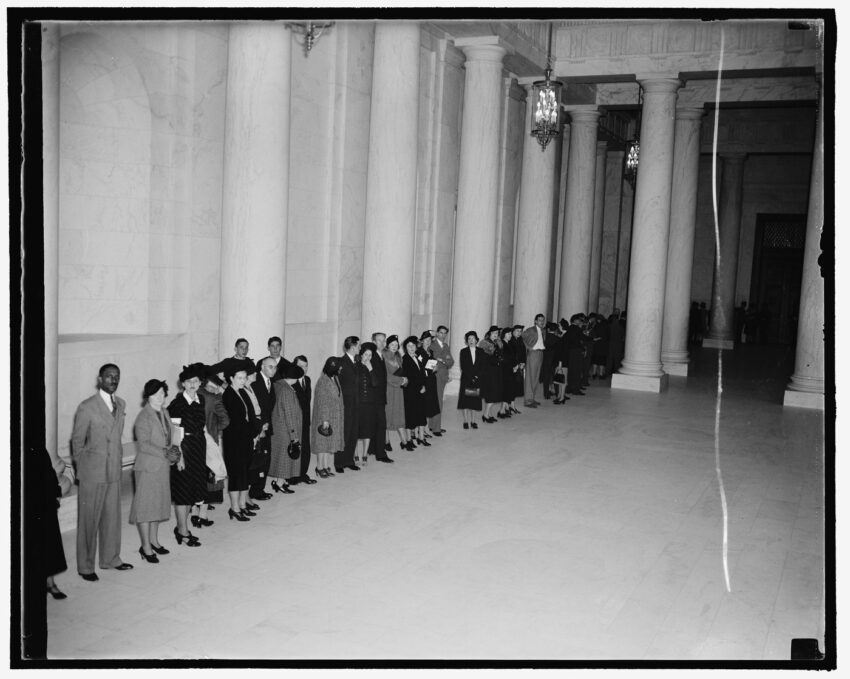
| Crowd seeks admittance to opening of U.S. Supreme Court, Washington, D.C., Oct. 3 [1938] | Harris & Ewing, photographer, Library of Congress, 1938-10-03 | Public domain: 1938 Harris & Ewing glass negative in the Library of Congress; the Wikimedia Commons file page for LCCN 2016874094 carries a Public domain tag. The LOC rights page itself was not retrievable when checked (HTTP 429). |
- Part 1: Roots & Reconstruction (Sunday, Nov. 8, noon Central)
- Part 2: Separate Tables (Monday, Nov. 9, noon Central)
- Part 3: The Original Watchtower & Esoteric Symbolism (Tuesday, Nov. 10, noon Central)
- Part 4: Mid-Century Transformation (Wednesday, Nov. 11, noon Central) — you are here
- Part 5: Global Expansion & Information Architecture (Thursday, Nov. 12, noon Central)
- Part 6: Contemporary Pressures & Institutional Scrutiny (Friday, Nov. 13, noon Central)
- Part 7: Synthesis & The Horizon (Saturday, Nov. 14, noon Central)
References
- Watch Tower Bible and Tract Society. “A Time of Testing (1914-1918),” in Jehovah's Witnesses—Proclaimers of God's Kingdom (online edition; publication year not shown on the page). ↩
- United States Court of Appeals, Second Circuit. “Rutherford et al. v. United States, 258 F. 855” (May 14, 1919; text from Harvard Caselaw Access Project). ↩
- Watch Tower Bible and Tract Society. “Reviewing the Past Year's Work World-wide,” The Watchtower (January 1, 1950, pp. 10-15). ↩
- Watch Tower Bible and Tract Society. 1976 Yearbook of Jehovah's Witnesses, report on the 1975 service year (1976). ↩
- Watch Tower Bible and Tract Society. “Development of the Organization Structure,” in Jehovah's Witnesses—Proclaimers of God's Kingdom (online edition; publication year not shown on the page). ↩
- Supreme Court of the United States. “Minersville School District v. Gobitis, 310 U.S. 586” (June 3, 1940). ↩
- Supreme Court of the United States. “West Virginia State Board of Education v. Barnette, 319 U.S. 624” (June 14, 1943). ↩
- United States Holocaust Memorial Museum. “Nazi Persecution of Jehovah's Witnesses,” Holocaust Encyclopedia (secondary source; fetched 2026). ↩
- Olev Liivik, Estonian Institute of Historical Memory. “The USSR's 1951 Deportation of Jehovah's Witnesses,” Platform of European Memory and Conscience (March 31, 2021; secondary source). ↩
- Watch Tower Bible and Tract Society. “Ukraine Declares Official Day of Remembrance for the Victims of Soviet Union's Operation North,” jw.org news (April 2026). ↩
- Watch Tower Bible and Tract Society. “Advertise the King and the Kingdom! (1919-1941),” in Jehovah's Witnesses—Proclaimers of God's Kingdom (online edition; publication year not shown on the page). ↩
- Watch Tower Bible and Tract Society. “How We Came to Be Known as Jehovah's Witnesses,” in Jehovah's Witnesses—Proclaimers of God's Kingdom (online edition; publication year not shown on the page). ↩
- Watch Tower Bible and Tract Society. “Noteworthy Events in the Modern-day History of Jehovah's Witnesses,” in Jehovah's Witnesses—Proclaimers of God's Kingdom (publication year not shown on the page). ↩
- Watch Tower Bible and Tract Society. “Part 2—United States of America,” 1975 Yearbook of Jehovah's Witnesses (1975, pp. 109-183). ↩
- Watch Tower Bible and Tract Society. “Preaching Publicly and From House to House,” in Jehovah's Witnesses—Proclaimers of God's Kingdom (online edition; publication year not shown on the page). ↩
- Watch Tower Bible and Tract Society. “Declaring the Good News Without Letup (1942-1975),” in Jehovah's Witnesses—Proclaimers of God's Kingdom (online edition; publication year not shown on the page). ↩
- Watch Tower Bible and Tract Society. “1969—A Year of Praise,” 1970 Yearbook of Jehovah's Witnesses (1970, pp. 314-320). ↩
- Supreme Court of the United States. “Cantwell v. Connecticut, 310 U.S. 296” (May 20, 1940). ↩
- Supreme Court of the United States. “Murdock v. Pennsylvania, 319 U.S. 105” (May 3, 1943). ↩
- Supreme Court of the United States. “Martin v. City of Struthers, 319 U.S. 141” (May 3, 1943). ↩
- Watch Tower Bible and Tract Society. “‘Defending and Legally Establishing the Good News,’” in Jehovah's Witnesses—Proclaimers of God's Kingdom (online edition; publication year not shown on the page). ↩
- Watch Tower Bible and Tract Society. “‘Objects of Hatred by All the Nations,’” in Jehovah's Witnesses—Proclaimers of God's Kingdom (online edition; publication year not shown on the page). ↩
- Supreme Court of the United States. “Lovell v. City of Griffin, 303 U.S. 444” (March 28, 1938). ↩
- Supreme Court of the United States. “Jones v. City of Opelika, 316 U.S. 584” (June 8, 1942). ↩
- Supreme Court of the United States. “Cox v. New Hampshire, 312 U.S. 569” (March 31, 1941). ↩
- Supreme Court of the United States. “Falbo v. United States, 320 U.S. 549” (January 3, 1944). ↩
- Supreme Court of the United States. “Prince v. Massachusetts, 321 U.S. 158” (January 31, 1944). ↩
- State Service of Ukraine for Ethnic Policy and Freedom of Conscience (DESS). “A Test of Faith: 75 Years of Operation North” (April 2026). ↩

Kemetic Minds Editorial Desk
Verified NewsroomPrimary-sourced investigative intelligence on civil rights, voting rights, federal policy, and consumer protection. Sourced from primary legal filings, government statistics, and direct field reporting.