Special Report, Part 3 of 7 — The Original Watchtower & Esoteric Symbolism. Published Tuesday, Nov. 10, 2026. Every quotation and statistic below is checked against a saved copy of its source.
Executive summary
- The Watch Tower Society’s own 1993 history says Bible Students wore a cross and crown as a badge and that the symbol was on the magazine’s front cover “from 1891 to 1931.” A subscriber’s letter printed in 1891 describes the January 1891 number as the Tower’s “new suit” bearing the emblem. [1][2]
- The Great Pyramid teaching of Russell’s Millennial Dawn, Volume III (Thy Kingdom Come, 1891) credits John Taylor (1859), Charles Piazzi Smyth and Robert Menzies, and quotes Joseph Seiss. [3][4][5]
- In May 1881 the Tower said of the pyramid, “We have great respect for it, though we do not build our faith upon it.” By 1891 a full chapter called it God’s “Stone Witness and Prophet.” [6][3]
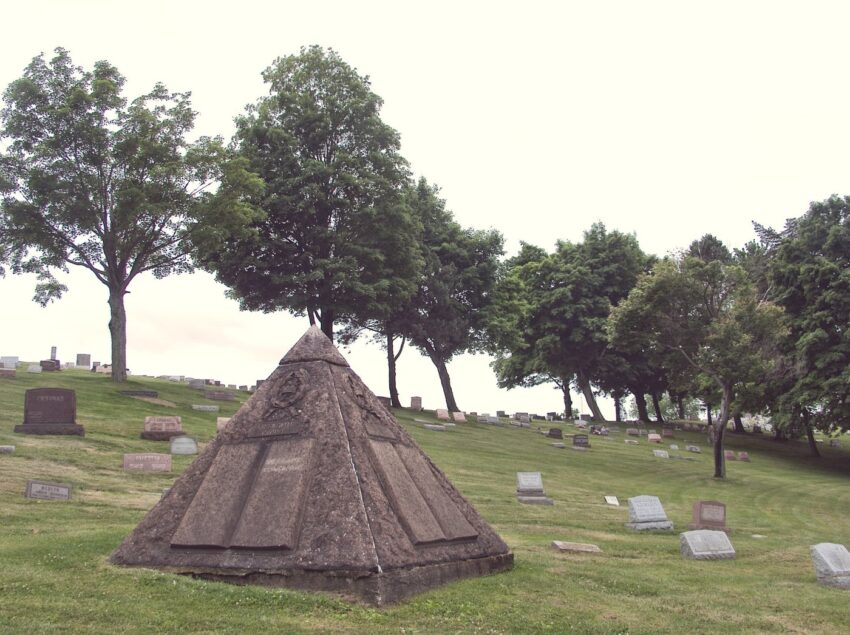
- A January 1919 convention report describes a “Pyramid Shape Monument,” planned for the Society’s burial plots near Pittsburgh and “accepted by Brother Russell,” with a cross, crown and wreath on its faces. A Masonic body’s page says it found no evidence of Masonic links. [7][10]
- The Watch Tower of 1 December 1928 declared that the pyramid of Gizeh “is neither a sign nor a witness unto the Lord of hosts.” The same issue’s cover still carries the cross-and-crown emblem. [8]
- Flinders Petrie, who surveyed Gizeh and published in 1883, found “no authentic example” of a “Pyramid inch,” the unit behind the inch-year reading. [9]
What this report covers, and what it cannot
This part asks a narrow question. What do the surviving documents show about the emblems and Great Pyramid teaching around Zion’s Watch Tower, and about how and why the Watch Tower organization abandoned them?
The evidence is the saved text of Tower volumes for 1879, 1881, 1886, 1889, 1891, 1892, 1895 and 1900, five 1928 issues, the 1891 first edition of Millennial Dawn, Volume III, books by Smyth, Seiss and Petrie, a 1919 convention report and the organization’s 1993 history. Watch Tower publications are primary evidence of what the organization taught and said about itself, not independent evidence that a teaching was correct. OCR of old print is imperfect, so “not found” means not found in the text we hold.
The 15 November 1928 issue, which the organization cites for its pyramid repudiation, and all 1929-1931 issues could not be obtained.
The mastheads: from Pittsburgh monthly to Brooklyn semimonthly
The first number is dated July 1879, Pittsburgh, “Published Monthly, 101 Fifth Avenue, Pittsburgh, Pa.” [11] A historical foreword in the Society’s own reprint volume says “the first issue appearing July, 1879; the title thereafter being changed to” The Watch Tower. [11] The foreword is undated in our copy. It also says the paper “has at all times carried the subtitle” The Herald of Christ’s Presence, and ties that subtitle to a belief that Christ’s invisible presence began in 1874. [11]
We can trace the masthead only at intervals. January 1881 and January 1886 still read Pittsburgh. The issue of 1 January 1892 reads Zion’s Watch Tower and Herald of Christ’s Presence, carries “PUBLISHED TWICE A MONTH,” and names the Tower Publishing Company, Arch Street, Allegheny. [2] By 1928 the cover reads The Watch Tower and Herald of Christ’s Presence, semimonthly, and the running page heads read Brooklyn. [8] We did not pin down the year “Zion’s” left the cover.
The 1928 cover shows a stone lighthouse beaming light across a stormy sea, with a caption reading Rock of Ages at lower left. A wreath enclosing a cross and crown sits at upper left, and a sword and helmet at upper right. [8]
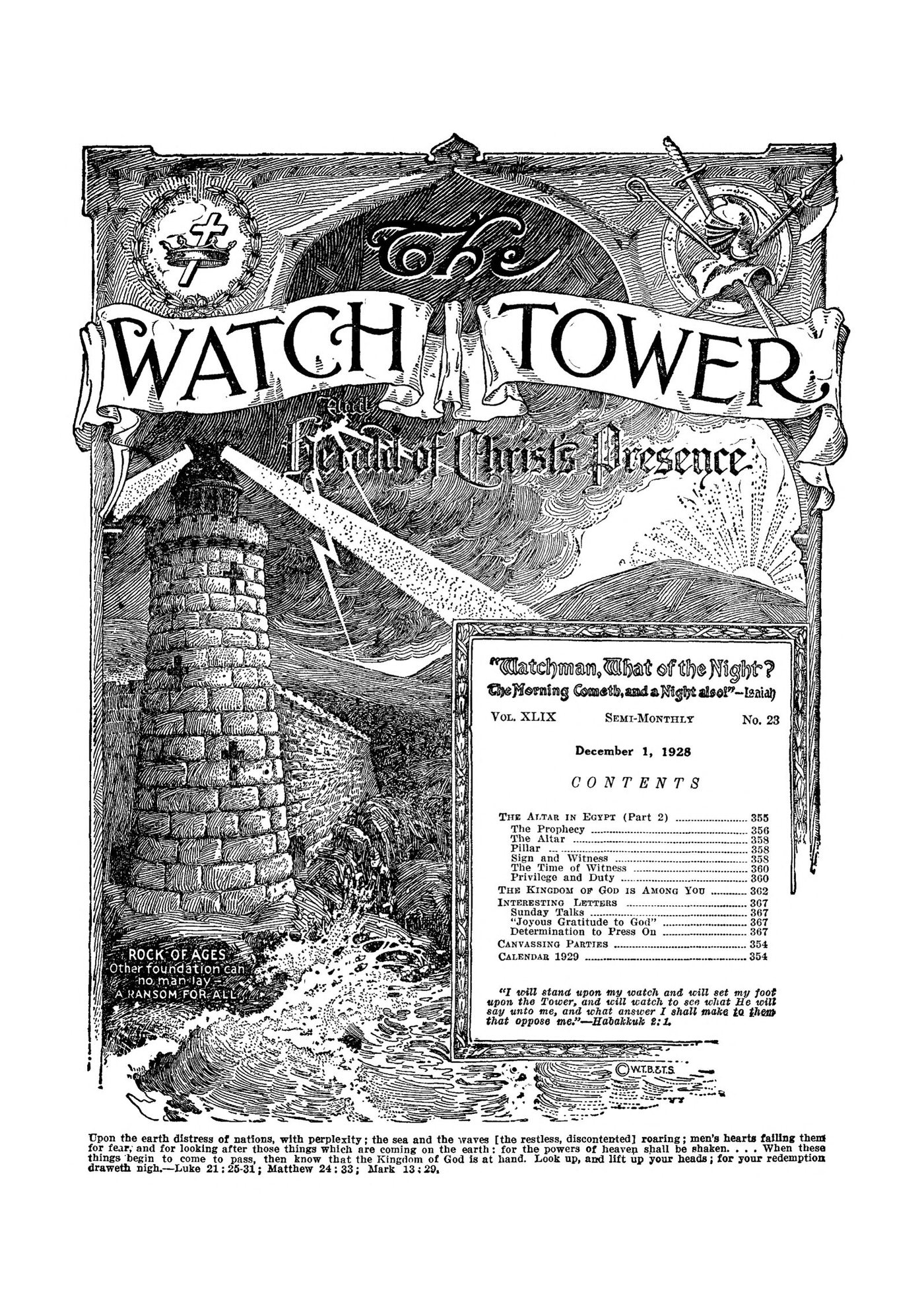
On the cover of 15 March 1937, which we inspected as a scan, the cross-and-crown wreath is gone. The title is now one word, Watchtower, still followed by And Herald of Christ’s Presence, and the cover carries the text of Isaiah 43:12 about being Jehovah’s witnesses. [12] That is our visual observation of one scan, not an organizational statement.
The cross and crown: when it appeared, what it meant
The earliest documentation we found is a subscriber’s letter in the 1891 volume. It says: [2]
Primary source excerpt. “The emblem of the cross and crown is an appropriate and beautiful design to be worn by the Tower. Its presence should ever encourage, sustain and comfort the household of faith.” (Zion’s Watch Tower, early 1891, letters column, reprint p. 1288) [2]
The same letter reads the design: “as the cross and crown are inseparable in the design, so the two are to be inseparably associated in the experience of the overcomers.” That is a reader’s gloss printed in the Tower’s letters column, not a statement by Russell. Tower text of 1900 has the same idea: “No cross, no crown.” [13]
The organization’s 1993 history confirms the date range: [1]
Primary source excerpt. “For years, Bible Students wore a cross and crown as a badge of identification, and this symbol was on the front cover of the […] from 1891 to 1931. But in 1928 it was emphasized that not a decorative symbol but one’s activity as a witness showed he was a Christian.” (Jehovah’s Witnesses—Proclaimers of God’s Kingdom, 1993, ch. 14 box, pp. 200-201) [1]
This is the only explanation of the change we could source. We could not read any 1929-1931 issue, so we cannot confirm the issue or any contemporary explanation. The December 1928 scan shows the emblem still on the cover three years before the date the organization gives. [8] Our search of the five saved 1928 issues found no discussion of a badge.
The Great Pyramid chain: Taylor, Smyth, Seiss, Menzies, Russell
Russell did not originate the pyramid reading. The documents show a line of transmission.
| Writer | Document | What the saved text shows |
|---|---|---|
| John Taylor, London publisher | The Great Pyramid: Why Was It Built? (1859) | Seiss summarizes Taylor’s theory: the builders “were not Egyptians” but men acting on a commission from heaven [5] |
| Charles Piazzi Smyth, Astronomer-Royal for Scotland | Our Inheritance in the Great Pyramid (1864) | Dedicated to Taylor; reports tests of Taylor’s measurements [4] |
| Joseph A. Seiss, Philadelphia pastor | A Miracle in Stone (1877) | Title page carries Isaiah 19:19-20, the “altar” and “pillar” verses [5] |
| Robert Menzies, “a young Scotchman” | Letter to Smyth, quoted in Volume III | Proposed that the Grand Gallery inches stand for years [3] |
| C. T. Russell | Thy Kingdom Come (1891) | Chapter X: pyramid as “Stone Witness and Prophet” [3] |
Smyth’s 1864 book reports a paper read to the Royal Society of Edinburgh on “March 21, 1864.” [4] Seiss’s book was copyrighted in 1877. [5] Seiss writes that Taylor, without having seen the pyramid, published a small volume in 1859. [5]
Primary source excerpt. “he gave it as his theory and conviction that the real architects of this edifice were not Egyptians, but men of quite another faith and branch of the human family” (Joseph A. Seiss, A Miracle in Stone, 1877, on John Taylor) [5]
Thy Kingdom Come, 1891: how the Tower used the pyramid
The Tower’s attitude changed between 1881 and 1891. In May 1881 it treated the pyramid with reserve. It set out the Grand Gallery’s measured lengths as marking dates, saying the gallery “measures 1874 inches long at the top, 1878 inches long at a groove cut in its sides about midway between bottom and top and 1881 inches, at the bottom.” Earlier in the same article it had said of the pyramid: [6]
Primary source excerpt. “But the teachings of THE GREAT PYRAMID are quite different. We have great respect for it, though we do not build our faith upon it.” (Zion’s Watch Tower, May 1881) [6]
The reprint carries a later bracketed note: “For later light on this subject see Scripture Studies, Vol. III.” [6] In September 1881 the Tower also used the pyramid as a picture: a pyramid “is a perfect figure or shape, hence we use it to represent perfect beings, in the chart.” [6]
By 1891 the pyramid had its own chapter in Volume III, “The Testimony of God’s Stone Witness and Prophet, the Great Pyramid in Egypt.” Its epigraph is Isaiah 19:19-20, the verses on Seiss’s title page. [3][5] The chapter credits its sources openly. Of Smyth’s book it says “we are mainly indebted for the data made use of in this chapter.” It credits Taylor’s work, “was by Mr. John Taylor, of England, A. D. 1859,” as the first of importance, and names Menzies as the source of the idea that the pyramid is Jehovah’s Witness. [3]
Primary source excerpt. “The suggestion came from a young Scotchman, Robert Menzies, who, when studying the scientific teachings of the Great Pyramid, discovered that prophetic and chronological teachings co-exist in it.” (Millennial Dawn, Vol. III, Thy Kingdom Come, 1891, ch. X) [3]
Volume III also quotes Seiss, and says the pyramid would “well merit the name given it by Dr. Seiss” if it matched Scripture. [3]
The chronology, and Smyth’s reaction
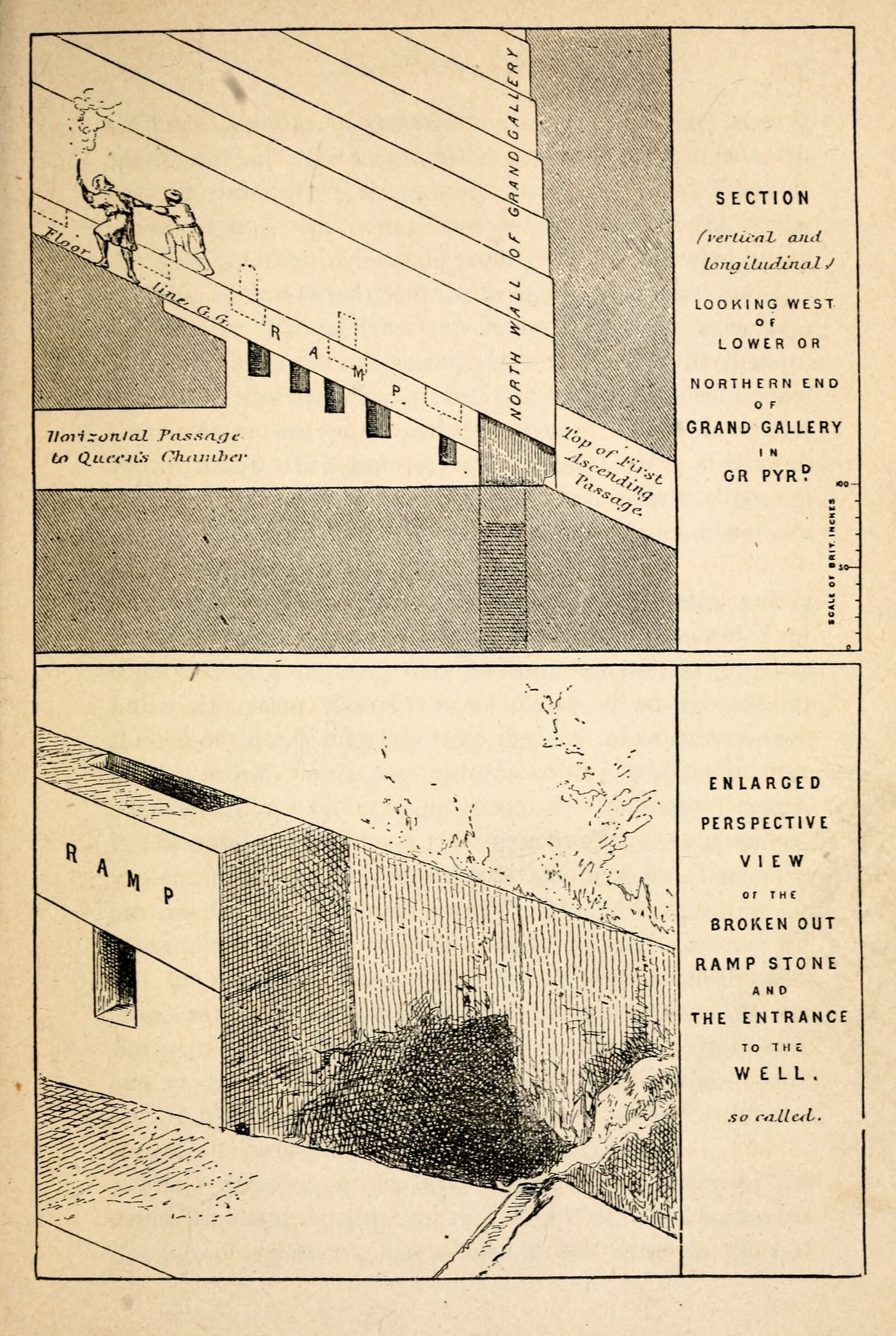
The page above is from Volume III. The book says its illustrations are “copies of a few of the seventeen plates” in Smyth’s work. [3] One panel is a vertical section looking west of the lower end of the Grand Gallery, with a torch-bearer and a second figure on the ramp. The other is the broken-out ramp stone and the entrance to the “Well.” Russell’s chapter read these passages as a history of the Christian dispensation. [3]
The chapter turns inches into years. It says Smyth fixed the pyramid’s building “at B. C. 2170,” and that a passage length of 3416 inches marks the start of the time of trouble. [3]
Primary source excerpt. “This calculation shows A. D. 1874 as marking the beginning of the period of trouble; for 1542 B. C. plus 1874 A. D. equals 3416 years.” (Thy Kingdom Come, 1891, ch. X) [3]
It also says “the forty years of judgment and trouble began in the fall of 1874.” [3] Forty years from autumn 1874 reaches 1914, our arithmetic, not a sentence we found in the chapter. Elsewhere in Volume III the “Time of the End” runs “from A. D. 1799 to A. D. 1914.” [3]
Volume III prints a letter from Smyth, dated at Clova, Ripon, on 21 December before publication. A correspondent, Wm. M. Wright, had mailed him Russell’s typewritten manuscript, and the book calls the letter a “kindly comment.” Smyth wrote that “as I progressed through the pages, the powers, the specialties and the originalities of the Author came out magnificently.” [3] He wrote that the author was both good and new on the chronology of parts of the pyramid, especially the First Ascending Passage and the Grand Gallery. The letter does not say he accepted every conclusion.
What contemporary measurement said
Petrie’s 1883 survey for the Royal Society is a primary technical source from before Volume III. It describes the inch-year theory and then rejects the unit on which it depends. [9]
Primary source excerpt. “there is no authentic example, that will bear examination, of the use or existence of any such measure” (W. M. F. Petrie, The Pyramids and Temples of Gizeh, 1883, on the so-called Pyramid inch) [9]
This report does not rest on Egyptology to judge the claims. It notes that a surveyor’s book, published eight years before Volume III, found no support for the unit Volume III used. Volume III cites Petrie once, for measurements “eight-tenths of an inch longer” than Smyth’s, and the text we searched does not address his rejection of the Pyramid inch. [3]
Russell’s pyramid in Rosemont Cemetery
The Society’s burial plots are in Rosemont United Cemeteries, north of Pittsburgh. A report of the January 1919 Pittsburgh convention describes a visit to the marble works to watch workmen “chisel out the monument,” then gives the design. [7]
Primary source excerpt. “In the exact center of the Bethel lot will be erected diagonally the Pyramid Shape Monument as designed by Brother Bohnet, and accepted by Brother Russell as the most fitting emblem for an enduring monument on the Society’s burial space.” (Souvenir Report of the Bible Students Convention, Pittsburgh, Jan. 2-5, 1919, account of the visit to the burial plots) [7]
The plots held “ample grave space,” in all “more than 275 adult graves.” [7] Each slope was to carry a relief of a Teacher’s Bible bearing the names of the buried. Above them would be inscriptions, then “the Cross and Crown and Wreath, and the whole capped with the apex stone, highly polished—its shape of course being pyramidal.” [7] A sealed box inside would hold Scripture Studies, tracts and photographs of Russell. [7]
The 1919 report speaks in the future tense, so it does not date completion. A page by the Grand Lodge of British Columbia and Yukon, a secondary source, cites a programme for the 31 October 1921 convention yet also says the monument was “installed in 1919.” No primary document we hold settles it. [10] The page reports that online accounts said the Society removed the monument on 1 September 2021. We could not confirm that, so the photograph shows the monument as it stood in 2015. [10]
The Masonic and occult allegations
Some writers outside the movement call the pyramid, the emblem and the cemetery monument Masonic or occult. The documents we hold do not support that. A search of the 1919 report, the 1 December 1928 Watch Tower, the Proclaimers chapter and Volume III found no link between Freemasonry and either symbol. An 1881 Tower passage names Masonic and Odd-Fellows societies among worldly societies that it says will not shelter anyone. The Grand Lodge page says “There is no evidence that early directors of the Watch Tower Society” were Freemasons. [10] That is a Masonic body’s statement, not independent proof. The documents’ own reasons are scriptural (Isaiah 19:19-20), metrological (inches read as years) and, for the emblem, “No cross, no crown.” They do not mention secret societies.
The Charts of the Ages
The July-August 1881 issue enclosed a Chart of the Ages and suggested readers hang it “in some convenient place where it will be often in your sight,” so that its diagram of the narrow way to life “may be a constant and helpful reminder to you of the way our Leader trod.” [6] The image we use is a later printing from the 1909 Plan of the Ages, not the 1881 original. [14]
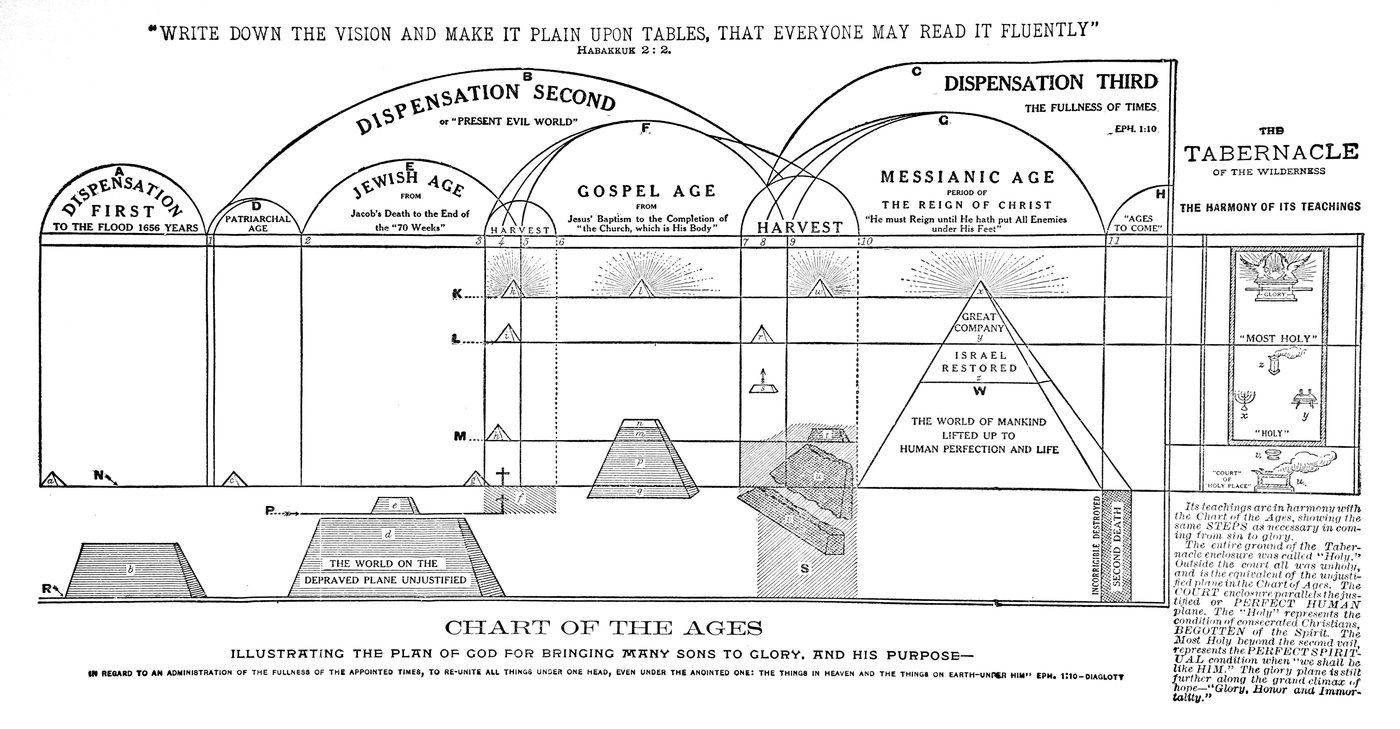
The 1909 chart is headed with Habakkuk 2:2. Arches mark three dispensations and the patriarchal, Jewish, Gospel and Messianic ages. Horizontal planes carry letters, pyramid figures mark spiritual and human conditions, and a diagram of the Tabernacle sits at right. [14] The 1881 Tower explained the figure: a pyramid stands for perfect beings. [6] We did not compare the 1881 and 1909 versions, and could not verify from text any emblem on the covers of the Studies volumes, so none is described.
The 1928 repudiation
The Watch Tower of 1 December 1928, in The Altar in Egypt (Part 2), applied Isaiah 19:19-20 to the anointed remnant instead of the pyramid. The organization’s 1993 history cites the 15 November and 1 December 1928 issues. [1] Part 2 says: [8]
Primary source excerpt. “[…] is impossible to fit the literal pyramid of Gizeh to the prophet’s description” (The Watch Tower, 1 December 1928, The Altar in Egypt, Part 2) [8]
It names Taylor, Smyth and Menzies, and dismisses them for two reasons: when they wrote, the Lord had not yet come to his temple, and it is not claimed that they were anointed. [8]
Primary source excerpt. “It is not claimed that any of these men were of the Lord’s anointed or devoted to the Lord. They were giving expression to their own wisdom.” (The Watch Tower, 1 December 1928, p. 356) [8]
It then treats pyramid study as a spiritual danger: [8]
Primary source excerpt. “One of the most subtle schemes Satan has yet adopted to accomplish that purpose has been and is the use of the pyramid of Gizeh.” (The Watch Tower, 1 December 1928, section Sign and Witness) [8]
The issue does not name Seiss or Russell. The organization’s later account is blunt: “For some 35 years, Pastor Russell thought that the Great Pyramid of Gizeh was God’s stone witness, corroborating Biblical time periods,” but Jehovah’s Witnesses “have abandoned the idea that an Egyptian pyramid has anything to do with true worship.” [1]
What the record does and does not show
- Documented: the cross and crown was on the Tower by early 1891 and still on the cover on 1 December 1928; the organization says it ended in 1931. The 1919 convention report described a pyramid monument accepted by Russell. [1][2][7][8]
- Documented: Volume III’s pyramid chapter drew on Taylor, Smyth, Menzies and Seiss, and says so. The 1928 Watch Tower rejected the pyramid and dismissed Taylor, Smyth and Menzies as men with their own wisdom. [3][8]
- Not established: the issue that dropped the cover emblem, any contemporary reason beyond the organization’s 1993 account, the 15 November 1928 text, the monument’s completion date, and the Studies volumes’ original covers.
- Not supported by the record we hold: Masonic or occult origins for the pyramid or the emblem. That is an allegation by outside writers. [10]
- Disputed: whether the abandonment was a principled correction, as the organization presents it, or a break with Russell. The same organization taught one position in 1891 and the opposite in 1928.
Image provenance
Every image in this report was checked against its source page for public-domain status. The basis is stated for each.
| Image (source page) | Creator, date | Public-domain basis |
|---|---|---|
| The Watch Tower and Herald of Christ's Presence, cover of 1 December 1928 | Watch Tower Bible and Tract Society (cover art credited with the initials W.T.B.&T.S.), 1 December 1928 | Published in the United States in 1928, before 1 January 1931, so public domain in 2026; the Internet Archive item carries a Public Domain Mark 1.0 licence URL. |
| Plate of the Grand Gallery and the Well in the Great Pyramid, from Millennial Dawn, Vol. III (Thy Kingdom Come) | C. T. Russell, Tower Publishing Co. (plates copied from C. Piazzi Smyth), 1891 | Published in the United States in 1891, before 1 January 1931, and the underlying plates are from an 1864 British book; public domain. |
| Pyramid monument near the grave of Charles Taze Russell, Rosemont United Cemeteries, Pittsburgh | Cbaile19 (Wikimedia Commons user), 8 June 2015 | Released by the photographer under CC0 1.0 (public domain dedication); the Wikimedia Commons file page licence tag reads CC0. |
| Chart of the Ages, from Studies in the Scriptures, Series I, The Plan of the Ages | Charles Taze Russell, 1909 | Published in the United States in 1909, before 1 January 1931; the Wikimedia Commons file page tags it Public domain. |
- Part 1: Roots & Reconstruction (Sunday, Nov. 8, noon Central)
- Part 2: Separate Tables (Monday, Nov. 9, noon Central)
- Part 3: The Original Watchtower & Esoteric Symbolism (Tuesday, Nov. 10, noon Central) — you are here
- Part 4: Mid-Century Transformation (Wednesday, Nov. 11, noon Central)
- Part 5: Global Expansion & Information Architecture (Thursday, Nov. 12, noon Central)
- Part 6: Contemporary Pressures & Institutional Scrutiny (Friday, Nov. 13, noon Central)
- Part 7: Synthesis & The Horizon (Saturday, Nov. 14, noon Central)
References
- Watch Tower Bible and Tract Society. “Jehovah's Witnesses—Proclaimers of God's Kingdom, ch. 14, 'They Are No Part of the World'” (1993). ↩
- Zion's Watch Tower and Herald of Christ's Presence. “1891 volume, with the 1 January 1892 issue” (1891-1892). ↩
- C. T. Russell. “Millennial Dawn, Volume III, Thy Kingdom Come” (1891). ↩
- C. Piazzi Smyth. “Our Inheritance in the Great Pyramid” (1864). ↩
- Joseph A. Seiss. “A Miracle in Stone: or, The Great Pyramid of Egypt” (1877). ↩
- Zion's Watch Tower and Herald of Christ's Presence. “1881 volume (May, July-August and September 1881 issues)” (1881). ↩
- International Bible Students Association. “Souvenir Report of the Bible Students Convention, Pittsburgh, Pa., January 2-5, 1919” (1919). ↩
- The Watch Tower and Herald of Christ's Presence. “The Altar in Egypt (Part 2), 1 December 1928, with cover scan” (1928). ↩
- W. M. Flinders Petrie. “The Pyramids and Temples of Gizeh” (1883). ↩
- Grand Lodge of British Columbia and Yukon. “Charles Taze Russell's monument” (undated, secondary source). ↩
- Zion's Watch Tower and Herald of Christ's Presence. “Volume for 1879, including the first number of July 1879 and a historical foreword” (1879). ↩
- The Watchtower and Herald of Christ's Presence. “15 March 1937 issue, cover scan” (1937). ↩
- Zion's Watch Tower and Herald of Christ's Presence. “1900 volume” (1900). ↩
- C. T. Russell. “Studies in the Scriptures, Series I, The Plan of the Ages, Chart of the Ages” (1909). ↩

Kemetic Minds Editorial Desk
Verified NewsroomPrimary-sourced investigative intelligence on civil rights, voting rights, federal policy, and consumer protection. Sourced from primary legal filings, government statistics, and direct field reporting.