
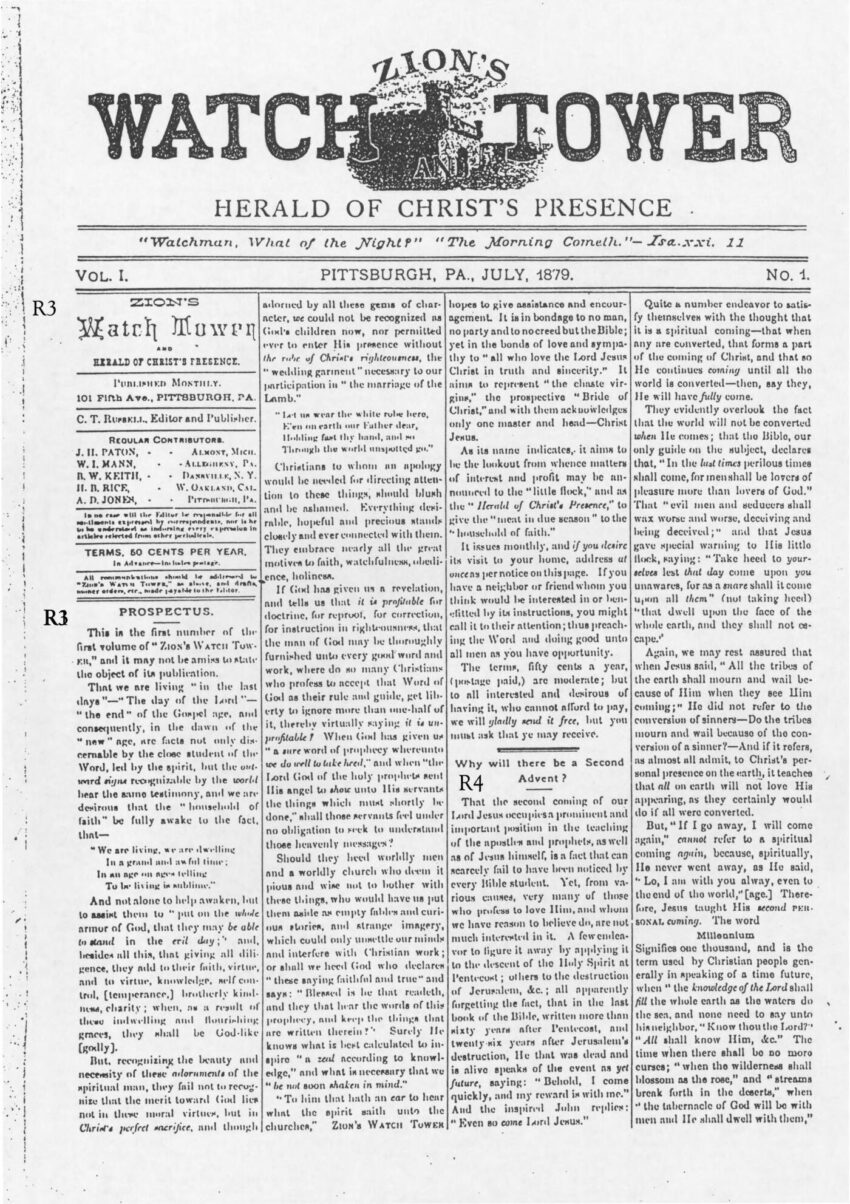
Special Report, Part 1 of 7 — Roots & Reconstruction. Published Sunday, Nov. 8, 2026. Every quotation and statistic below is checked against a saved copy of its source.
Executive summary
- Zion’s Watch Tower first appeared in Pittsburgh in July 1879. The Watch Tower Society’s own 1955 history says “Soon 6,000 copies had been distributed.” That is the organization’s account of itself, not independent evidence. [1]
- The first issue traces the project to Charles Taze Russell’s 1876 contact with N. H. Barbour, whose Herald of the Morning had pointed to autumn 1874. By March 1880 the Tower said the Times of the Gentiles extend to 1914. [2][3]
- The Tower reported that the charter of incorporation of the Zion’s Watch Tower Tract Society “was granted December 13th, 1884.” [4]
- The Census counted 6,580,793 Black Americans in 1880 and 7,488,676 in 1890. A 1909 survey puts Allegheny County’s Negro population at 7876 in 1880 and 13501 in 1890. [5][6]
- In the saved 1879-1890 Tower volumes, passages on Black Americans or American slavery are few. Two (June 1888, September 1889) say freed people were “happier” under slavery while defending freedom or knowledge as a principle. A third (September 1888) repeats, as hearsay, that liberty “meant license” for them. [7][8][9]
- None that we found addresses Black Codes, convict leasing, disfranchisement or segregation statutes. The saved 1886 text of Volume 1 of Millennial Dawn has no occurrence of “negro”, “african” or “colored”. [10]
The question, and the limits of the evidence
This report asks a narrow question. What do the surviving primary documents show about how Russell’s Pittsburgh circle spoke of race, slavery and Black Americans while the United States was dismantling Reconstruction?
The evidence is the full OCR text of the Zion’s Watch Tower volumes for 1879 through 1890, the July 1879 first issue, and an 1886 printing of Millennial Dawn, Volume 1. Volumes after 1890 were not examined. OCR of nineteenth-century print is imperfect, so a keyword search can miss a word. “Not found” below means not found in the text we hold, not proof that nothing was ever said.
Pittsburgh, 1879: a paper, a chronology and a break with Barbour
The first number is dated July 1879, Vol. I, No. 1, “Pittsburgh, Pa.”, with C. T. Russell as “Editor and Publisher” at 101 Fifth Avenue. [2] In it Russell told readers how the paper began. He had received Barbour’s Herald of the Morning and in 1876 arranged for Barbour and Paton to hold meetings in Philadelphia. [2]
Primary source excerpt. “how scriptural arguments pointed to the autumn of 1874 as the time it was due; how that as the disappointment connected therewith began to abate, he and others had re-examined the scriptural proofs that appeared to teach that the end of the world was due at the time supposed” (Zion’s Watch Tower, July 1879, No. 1, Russell’s account of the Herald of the Morning) [2]
The same issue credits George Storrs, “our dearly beloved and aged brother”, with help “both by word and pen”. It also records a financial dispute between Russell and Barbour over the Herald. That is Russell’s side only, and the saved sources do not let us judge it. [2]
The 1914 date appears in the first volume year. A December 1879 line speaks of the “37” years “we have entered” reaching to 1914, though the OCR there is poor. [11] By March 1880 the statement is plain:
Primary source excerpt. “extend to 1914, and the heavenly kingdom will not have full sway till then” (Zion’s Watch Tower, March 1880, p. 3, on the Times of the Gentiles) [3]
The organization frames the story theologically: its 1955 history says “Jehovah’s hand was upon the small Pittsburgh (Pa.) Bible group under C. T. Russell’s chairmanship.” [1] That is a statement of faith. The primary record shows what the group printed and when, not divine selection.
From Tract Society to corporation
The organization’s later account and the Tower’s contemporaneous reports are separated below.
| Date | Event | Source and what kind it is |
|---|---|---|
| July 1879 | First issue of Zion’s Watch Tower, Pittsburgh; “Soon 6,000 copies had been distributed” | The issue (primary) [2]; the circulation claim is from the 1955 Watchtower (organization’s later account) [1] |
| Early 1881 | Society “established as an unincorporated administrative agency with Russell as its manager”; “Russell and others liberally contributed $35,000” | 1955 Watchtower (the organization’s later account) [1] |
| 1884 | Tower says the Society “has never yet had legal incorporation” and that application for a charter “has been done” | Zion’s Watch Tower, 1884 (primary) [12] |
| 13 Dec 1884 | Charter of incorporation granted | Zion’s Watch Tower, January 1885 (primary) [4] |
| Jan 1885 | Voting certificates to donors of Ten Dollars or more, one share per ten dollars; six directors, Russell president | Zion’s Watch Tower, January 1885 (primary) [4] |
The Tower gave its reasons in 1884. Some of the saints would be in the flesh during a great part at least of the time of trouble, and a charter would give “a legal standing” if those prominent in the work were interrupted. [12] The January 1885 issue printed a two-year tract fund report with voluntary cash receipts of $2,491.43 and a balance owing of $2,446.01. [4] Money and voting shares were tied together in the charter from the start.
The country the Tower was published in
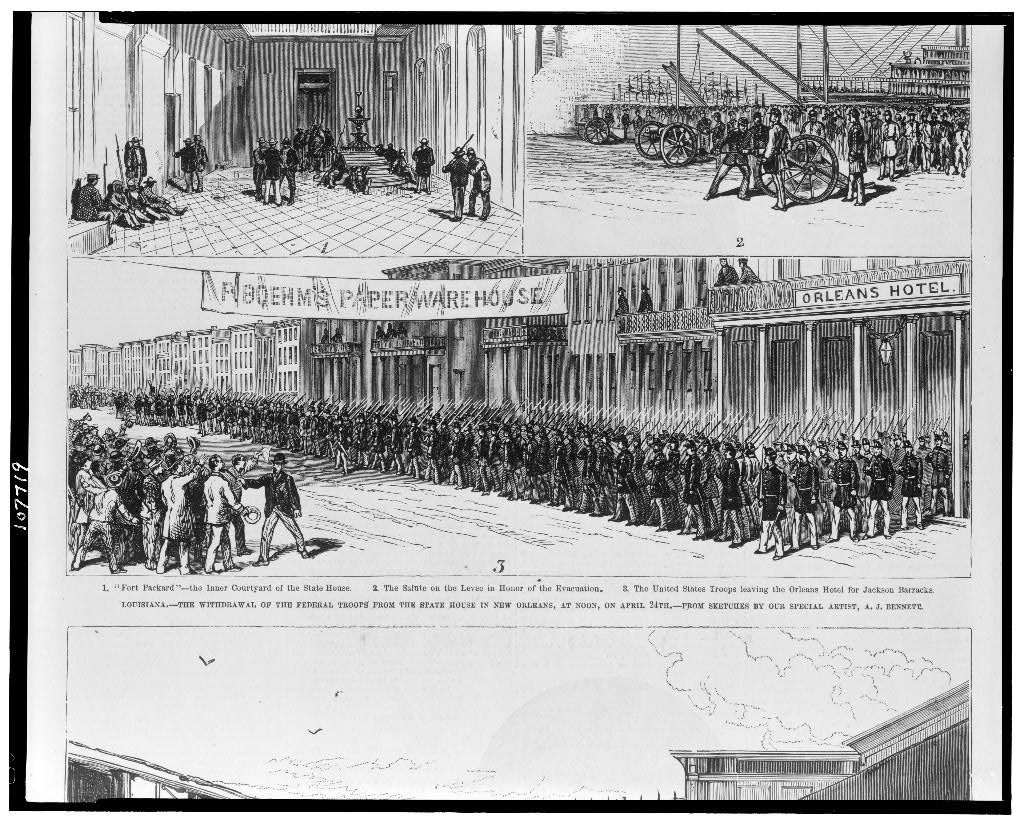
The Library of Congress dates Reconstruction from 1865 to 1877 and says it “ended with the withdrawal of federal troops from the southern states in 1877.” [13] The Library also holds a Frank Leslie’s illustration of troops leaving the State House in New Orleans on 24 April 1877. [14]
In 1865 Mississippi’s legislature defined as vagrants freedmen found without lawful employment, and added white persons who associated with them “on terms of equality”. [15]
Primary source excerpt. “All freedmen, free negroes and mulattoes in this State, over the age of eighteen years, found on the second Monday in January, 1866, or thereafter, with no lawful employment or business, […] shall be deemed vagrants, and on conviction thereof shall be fined” (Mississippi Vagrant Law, Laws of Mississippi, 1865, as excerpted by MIT) [15]
The National Park Service’s Reconstruction theme study, a secondary scholarly synthesis, says new state governments passed Black Codes “that excluded African Americans from testifying in court”. It adds that “During the 1870s and 1880s, prison officials increasingly leased prisoners to planters and other businessmen at a cost lower than the rate of pay for free workers”, and that the leased prisoners were “the vast majority of whom were African Americans”. [16]
Disfranchisement then moved state by state. The NPS study says: “Beginning in Mississippi in 1890, southern states launched plans to legally disenfranchise African Americans.” [16] The Mississippi constitution of 1890 does not mention race in its franchise article. It sets a poll tax of two dollars and, from 1 January 1892, a test of reading, understanding or interpreting the constitution. [17]
Primary source excerpt. “every elector shall, in addition to the foregoing qualifications, be able to read any section of the constitution of this State; or he shall be able to understand the same when read to him, or give a reasonable interpretation thereof.” (Constitution of Mississippi, 1890, Article 12, Section 244) [17]
In 1896 the US Supreme Court upheld Louisiana’s law requiring “equal but separate accommodations for the white, and colored races” on railways. It rejected the plaintiff’s contention that “the enforced separation of the two races stamps the colored race with a badge of inferiority.” [18]
Primary source excerpt. “Our constitution is color-blind, and neither knows nor tolerates classes among citizens.” (Justice Harlan, dissenting, Plessy v. Ferguson, 163 U.S. 537, 18 May 1896) [18]
Ida B. Wells, in 1895, said she relied on the Chicago Tribune’s compilation of lynching statistics and wrote: “In 1892 there were 241 persons lynched.” Her tabulation of Black victims in 1893, drawn from the Tribune’s record of 1 January 1894, totals 159. [19] These are a journalist’s tallies from newspaper records, not an official count.
Numbers: the Black population the Tower rarely named
The Census Bureau’s 1918 compilation gives the Negro population of the United States as 4,880,009 in 1870, 6,580,793 in 1880 and 7,488,676 in 1890. [5] By our calculation, that is a rise of about one-seventh across the decade of the Tower’s first years. The Bureau’s modern working paper lists the same 1880 figure as “6 580 793”. [20]
| Measure | Year | Figure | Source |
|---|---|---|---|
| United States, Negro population | 1870 | 4,880,009 | Census Bureau, 1918 [5] |
| United States, Negro population | 1880 | 6,580,793 | Census Bureau, 1918 [5] |
| United States, Negro population | 1890 | 7,488,676 | Census Bureau, 1918 [5] |
| Allegheny County, Negro population | 1880 | 7876 (2.2 per cent of the county) | Tucker, 1909 survey [6] |
| Allegheny County, Negro population | 1890 | 13501 (2.4 per cent of the county) | Tucker, 1909 survey [6] |
| Pittsburgh city, Black population | 1880 | 4,077 (2.6%) | Logan et al., peer-reviewed [21] |
| Pittsburgh city, Black population | 1900 | 17,040 (5.2%) | Logan et al., peer-reviewed [21] |
The county figures are printed in Helen Tucker’s 1909 report as a chart without separators, and we reproduce them as printed. She wrote that Pittsburgh and Allegheny were important stations of the underground railroad, and that three-quarters of the county’s Negroes lived in Pittsburgh and Allegheny City. [6] By our calculation, Pittsburgh city’s Black count more than quadrupled between 1880 and 1900. [21] We found no verified separate count for Allegheny City, and the county and city rows use different geographies.
What the Tower actually said
The word “Negro” or “negroes” occurs ten times in the 1879-1890 text. Searches for “freedmen”, “emancipation”, “colored” and “slave” near American place-names add the passages below.
Slavery as metaphor. In July-August 1881 the Tower argued that Jesus’ promise of liberty to captives meant release from sin, not politics: “How singular-did Jesus tell of the emancipation of slaves-of the freedom of the serfs of Russia, or the negroes of America?” [22] In August 1889 it likened Pope Leo XIII’s announcement about purgatory to how “President Lincoln signed the Emancipation Proclamation which set free millions of slaves in the South.” [23] The 1886 Volume 1 also uses slavery figuratively, of church systems, and warns that corporations could “reduce wage-workers to penury and slavery.” [10]
Freed people as an illustration, 1888-1889. These passages bear most directly on the question. In June 1888 a “View from the Tower” on European landlords and peasants conceded a point:
Primary source excerpt. “many of the Negroes once slaves in the United States were happier and better provided for in slavery, than now that they are their own masters. But the principle involved is that the freedom is needful to the development of the human mind and of self-control and progress in general toward the true ends of human existence.” (Zion’s Watch Tower, June 1888, p. 1, View from the Tower) [7]
In September 1888 an article titled “Christian Freedom” opened by recounting a report about freed people, then applied it to believers freed from sin:
Primary source excerpt. “It is said that, after the emancipation of American slaves, when millions who had for years been subject to the master’s law and whip, were suddenly given the right to control their own affairs, it was almost impossible to get the majority of them to do anything. In their degraded condition liberty meant license;” (Zion’s Watch Tower, September 1888, p. 3, Christian Freedom) [8]
The article continues that “Experience is slowly teaching them” self-control. It later says “The American freedmen found many of their former masters willing to take advantage of their weaknesses and ignorance, to get them into their debt in advance; so that they would be compelled to serve them virtually as before.” [8] The Tower names no source for the “it is said” claim. In September 1889 a second “View from the Tower”, on increased knowledge, returned to the subject:
Primary source excerpt. “The Negroes of the South were probably happier fifty years ago, in slavery, than they now are; […] yet the reports are that a race war, between blacks and whites, is to be feared.” (Zion’s Watch Tower, September 1889, p. 1, View from the Tower) [9]
Primary source excerpt. “it is a fuller knowledge of his rights as a man, under the law of God, and as a citizen, under the Constitution of these United States, that is stirring within the hearts of the Negroes a desire for more and more, until they shall feel satisfied that they have their full proportion of the rights, privileges and common blessings of our day.” (Same article, September 1889, p. 1) [9]
Read together, these passages repeat, without evidence offered, claims that the formerly enslaved were better off before emancipation or struggled with liberty, claims common in defenses of slavery. They also say emancipation followed from increased knowledge, that Black citizens’ demands under “the Constitution” flow from it, and that former masters exploited freedmen through debt. The passages neither endorse nor mention the Black Codes, lynching or disfranchisement. How readers took them is not recorded.
Aid and missions. The September 1886 Tower listed church funds its readers were never asked for, including a “freedmen’s aid fund”, and declared: “The work for the freedmen can safely stand until the harvest is over.” [24] In January 1890 it said readers might be asked “to help Home Missions to teach the Indians of the West and the Negroes of the South”, and that this would help “put upon others the chains of error.” [25] In both, the reasons given are doctrinal, and the saved text gives no others.
Black readers and Africa. The May 1882 Tower printed a letter dated Caledonia, Miss., April 8, 1882:
Primary source excerpt. “I am a colored Congregational minister, and I am anxious to know the truth of God’s word, but I am too poor to purchase the Bible helps I need.” (Zion’s Watch Tower, May 1882, letters from readers, Reprints pp. 345-346) [26]
The June 1882 issue reported: “The colored minister who desired a Diaglott has been supplied. Four persons sent pay for him.” [26] It is the only reference we found to a Black reader as such. In May 1887 the Tower reprinted traveller Joseph Thomson on African cities, including his admission that he had believed “the negro was not capable of development” until what he saw changed his mind. The Tower’s conclusion was theological: “morality and Christianity are not the same thing.” [27]
Lynching, in the law-and-order sense. The April 1886 Tower reprinted a newspaper’s crime statistics for 1884, including “applying lynch law to 219 murderers, against 92 thus disposed of in 1883”, as evidence of rising crime. [28] In December 1887 it praised Chicago because “her citizens refrained from lynching” the condemned anarchists. [29] Neither mentions race or the Southern lynching of Black victims that Wells documented.
The silence
| Development | Documented in | Found in the saved Tower volumes, 1879-1890? |
|---|---|---|
| End of Reconstruction, 1877 | Library of Congress [13] | No article. “Reconstruction” occurs three times, each on other subjects |
| Black Codes; convict leasing | NPS study; Mississippi statute [16][15] | No article found |
| Disfranchisement | Mississippi 1890 constitution [17] | Not found. “Disfranchise” occurs once, about Ireland |
| Lynching of Black Americans | Wells, 1895 [19] | Not found. Two passages on lynching, neither about race |
| Segregation statutes; Plessy, 1896 | Supreme Court [18] | Not examined (1896 is after the saved volumes) |
| Freed people and slavery | The Tower itself | Yes: 1881, June 1888, September 1888, August 1889, September 1889 (quoted above) |
Volume 1 of 1886 has no such passages. Its universalism is stated in other terms: the gospel went “not to the Jew only, but to all nations”.
Primary source excerpt. “not to the Jew only, but to all nations […] Jesus Christ, by the grace of God, tasted death for every man” (Millennial Dawn, Vol. I, 1886, Chapter IV) [10]
The scan is an early printing: the title page is dated 1886 and the preface November 1886, but the printing number is garbled in the OCR. [10] The line about “every man” concerns salvation, not citizenship or equality.
What the record does and does not show
- Established by primary text: the Tower began in July 1879 in Pittsburgh. It recounted the 1874 expectation of Barbour’s Herald and by March 1880 gave 1914 as the end of the Times of the Gentiles. The Society was chartered on 13 December 1884, with voting shares tied to donations. [2][3][4]
- Established by primary text: in 1888 and 1889 the Tower asserted that freed people were probably happier in slavery or struggled with liberty, while calling freedom and knowledge essential. It reported a Black minister as a reader in 1882, and its 1886 book framed salvation in terms of “every man”. [7][8][9][26][10]
- Not found, and therefore not claimed: any article in the 1879-1890 volumes on Black Codes, convict leasing, disfranchisement, segregation statutes or the lynching of Black Americans. OCR limits and the missing post-1890 volumes mean this describes our corpus, not every page printed.
- Not established: why the Tower was silent, what Russell personally believed, or how Black readers received the paper. This report does not infer it.
- The organization’s own account: the Society’s 1955 history of this period covers the 1879 launch and the 1881 and 1884 organizational steps, and its saved text has no reference to race, slavery or Black people. [1] Its description of the early years as divinely chosen is a claim of faith, and the 6,000-copy figure is its own later claim, not found in the OCR of the first issue. Later accounts of early Black Bible Students are for Part 2.
Image provenance
Every image in this report was checked against its source page for public-domain status. The basis is stated for each.
| Image (source page) | Creator, date | Public-domain basis |
|---|---|---|
| Zion's Watch Tower and Herald of Christ's Presence, Vol. I, No. 1 (July 1879), front page | C. T. Russell, editor and publisher (Pittsburgh, Pa.), July 1879 | Published in the US in 1879, before 1931, so public domain; the Internet Archive item is marked Public Domain Mark 1.0 |
| Louisiana–the withdrawal of the federal troops from the State House in New Orleans, at noon, on April 24th | A. J. Bennett (special artist), Frank Leslie's Illustrated Newspaper, 19 May 1877 | Library of Congress rights statement: No known restrictions on publication; US periodical illustration of 1877 (published before 1931) |
- Part 1: Roots & Reconstruction (Sunday, Nov. 8, noon Central) — you are here
- Part 2: Separate Tables (Monday, Nov. 9, noon Central)
- Part 3: The Original Watchtower & Esoteric Symbolism (Tuesday, Nov. 10, noon Central)
- Part 4: Mid-Century Transformation (Wednesday, Nov. 11, noon Central)
- Part 5: Global Expansion & Information Architecture (Thursday, Nov. 12, noon Central)
- Part 6: Contemporary Pressures & Institutional Scrutiny (Friday, Nov. 13, noon Central)
- Part 7: Synthesis & The Horizon (Saturday, Nov. 14, noon Central)
References
- Watch Tower Bible and Tract Society. “Modern History of Jehovah's Witnesses, Part 2: Small Beginnings (1879-1889),” The Watchtower, pp. 45-48 (15 January 1955; the organization's own account). ↩
- C. T. Russell, ed. “Zion's Watch Tower and Herald of Christ's Presence, Vol. I, No. 1” (July 1879; primary). ↩
- C. T. Russell, ed. “Zion's Watch Tower, 1880 volume, March 1880 issue” (primary). ↩
- C. T. Russell, ed. “Zion's Watch Tower, January 1885: Zion's Watch Tower Tract Society and Tract Fund Report” (primary). ↩
- U.S. Bureau of the Census. “Negro Population in the United States, 1790-1915” (1918; Census Bureau publication, Table 1). ↩
- Helen A. Tucker. “The Negroes of Pittsburgh,” Charities and the Commons, pp. 599-608, Pittsburgh Survey (2 January 1909; contemporary survey, secondary for census figures). ↩
- C. T. Russell, ed. “Zion's Watch Tower, 1888 volume, June 1888 issue” (primary). ↩
- C. T. Russell, ed. “Zion's Watch Tower, September 1888: Christian Freedom” (primary). ↩
- C. T. Russell, ed. “Zion's Watch Tower, September 1889: View from the Tower” (primary). ↩
- C. T. Russell. “Millennial Dawn, Volume I: The Plan of the Ages” (Tower Publishing Co., Allegheny, 1886; later titled Studies in the Scriptures, vol. 1; primary). ↩
- C. T. Russell, ed. “Zion's Watch Tower, 1879 volume, December 1879 issue” (primary). ↩
- C. T. Russell, ed. “Zion's Watch Tower, 1884: Legal Incorporation” (primary). ↩
- Library of Congress. “Reconstruction: A Resource Guide, Introduction” (research guide; secondary). ↩
- Frank Leslie's Illustrated Newspaper (A. J. Bennett, artist). “Louisiana–the withdrawal of the federal troops from the State House in New Orleans, at noon, on April 24th” (19 May 1877; Library of Congress record). ↩
- State of Mississippi. “Mississippi Vagrant Law, Laws of Mississippi, 1865” (as excerpted by MIT 21H.102; primary text, secondary host). ↩
- National Park Service. “The Era of Reconstruction: 1861-1900, National Historic Landmarks Theme Study” (government scholarly synthesis; secondary). ↩
- Mississippi Department of Archives and History. “The Mississippi Constitution of 1890 as originally adopted” (1890; primary text). ↩
- U.S. Supreme Court. “Plessy v. Ferguson, 163 U.S. 537” (18 May 1896; primary). ↩
- Ida B. Wells. “The Red Record: Tabulated Statistics and Alleged Causes of Lynching in the United States” (1895; contemporary compilation from newspaper records). ↩
- Campbell Gibson and Kay Jung, U.S. Census Bureau. “Historical Census Statistics on Population Totals by Race, 1790 to 1990, Working Paper No. 56” (September 2002; secondary compilation). ↩
- John R. Logan, Weiwei Zhang, Richard Turner and Allison Shertzer. “Creating the Black Ghetto: Black Residential Patterns Before and During the Great Migration” (peer-reviewed article, Appendix Table 1; secondary). ↩
- C. T. Russell, ed. “Zion's Watch Tower, July-August 1881” (primary). ↩
- C. T. Russell, ed. “Zion's Watch Tower, August 1889” (primary). ↩
- C. T. Russell, ed. “Zion's Watch Tower, September 1886: Seed Time and Harvest” (primary). ↩
- C. T. Russell, ed. “Zion's Watch Tower, January 1890” (primary). ↩
- C. T. Russell, ed. “Zion's Watch Tower, May and June 1882” (primary). ↩
- C. T. Russell, ed. “Zion's Watch Tower, May 1887: Christianizing the World” (primary). ↩
- C. T. Russell, ed. “Zion's Watch Tower, April 1886” (primary). ↩
- C. T. Russell, ed. “Zion's Watch Tower, December 1887” (primary). ↩

Kemetic Minds Editorial Desk
Verified NewsroomPrimary-sourced investigative intelligence on civil rights, voting rights, federal policy, and consumer protection. Sourced from primary legal filings, government statistics, and direct field reporting.