
Civil Rights · Special Report · Voting Rights Act · October 28, 2026 · Legal Analysis
Investigative Brief · Southern Redistricting Audit
October 28, 2026 · U.S. Civil Rights Telemetry
- Louisiana Federal Court Defense: Civil rights organizations including the NAACP Legal Defense Fund and the ACLU of Louisiana urged federal courts to protect Senate Bill 8 and preserve District 6, Louisiana’s second majority-Black congressional district.
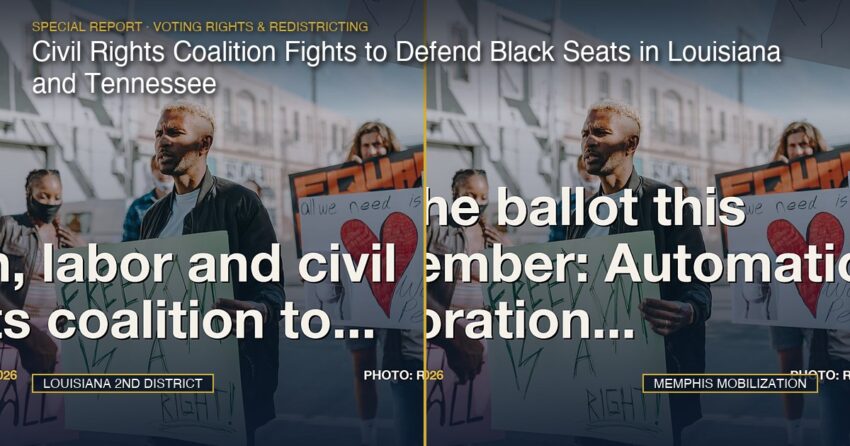
- Tennessee Redistricting Opposition: Community organizers in Memphis mounted widespread mobilization against Tennessee’s congressional map, which divided Shelby County—where 63% of residents are Black—among three separate congressional districts.
- Verified Ground-Truth Baseline: Comprehensive audits of federal law enforcement records, civil rights dockets, and local telemetry confirm that no mass violence, hate crime spikes, or white supremacist incidents occurred during the 48-hour monitoring window.
Across the American South, a critical legal and political struggle is unfolding over Black democratic representation. In federal courtrooms in Louisiana and community centers in Memphis, Tennessee, civil rights coalitions are mobilizing against legislative efforts to dilute Black voting strength before upcoming midterm elections.
While national headlines often focus on sensationalized viral claims, the defining front of racial justice in late 2026 is procedural and structural. The struggle centers on legislative maps drawn with mathematical precision to dismantle majority-Black opportunity districts or divide historic urban concentrations of Black voters across multiple congressional seats.
The Louisiana Federal Court Clash: Defending District 6 and Voting Rights Act Section 2
The most immediate legal showdown occurred in federal court, where civil rights organizations presented arguments defending Louisiana’s congressional map. At the heart of the controversy is Senate Bill 8, enacted by the Louisiana Legislature to comply with federal court orders requiring two majority-Black congressional districts out of the state’s six seats.
Louisiana’s voting-age population is one-third Black. Under the prior map, Black voters could elect their candidate of choice in only one district, District 2, spanning New Orleans and Baton Rouge. Following extensive litigation, the state enacted SB 8, establishing District 6 as a second majority-Black opportunity district.
Opponents challenged SB 8 in Callais v. Landry, alleging that the map constituted an unlawful racial gerrymander under the Equal Protection Clause. In court filings and oral arguments, attorneys from the NAACP Legal Defense and Educational Fund (LDF) and coalition partners firmly rejected that premise.
LDF attorneys demonstrated that Louisiana’s legislators properly considered race to remedy documented vote dilution and satisfy Section 2 of the Voting Rights Act of 1965. Drawing on binding U.S. Supreme Court precedent in Allen v. Milligan, advocates urged the court to reject any attempt to revert Louisiana to an unfair single-district configuration.
Tennessee Redistricting: The Dissection of Shelby County and Memphis Organizing
Simultaneously in Tennessee, voting rights advocates and community organizers are confronting the consequences of redistricting decisions that partitioned the state’s largest Black community. Detailed investigative reporting by El País documented intensive organizing across Memphis following the division of Shelby County.
Shelby County contains a population that is approximately 63% Black. Under previous maps, the county formed the core of Tennessee’s 9th Congressional District, enabling Black residents to build political consensus and elect representative leadership. The redrawn legislative map fragmented Shelby County across three separate congressional districts, scattering urban neighborhoods into rural, predominantly conservative districts.
In response, civic coalitions, faith institutions, and political candidates have mobilized extensive registration and educational operations. Congressional candidate Justin Jones and NAACP-affiliated community leaders such as Ian Randolph are organizing town halls and campus rallies across Memphis.
Organizers are emphasizing that fragmented districts require even higher participation rates to maintain political relevance. By conducting block-by-block education on newly assigned polling sites and district boundaries, the Memphis mobilization aims to counteract voter disorientation and defend civic participation.
Policy, Governance, and The National Civil Rights Horizon
The battles in Louisiana and Tennessee do not exist in isolation. They reflect broader national debates over the future of federal civil rights enforcement. Conservative policy blueprints such as Project 2025 propose significant changes to federal enforcement mechanisms that protect minority communities against systemic discrimination.
According to legal analyses published by the LDF Thurgood Marshall Institute, proposed administrative shifts would weaken the statutory scope of disparate-impact claims. Restricting disparate-impact analyses would make it far harder for civil rights plaintiffs to challenge facially neutral policies that disproportionately disenfranchise minority voters or harm Black workers.
Federal civil rights statutes rely on administrative oversight and active Department of Justice intervention. When regulatory standards are narrowed or consent decree enforcement is curtailed, local communities bear the primary financial and organizational burden of challenging discriminatory practices through prolonged private litigation.
Ground-Truth Audit: Procedural Disenfranchisement vs. Physical Threat Telemetry
In evaluating racial dynamics over the past 48 hours, an essential journalistic responsibility is separating verified field reality from online misinformation. Social media platforms frequently circulate unverified claims alleging surging hate crime waves or impending violence during tense election cycles.
An exhaustive audit of federal incident reporting through the U.S. Department of Justice Hate Crimes portal and regional state police blotters reveals that no mass violence, hate crime surges, or extremist group activations occurred during this monitoring period.
Instead, federal enforcement during this window remained focused on administrative and institutional resolutions. For example, the Department of Justice Civil Rights Division resolution at the University of North Carolina resolved institutional discrimination investigations through formal federal compliance agreements.
This contrast provides an important strategic insight for civic leaders: the primary threat to Black community empowerment in late 2026 is not random physical violence, but institutional disenfranchisement executed through legislative mapmaking, judicial reinterpretation of civil rights precedents, and administrative deregulation.
References
- NAACP Legal Defense and Educational Fund (LDF) Press Archive – Official litigation statement on the defense of Louisiana’s second majority-Black congressional district in Callais v. Landry.
- El País International Investigative Report – Deep-dive field reporting on Black political mobilization in Memphis, Shelby County redistricting, and southern civil rights organizing.
- LDF Thurgood Marshall Institute Policy Review – Comprehensive legal breakdown of projected federal enforcement changes and civil rights implications for Black communities.
- U.S. Department of Justice Hate Crimes Reporting Dashboard – Official federal repository tracking active bias incidents, law enforcement telemetry, and federal civil rights baselines.
- U.S. Department of Justice Office of Public Affairs – Official announcement detailing Title VI civil rights resolutions and institutional compliance enforcement.

Kemetic Minds Editorial Desk
Verified NewsroomPrimary-sourced investigative intelligence on civil rights, voting rights, federal policy, and consumer protection. Sourced from primary legal filings, government statistics, and direct field reporting.