
Special Fact Check · Energy & Infrastructure · October 25, 2026 · Meteorological & Grid Audit
Forensic Fact Check · Energy Grid Audit
October 25, 2026 · United Kingdom Infrastructure Review
The Reality: The localized electricity outages across Northern England, Scotland, and the Midlands were directly triggered by severe physical damage from back-to-back autumnal tempests, Storm Austen and Storm Boelo. Hurricane-force winds of 84 to 85 miles per hour toppled mature trees and severed overhead distribution cables. The claim that data centers receive restoration priority over domestic households is completely unfounded. Under statutory regulations enforced by the Office of Gas and Electricity Markets (Ofgem), emergency restoration priorities are strictly assigned to life-critical health facilities, vulnerable individuals on the Priority Services Register, and public safety infrastructure.
A viral social media post claiming that over 271,000 homes across the United Kingdom suffered a mysterious blackout has gathered hundreds of thousands of views. The viral claims sparked unfounded conspiracy theories alleging that commercial data centers were prioritized while domestic households were left in the dark.
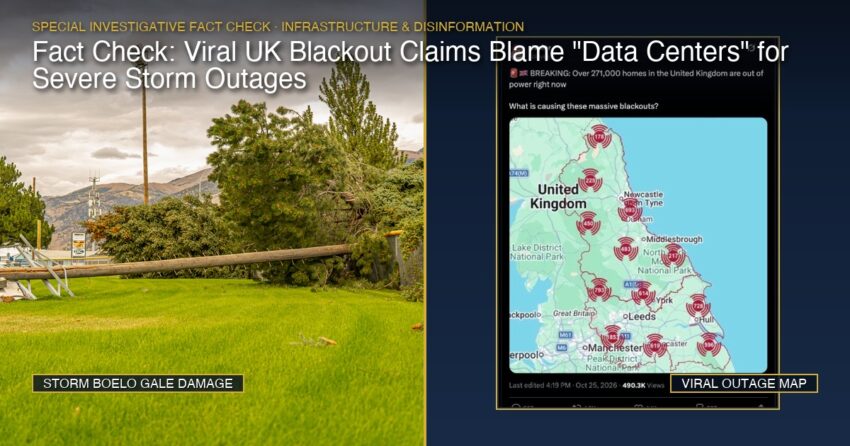
The sensational assertions, published alongside screenshots of regional power distribution maps displaying concentrated fault clusters across Northern England, omit the defining reality behind the disruptions. The outages were not an unexplained grid mystery or an intentional resource diversion. Instead, they were the direct consequence of violent, back-to-back meteorological systems that battered the British Isles with destructive winds and torrential rainfall.
The Viral Claims: How Autumn Gale Damage Was Rebranded as a Grid Mystery
The viral flurry began when online commentators shared a cropped snapshot from a regional utility outage tracker. Pointing to red concentric fault circles across Newcastle, Durham, Leeds, Manchester, and Hull, the original post asked, “What is causing these massive blackouts?” Within hours, responding accounts amplified speculative narratives, declaring that artificial intelligence computing hubs and commercial data facilities were consuming excessive electricity and receiving priority power allocations over freezing families.
This narrative misinterprets how distribution network fault maps function. The circular markers depicted on live utility interfaces indicate localized engineering incidents, such as blown pole fuses, severed conductors, or fallen branches touching high-voltage wooden pole lines. Rather than demonstrating an intentional rolling blackout or supply shortfall, the graphic illustrated repair crews responding to severe, distributed physical trauma across exposed regional circuits.
The Meteorological Reality: The Double Impact of Storm Austen and Storm Boelo
Official meteorological records confirm that Britain was struck by an intense meteorological double system during late October 2026. The initial disturbance, Storm Austen, delivered rapid cyclogenesis across southern and western regions, generating wind speeds exceeding 80 miles per hour and weakening tree structures across regional transport and power corridors.
Before recovery operations could fully conclude, Storm Boelo descended across Scotland, Northern Ireland, and Northern England over the weekend. Official advisories documented in the UK Met Office National Severe Weather Warning Service and Storm Centre logged sustained hurricane-force gusts reaching 84 to 85 miles per hour across exposed coasts and elevated inland moors. These extreme winds brought down mature timber, collapsed power poles, and severed lines across rural and suburban distribution feeders.
According to data compiled under the Energy Networks Association Severe Weather Protocol, the dual storms knocked out power to roughly 840,000 properties cumulatively. Despite challenging conditions, distribution network operators, including Northern Powergrid, Scottish and Southern Electricity Networks, and Electricity North West, mobilised hundreds of engineers, reconnecting over 90 percent of impacted customers within 24 hours of peak gusts.
Debunking the Data Center Priority Myth: How UK Grid Restoration Works
The viral assertion that commercial data centers take precedence over domestic customers during emergency outages is contradicted by statutory grid regulations. In the United Kingdom, local distribution networks operate under strict codes established by national energy authorities.
When gale-force winds bring down overhead cables, network technicians dispatch repair teams based strictly on safety, circuit topology, and community vulnerability. Under legal mandates governed by the Ofgem Priority Services Register Regulations, priority assistance during supply emergencies is legally reserved for vulnerable domestic citizens, including medically dependent patients on kidney dialysis or home oxygen, elderly residents, and families with infant children.
Commercial data operations do not receive preferential line restoration during storm damage. Large enterprise data centers connect to high-voltage transmission lines or maintain independent uninterruptible power supply batteries and backup diesel generators to manage external power failures. They do not siphon domestic feeder circuits, nor do utility line workers bypass residential neighborhoods to repair industrial data facilities.
Consumer Rights and Restoration Accountability During Severe Storms
While severe autumn storms inevitably stress overhead infrastructure, British energy consumers maintain robust statutory protections. Distribution network operators are legally required to restore power within strict statutory deadlines or provide automatic financial restitution to affected households.
Under the Ofgem Guaranteed Standards of Performance for Unplanned Power Outages, domestic customers experiencing extended supply interruptions during severe category storms are entitled to financial compensation based on the duration of the fault. These regulated frameworks ensure network operators face direct financial penalties if they fail to prioritize rapid, universal civilian restoration.
Residents seeking live incident verification and localized restoration progress can inspect real-time engineering updates through the Northern Powergrid Distribution Network Fault Map and associated regional distribution operator portals, rather than relying on unverified social media claims.
Primary Regulatory, Meteorological, and Network Verification Sources
This investigative fact check is grounded in verified meteorological bulletins, utility engineering incident logs, and statutory energy regulations. Readers are invited to review primary source records:
- UK Met Office Storm Centre & Severe Weather Warnings – Official meteorological bulletins tracking wind velocity, cyclone trajectories, and named storm criteria for Storm Austen and Storm Boelo.
- Energy Networks Association Severe Weather Protocols – Industry operational updates tracking cumulative property restorations and emergency field engineering response across British network operators.
- Ofgem Priority Services Register Statutory Framework – Official government regulations establishing priority support criteria during electrical network emergencies.
- Ofgem Guaranteed Standards of Performance for Power Cuts – Legal standards governing customer restitution and mandatory utility restoration obligations.
- Northern Powergrid Live Incident & Fault Mapping Portal – Public real-time dashboard displaying verified line faults, engineering dispatches, and estimated restoration timetables.

Kemetic Minds Editorial Desk
Verified NewsroomPrimary-sourced investigative intelligence on civil rights, voting rights, federal policy, and consumer protection. Sourced from primary legal filings, government statistics, and direct field reporting.