
Special Report · National Security · October 25, 2026 · Fact Check & Analysis
Verified Fact Check · National Defense Audit
October 25, 2026 · Strategic Infrastructure Review
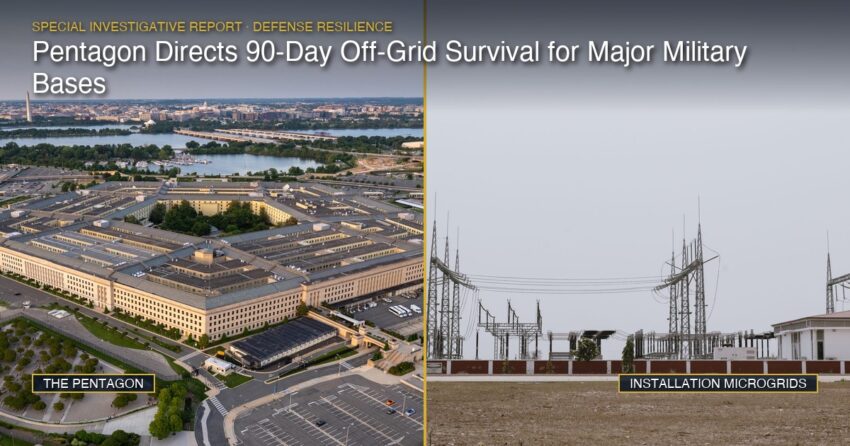
The Reality: The Department of Defense is systematically upgrading energy resilience standards across domestic military installations, transitioning from historical 14-day diesel backup reserves to comprehensive 90-day off-grid islanding capabilities. However, this initiative is an engineering response to vulnerable commercial power grids, severe transformer supply bottlenecks, and advanced cyber-physical threats. It does not reflect intelligence of an imminent catastrophic domestic collapse or unannounced martial law contingency.
Viral rumors circulating across social media channels claim that the Pentagon is quietly preparing for a catastrophic, nationwide blackout that will collapse the electrical grid while military bases seal their perimeters for three months. These sensational reports have ignited widespread panic, portraying military resilience planning as covert preparation for a planned national shutdown.
The actual program behind these claims is the expansion of Department of Defense installation energy resilience directives under federal statute. Defense leaders have recognized that relying on vulnerable commercial power grids poses severe national security vulnerabilities during extended crises. Rather than an ominous sign of immediate societal collapse, the shift represents a long-planned modernization of military infrastructure designed to maintain operational readiness regardless of regional grid stability.
The Viral Rumors Versus Ground Truth: Separating Defense Planning from Panic
Speculative claims amplified across online forums assert that defense installations have received immediate orders to disconnect from regional electrical distribution systems. Online commentators have seized on public procurement filings and modernization blueprints, conflating long-range installation resilience planning with imminent catastrophic black-sky scenarios.
A rigorous review of defense policy records confirms that base commanders are not disconnecting from civilian utility networks. Instead, installations are constructing modern microgrid switching systems that remain connected to municipal power during regular operations while maintaining the capability to disconnect and operate independently whenever severe emergencies disrupt surrounding civilian infrastructure.
The Strategic Shift: Why 14 Days Under DoDI 4170.11 Was No Longer Enough
For decades, defense installations adhered to DoD Instruction 4170.11, which required critical facilities to maintain a minimum of 14 days of emergency diesel generator fuel. While adequate for localized weather disturbances such as hurricanes or ice storms, the 14-day standard proved fundamentally flawed when evaluating complex national infrastructure threats.
Federal evaluations conducted under the 10 U.S.C. Section 2920 energy resilience statutes established that civilian grid recovery from coordinated physical attacks or sophisticated cyber incidents could take months rather than days. Severe bottlenecks in high-voltage transformer manufacturing, where custom replacement units require lead times exceeding 24 months, meant that a prolonged regional disruption would quickly exhaust short-term fuel reserves.
The Modernization Tech Stack: Islanded Microgrids, BESS, and Micro-Reactors
Achieving continuous 90-day off-grid capability requires moving beyond conventional diesel backup generation toward integrated, multi-source clean energy microgrids. Military installations across the country are deploying utility-scale solar arrays combined with industrial battery energy storage systems to establish persistent localized generation.
These modern microgrids utilize automated intelligent switchgear capable of detecting upstream commercial power failure within milliseconds. Once disconnected, the installation creates a self-balancing islanded network that powers critical command facilities, medical centers, and secure communications arrays. In addition, the defense sector is advancing mobile high-temperature gas-cooled micro-reactors to provide resilient baseload power that operates independently of commercial supply chains for years.
The Civilian Preparedness Gap: Why Federal 72-Hour Guidelines Fall Short
The Pentagon’s strategic transition to 90-day resilience highlights an uncomfortable reality for civilian communities: federal disaster guidelines remain anchored to an outdated 72-hour planning assumption. Traditional guidance from emergency managers assumes that regional power and municipal utility services will resume within three days of a major catastrophe.
According to strategic vulnerability assessments coordinated through the CISA National Critical Functions framework, cascading infrastructure failures rapidly overwhelm municipal services during extended power disruptions. Water treatment plants, municipal sewage systems, and cellular tower backup batteries often fail within hours of losing main power, leaving households vulnerable if they only maintain short-term emergency supplies.
Federal infrastructure agencies, including the Department of Energy CESER infrastructure division, emphasize that private citizens must take proactive steps to safeguard their homes. While the military develops hardened base infrastructure, households must adapt similar tiered principles to guarantee access to clean water, reliable off-grid energy, shelf-stable nutrition, and secure neighborhood communication.
Downloadable Resource: 90-Day Defense Resilience Civilian Action Plan
To help families and neighborhood networks bridge the resilience gap between basic government advice and real-world infrastructure risks, Kemetic Minds has adapted military installation survival standards into an accessible civilian planning tool.
Official Field Document · 6-Part Framework
The 90-Day Off-Grid Preparedness & Islanding Guide
A comprehensive, printable readiness framework adapted directly from Department of Defense installation resilience criteria. Includes exact operational protocols for household water filtration, solar micro-generation, caloric reserves, emergency medical continuity, and local community security networks.
Primary Government Records & Authoritative Sources
This investigative fact check is grounded in public statutory records, federal infrastructure directives, and emergency management guidelines. Readers are encouraged to inspect primary government materials directly:
- 10 U.S.C. Section 2920 Energy Resilience Mandates – Statutory guidelines governing military base islanding capabilities and electrical security requirements.
- CISA National Critical Functions Framework – Cybersecurity and Infrastructure Security Agency analysis of national power dependencies and grid vulnerability points.
- Department of Energy CESER Division – Official programs addressing electric grid physical security, cyber threats, and long-duration disaster recovery.
- FEMA Emergency Kit Preparedness Recommendations – Baseline federal recommendations for family emergency kits and disaster supplies.
- Kemetic Minds 90-Day Civilian Resilience Checklist – The complete downloadable reference guide for long-duration household independence.

Kemetic Minds Editorial Desk
Verified NewsroomPrimary-sourced investigative intelligence on civil rights, voting rights, federal policy, and consumer protection. Sourced from primary legal filings, government statistics, and direct field reporting.