
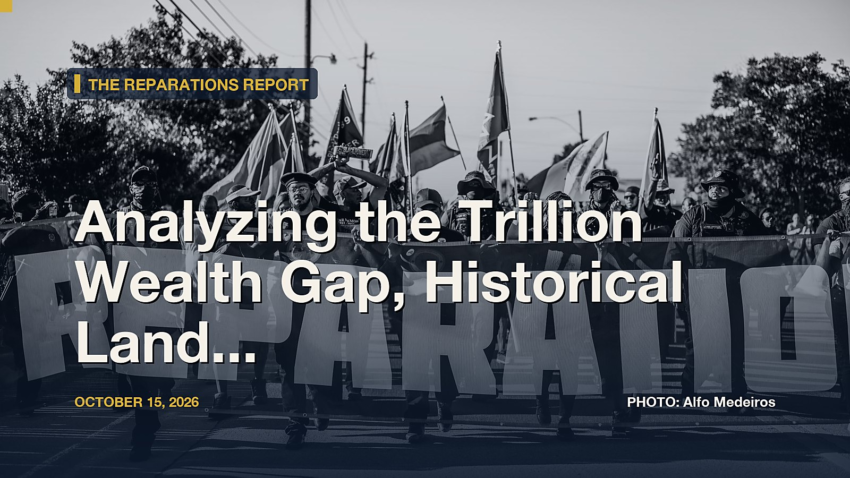
Black News · The Reparations Report · October 15, 2026, 9:38 AM CDT
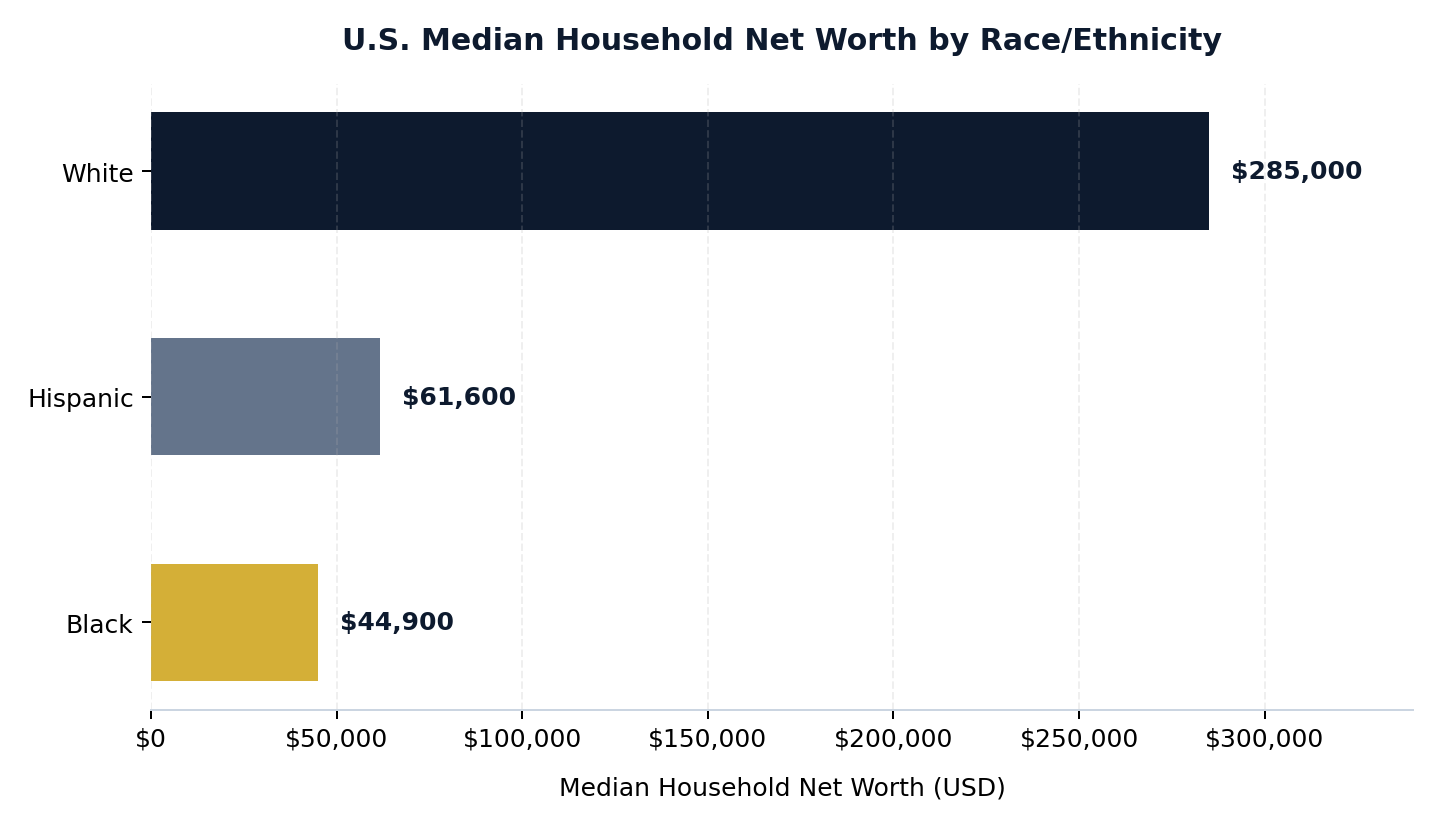
Executive Summary · Empirical Findings & Restorative Policy.Closing the racial wealth divide requires more than symbolic gestures. New data from the Federal Reserve show a persistent wealth gap. The median net worth of white families is $285,000, while Black families hold just $44,900. That is a ratio of more than six to one. At the same time, Black farmers lost more than 13 million acres of farmland over the past century. In California, state economists calculate cumulative harms exceeding $1.2 million per eligible resident. Below, Kemetic Minds examines the data and recaps the top restorative policy news for the week of October 15, 2026.
National wealth gap required to achieve racial parity, or roughly $350,000 per Black household.
Black median wealth for every dollar of white median wealth, based on Federal Reserve data.
Decline in Black farmland acreage since 1910, representing over $326 billion in lost land wealth.
Calculated economic harm per eligible descendant under California Assembly Bill 3121.
1. The Economics of Inequality: Unpacking the $14 Trillion Racial Wealth Gap
Public debate around reparations often stalls on abstract legal questions. Yet the economic foundation rests on hard, verifiable numbers. According to the Federal Reserve’s Survey of Consumer Finances (SCF), the median net worth of white families is $285,000. In contrast, the median net worth for Black families is $44,900. This means Black households hold less than 16 cents for every dollar of white household wealth.[1] This divide persists across all income levels and education brackets.
In their landmark book From Here to Equality, economists William Darity Jr. and A. Kirsten Mullen show that closing this divide requires between $13.5 and $14 trillion in direct capital transfers.[2] That equals roughly $350,000 per Black American household. The disparity stems from generations of blocked wealth accumulation. White families pass down homes, land, and financial gifts that compound over time. Black families, by contrast, were systematically locked out of these wealth-building channels.
Housing equity forms the core of middle-class net worth. U.S. Census data show that white homeownership regularly exceeds 74 percent. Black homeownership remains stuck near 44 percent. That gap is wider today than it was in 1968 when the Fair Housing Act passed. In addition, research from the Brookings Institution shows that homes in Black neighborhoods are devalued by an average of $48,000 each. This systemic undervaluation costs Black homeowners an estimated $156 billion in cumulative equity.[3]
2. Dispossession by Decree: The Century of Black Agricultural Land Loss
Real property and land ownership represent the most enduring drivers of family security. Yet the twentieth century saw a massive erasure of Black rural land holdings. In 1910, Black farmers owned between 16 and 19 million acres across the United States. Nearly one million Black families operated farms, predominantly across the South. Over the next hundred years, that number plummeted by more than 85 percent.[4]
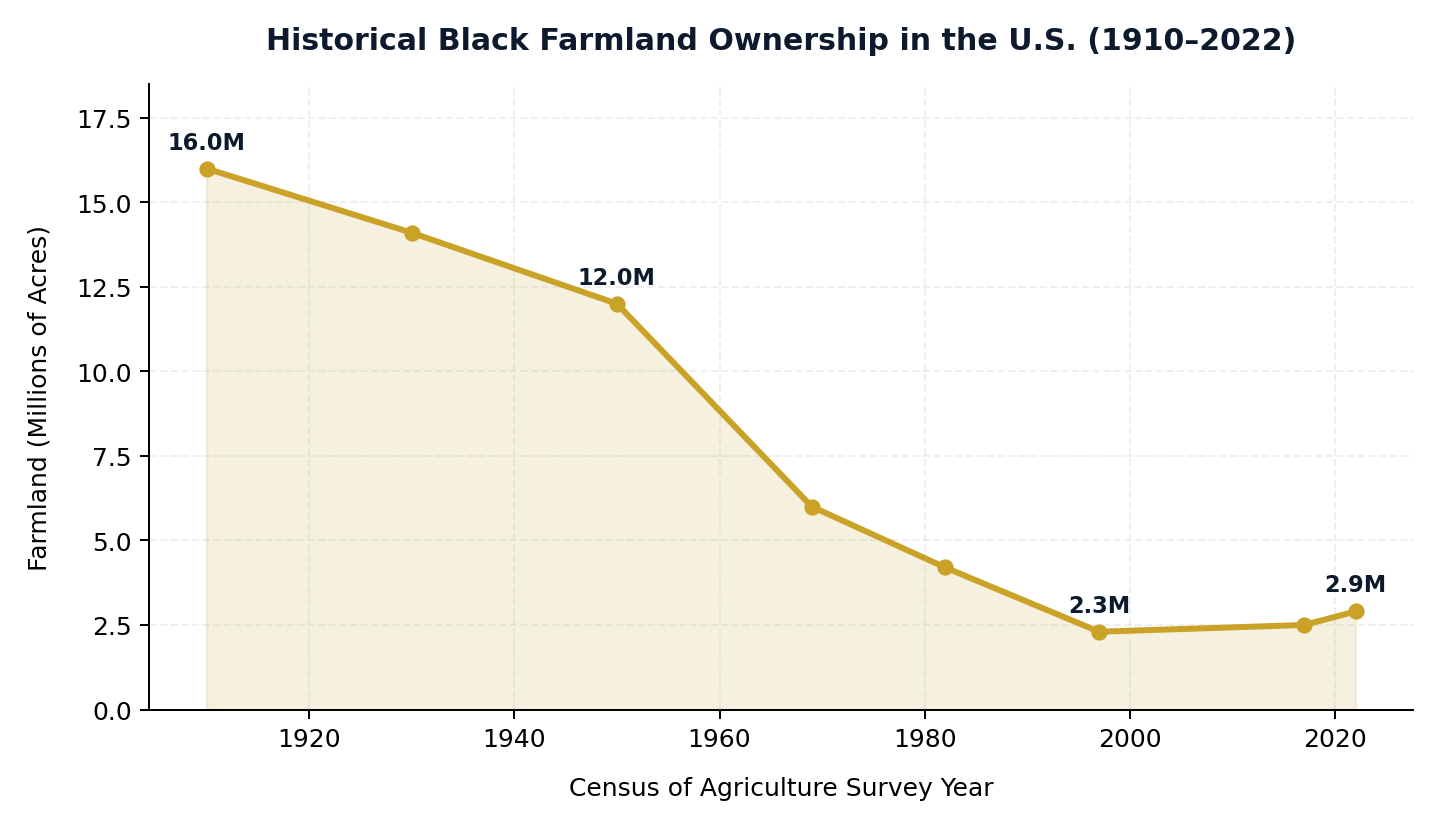
This land loss was not an accident of the free market. It resulted from documented, institutional actions. Local USDA loan committees routinely denied seasonal credit to Black farmers. Emergency disaster relief was withheld or delayed until planting seasons passed. In addition, predatory developers exploited legal loopholes in heir property laws to force partition sales. An economic study in the American Economic Association Papers and Proceedings estimated the compounding value of this lost farmland at $326 billion.[5]
3. Econometric Harms Modeling: California’s AB 3121 Benchmarks
California made legal history by creating the first state-backed task force to study reparations under Assembly Bill 3121. The panel did not rely on arbitrary dollar amounts. Instead, it hired professional economists and statisticians to measure the financial toll of state-sponsored discrimination.[6] Their final report produced clear, category-by-category estimates of economic damages.
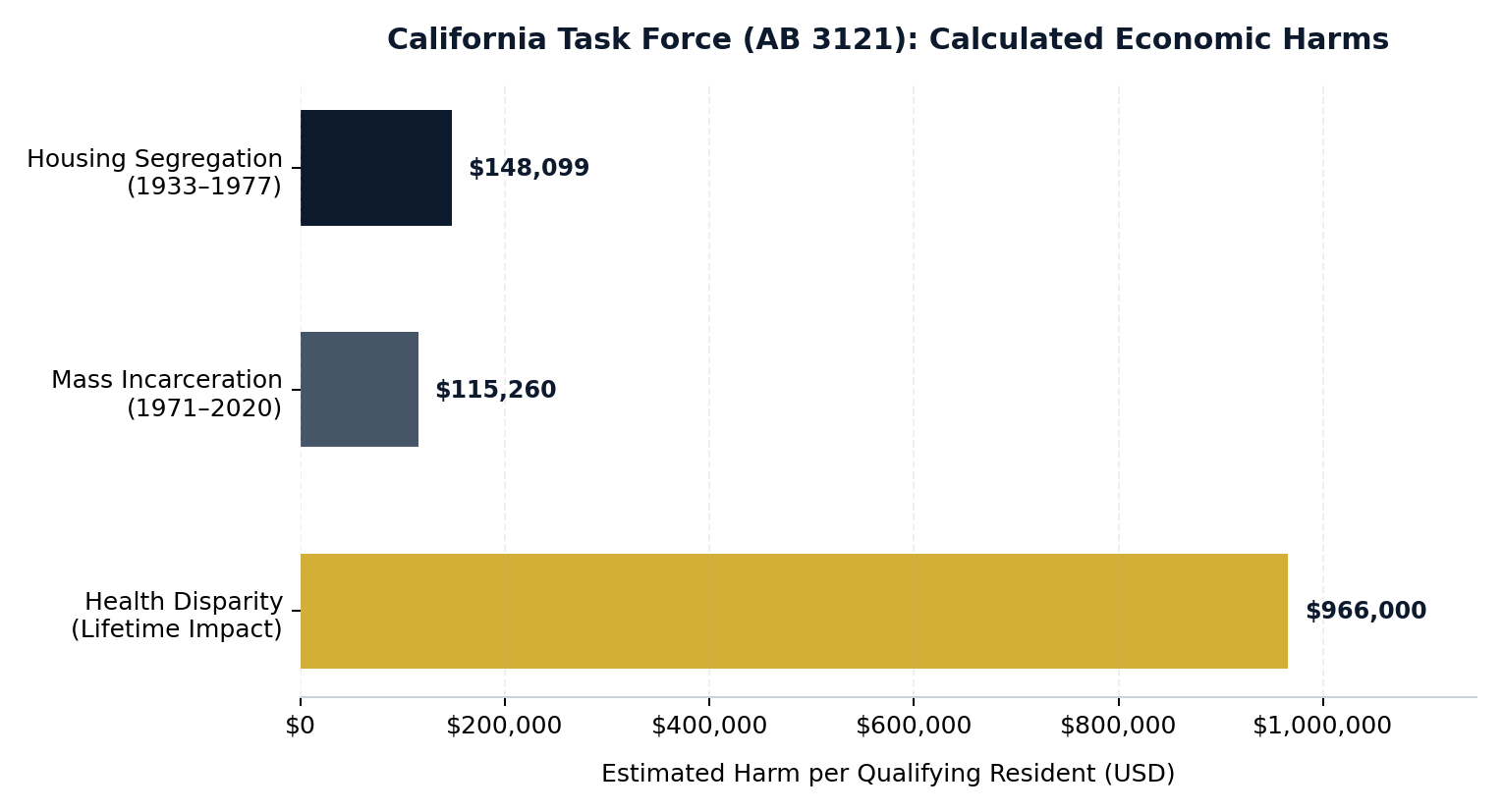
The Task Force quantified three major categories of harm:
- Housing Discrimination and Redlining (1933–1977): Economists estimated this harm at $148,099 per qualifying resident. This breaks down to $3,378 for each year of state residency during the era of racial covenants.
- Mass Incarceration and Over-Policing (1971–2020): The panel calculated damages of $115,260 per eligible person, or $2,352 for every year spent living in California during the drug war.
- Health Inequity and Premature Mortality: The team calculated a disparity cost of $13,579 per year of lost life expectancy. Over a typical 71-year lifespan, that harm totals approximately $966,000.
4. Restorative Justice Models: Lineage-Based vs. Harm-Based Frameworks
As reparations move closer to legislative action, debates have sharpened over who qualifies for compensation. Policy experts and legal scholars broadly divide into two camps:
The Lineage-Based Model (California & Darity Framework)
This model limits eligibility to direct descendants of enslaved persons in the United States or freed Black people residing in the country prior to 1900. Supporters argue this criterion directly remedies the unpaid labor and wealth denial of chattel slavery. It also shields policies against court challenges under the Fourteenth Amendment by relying on ancestry rather than race alone.
The Harm-Based Municipal Model (Evanston Framework)
This model provides remedies based on documented local discrimination. In Evanston, Illinois, the city council created the Local Reparations Restorative Housing Program. It grants $25,000 to Black residents who lived in Evanston between 1919 and 1969 or their descendants to help buy or repair homes.[7]
| Model / Program | Jurisdiction | Eligibility Rule | Core Remedy | Current Status |
|---|---|---|---|---|
| Federal H.R. 40 / S. 40 | National (U.S.) | Descendants of enslaved persons in U.S. | National 13-member study commission | Pending in Congress; Executive order sought |
| California AB 3121 | State (California) | Lineage-based (chattel slavery / pre-1900) | Formal apology, lineage agency, civil codes | Final report issued; legislative bills active |
| Evanston Housing Program | City (Evanston, IL) | Residency 1919–1969 & direct descendants | $25,000 housing and home loan grants | Active disbursement via local cannabis taxes |
| Bruce’s Beach Transfer (SB 796) | County (Los Angeles, CA) | Direct legal heirs of dispossessed owners | Return of beachfront real estate ($20M value) | Completed; Property repurchased by county |
| CARICOM 10-Point Plan | International (Caribbean) | Nations harmed by colonial slave trade | Formal apologies, debt cancellation, capital funds | Diplomatic mobilization ahead of CHOGM summit |
5. The Week in Restorative Justice: October 8–15, 2026 Recap
The past week has seen notable developments across global and national reparations initiatives:

London Reparations Conference Convenes: Black Current News announced that it is serving as a media partner for the UK Reparations Conference this Saturday, October 17, 2026.[8] Organized by the All-Party Parliamentary Group (APPG) for Afrikan Reparations, the event takes place at Friends House in London. The conference brings together grassroots organizers, policymakers, and international legal scholars. Key topics include debt cancellation, the return of looted cultural artifacts, and financial restitution from British institutions.
CARICOM Steps Up Pressure on the British Crown: Caribbean leaders renewed calls for formal reparations talks ahead of the Commonwealth Heads of Government Meeting (CHOGM). Prime Minister Mia Mottley of Barbados and Bahamas officials pointed to research estimating that Britain extracted over £18 trillion from the Caribbean during the colonial era.[9] Delegations plan to press the issue directly during bilateral sessions.
Federal Stagnation and Calls for Executive Action: In Washington, H.R. 40 remains stalled in the House of Representatives. Civil rights organizations, including the National African American Reparations Commission (NAARC), are urging the Biden administration to establish a federal study commission by executive order before the year ends.[10]
State and Local Legislative Battles: In Sacramento, the California Legislative Black Caucus is advancing bills to enact the Task Force’s policy recommendations.[11] These include establishing the California American Freedman Affairs Agency to verify lineage claims. Meanwhile, municipal programs face mounting legal challenges. Conservative legal foundations have filed federal lawsuits against race-conscious housing grants, arguing they violate equal protection guarantees.
6. Kemetic Minds Analysis: Moving from Symbolism to Structural Equity
INDEPENDENT AUDIT
The data prove that closing a six-to-one wealth gap cannot happen through small local grants alone. Municipal programs are valuable testing grounds, but their budgets are limited. Evanston’s program operates on modest local tax revenue. In contrast, the national wealth gap stands at $14 trillion. Meaningful reparations policy requires three structural pillars:
Only the federal government has the budget scale to close a multi-trillion-dollar wealth divide without bankrupting local cities.
Grounding eligibility in direct ancestry from enslaved Americans ties remedies to specific legal harms. This protects programs against court challenges.
Cash payments must be matched with land restoration, commercial banking charters, and community endowments so wealth compounds over generations.
References
- Federal Reserve Board. Survey of Consumer Finances: U.S. Household Wealth Data. ↩
- Darity, W. A., & Mullen, A. K. (2020). From Here to Equality: Reparations for Black Americans in the Twenty-First Century. ↩
- Perry, A. M., Rothwell, J., & Harshbarger, D. (2018). The Devaluation of Assets in Black Neighborhoods. Brookings Institution. ↩
- USDA National Agricultural Statistics Service. Census of Agriculture: Historical Trends in Land Ownership. ↩
- Newbold, T. W., Francis, D. C., Darity, W. A., & Robinson, J. (2022). The Valuation of Black Farmland Loss in the American South. American Economic Association. ↩
- California Task Force to Study Reparations. (2023). Final Report: Redressing Systemic Harm Against Black Californians. California Department of Justice. ↩
- City of Evanston. Local Reparations Housing Program Rules and Resolutions. ↩
- Black Current News. (2026, October 15). ‘Make It Make Sense’ | What Are Slavery Reparations and How Would They Work?. ↩
- CARICOM Reparations Commission. Ten-Point Action Plan for Reparatory Justice. ↩
- National African American Reparations Commission (NAARC). The Urgent Need for Federal Restorative Justice Action. ↩
- California Legislative Black Caucus. Reparations Legislative Package: Priority Bills and Policy Matrix. ↩
Investigative methodology: All numerical figures in this report come directly from official government surveys and published economic studies. These sources include the Federal Reserve Survey of Consumer Finances, the USDA National Agricultural Statistics Service, the California Department of Justice AB 3121 Final Report, and the American Economic Association. No statistics were generated by an artificial intelligence model. News events are cited for current weekly context.

Kemetic Minds Editorial Desk
Verified NewsroomPrimary-sourced investigative intelligence on civil rights, voting rights, federal policy, and consumer protection. Sourced from primary legal filings, government statistics, and direct field reporting.