

Kemetic Minds — Financial Justice Series | June 26, 2026
🏪 Key Findings
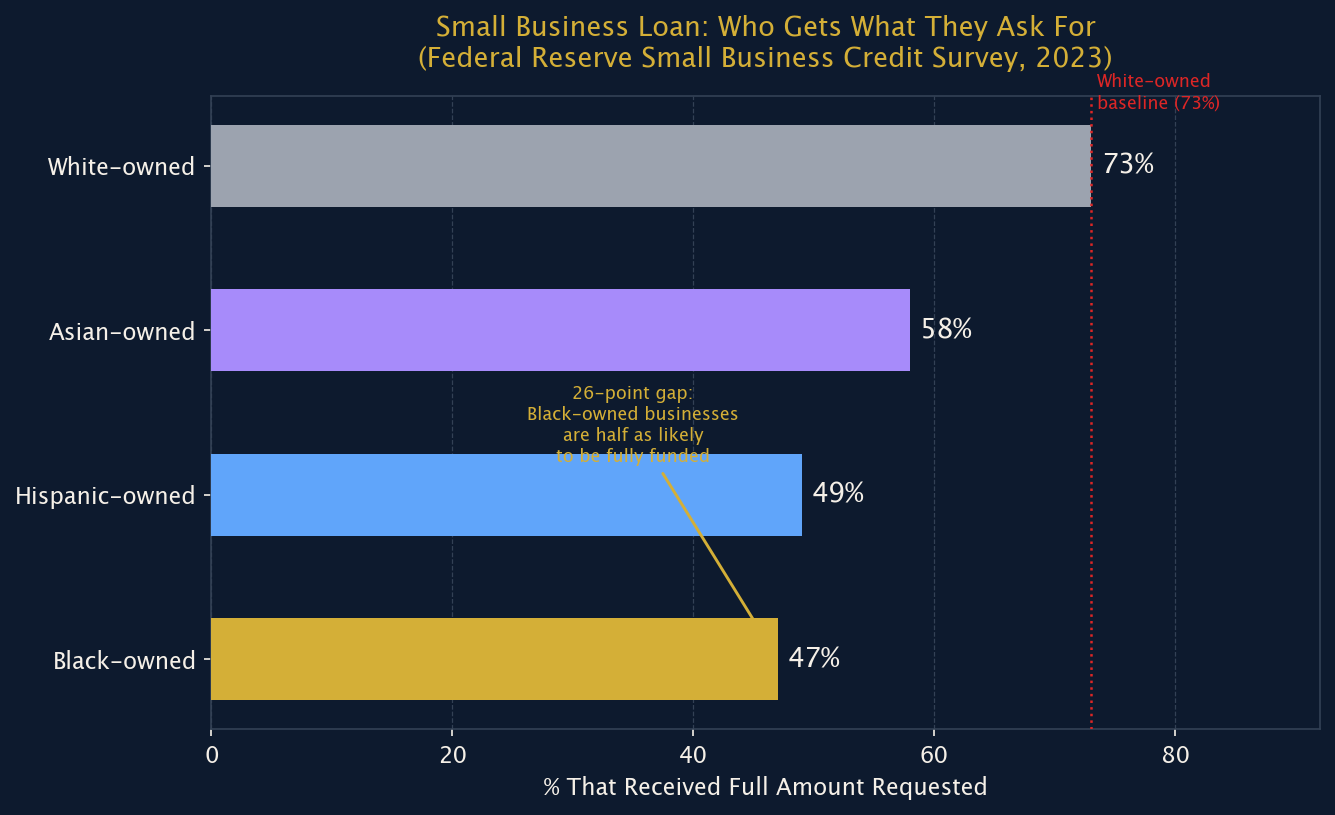
- Only 47% of Black-owned businesses that applied for loans received their full requested amount, versus 73% of white-owned businesses (Federal Reserve SBCS, 2023).
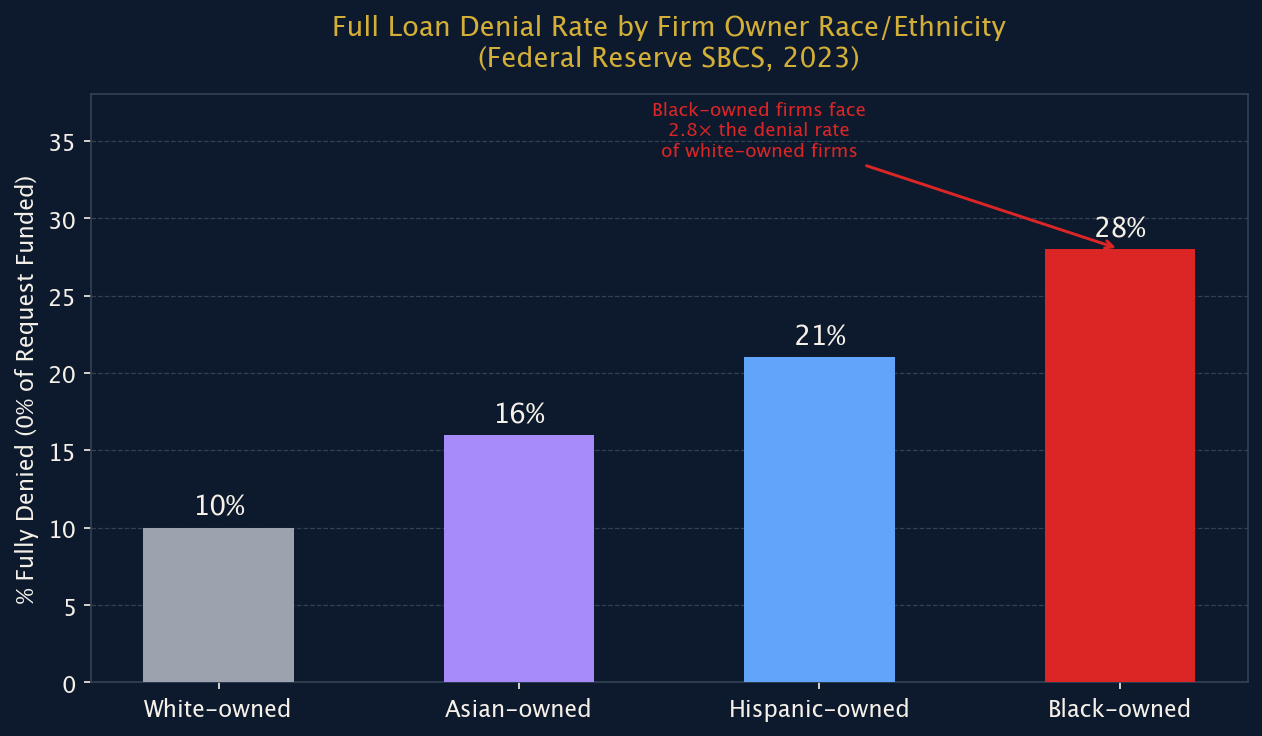
- Black-owned firms face a full denial rate of 28% — nearly 3 times the 10% rate for white-owned firms (Federal Reserve SBCS, 2023).
- McKinsey estimates the lending gap costs Black entrepreneurs an estimated $190 billion in potential business revenue annually (McKinsey, 2021).
- Alternative paths exist: SBA 8(a), CDFIs, and Black-focused venture funds have expanded significantly since 2020.
A 26-Point Gap That Cannot Be Explained Away
Every year, the Federal Reserve’s 12 regional banks collaborate to survey small business owners about their financing experiences. The 2023 Small Business Credit Survey captures the experiences of roughly 10,000 small businesses across the United States — and the findings on racial disparities in lending are stark and consistent.
When a Black-owned business applies for a loan, only 47% receive the full amount they requested. For white-owned businesses, that number is 73%. That 26-percentage-point gap cannot be explained by differences in business size, industry, or credit profile alone — researchers controlling for those factors still find significant unexplained disparities consistent with discriminatory treatment (Fairlie et al., 2022).
Figure 1
Small Business Loan: % Receiving Full Amount Requested (Fed SBCS, 2023)
Discouraged Before They Even Apply
The survey data also reveal a pattern economists call “discouraged borrowers” — business owners who need capital but do not apply because they expect to be denied. The Fed’s 2023 SBCS found that 37% of Black business owners did not apply for financing they needed due to fear of rejection, compared to 17% of white business owners. This means the raw application data understate the disparity, because many Black entrepreneurs have already been pushed out of the process before it begins.
This has direct consequences for business formation and survival. A 2022 National Bureau of Economic Research study found that the gap in access to startup capital explains a significant share of the difference in business formation rates between Black and white Americans — and that Black-owned businesses that do access capital grow at similar rates to their peers (Chatterji & Seamans, 2022). The problem is access, not capability.
Figure 2
Full Loan Denial Rate by Business Owner Race/Ethnicity (Fed SBCS, 2023)

The Historical Roots: Redlining Didn’t End in 1968
The modern lending gap did not emerge from nowhere. Federal redlining policies, formally in place from the 1930s to the 1960s, denied mortgage and business loans to Black-owned properties and businesses in systematically mapped neighborhoods. The Fair Housing Act of 1968 and Equal Credit Opportunity Act of 1974 outlawed explicit discrimination — but the effects compound over generations.
Research by the National Community Reinvestment Coalition found that 74% of neighborhoods redlined in the 1930s are still lower-income today, and that business lending in formerly redlined areas remains disproportionately low even when controlling for current income and creditworthiness (NCRC, 2020). The structural disadvantage built by law continues to operate through market mechanisms.
Where to Find Capital: The Real Landscape
🏛️ SBA 8(a) Business Development Program
The SBA’s 8(a) program provides small, disadvantaged businesses with access to set-aside federal contracts, technical assistance, and access to SBA-backed loans. Eligibility requires demonstrating social and economic disadvantage. Apply at SBA.gov. Being accepted into 8(a) can transform a small business’s access to capital and contracts.
💳 Community Development Financial Institutions (CDFIs)
CDFIs are mission-driven lenders certified by the U.S. Treasury Department to serve underbanked communities. Many specialize in small business lending to Black and minority entrepreneurs at market rates without requiring the same collateral thresholds as traditional banks. Find CDFIs near you at CDFIFund.gov.
🤝 Black-Focused Venture Capital and Accelerators
Since 2020, several dedicated funds and accelerators have grown significantly: Black Venture Capital Consortium, the SBA’s Small Business Investment Company (SBIC) program, and accelerators like Backstage Capital (focused on underrepresented founders) offer equity capital for growth-stage businesses. These are not loans — they are equity investments for businesses with growth potential.
📊 Revenue-Based Financing and Merchant Cash Advance (with caution)
Revenue-based financing (RBF) is a newer model where investors provide capital in exchange for a percentage of future revenues. Unlike loans, there is no fixed payment — you pay more when revenue is high, less when it’s low. Warning: Merchant cash advances (MCAs), sometimes marketed similarly, can carry effective rates of 50%–350% and should be used only as a last resort. Verify the effective APR before signing any MCA agreement.
✅ Your Funding Application Checklist
- Know your personal and business credit scores. Get your business credit report from Dun & Bradstreet (D-U-N-S number) and Experian Business. A FICO SBSS score above 160 improves SBA loan odds significantly.
- Prepare 2 years of business tax returns, a P&L statement, balance sheet, and cash flow projection. Lenders who discriminate still cannot deny an application that is financially airtight — and a clean application provides documentation if you need to file a CFPB complaint.
- Apply to at least 3 lenders. Do not self-select out. A denial from a large bank does not mean a CDFI or credit union will deny you.
- File a complaint if denied without explanation. Under ECOA and the Community Reinvestment Act, lenders must provide a reason for denial. If the reason does not match your financials, report to the CFPB at consumerfinance.gov/complaint.
- Connect with your local SBDC. Small Business Development Centers (SBDCs) are free, federally funded advisors who can review your application and connect you to lenders. Find yours at SBA.gov/SBDC.
References
Chatterji, A., & Seamans, R. (2022). Entrepreneurial finance, credit cards, and race (NBER Working Paper No. 28337). National Bureau of Economic Research. nber.org
Federal Reserve Banks. (2023). 2023 report on employer firms: Findings from the Small Business Credit Survey. www.fedsmallbusiness.org
McKinsey & Company. (2021). The economic state of Black America: What is and what could be. mckinsey.com
National Community Reinvestment Coalition. (2020). Redlining and neighborhood health. ncrc.org
U.S. Small Business Administration. (2024). 8(a) Business Development program. sba.gov
U.S. Department of the Treasury. (2024). CDFI Fund: Community Development Financial Institutions program. cdfifund.gov
Methodology: Loan approval and denial figures from the Federal Reserve’s 2023 Small Business Credit Survey. McKinsey revenue-gap estimate from their 2021 report on the economic state of Black America. This article is for educational purposes and does not constitute financial advice.
📱 Stay Connected

Kemetic Minds Editorial Desk
Verified NewsroomPrimary-sourced investigative intelligence on civil rights, voting rights, federal policy, and consumer protection. Sourced from primary legal filings, government statistics, and direct field reporting.