KEMETIC MINDS
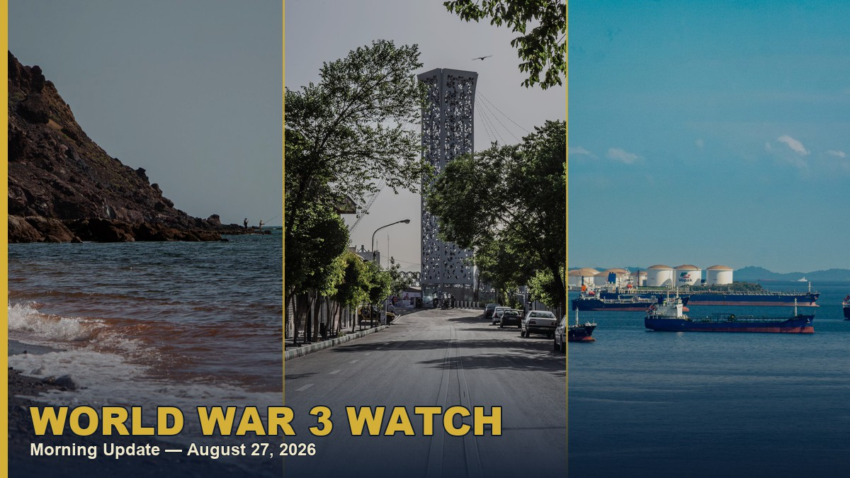
World War 3 Watch — Morning Update — August 27, 2026
- Hormuz traffic has collapsed from more than 100 vessels a day to just five — a roughly 95 percent drop (Al Jazeera, 2026).
- Another tanker was hit by an unknown projectile off Oman on Tuesday and caught fire; the crew is safe (Associated Press, 2026).
- Iran and Oman are preparing a safe-passage arrangement, and Iran’s deputy foreign minister says the US must “correct its mistakes” before the strait reopens (Sina Finance, 2026, authors’ translation).
- Trump has published at least 319 Iran-related Truth Social posts since February 28 — referring to himself 221 times (Al Jazeera, 2026).
- “To me, this isn’t D-Day. It’s Desperation Day,” said former US diplomat Aaron David Miller of the new sanctions push (Reuters, 2026).
- Tehran dismisses Washington’s latest sanctions even as fuel queues grow and the rial hits a record low (Associated Press, 2026; CNBCTV18, 2026).
The Story So Far
Six months after U.S. and Israeli forces struck Iran — killing its supreme leader and maiming his son and successor — the war has reached what Reuters calls “a costly stalemate” (Reuters, 2026). Tehran is under economic siege, yet it still holds power and believes time is on its side (Reuters, 2026).
Overnight, the dominant news was logistical, not military. Another tanker was hit in the Strait of Hormuz, regional powers hunted for an off-ramp, and the Qatari prime minister landed in Tehran (Associated Press, 2026; CNBCTV18, 2026).
Chinese-language outlets, meanwhile, report a diplomatic counter-move absent from the English wires: Iran and Oman are building a safe-passage arrangement, with Tehran setting conditions for reopening the strait (Sina Finance, 2026, authors’ translation; NetEase, 2026, authors’ translation).
The result is a war fought with shipping manifests and bank wires as much as missiles — and a 95 percent collapse in traffic through the world’s most important oil chokepoint (Al Jazeera, 2026).
Video: BIG HORMUZ SHOWDOWN! Iran Stops Indian Vessel; Fires Shots Before Shock Turnaround | Watch. Source: Times Of India.
1. The Chokepoint That Nearly Stopped: Hormuz Down to Five Ships a Day
Hormuz is a 33km (21-mile) passage that carries more than one-third of global seaborne crude oil, and before the war more than 100 vessels transited it daily (Al Jazeera, 2026). Six months into the U.S.-Israel war on Iran, traffic has fallen to just five vessels a day (Al Jazeera, 2026).
Chinese coverage puts the number even lower, at two daily transits, and ties the collapse to a new Iran-Oman revenue-sharing agreement (NetEase, 2026, authors’ translation). The gap between five and two is itself a reminder that even the most basic counts are contested in this war.
The stakes extend far beyond oil. About 80 percent of world trade by volume moves by sea at some point, and dry bulk carriers — the ships that move grain, coal and iron ore — averaged about 20 Hormuz transits a day before the war, according to Lloyd’s List (Al Jazeera, 2026).
The latest incident shows why the waterway still matters. UKMTO, the British military’s maritime monitoring agency, reported that an oil tanker was hit by an unknown projectile Tuesday in the waters between Oman and Iran, causing it to catch fire (Associated Press, 2026). The crew is safe, and there are no reports of environmental damage (Associated Press, 2026).
2. Tehran’s Counter-Gambit: The Iran-Oman Safe Passage Deal
While English-language wires report the war as blockade and siege, Chinese-language outlets are covering a diplomatic track that recasts Tehran as a player setting terms, not a target absorbing blows. Iran and Oman plan to establish a safe passage in Hormuz, and Iran’s deputy foreign minister has said that to reopen the strait, Washington “must correct its mistakes and fulfill its previous commitments” (Sina Finance, 2026, authors’ translation).
NetEase adds that Iran and Oman have reached a revenue-sharing agreement, then asks directly whether the United States is obstructing the reopening (NetEase, 2026, authors’ translation). Wallstreetcn reports that Iran has opened “conditions for reopening the strait,” while Trump insists there is “no timetable for negotiations” (Wallstreetcn, 2026, authors’ translation).
The sharpest Chinese claim has no counterpart in today’s English coverage at all: Sohu reports that Iran has pried away a U.S. ally in Washington’s own backyard — checkmating the administration and leaving Trump rattled (Sohu, 2026, authors’ translation).
3. ‘Desperation Day’: Sanctions, Stalemate and the Off-Ramp
On Monday, Washington moved the conflict into a new phase, shifting the battlefield from missiles and airstrikes to Iran’s oil revenues, banks and trading partners (Reuters, 2026). Treasury Secretary Scott Bessent said the United States will cut off the financial lifelines sustaining Iran’s economy, and unveiled the measures by invoking the 1944 D-Day landings of World War Two (Reuters, 2026).
Former U.S. diplomat Aaron David Miller offered a blunter reading: “To me, this isn’t D-Day. It’s Desperation Day” — the administration, he said, is “groping in a sort of desperate fashion” for a way out (Reuters, 2026).
There is a structural reason for the desperation. Tehran is betting Trump will never take the final step of aggressively enforcing secondary sanctions on the countries keeping its economy afloat — foremost among them China and India (Reuters, 2026). Horizon Engage’s Michael Knights, for his part, says the naval blockade “may prove more consequential” (Reuters, 2026).
The Iranian government has publicly dismissed Washington’s latest sanctions (Associated Press, 2026). On the streets of Tehran, the cost of the standoff is visible: rising prices, a record-low rial and growing fuel queues (CNBCTV18, 2026).
Regional powers are still hunting for an off-ramp, and Qatar’s prime minister arrived in Tehran on Thursday to meet Iranian officials (Associated Press, 2026; CNBCTV18, 2026). Chinese coverage compresses the whole dynamic into a headline: the U.S. has “changed its tactics,” Iran “will not compromise,” and the confrontation has entered a stalemate phase (Dahecube, 2026, authors’ translation).
4. The War on Truth Social: 319 Posts, 221 Self-References
Al Jazeera has reconstructed six months of the war from Trump’s own feed. Since February 28, he has published at least 319 posts mentioning Iran on Truth Social — one every 14 hours — out of 4,189 total posts, an average of 24 per day (Al Jazeera, 2026).
The word cloud is its own psychological profile. “Iran” dominates with 510 mentions, more than three times the next word, but the two terms that follow are not Iran’s leaders or its nuclear program: they are Trump’s own name and country (Al Jazeera, 2026). He refers to himself as “President Donald J Trump” or “President DJT” 221 times — more often than he mentions the Strait of Hormuz, nuclear weapons and Israel combined (Al Jazeera, 2026).
His signature closer, “Thank you for your attention to this matter,” ends one in every four Iran posts (Al Jazeera, 2026).
Read in sequence, the posts tell a complete arc: a war announced, prosecuted, declared won, negotiated and then reopened, all in the president’s own words (Al Jazeera, 2026). Before the strikes, that meant applauding Iran for canceling more than 800 scheduled hangings, threatening 25 percent tariffs on nations doing business with Iran, and demanding, “MAKE A DEAL!” (Al Jazeera, 2026).
That posture has since given way to a different line, reported by the Chinese financial press: there is “no timetable for negotiations” (Wallstreetcn, 2026, authors’ translation).
5. Two Coverage Worlds: What Chinese and English Outlets Each See
Today’s two source sets read like coverage of different wars. The English wires foreground Iranian pain and American resolve: fuel queues, a record-low rial, the tightening blockade, Trump’s sanctions theater (CNBCTV18, 2026; Reuters, 2026). The Chinese headlines foreground Iranian agency: the Oman safe passage, Tehran’s conditions, a U.S. ally pulled out of Washington’s own hemisphere (Sina Finance, 2026, authors’ translation; Sohu, 2026, authors’ translation).
English coverage also carries adjacent stories with no Chinese counterpart today — most notably the sharp rebuke Israel’s Gaza strikes drew from the diplomat overseeing the U.S.-brokered ceasefire (Associated Press, 2026). The Chinese outlets, by contrast, are nearly single-minded: the Hormuz file, told as a story of Iranian initiative and American obstruction (NetEase, 2026, authors’ translation).
Even the most basic number disagrees: Al Jazeera counts five daily transits of Hormuz; NetEase counts two (Al Jazeera, 2026; NetEase, 2026, authors’ translation). We mapped this divergence in our narrative-comparison report on how US, Israeli, Iranian, and BRICS media each tell this war; the August 27 feed is the pattern running live.
Is This Actually World War 3?
On today’s evidence, the honest answer is: not yet — but the war is already global in its economic footprint. About 80 percent of world trade by volume moves by sea, and one of its essential chokepoints has lost 95 percent of its traffic (Al Jazeera, 2026).
The great-power layer is visible but indirect. China and India appear in Reuters’ coverage not as combatants but as the buyers keeping Iran’s economy afloat — exactly why Tehran bets Washington will not enforce secondary sanctions to the end (Reuters, 2026). There is no China-Taiwan or Russia theater in today’s sources; the second flashpoint this series watches is quiet in this feed.
What today’s sources show instead is a war consolidating onto two parallel tracks: diplomacy hunting for an off-ramp (Qatar’s PM in Tehran, the Iran-Oman channel, Trump’s “no timetable”) and a blockade that keeps tightening (CNBCTV18, 2026; Sina Finance, 2026, authors’ translation; Wallstreetcn, 2026, authors’ translation).
The hinge of this phase is enforcement. Blink on China and India and the stalemate grinds on; squeeze them and the economic war grades into the direct great-power collision the “World War 3” label implies (Reuters, 2026). The shipping giants’ warning — that the market underestimates the risk of a long-term stalemate — points to the most probable outcome: neither victory nor escalation, but a slow bleed through the world’s supply lines (Wallstreetcn, 2026, authors’ translation).
What You Can Do Right Now
- Re-read our survival skills and preparedness guide — with 95 percent of Hormuz traffic gone and roughly 80 percent of world trade moving by sea, the price and availability of fuel, grain and consumer goods now hinge on a 33km strait (Al Jazeera, 2026).
- Run your news diet through both framings: compare today’s English wires with the Chinese-language headlines summarized here, and watch the same war appear as siege narrative and counter-gambit — our narrative-comparison report walks through exactly how to do it.
- Audit your household’s exposure to seaborne supply chains: if your fuel, food or medicine moves through routes touched by Hormuz, the long-stalemate scenario the shipping giants say the market underestimates is the one to plan for (Wallstreetcn, 2026, authors’ translation).
SUPPORT KEMETIC MINDS
Enjoying this coverage? Back the work and find every way to connect with us in one place.
Support the Page →Kemetic Minds Analysis
This roundup pulled directly from the day’s English- and Chinese-language wires side by side, because the gap between what each side chooses to report is often as informative as any single strike count. Treat the Key Takeaways above as the verified factual floor, and the framing differences noted in the sections above as the more interesting, harder-to-fake signal about where this war is actually headed next.
References
- Cnbctv18. (2026, August 27). US-Iran War Live Updates: Qatar’s PM arrives in Tehran to meet Iranian officials. cnbctv18.com
- Newsday. (2026, August 26). Regional powers seek off-ramp from Iran war, and other Middle East developments. newsday.com
- Al Jazeera. (2026, August 27). How a 95 percent drop in Hormuz traffic changed global shipping. aljazeera.com
- Al Jazeera. (2026, August 26). Six months of the Iran war – as told through Trump’s social media posts. aljazeera.com
- Mcall. (2026, August 27). Regional powers seek off-ramp from Iran war, and other Middle East developments. mcall.com
- a Costly Stalemate. (2026, August 26). Analysis-After Six Months, the Iran War Has Reached Its Endgame. usnews.com
- 新浪财经. (2026, August 27). 伊朗阿曼拟在霍尔木兹建安全通道,伊朗副外长:重开海峡,美国必须纠错并履行此前承诺 [Iran and Oman Plan to Establish a Security Passage in the Strait of Hormuz; Iran's Deputy Foreign Minister: To Reopen the Strait, the US Must Correct Its Mistakes and Honor Previous Commitments]. finance.sina.cn
- 手机网易网. (2026, August 27). 霍尔木兹海峡单日仅2艘通航,伊朗与阿曼达成分成协议,美国阻挠重开? [Only 2 Ships Transit Strait of Hormuz in a Day; Iran and Oman Reach Deal—Is US Blocking Reopening?]. m.163.com
- 大河财立方. (2026, August 26). 美方“换打法” 伊朗“不妥协” 双方对峙进入僵持阶段 [U.S. shifts tactics, Iran refuses to yield — standoff enters a stalemate.]. app.dahecube.com
- 华尔街见闻. (2026, August 27). 特朗普称“谈判没有时间表”,伊朗开出“重开海峡条件”,航运巨头评价“市场低估了长期僵局风险” [Trump says "no timetable" for talks as Iran sets conditions to reopen the strait; shipping giant warns the market underestimates the risk of prolonged stalemate.]. wallstreetcn.com
- 搜狐网. (2026, August 27). 伊朗撬走美国后院盟友,将了美国一军,果然特朗普急眼了 [Iran poaches an ally from America's backyard, outmaneuvering the US — and sure enough, Trump is furious.]. m.sohu.com
Investigative Methodology: This roundup is generated on a fixed schedule (noon and evening, America/Chicago) from live English- and Chinese-language wire sources. Every claim is grounded in fetched source text with an APA7 in-text citation; translated Chinese-language quotes are marked “authors’ translation.” Every video embed is verified to be a real, existing video via YouTube’s oEmbed endpoint before publication — none are written by the drafting model. No Wikipedia sources are used.
Stay Connected

Kemetic Minds Editorial Desk
Verified NewsroomPrimary-sourced investigative intelligence on civil rights, voting rights, federal policy, and consumer protection. Sourced from primary legal filings, government statistics, and direct field reporting.