
KEMETIC MINDS
Infrastructure Watch — Daily Update — August 30, 2026
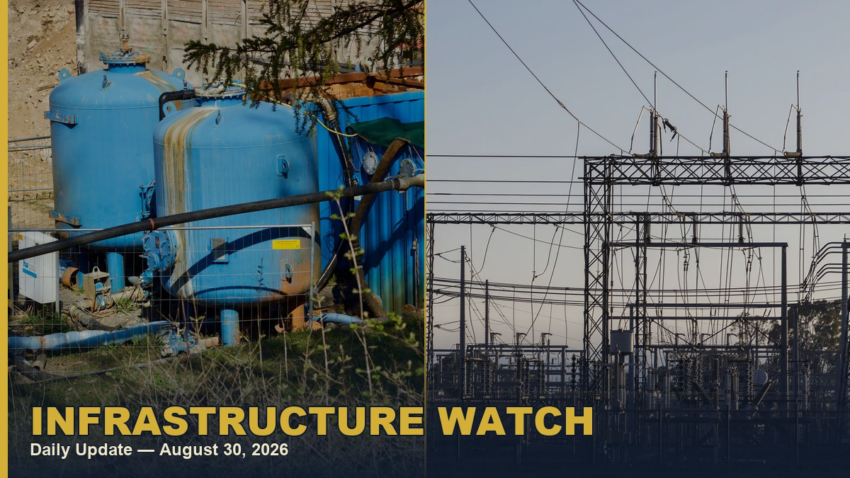
Two infrastructure alarms anchor today’s watch: UNICEF confirms lethal strikes on Gaza drinking-water infrastructure, and MSN warns of flicker spanning half the U.S. power grid tied to one county’s data centers. Here is what today’s sourcing supports.
- At least four children were killed in Gaza over the past five days, with many more injured, in attacks that also hit water and nutrition infrastructure (UNICEF, 2026).
- A UNICEF-supported water well and desalination facility in Deir Al Balah was severely damaged by a nearby strike on 24 August, cutting safe drinking water for more than 4,000 people, including around 2,000 children (UNICEF, 2026).
- A warehouse holding more than US$770,000 in UNICEF nutrition supplies — destined for more than 40,500 children and 4,900 pregnant and breastfeeding women — was destroyed by a nearby strike on 25 August (UNICEF, 2026).
- MSN reports flickering across 50% of the U.S. grid triggered by one county’s data centers, quoting an unnamed voice: “We’re dealing with a real big problem” (MSN, 2026).
- UNICEF and partners are emergency-trucking water to affected families while the Deir Al Balah facility remains unable to operate (UNICEF, 2026).
“On 25 August, three children aged eight, ten and seventeen were reported hit by live ammunition fire and two 11-year-olds by shrapnel following strikes, suffering life-changing injuries.”
UNICEF —
Read the full report →
1. Water Supply: Gaza Facility Hit, Children Killed
At least four children were reported killed in the Gaza Strip over the past five days, according to a UNICEF press release dated 28 August 2026. The dead include two boys, aged two and four, killed in separate strikes; a 10-year-old girl hit by ground fire while inside her tent; and a 16-year-old boy who died from serious injuries sustained in a previous strike (UNICEF, 2026).
On 25 August, children aged eight, ten and seventeen were reported hit by live ammunition fire, and two 11-year-olds were hit by shrapnel following strikes, suffering life-changing injuries (UNICEF, 2026). The same day, a nearby strike destroyed a warehouse containing more than US$770,000 worth of UNICEF nutrition supplies intended for more than 40,500 vulnerable children aged 6 to 23 months, as well as 4,900 pregnant and breastfeeding women (UNICEF, 2026).
The water-infrastructure loss came one day earlier. On 24 August, a UNICEF-supported water well and desalination facility in the Deir Al Balah area was severely damaged by a nearby strike; more than 4,000 people, including around 2,000 children, rely on it for safe drinking water (UNICEF, 2026). While the facility is unable to operate, UNICEF and partners are providing emergency water trucking to affected families (UNICEF, 2026).
“Children are being killed and injured, while those who survive are seeing essential services and supplies that they depend on destroyed,” said UNICEF Regional Director for the Middle East and North Africa, Edouard Beigbeder (UNICEF, 2026).
2. Power Supply: Grid Flicker Warning
An MSN report published 30 August 2026 warns that America’s aging power grid is flashing a “big warning sign,” with flickering across 50% of the U.S. triggered by one county’s data centers (MSN, 2026). The article opens with an unnamed voice stating, “We’re dealing with a real big problem” (MSN, 2026).
The sourcing is thin: the report does not name the county, the utilities involved, or the source of the opening quote, and no independent grid data or operator statements appear in the available text (MSN, 2026). Treat the 50% figure as an as-reported claim pending corroboration.
What’s Disputed or Unconfirmed
The MSN (2026) report carries the least verification of today’s items: the headline claim of flicker across 50% of the U.S. grid tied to one county’s data centers is not backed by named officials, utility data, or independent confirmation in the sourced text, and the quote “We’re dealing with a real big problem” is unattributed. It should be read as a one-sided, unverified report.
The UNICEF (2026) release attributes the deaths and infrastructure damage to strikes and ground fire but does not specify which party carried out the attacks. Casualty counts, the US$770,000 supply loss, and the Deir Al Balah facility damage are as reported by UNICEF and its partners, without independent verification included in the source material.
Kemetic Minds Analysis
Today’s verified reporting covered: Water Supply; Power Supply. Every claim above traces back to a specific, dated, fetched source — treat the Key Takeaways as the verified factual floor, and the ‘What’s Disputed or Unconfirmed’ section as the honest boundary of what today’s sourcing actually supports versus what’s still allegation or one-sided claim. The two checklists below are static, agency-sourced preparedness guidance (FEMA/Ready.gov/CDC/USDA) and are not tied to today’s specific stories.
🛡️ Free Preparedness Guides
Two free, printable checklists you can download and keep on hand — one for water-supply
disruptions, one for power outages.
📄 Get this checklist as a free, printable PDF you can keep on hand.
📄 Get this checklist as a free, printable PDF you can keep on hand.
SUPPORT KEMETIC MINDS
Enjoying this coverage? Back the work and find every way to connect with us in one place.
References
- UNICEF. (2026, August 30). Four children killed as separate attacks destroy humanitarian supplies and damage critical water infrastructure in Gaza. unicef.org
- MSN. (2026, August 30). America's aging power grid flashes big warning sign: Flickering across 50% of US triggered by 1 county’s data centers. Protect yourself now. msn.com
Investigative Methodology: This roundup is generated once daily at 5:00 PM America/Chicago from live news sources published within the prior 24 hours. Every claim is grounded in fetched source text with an APA7 in-text citation; nothing is written from the model’s general knowledge. Every video embed is verified to be a real, existing video via YouTube’s oEmbed endpoint, published within the last 24 hours, and restricted to a credible-outlet allowlist before publication — none are written by the drafting model. Pull-quotes are extracted verbatim from the cited article, never composed. The preparedness checklists are static guidance sourced from FEMA/Ready.gov, the CDC, and the USDA, never generated by the drafting model, and are not medical, legal, or emergency-response advice.
Stay Connected

Kemetic Minds Editorial Desk
Verified NewsroomPrimary-sourced investigative intelligence on civil rights, voting rights, federal policy, and consumer protection. Sourced from primary legal filings, government statistics, and direct field reporting.