
KEMETIC MINDS
Infrastructure Watch — Daily Update — August 29, 2026
Today’s Infrastructure Watch tracks two front-line grid stories: the Trump administration’s new national emergency over foreign-made U.S. power equipment, and DW’s report on how Russia’s August 26 strikes pushed Ukraine’s grid and its nuclear reactors to the brink.
- President Donald Trump declared a national emergency over foreign-made technology in the U.S. power grid, giving the Energy Department authority to block risky equipment, software, and services (DiMolfetta, 2026).
- The order targets the bulk-power system, covering transmission infrastructure at 69 kilovolts or higher and affecting equipment such as transformers, generators, and industrial controls (DiMolfetta, 2026).
- The Energy Department has 120 days to identify which countries, vendors, products, and transactions pose an unacceptable national security risk (DiMolfetta, 2026).
- On August 26, Russia fired more than 200 missiles and drones at Ukrainian energy infrastructure, knocking out power to around 8 million homes (DW.com, 2026).
- Four reactors disconnected and plant operators powered one unit down completely as the grid buckled, a scenario nuclear specialist Shaun Burnie says has never been seen before (DW.com, 2026).
- Russia has started targeting electrical substations, including about 10 that are critical to nuclear plant safety, raising the stakes of the grid fight (DW.com, 2026).
“Photography by TIL/Getty Images Stay Connected By David DiMolfetta President Donald Trump declared a national emergency this week over foreign-made technology in the U.S.”
Nextgov/FCW —
Read the full report →
1. Power Supply
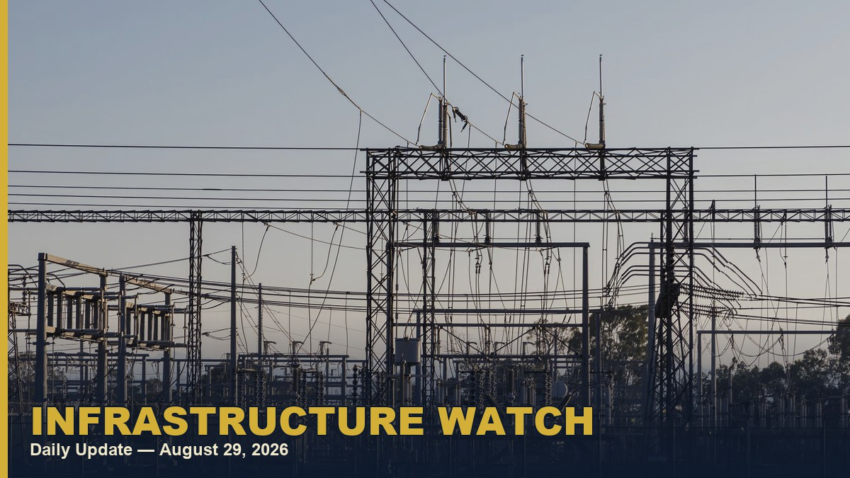
Nextgov/FCW reports that President Donald Trump declared a national emergency over foreign-made technology in the U.S. power grid, giving the Energy Department broader authority to block equipment, software, and services that could let an adversary disrupt or remotely access the electricity system (DiMolfetta, 2026). The executive order prohibits the purchase, import, or installation of certain foreign-produced equipment connected to a covered foreign entity that presents an unacceptable national security risk, and the Energy Department has 120 days to identify which countries, vendors, products, and transactions warrant restrictions (DiMolfetta, 2026).
The directive does not name China or any individual company; covered foreign entities include countries subject to certain U.S. arms embargoes or sanctions, as well as people and companies controlled by or operating under those governments (DiMolfetta, 2026). It focuses on the bulk-power system — high-voltage generation and transmission infrastructure — covering lines at 69 kilovolts or higher, not local distribution facilities. Affected technology could include transformers, generators, and industrial control equipment, and Energy may review software, firmware, remote-access capabilities, and update mechanisms that could hide backdoor access; the administration also contends that overseas reliance could leave the U.S. without critical spare parts during trade disruptions (DiMolfetta, 2026).
Separately, DW.com’s audio report on war-proofing Ukraine’s grid with solar recounts the August 26 attack, when Russia fired more than 200 missiles and drones and systematically pounded gas and coal-fired plants, the grid, and transformers (DW.com, 2026). Around 8 million homes lost power, and Greenpeace nuclear specialist Shaun Burnie says the key shift is that Russia started targeting electrical substations (DW.com, 2026). Roughly 10 substations are critical to nuclear plant safety (DW.com, 2026).
During the attack, the grid began to buckle: four reactors disconnected, and plant operators powered one down completely (DW.com, 2026). Burnie describes a loss of offsite power, or LOOP, in which plants must switch to emergency diesel generators within minutes, but those generators hold maybe seven to ten days of fuel. Restarting a reactor takes far more power than those generators can provide, so the grid has to come back first (DW.com, 2026).
“The world's biggest threat to nuclear safety.”
DW.com —
Read the full report →
What’s Disputed or Unconfirmed
The Nextgov/FCW report says the “spectre of China appears to loom over the policy,” but the directive itself names no country and no individual company, so any conclusion that China is the target remains inference rather than official designation (DiMolfetta, 2026). The actual list of restricted vendors, products, and transactions is not yet known because the Energy Department has 120 days to make its determinations (DiMolfetta, 2026).
DW.com’s account centers on the testimony of Shaun Burnie, a Greenpeace nuclear specialist, and the details of the August 26 attack and its nuclear-safety implications are not independently verified in the source material (DW.com, 2026).
Kemetic Minds Analysis
Today’s verified reporting covered: Power Supply. Every claim above traces back to a specific, dated, fetched source — treat the Key Takeaways as the verified factual floor, and the ‘What’s Disputed or Unconfirmed’ section as the honest boundary of what today’s sourcing actually supports versus what’s still allegation or one-sided claim. The two checklists below are static, agency-sourced preparedness guidance (FEMA/Ready.gov/CDC/USDA) and are not tied to today’s specific stories.
🛡️ Free Preparedness Guides
Two free, printable checklists you can download and keep on hand — one for water-supply
disruptions, one for power outages.
📄 Get this checklist as a free, printable PDF you can keep on hand.
📄 Get this checklist as a free, printable PDF you can keep on hand.
SUPPORT KEMETIC MINDS
Enjoying this coverage? Back the work and find every way to connect with us in one place.
References
- Nextgov/FCW. (2026, August 28). Trump admin moves to block risky foreign technology from US power grid. nextgov.com
- DW.com. (2026, August 29). War-proofing Ukraine's power grid with solar. dw.com
Investigative Methodology: This roundup is generated once daily at 5:00 PM America/Chicago from live news sources published within the prior 24 hours. Every claim is grounded in fetched source text with an APA7 in-text citation; nothing is written from the model’s general knowledge. Every video embed is verified to be a real, existing video via YouTube’s oEmbed endpoint, published within the last 24 hours, and restricted to a credible-outlet allowlist before publication — none are written by the drafting model. Pull-quotes are extracted verbatim from the cited article, never composed. The preparedness checklists are static guidance sourced from FEMA/Ready.gov, the CDC, and the USDA, never generated by the drafting model, and are not medical, legal, or emergency-response advice.
Stay Connected

Kemetic Minds Editorial Desk
Verified NewsroomPrimary-sourced investigative intelligence on civil rights, voting rights, federal policy, and consumer protection. Sourced from primary legal filings, government statistics, and direct field reporting.