KEMETIC MINDS
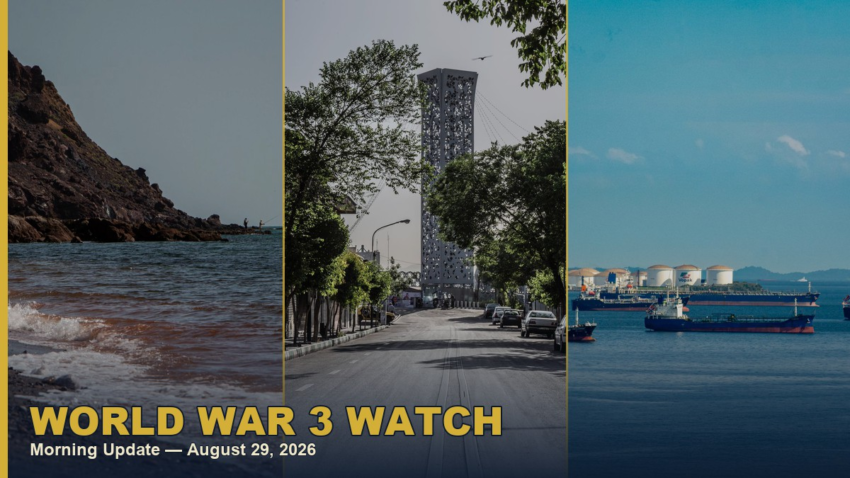
World War 3 Watch — Morning Update — August 29, 2026
- The US-Iran war entered its sixth month on Friday with no resolution in sight, despite Trump’s early promise of a quick campaign and his midweek “MISSION ACCOMPLISHED 2026” post (Common Dreams, 2026; CBC, 2026).
- Iran’s hold on the Strait of Hormuz has cost US consumers an estimated $71.5bn in extra fuel costs, with ship transits falling from more than 100 a day before the war to just five on one day this week (Common Dreams, 2026).
- Tehran says it moved $7.5bn in oil revenue to the central bank and hit 99 percent of its budgeted revenue target — even as President Pezeshkian admitted trade is down by more than a third (Middle East Eye, 2026; Crypto Briefing, 2026).
- The IRGC asserts firm control of the strait and says no vessel passes without coordination — a stance Chinese outlets report as flat fact, while US outlets frame it as a claim (Al Jazeera, 2026; China News Service, 2026, authors’ translation).
- Washington’s pressure is shifting from bombs to banks: the AP describes sanctions as the new “cudgel of choice,” and the WSJ’s Chinese edition reports a core Egyptian bank caught up in Treasury’s Iran crackdown (Common Dreams, 2026; WSJ Chinese, 2026, authors’ translation).
- Any reopening of Hormuz is conditional: Iran says the US must first end the blockade, release frozen assets, and lift sanctions under the June memorandum of understanding (Middle East Eye, 2026; The Paper, 2026, authors’ translation).
The Story So Far
Six months after the United States and Israel opened their war on Iran, the “quick war” promised in Washington has become a grinding stalemate (Common Dreams, 2026; CBC, 2026).
Control of the Strait of Hormuz remains the crux: Iran says it holds the waterway, Washington says it is enforcing a blockade, and shipping data shows the strait nearly empty (Al Jazeera, 2026; Common Dreams, 2026).
Tehran is simultaneously banking oil revenue and admitting wartime pain — $7.5bn transferred to the central bank, while foreign trade has shrunk by more than a third (Middle East Eye, 2026; Crypto Briefing, 2026).
China’s press is watching the same war from a different angle, leading with Iran’s terms for reopening Hormuz and a new financial-front story: an Egyptian bank snared in the US Treasury’s crackdown (The Paper, 2026, authors’ translation; WSJ Chinese, 2026, authors’ translation).
Video: 'HORMUZ COMPLETELY CLOSED': Trump's 'STRAIT OPEN' Claim Backfires, IRGC To Start Bombing Wave?. Source: Times Of India.
1. Six Months In: The ‘Quick War’ That Isn’t Ending
Trump declared the campaign a success this week, sharing a social media post reading “MISSION ACCOMPLISHED 2026” alongside AI-generated images that included the face of Supreme Leader Ayatollah Ali Khamenei, killed on the war’s opening day (CBC, 2026).
On the water, the picture contradicts the post. The Washington Post reported that Trump’s edge faded “after Iranian leaders discovered that they could withstand intense bombardment and slowly degrade the world’s most powerful military with a cheap combination of mines and drones” (Common Dreams, 2026).
Shipping tracker Kpler recorded just five vessels transiting the strait on one day this week, against more than 100 a day before the war (Common Dreams, 2026).
The closure has cost US consumers an estimated $71.5bn more to fill up their cars than they otherwise would have paid (Common Dreams, 2026).
The Associated Press reports the administration now favors sanctions “as the cudgel of choice,” while weighing “diminished munitions stockpiles after months of war” — a shift that raises concerns about US military readiness in other theaters (Common Dreams, 2026).
Trump, who once promised a war over “in a matter of weeks,” now says he is “not in a hurry” to end it (Common Dreams, 2026).
CBC opens its six-month coverage with Trump’s attention “largely elsewhere” — on a separate fight with Canada — even as US lawmakers call on him to end the conflict (CBC, 2026).
Former Defense Intelligence Agency officer Harrison Mann’s verdict: Trump has “lost the Iran War in every way possible in less than six months” (Common Dreams, 2026).
2. Tehran’s Wartime Ledger: Oil Money, Shrinking Trade, ‘Exceptional’ Conditions
Iran transferred $7.5bn in oil revenue from the first four months of its calendar year to the central bank, the semi-official Fars News Agency reported (Middle East Eye, 2026).
The funds, per oil ministry data, cover the government’s foreign-currency expenditures from July through December, with revenue hitting 99 percent of the budgeted projection (Middle East Eye, 2026).
The figures cut against the blockade’s intended effect on exports — but the wider picture is bleaker (Middle East Eye, 2026).
President Masoud Pezeshkian told state TV that trade has diminished by more than a third, and that sanctions are hurting the economy (Crypto Briefing, 2026; Middle East Eye, 2026).
“Some say sanctions have no effect at all; to those people, I really don’t know what to say,” Pezeshkian said. “We are in a war situation, and we must accept these wartime conditions” (Middle East Eye, 2026).
Tehran Governor Mohammad Sadeq Motamedian called the blockade’s effect “very exceptional and unique,” noting that more than 1,200 electricity infrastructure sites across Tehran province were struck during the US-Israeli campaign (Anews, 2026).
Water, telecommunications, and gas networks were also damaged, he said, though authorities restored services quickly (Anews, 2026).
3. The Financial Front: An Egyptian Bank Caught in Treasury’s Crackdown
While the military front stalls, the financial war is widening. The Chinese edition of the Wall Street Journal reports that a core Egyptian bank has been caught up in the US Treasury’s crackdown on Iran (WSJ Chinese, 2026, authors’ translation).
The development did not appear in this morning’s English-language Iran wires — only in the Mandarin edition — and it lands as Washington turns to sanctions as its primary pressure tool (WSJ Chinese, 2026, authors’ translation; Common Dreams, 2026).
The bank story matters because frozen assets are a named sticking point (Middle East Eye, 2026).
Iran says it will not fully reopen the strait until Washington ends the blockade, releases frozen Iranian assets, and lifts sanctions under the June memorandum of understanding (Middle East Eye, 2026).
If Treasury is still expanding its net around third-country banks six months into the war, the “release” half of that bargain looks distant (WSJ Chinese, 2026, authors’ translation; Middle East Eye, 2026).
4. Two Presses, Two Wars: Hormuz Control vs. ‘Mission Accomplished’
The four Mandarin headlines in our morning feed are unanimous: “Iran continues to control the Strait of Hormuz; vessels may not pass without coordination” (Ifeng, 2026, authors’ translation; China News Service, 2026, authors’ translation).
China’s outlets frame Iran’s control as settled fact, while Al Jazeera carefully attributes the same claim to the IRGC — which accuses US leaders of spreading false statements about the strait to sway energy prices (Al Jazeera, 2026).
The Mandarin framing also foregrounds conditionality: “If the Strait of Hormuz reopens, the United States must fulfill its obligations,” Iran’s president says, as carried by The Paper and Wallstreetcn (The Paper, 2026, authors’ translation; Wallstreetcn, 2026, authors’ translation).
English-language coverage leads instead with Washington’s domestic politics — the “MISSION ACCOMPLISHED” post, the $71.5bn fuel tab, and lawmakers demanding an exit (CBC, 2026; Common Dreams, 2026).
The Egyptian bank story is the sharpest asymmetry: a significant financial-front development surfaced only in the WSJ’s Chinese edition, not in the English Iran wires reviewed this morning (WSJ Chinese, 2026, authors’ translation).
For a fuller comparison of how each camp tells this war, see our narrative-comparison report on how US, Israeli, Iranian, and BRICS media each tell this war.
Is This Actually World War 3?
Based on this morning’s sources: not yet — but the war keeps generating global shockwaves.
None of today’s reporting shows direct great-power combat, and none touches the parallel China-Taiwan flashpoint that defines this series’ brief.
What the sources do show is a six-month regional war with globalized costs: energy prices spiking, a vital chokepoint nearly shut, US readiness concerns in other theaters, and a sanctions net now reportedly reaching into an Egyptian core bank (Common Dreams, 2026; WSJ Chinese, 2026, authors’ translation).
That is the pattern to watch — a regional conflict whose financial and energy aftershocks keep widening, one bank and one barrel at a time, even as the shooting stays contained.
What You Can Do Right Now
- Re-read the June memorandum of understanding’s terms — blockade, frozen assets, sanctions — and track which side is actually moving on each; the gap between promise and delivery is where escalation lives (Middle East Eye, 2026).
- If energy prices keep climbing on Hormuz disruption, review your fuel, heating, and supply-chain exposure now rather than after the next spike — our survival skills and preparedness guide walks through the basics.
- Read the same day’s news from both press ecologies: the Mandarin framing of Hormuz control and US obligations is as informative as the US framing of the “mission accomplished” politics (The Paper, 2026, authors’ translation; CBC, 2026).
SUPPORT KEMETIC MINDS
Enjoying this coverage? Back the work and find every way to connect with us in one place.
Support the Page →Kemetic Minds Analysis
This roundup pulled directly from the day’s English- and Chinese-language wires side by side, because the gap between what each side chooses to report is often as informative as any single strike count. Treat the Key Takeaways above as the verified factual floor, and the framing differences noted in the sections above as the more interesting, harder-to-fake signal about where this war is actually headed next.
References
- Middleeasteye. (2026, August 29). Iran reports $7.5bn in oil revenues amid US naval blockade. middleeasteye.net
- Cryptobriefing. (2026, August 29). Iran admits trade shrinks by over a third amid US conflict. cryptobriefing.com
- Anews. (2026, August 29). US naval blockade put Iran under ‘exceptional’ conditions during war: Tehran governor. anews.com.tr
- Al Jazeera. (2026, August 29). Iran war live: Tehran pledges to stand firm against ‘unjust’ US sanctions. aljazeera.com
- CBC. (2026, August 28). While Trump targets Canada, U.S. lawmakers decry toll of 6-month Iran war. cbc.ca
- Common Dreams. (2026, August 28). Iran War Trump Said Would Be Quick Has Now Lasted 6 Months With 'No End In Sight'. commondreams.org
- 华尔街见闻. (2026, August 29). 伊朗总统称“若霍尔木兹海峡重开,美国必须履行其义务”,军方强调“船只未经协调不得通过” [Iranian President Says US Must Fulfill Obligations If Strait of Hormuz Reopens; Military Warns Vessels Cannot Pass Without Coordination]. wallstreetcn.com
- 凤凰网. (2026, August 28). 伊朗:持续控制霍尔木兹海峡,船只未经协调不得通过 [Iran: Continuing to Control the Strait of Hormuz, Vessels Cannot Pass Without Coordination]. news.ifeng.com
- thepaper.cn. (2026, August 28). 伊朗总统:若霍尔木兹海峡重开,美国必须履行其义务 [Iranian president: If the Strait of Hormuz reopens, the US must fulfill its obligations.]. thepaper.cn
- chinanews.com.cn. (2026, August 28). 伊朗:持续控制霍尔木兹海峡 船只未经协调不得通过 [Iran: Continuing to Control the Strait of Hormuz, Vessels May Not Pass Without Coordination]. chinanews.com.cn
- 华尔街日报中文网. (2026, August 29). 一家埃及核心银行卷入美国财政部对伊朗的打击行动 [A key Egyptian bank is caught up in the US Treasury's crackdown on Iran.]. cn.wsj.com
Investigative Methodology: This roundup is generated on a fixed schedule (noon and evening, America/Chicago) from live English- and Chinese-language wire sources. Every claim is grounded in fetched source text with an APA7 in-text citation; translated Chinese-language quotes are marked “authors’ translation.” Every video embed is verified to be a real, existing video via YouTube’s oEmbed endpoint before publication — none are written by the drafting model. No Wikipedia sources are used.
Stay Connected

Kemetic Minds Editorial Desk
Verified NewsroomPrimary-sourced investigative intelligence on civil rights, voting rights, federal policy, and consumer protection. Sourced from primary legal filings, government statistics, and direct field reporting.