KEMETIC MINDS
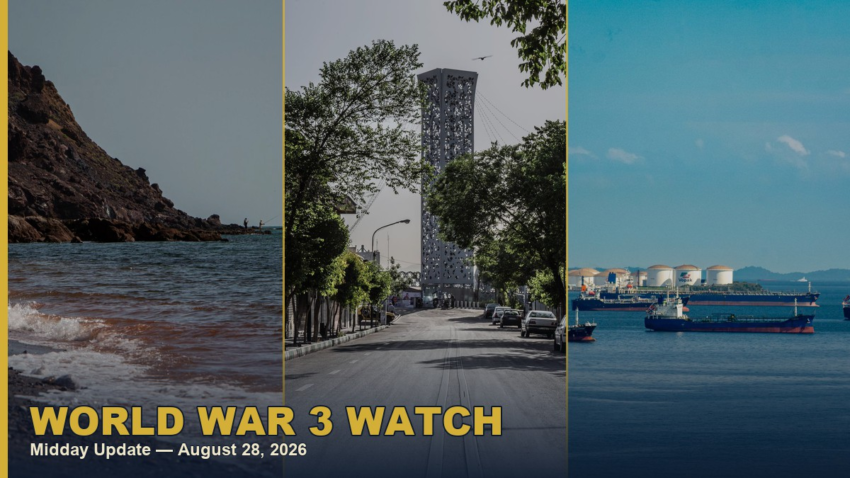
World War 3 Watch — Midday Update — August 28, 2026
Key Takeaways
- Six months after the Feb. 28 strikes that killed Iran’s supreme leader, the war has killed an estimated 8,000-10,000 people and wounded tens of thousands more (Yahoo News, 2026).
- The White House says Iran is “begging” for a deal, while Iranian officials say talks are stalled and Trump’s timeline has stretched to “as long as necessary” (CBS News, 2026; MSN, 2026).
- Washington is escalating “economic asphyxiation,” cutting off Banque Misr’s UAE branches and sanctioning an Iranian bank manager and a Hong Kong trading company (CBS News, 2026).
- Analysts say the chokehold depends on China — and Beijing’s cooperation is unlikely; China keeps buying Iranian oil (MSN, 2026; Oneindia, 2026).
- Chinese-language outlets frame Trump’s threat to sanction Chinese banks as bravado and ask whether Washington can block China’s “teapot refineries” (Guancha, 2026, authors’ translation; Wenxuecity, 2026, authors’ translation).
- The U.S. says Hormuz is clear of mines, but U.S. allies reportedly doubt it and transits remain a fraction of pre-war levels (CBS News, 2026).
The Story So Far
Six months ago today, U.S. and Israeli missile strikes hit Tehran, killing Supreme Leader Ayatollah Ali Khamenei and senior officials — along with scores of children at a school in Minab (Yahoo News, 2026). Trump promised a war of “four to five weeks” (Yahoo News, 2026).
Instead, the conflict reached the Caspian Sea, triggered a global oil-supply crisis, and has now killed an estimated 8,000-10,000 people (Yahoo News, 2026). There is no end in sight (CBS News, 2026).
Washington’s message today is that Iran is “begging” for a deal; Tehran says talks are stalled (CBS News, 2026). Treasury is tightening the economic siege, and China remains the variable Washington cannot control (CBS News, 2026; Oneindia, 2026).
This is the midday update in our World War 3 Watch series, tracking the Iran/Hormuz war and its great-power ripples.
Video: US marks 6 months of war with Iran. What happens now?. Source: 13WMAZ.
1. Six Months In: The Body Count and the Oil Shock
The U.S. entered the war with murky goals, first describing the Feb. 28 strikes as preemptive self-defence (Yahoo News, 2026). Trump had claimed the U.S. “obliterated” Iran’s nuclear program when it joined Israel’s 12-day war on Iran in June 2025, then claimed in February that Tehran was weeks away from a weapon (Yahoo News, 2026).
Washington’s stated demands were blunt: hand over Iran’s 440kg of highly enriched uranium and commit to zero enrichment going forward (Yahoo News, 2026). Tehran refused, though it appeared open at one point to sending the stock to a third country, and it insisted on keeping a civilian nuclear power capacity (Yahoo News, 2026).
The costs are visible across the region. An estimated 8,000-10,000 people are dead, tens of thousands are wounded, and fighting has spread as far as the Caspian Sea (Yahoo News, 2026). More than one-fifth of oil and gas cargo transits Hormuz, and the battle for the strait has produced a global supply crisis (Yahoo News, 2026).
A scorecard appearing on MSN, from Al Jazeera, tracks “the dead and displaced” and “the shock delivered to the global economy” (MSN, 2026).
Video: Morning News NOW Full Episode – Aug. 28. Source: NBC News.
2. “Begging” vs. Stalled: The Diplomacy Gap
In a new Hormuz assessment, Trump said Iran “doesn’t want us to go back at them” and claimed Tehran is “begging” to make a deal, according to a Truth Social post (MSN, 2026). He insisted the same Thursday, even as Iranian officials pushed back and talks remained stalled six months in (CBS News, 2026).
The president’s timeline has moved from “four to five weeks” to “as long as necessary” (Yahoo News, 2026; CBS News, 2026).
On the water, Adm. Brad Cooper, head of U.S. Central Command, said the Strait of Hormuz is clear of sea mines — “open, and momentum is building” (CBS News, 2026). Some U.S. allies reportedly doubt that assessment, and Iran’s threat to commercial vessels has kept transits at a fraction of their pre-war level (CBS News, 2026).
The Chinese-language material in this set tells the same news cycle differently. Al-Monitor’s Chinese edition headlines “Iran intensifies ceasefire efforts, the U.S. says the mines in the Strait of Hormuz have been cleared, oil prices fall” (Al-Monitor, 2026, authors’ translation).
3. Economic Asphyxiation: Treasury Targets an Egyptian Bank
U.S. Treasury Secretary Scott Bessent has promised “economic asphyxiation” for Iran (CBS News, 2026). “Treasury promised to sever every economic lifeline Tehran has left,” Bessent said, warning that Iran’s enablers “cannot continue to enjoy access to the U.S. dollar” (CBS News, 2026).
The first named target Friday is Egypt’s second-biggest bank. Treasury is set to cut Banque Misr’s UAE operations off from the U.S. financial system; Bessent said the bank “decided to find out the hard way” (CBS News, 2026).
Washington also sanctioned Reza Mohammad Taeedi, manager of Iranian Bank Melli’s Dubai branch, and Hong Kong-based Kameng Trading Limited (CBS News, 2026).
The crux remains China. Analysts say a successful chokehold on Iran requires the unlikely cooperation of China (MSN, 2026).
4. China Is the Wall Washington Can’t Breach
China continues to purchase Iranian oil despite intense U.S. sanctions and pressure (Oneindia, 2026). Oneindia’s headline frames the purchases as open defiance: “Xi Jinping humiliates Trump! Defies U.S. sanctions in Hormuz, continues buying Iranian oil” (Oneindia, 2026).
Asked Thursday whether Washington would impose sanctions on Chinese banks that cooperate with Iran — a step analysts call crucial — Trump shot back, “Who said I’m not?” and added he did not “have to announce everything” (CBS News, 2026).
Chinese-language outlets pounced. Guancha headlines “Trump, unabashed, says: Who said I wouldn’t do this to China?” (Guancha, 2026, authors’ translation). Sohu framed the answer as Trump “getting anxious” at questions about whether he dares to sanction Chinese banks (Sohu, 2026, authors’ translation).
Wenxuecity argues the more Washington sanctions, the harder it becomes to block — and predicts the U.S. is likely at a loss against China’s “teapot refineries” (Wenxuecity, 2026, authors’ translation).
5. Two Media Lenses on the Same War
Today’s English-language sources lead with Trump’s “begging” claim, Adm. Cooper’s assurance that Hormuz is open, and Treasury’s new sanctions (MSN, 2026; CBS News, 2026). The Chinese-language material in this set leads with Iran’s ceasefire push, falling oil prices, and the limits of U.S. sanctions (Al-Monitor, 2026; Wenxuecity, 2026).
Chinanews delivers the sharpest formulation: Hormuz, “offline” for half a year, “is no longer the Hormuz it once was” (Chinanews, 2026, authors’ translation).
The contrast is in the verbs. Washington says Iran is “begging”; the Chinese-language material says Iran is “intensifying ceasefire efforts” (CBS News, 2026; Al-Monitor, 2026, authors’ translation). One framing makes Tehran a supplicant; the other makes it an actor.
That divergence is exactly what our narrative-comparison report on how US, Israeli, Iranian, and BRICS media each tell this war documents.
Is This Actually World War 3?
Based only on today’s sources, this is still a regional war with global shockwaves. U.S. and Israeli forces are striking Iran, the oil market is in crisis, and Washington is cutting Iran’s enablers off from the dollar and the U.S. financial system (Yahoo News, 2026; CBS News, 2026).
In these sources, China appears only as an economic actor: buying Iranian oil, resisting sanctions, and linked to a Hong Kong trading company now under U.S. sanctions (Oneindia, 2026; CBS News, 2026).
Yet the great-power structure is shifting. Experts say the conflict is “realigning the global order” as new alliances form and dominant ones “show signs of crumbling” (Yahoo News, 2026).
Is that World War 3? Not on the evidence here. But the front lines now include an Egyptian bank in the UAE, a Hong Kong trading firm, and China’s “teapot refineries” (CBS News, 2026; Wenxuecity, 2026, authors’ translation).
What You Can Do Right Now
- Don’t take “Hormuz is open” at face value: even U.S. allies reportedly doubt it, and transits remain a fraction of pre-war levels (CBS News, 2026).
- Watch Beijing, not Washington’s talking points: China’s continued oil purchases and its teapot refineries are the real test of “economic asphyxiation” (Oneindia, 2026; Wenxuecity, 2026, authors’ translation).
- Expect oil-price and supply-chain volatility — more than a fifth of world oil and gas cargo normally moves through Hormuz, and a supply crisis is already underway (Yahoo News, 2026). Our practical preparedness guide covers the basics.
SUPPORT KEMETIC MINDS
Enjoying this coverage? Back the work and find every way to connect with us in one place.
Support the Page →Kemetic Minds Analysis
This roundup pulled directly from the day’s English- and Chinese-language wires side by side, because the gap between what each side chooses to report is often as informative as any single strike count. Treat the Key Takeaways above as the verified factual floor, and the framing differences noted in the sections above as the more interesting, harder-to-fake signal about where this war is actually headed next.
References
- MSN. (2026, August 28). Trump says Iran 'doesn't want us to go back at them' in new Hormuz assessment. msn.com
- Yahoo. (2026, August 28). After six months of war, what have US, Iran gained and lost?. yahoo.com
- MSN. (2026, August 28). US-Israel war on Iran, six months down the line: In numbers. msn.com
- Oneindia. (2026, August 28). Xi Jinping HUMILIATES Trump! Defies U.S. Sanctions In Hormuz, Continues Buying Iranian Oil. oneindia.com
- Cbsnews. (2026, August 28). Live Updates: Iran war hits 6-month mark with no end in sight. cbsnews.com
- MSN. (2026, August 28). China's help critical, but unlikely, for US to choke off Iran. msn.com
- chinanews.com.cn. (2026, August 28). 东西问丨“掉线”半年,霍尔木兹早已不是从前的霍尔木兹 [East-West Questions | 'Offline' for six months, Hormuz is no longer the Hormuz it once was]. chinanews.com.cn
- Al-Monitor. (2026, August 28). 伊朗加大停火力度,美国称霍尔木兹海峡地雷已清除,油价下跌 [Iran escalates cease-fire efforts, US says Strait of Hormuz mines cleared, oil prices fall]. al-monitor.com
- guancha.cn. (2026, August 28). 特朗普大言不惭:谁说我不会对中国这么做? [Trump brazenly boasts: Who said I wouldn't do this to China?]. guancha.cn
- 文学城. (2026, August 27). 越制裁越难堵 美国恐拿中国“茶壶炼油厂”没辙 [The More Sanctions, the Harder to Block: US at a Loss Over China's 'Teapot Refineries]. wenxuecity.com
- 搜狐网. (2026, August 28). 被质疑不敢制裁中国银行,特朗普急了:谁说我不会这么做? [Questioned over not daring to sanction Chinese banks, Trump fires back: Who said I wouldn't?]. m.sohu.com
Investigative Methodology: This roundup is generated on a fixed schedule (noon and evening, America/Chicago) from live English- and Chinese-language wire sources. Every claim is grounded in fetched source text with an APA7 in-text citation; translated Chinese-language quotes are marked “authors’ translation.” Every video embed is verified to be a real, existing video via YouTube’s oEmbed endpoint before publication — none are written by the drafting model. No Wikipedia sources are used.
Stay Connected

Kemetic Minds Editorial Desk
Verified NewsroomPrimary-sourced investigative intelligence on civil rights, voting rights, federal policy, and consumer protection. Sourced from primary legal filings, government statistics, and direct field reporting.