KEMETIC MINDS
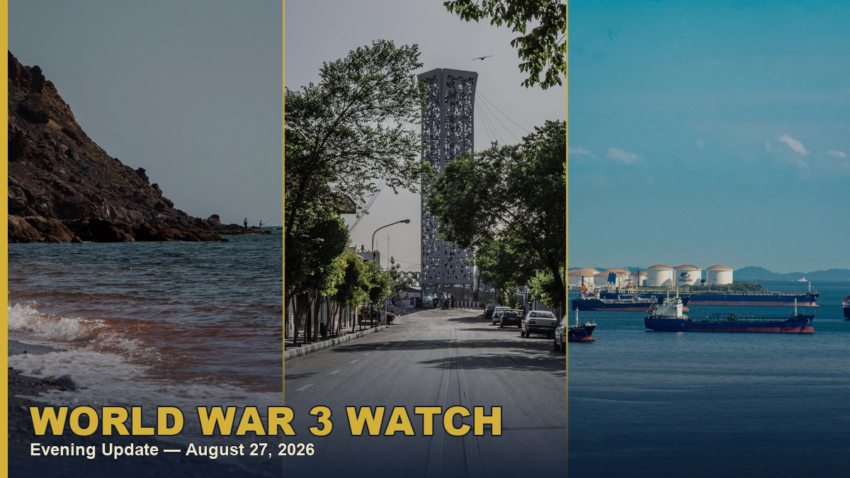
World War 3 Watch — Evening Update — August 27, 2026
- The U.S.-Iran war hits six months on Friday with no off-ramp; a June memorandum of understanding has collapsed and no negotiations are happening now (OC Register, 2026).
- Qatar’s prime minister is in Tehran mediating, including a proposed Iran-Oman plan for safe passage and mine-clearing in the Strait of Hormuz (Boston Herald, 2026).
- The U.S. Treasury’s new sanctions target anyone dealing with Iran, but China’s August purchases of Iranian oil have already dropped to about 534,000 barrels per day from a 2025 average of 1.4 million (NetEase, 2026, authors’ translation).
- Beijing has issued a blocking statute that forbids Chinese firms from complying with U.S. sanctions on five Chinese companies, including Hengli Petrochemical (NetEase, 2026, authors’ translation).
- Iran’s official media says Tehran will counter any escalation in the economic sphere (The Beijing News, 2026, authors’ translation).
- Trump says the U.S. “doesn’t want to speak to Iran” and that Iran is in “deep trouble” from economic pressure (Fox News, 2026).
The Story So Far
Six months after President Donald Trump launched the war with Iran, the conflict has no off-ramp in sight, and Washington’s goals have shifted from destroying Iran’s military to reopening the Strait of Hormuz and squeezing its economy (OC Register, 2026).
On Thursday, Qatar’s prime minister sat in Tehran with Iran’s president, foreign minister and parliamentary speaker, pushing a proposed Iran-Oman plan to allow safe passage and clear mines from the strait (Boston Herald, 2026). A new tanker attack in the waterway was reported to British maritime authorities on Tuesday (Boston Herald, 2026).
Trump, meanwhile, told reporters at the White House that the U.S. doesn’t want to speak to Iran and that Iran is in “deep trouble” (Fox News, 2026). The war’s main front is now economic, and the target is China, Iran’s top oil buyer and the country Washington must convince to stop buying (Baltimore Sun, 2026).
For a breakdown of how each side’s media is framing this war, see our narrative-comparison report.
Video: Trita Parsi: Trump’s Iran Strategy Is A CATASTROPHE. Source: The Young Turks.
1. The Six-Month Stalemate
Trump’s initial forecast was a four-to-five-week war; the conflict reaches its six-month mark on Friday (OC Register, 2026; Boston Herald, 2026).
The June memorandum of understanding designed to end the war has “fallen by the wayside,” and White House press secretary Karoline Leavitt said Thursday that no negotiations are happening (OC Register, 2026). Washington has pivoted from mass strikes to economic pressure, while U.S. stockpiles of key weapons have diminished (OC Register, 2026).
Trump now says he has “no time schedule” to wrap up the conflict (Boston Herald, 2026). Chinese online media summarize the same six months as “spending heavily, using aircraft carriers, expending ammunition, and ending with a failed memorandum” (Sohu, 2026, authors’ translation).
The goals themselves have morphed: reopening the Strait of Hormuz, never an original objective, is now a prime one (OC Register, 2026).
Video: Oil tanker STRUCK in Hormuz as Trump vows to continue Iran war 'as long as necessary'. Source: Fox News.
2. The Strait Under Siege
Hormuz is the raw nerve of the war. Before the conflict, about 20% of the world’s oil passed through the waterway; it has been largely closed since the war began, driving up fuel and fertilizer prices (OC Register, 2026).
On Thursday, the UK Maritime Trade Organization said it had received a report of an oil tanker hit in the strait by an unknown projectile on Tuesday (Boston Herald, 2026). The attack is a reminder that the chokepoint stays dangerous even as diplomats push for a deal.
Qatar’s prime minister met in Tehran with Iran’s foreign minister, president and parliamentary speaker to discuss a proposed Iran-Oman plan for safe passage and mine-clearing (Boston Herald, 2026). Iranian sources say consultations with Oman over the agreement’s details are still underway (Xinhua, 2026, authors’ translation).
English-language coverage treats the plan as one of several off-ramp attempts in a war without an end date (Boston Herald, 2026). Chinese state media, by contrast, foreground the Iran-Oman channel as an active diplomatic track (Xinhua, 2026, authors’ translation).
Video: Iran, Oman Agree On Share Of Territory, Revenues From Hormuz | Gravitas Highlights. Source: WION.
3. Operation Economic Outcast
Washington’s latest lever is a sanctions campaign named “Operation Economic Outcast,” announced Monday by Treasury Secretary Scott Bessent (Baltimore Sun, 2026). “Those who tether themselves to the Iranian regime should expect to share in the isolation,” Bessent said (Baltimore Sun, 2026).
The UAE’s decision to suspend trade relations with Iran last week kick-started this phase (Baltimore Sun, 2026). Iran entered the war with its commerce dangerously concentrated: the UAE, China and Turkey supplied nearly three-quarters of its merchandise imports in 2024, and China, Iraq, the UAE and Turkey bought more than two-thirds of its non-oil exports (Baltimore Sun, 2026).
The success of the strategy hinges on China, the main buyer of Iranian oil and Iran’s top trading partner (Baltimore Sun, 2026). Russia probably can’t offer much hard financial support amid its own sanctions crisis, and regional partners like Turkey, Pakistan and Iraq have reason to avoid secondary sanctions (Baltimore Sun, 2026).
Chinese media report that the U.S. Treasury’s own April assessment put China at roughly 90% of Iran’s oil exports, with much of it going to independent refineries in Shandong (NetEase, 2026, authors’ translation).
4. Beijing’s Counterpunch
The sanctions drive is colliding with a wall of data and a Chinese legal countermeasure. Kpler ship-tracking data shows Iran’s 2026 shipments to China have fallen from a 2025 average of about 1.4 million barrels per day to roughly 534,000 barrels per day this August (NetEase, 2026, authors’ translation).
Yet the U.S. Treasury’s new sanctions list, which added about 60 individuals, entities and ships, notably excluded major Chinese banks suspected of involvement in Iranian oil trade (NetEase, 2026, authors’ translation). Bessent has acknowledged the U.S. does not want to blow up the global financial system (NetEase, 2026, authors’ translation).
Chinese media frame this as Washington fearing it can’t get a grip on China’s “teapot refineries,” the small independent processors with limited exposure to Western finance (Wenxuecity, 2026, authors’ translation). Beijing, meanwhile, has moved from protest to law: on May 2, China’s commerce ministry issued a blocking statute ordering that U.S. sanctions against five Chinese companies, including Hengli Petrochemical, not be recognized, enforced or complied with inside China (NetEase, 2026, authors’ translation).
The English-language coverage from Thursday concentrates on U.S. pressure on regional states and barely touches this legal front (Baltimore Sun, 2026). Chinese coverage leads with it.
5. The Off-Ramp Question
Even with sanctions escalating, the channels for ending the conflict remain open. Qatar’s prime minister told Iranian leaders that his country has never hesitated to cooperate with Iran, and Iran’s Supreme National Security Council secretary underscored the longstanding ties between the two nations (Boston Herald, 2026).
The June framework had included up to 60 days of negotiations on the hardest issues — nuclear, sanctions, regional security — while granting sanctions exemptions for Iranian oil exports (NetEase, 2026, authors’ translation). It also included a phased release of about $6 billion in frozen Iranian revenues held in Qatar, earmarked mainly for U.S. corn, wheat, soybeans and medical goods, and discussion of a $300 billion reconstruction and development fund (NetEase, 2026, authors’ translation).
But Trump said Thursday that the U.S. doesn’t want to speak to Iran (Fox News, 2026), and an Iranian official warns that Tehran will counter any action that escalates tensions in the economic sphere (The Beijing News, 2026, authors’ translation).
The region is reaching for an off-ramp; the White House is not yet reaching back.
Is This Actually World War 3?
Today’s sources describe a war of economic compulsion, not a globe-spanning military clash. The shooting is contained to the Iran theater and the tanker lanes of Hormuz.
The great-power dimension is real but plays out in sanctions, shipping data and legal statutes. The U.S. is deliberately avoiding a direct break with the dollar system, and China’s countermove is a court order, not a carrier strike group (NetEase, 2026, authors’ translation).
If World War 3 means direct military conflict between great powers, the evidence doesn’t meet that bar. If it means an escalating multi-theater confrontation over the global economy, then this war is already part of a larger one.
What You Can Do Right Now
Track the signals, don’t just absorb the headlines. Here’s what’s actionable today:
- Watch the UK Maritime Trade Organization advisories and any Treasury announcements — tanker attacks and sanctions like “Operation Economic Outcast” are the kind of news that moves oil prices and shipping costs before general coverage catches up (Boston Herald, 2026; Baltimore Sun, 2026).
- If you work in trade or logistics, map your exposure to the China-Iran-UAE triangle; the sanctions threat is aimed at any intermediary, and the UAE’s suspension of trade with Iran shows how fast commerce lanes can snap (Baltimore Sun, 2026).
- Review our practical preparedness guide — with Hormuz largely closed and fuel and fertilizer prices rising, a household buffer is looking less like paranoia and more like prudence (OC Register, 2026).
SUPPORT KEMETIC MINDS
Enjoying this coverage? Back the work and find every way to connect with us in one place.
Support the Page →Kemetic Minds Analysis
This roundup pulled directly from the day’s English- and Chinese-language wires side by side, because the gap between what each side chooses to report is often as informative as any single strike count. Treat the Key Takeaways above as the verified factual floor, and the framing differences noted in the sections above as the more interesting, harder-to-fake signal about where this war is actually headed next.
References
- Ocregister. (2026, August 27). US goals have shifted after 6 months of Iran war. The Strait of Hormuz is now a top concern. ocregister.com
- Bostonherald. (2026, August 27). Regional powers seek off-ramp from Iran war, and other Middle East developments. bostonherald.com
- Fox News. (2026, August 27). President Trump: We don’t want to speak to Iran. foxnews.com
- The Baltimore Sun. (2026, August 27). Iran scrambles to sustain trade as US threatens to sanction countries that refuse to break ties. baltimoresun.com
- 新华网. (2026, August 27). 伊朗消息人士:仍在与阿曼磋商霍尔木兹海峡协议细节 [Iranian sources: still in talks with Oman on details of Strait of Hormuz agreement]. news.cn
- 新京报. (2026, August 27). 伊朗官员:伊方将反制任何升级经济领域紧张局势的行动 [Iranian official: Iran will counter any actions that escalate economic tensions]. bjnews.com.cn
- 搜狐网. (2026, August 27). 斥巨资、用航母、耗弹药,美对伊战事半年换得一纸失效备忘录 [After spending billions, deploying carriers, and expending ammunition, six months of US war on Iran yields only a worthless memorandum.]. m.sohu.com
- 文学城. (2026, August 27). 越制裁越难堵 美国恐拿中国“茶壶炼油厂”没辙 [More sanctions, harder to plug: US may be powerless against China's 'teapot refineries]. wenxuecity.com
- 手机网易网. (2026, August 27). 中国买走伊朗大批石油,贝森特直接威胁中国!这套制裁能撑多久? [China Buys Large Volumes of Iranian Oil, Bessent Directly Threatens Beijing — How Long Can These Sanctions Hold?]. 163.com
Investigative Methodology: This roundup is generated on a fixed schedule (noon and evening, America/Chicago) from live English- and Chinese-language wire sources. Every claim is grounded in fetched source text with an APA7 in-text citation; translated Chinese-language quotes are marked “authors’ translation.” Every video embed is verified to be a real, existing video via YouTube’s oEmbed endpoint before publication — none are written by the drafting model. No Wikipedia sources are used.
Stay Connected

Kemetic Minds Editorial Desk
Verified NewsroomPrimary-sourced investigative intelligence on civil rights, voting rights, federal policy, and consumer protection. Sourced from primary legal filings, government statistics, and direct field reporting.