KEMETIC MINDS
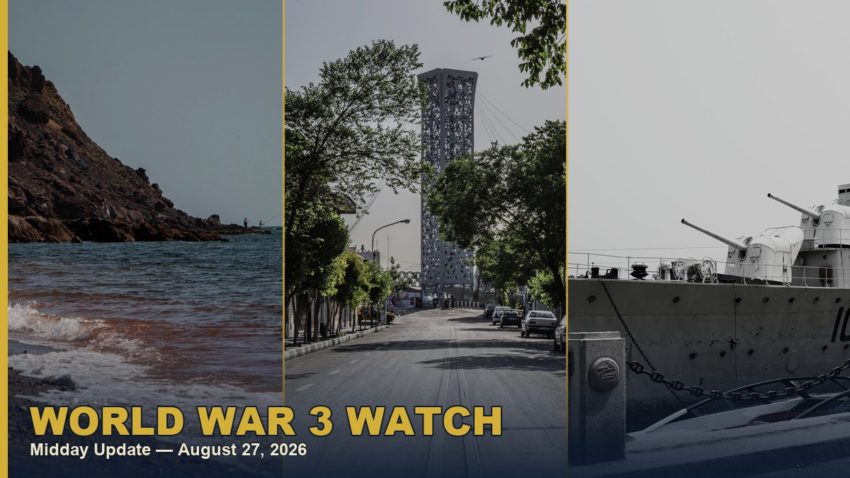
World War 3 Watch — Midday Update — August 27, 2026
- Hormuz traffic hit a three-month low: Kpler counted just two commercial ships on Aug 24, versus more than 130 a day before the war (163.com, 2026, authors’ translation; Arise, 2026).
- Iran and Oman reached a corridor deal, but Tehran says reopening depends on the US fulfilling the June Islamabad Memorandum of Understanding — whose 60-day window lapsed Aug 17 (MSN, 2026; 163.com, 2026, authors’ translation).
- Washington insists it is not talking to Tehran, even as Qatar’s prime minister flies in as a back channel (CNN, 2026; Arise, 2026).
- The economic front is widening: Treasury’s “Operation Economic Outcast” expands secondary sanctions, and Chinese media warn of moves against China’s four biggest banks (163.com, 2026, authors’ translation; Wenxuecity, 2026, authors’ translation).
- Six months in, the war’s goals have drifted: reopening Hormuz was never an original objective, and no off-ramp is in sight (Boston Herald, 2026; Detroit News, 2026).
The Story So Far
Six months after President Donald Trump launched a war he once called a “little excursion,” the Strait of Hormuz is moving a fraction of the traffic it carried before February (Detroit News, 2026).
Iran and Oman say they have an understanding on a temporary shipping corridor, but Tehran insists it will only reopen once Washington delivers (MSN, 2026).
Trackers counted just two commercial crossings on Aug 24, while Trump insists the strait is “a very functioning strait” (163.com, 2026, authors’ translation; Arise, 2026).
Treasury has opened what it calls an “Economic D-Day” against Iran, and Chinese media warn the new campaign could reach China’s largest banks (163.com, 2026, authors’ translation; Wenxuecity, 2026, authors’ translation).
Here is where the six-month conflict stands at midday, August 27.
Video: Iran reportedly reaches deal with Oman to open Strait of Hormuz | ABC NEWS. Source: ABC News (Australia).
1. Hormuz in Freefall: A 3-Month Low of Two Ships
Tanker traffic through the strait has collapsed, and the tracking firms are documenting it. Kpler counted just two commercial ships on Aug 24 — one very large gas carrier and one very large crude carrier entering from the Gulf of Oman — the lowest level since early May (163.com, 2026, authors’ translation).
Tuesday’s preliminary tally was five commodity carriers, against a 10-day average of 15 (163.com, 2026, authors’ translation). All five used a unilateral route designated by Iran, not the Omani-side channel the US has tried to organize (Arise, 2026).
Vortexa’s independent data agree: oil movement in the week of Aug 23 ran at 6 million to 7 million barrels a day, far below the pre-war norm (163.com, 2026, authors’ translation).
Before the war, more than 130 vessels a day crossed the strait — the lane through which about 20% of the world’s oil passed (Arise, 2026; Boston Herald, 2026).
What traffic does move is running dark. About 80% of ships in the past two weeks crossed with their AIS transponders off, a pattern that is itself a measure of how dangerous the waterway has become (163.com, 2026, authors’ translation).
The danger is not abstract. The UK Maritime Trade Operations agency reported an oil tanker struck by an unidentified projectile off the Omani coast early Thursday, with the fire extinguished and the crew safe — the second commercial vessel attacked in the waterway (Arise, 2026; Fox News, 2026).
Trump declared Wednesday that the strait is fully cleared of mines (Arise, 2026).
“Yes, every once in a while there will be a drone or a rocket or something shot, but it is a very functioning strait. A lot of oil is pouring out,” he said (Arise, 2026).
He has also claimed 10 million barrels moved through in a single day — a day trackers counted five confirmed crossings (163.com, 2026, authors’ translation; Arise, 2026).
US allies remain skeptical that the mines are truly gone (Arise, 2026).
Crude held near $82 a barrel Thursday despite the latest attack (Fox News, 2026). Chinese coverage puts Brent below $88, down nearly 6% on the week but still up more than 40% this year (163.com, 2026, authors’ translation).
Video: Trump Ignored Warnings Before Iran War, Report Claims | WION News. Source: WION.
2. Iran and Oman Have a Deal — Now They Need Washington
On the diplomatic track, the pieces are moving. Omani Foreign Minister Badr traveled to Tehran on Aug 25, and with Iranian Foreign Minister Araghchi issued a joint statement proposing a phased restoration of safe navigation (163.com, 2026, authors’ translation).
The proposal: a jointly agreed temporary sea lane, cooperation on mine clearance, and technical talks on a permanent route, traffic management, intelligence exchange, and security services (163.com, 2026, authors’ translation).
The next day, IRGC spokesman Hossein Mohebbi told the semi-official Tasnim news agency that Iran and Oman had reached a “mutually acceptable agreement” on the shares of the strait each controls and how revenue would be split (163.com, 2026, authors’ translation).
Negotiations began about a month ago, but no details on shares, fees, or timing were disclosed (163.com, 2026, authors’ translation). Fox News frames the same talks as an effort to establish fees in the waterway — the commercial logic behind what Tehran calls revenue distribution (Fox News, 2026).
English coverage describes an understanding that clears “a major hurdle” to reopening, with implementation still awaiting US buy-in (MSN, 2026).
Tehran’s stated precondition is pointed straight at Washington: the US must stop what Iran calls obstruction and fulfill the Islamabad Memorandum of Understanding signed in June (163.com, 2026, authors’ translation).
Under that memorandum, the US would end military operations, open a 60-day window for final-agreement talks, and progressively lift its naval blockade on Iranian ports (163.com, 2026, authors’ translation).
Iran would guarantee free and safe passage and clear mines; the US would lift sanctions, allow Iranian oil exports, and release frozen assets (163.com, 2026, authors’ translation).
Both sides say the other failed to deliver, and the 60-day window lapsed Aug 17 (163.com, 2026, authors’ translation). The AP’s accounting is blunt: the June memorandum was designed to end the war but “has fallen by the wayside” (Boston Herald, 2026).
Mohebbi also claimed the strait is “under Iranian control,” with enemy warships withdrawn at least 400 kilometers — including, he said, from the waters off Oman’s side (163.com, 2026, authors’ translation).
None of it is happening with a formal US-Iran channel open. “No negotiations are happening right now, and this will continue until the president feels that maybe they come to the table in a meaningful way,” White House press secretary Karoline Leavitt said Thursday (Boston Herald, 2026).
Trump, meanwhile, says US financial strength will carry the country “toward a very big victory” over Iran and that he does not believe the supreme leader is dead (CNN, 2026).
3. Washington’s ‘Economic D-Day’ Turns Toward China’s Banks
With the military track stalled, the economic one is accelerating. On Aug 24, Treasury Secretary Scott Bessent announced “Operation Economic Outcast,” describing it as an “Economic D-Day” against Iran (163.com, 2026, authors’ translation).
The program expands secondary sanctions into digital assets, technology, gold, aviation, and shipping, and names 60 individuals, entities, and ships (163.com, 2026, authors’ translation).
Bessent’s warning was global: states and firms aligned with Iran risk exclusion from the dollar system (163.com, 2026, authors’ translation).
Yet the hammer has not swung. The US has so far imposed no major secondary sanctions — including on the Chinese financial institutions that reportedly help move Iranian oil (163.com, 2026, authors’ translation).
“Why would I blow up the global financial system? We think it’s important to set benchmarks and give people a remediation period, but they should know this will move quickly and we’re serious,” Bessent said (163.com, 2026, authors’ translation).
Chinese-language outlets are reading that as a threat aimed at them. One report asks whether Washington is preparing to move against China’s four largest banks with what it calls an “economic nuclear weapon” that could shake the world (Wenxuecity, 2026, authors’ translation).
Another, by the energy analyst Michal Meidan, declares the war’s “unexpected winner” to be China (Guancha, 2026, authors’ translation).
The political timing is not subtle. Sohu headlines a question — “Three countries protect Iran?” — and reports Rubio saying new strikes are paused while Washington rushes to finish two things before the midterm elections (Sohu, 2026b, authors’ translation).
4. Qatar’s Back Channel Runs Into Netanyahu’s ‘Impossible’
Qatar’s Prime Minister Mohammed bin Abdulrahman Al Thani is in Iran for talks aimed at easing US-Iran tensions, leveraging Doha’s established role as a back channel between Washington and Tehran (Arise, 2026).
His spokesperson said the visit would address freedom of navigation in the strait and “the need for it to return to the status quo prior to February 28” (Arise, 2026).
That date pins the dispute to the war’s opening rather than to any older grievance.
Running against that current is Israel’s prime minister. Sohu reports Netanyahu declaring that a US-Iran diplomatic agreement is “impossible” and that he discussed with Trump both another strike on Iran and tightening the blockade (Sohu, 2026a, authors’ translation).
The two tracks — Doha trying to build an off-ramp, Jerusalem trying to close one — are pressing on the same White House at the same moment.
5. Six Months of War, and the Off-Ramp Keeps Moving
Trump opened the war in late February forecasting four to five weeks of fighting; six months later, there is still no off-ramp in sight (Boston Herald, 2026).
The Detroit News calls what was once a “little excursion” a “deeply unpopular stalemate that threatens to derail his presidency” (Detroit News, 2026).
The AP’s scorecard shows how far the mission has drifted. Iran seized the waterway as a chokepoint for the global economy, its near-closure drove up fuel and fertilizer prices, and reopening Hormuz — never an original objective — is now a top concern (Boston Herald, 2026).
Capability has shaped strategy. With US stockpiles of key weapons diminished, the administration has pivoted from strikes to economic pressure (Boston Herald, 2026).
On the nuclear file, Trump declared in June 2025 that the US had “obliterated” Iran’s program, but the fate of a roughly 970-pound (440-kilogram) stockpile of enriched uranium — material that could still be turned to a weapon — remains unresolved (Boston Herald, 2026).
The shift from bombs to bank accounts reads less as a strategy than as a recognition of limits.
6. One War, Two Coverage Maps: English vs. Chinese Sources
Reading the English and Chinese feeds side by side tonight is like watching two different wars on the same waterway.
English-language coverage foregrounds the presidential narrative — the mine-clearance success story, the “big victory” forecast — and the mechanics of the Qatari and Omani diplomatic tracks (CNN, 2026; Arise, 2026; MSN, 2026).
The AP long read is the exception, a sober audit of six months of drift (Boston Herald, 2026).
Chinese-language coverage dwells on the independent data that complicates the White House line — the two-ship day, the AIS blackouts — and on the legal mechanics that Tehran says decide reopening: the Islamabad Memorandum and its expired 60-day window (163.com, 2026, authors’ translation).
It also trains its attention where Western copy mostly does not: on China’s balance sheet. The four-bank scare, the “China is the winner” thesis, and the midterm calculus all treat the war as, at bottom, a US-China financial story (Wenxuecity, 2026, authors’ translation; Guancha, 2026, authors’ translation; Sohu, 2026b, authors’ translation).
The two camps even disagree on basic arithmetic. Arise, citing Kpler, reports seven confirmed crossings on Monday, while the Chinese report counts just two ships that same day (Arise, 2026; 163.com, 2026, authors’ translation).
They converge only rarely. Both quote the same Trump “drone or rocket” remark — one to project confidence, the other to measure it against the tracking data (Arise, 2026; 163.com, 2026, authors’ translation).
We mapped this divergence in our narrative-comparison report on how US, Israeli, Iranian, and BRICS media each tell this war — the same facts, deployed to opposite conclusions.
Is This Actually World War 3?
If the phrase means major powers trading fire, today’s sources do not support it. There is no US-China or NATO-Russia shooting war here, and Taiwan does not appear anywhere in today’s coverage.
What the sources do show is a large regional war in its seventh month, a global energy artery running at a fraction of capacity, and a financial campaign explicitly aimed at Iran’s partners — with China’s largest banks publicly floated as targets (163.com, 2026, authors’ translation; Wenxuecity, 2026, authors’ translation).
That is a great-power conflict, but it is being fought with sanctions lists, tanker tracking, and dollar access rather than missile exchanges.
The honest label for this moment: a regional shooting war wrapped in a great-power economic war, with tonight’s escalation ladder running through the financial system, not the Taiwan Strait.
What You Can Do Right Now
- Follow the raw data, not the press conferences. The gap between the White House’s “functioning strait” and the two-ship tracking count is the week’s central fact; independent shipping and oil figures are easy to trip over from here (163.com, 2026, authors’ translation; Arise, 2026).
- Read across language barriers. English and Chinese coverage of this war do not just differ in emphasis; they disagree on the facts. Following both is the only way to see the full board (Arise, 2026; 163.com, 2026, authors’ translation).
- Treat the logistics seriously. With fuel and fertilizer prices squeezed by a near-closed strait, a little preparation goes a long way — start with our survival skills and preparedness guide.
SUPPORT KEMETIC MINDS
Enjoying this coverage? Back the work and find every way to connect with us in one place.
Support the Page →Kemetic Minds Analysis
This roundup pulled directly from the day’s English- and Chinese-language wires side by side, because the gap between what each side chooses to report is often as informative as any single strike count. Treat the Key Takeaways above as the verified factual floor, and the framing differences noted in the sections above as the more interesting, harder-to-fake signal about where this war is actually headed next.
References
- Fox News. (2026, August 27). Iran attacks another commercial ship in Strait of Hormuz as Trump sends new warship to Middle East. foxnews.com
- MSN. (2026, August 27). Iran and Oman come to agreement to open Strait of Hormuz, but await US buy-in. msn.com
- CNN. (2026, August 27). US says not talking to Iran as Strait of Hormuz diplomacy intensifies. cnn.com
- Bostonherald. (2026, August 27). US goals have shifted after 6 months of Iran war. The Strait of Hormuz is now a top concern. bostonherald.com
- Arise. (2026, August 27). Qatar PM Heads To Iran As Hormuz Tensions Threaten US-Iran Dialogue. arise.tv
- Detroitnews. (2026, August 27). Six consequences after six months of war in Iran. detroitnews.com
- 手机网易网. (2026, August 27). 霍尔木兹海峡单日仅2艘通航,伊朗与阿曼达成分成协议,美国阻挠重开? [Only 2 ships transit Strait of Hormuz in a single day as Iran and Oman reach deal — Is the US blocking its reopening?]. 163.com
- 搜狐网. (2026, August 26). 内塔尼亚胡:美国和伊朗“不可能”达成外交协议,还和特朗普讨论了再次打击伊朗和加强对伊封锁 [Netanyahu: US-Iran Diplomatic Deal 'Impossible,' Discussed New Strikes and Tighter Blockade with Trump]. m.sohu.com
- 搜狐网. (2026, August 27). 三国保伊朗?鲁比奥称新打击暂停,他们要赶在中期选举前做两件事! [Three countries protecting Iran? Rubio says new strikes are paused — they're racing to do two things before midterms!]. m.sohu.com
- 观察者. (2026, August 27). 伊朗战争的“意外赢家”是:中国-米哈尔·梅丹 [The "Unexpected Winner" of the Iran War: China — Michal Maidan]. guancha.cn
- 文学城. (2026, August 27). 美国要动中国四大银行?“经济核武”恐震动全球 [Is the US Moving Against China's Big Four Banks? 'Economic Nuclear Weapon' Could Shake the World]. wenxuecity.com
Investigative Methodology: This roundup is generated on a fixed schedule (noon and evening, America/Chicago) from live English- and Chinese-language wire sources. Every claim is grounded in fetched source text with an APA7 in-text citation; translated Chinese-language quotes are marked “authors’ translation.” Every video embed is verified to be a real, existing video via YouTube’s oEmbed endpoint before publication — none are written by the drafting model. No Wikipedia sources are used.
Stay Connected

Kemetic Minds Editorial Desk
Verified NewsroomPrimary-sourced investigative intelligence on civil rights, voting rights, federal policy, and consumer protection. Sourced from primary legal filings, government statistics, and direct field reporting.