
KEMETIC MINDS
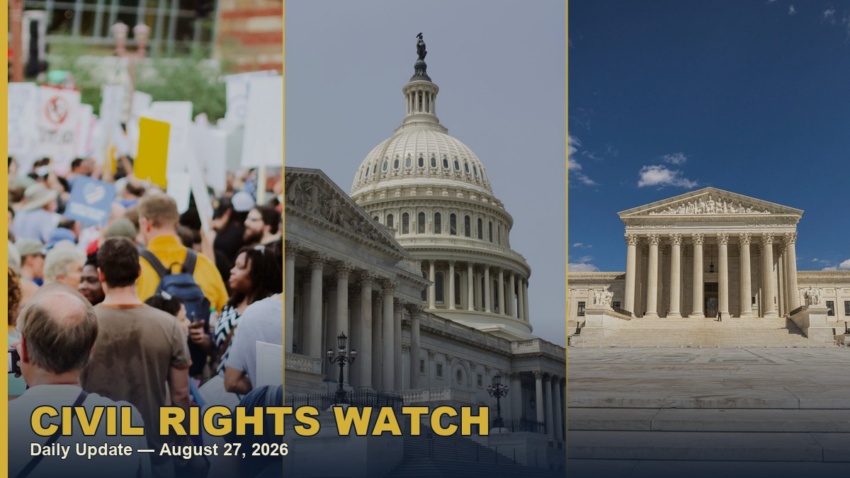
Civil Rights Watch — Daily Update — August 27, 2026
Tonight’s briefing leads with a 24-state lawsuit filed in Boston that calls new U.S. Postal Service mail-voting rules unconstitutional — a challenge the Supreme Court explicitly left open just two days earlier. We also cover a federal appeals court vacating Georgia’s landmark voting-rights ruling, fresh scholarship on corporate PAC giving, and hate crime charges in a North Carolina arson case.
Key Takeaways
- Twenty-four states, co-led by Washington Attorney General Nick Brown, sued USPS in federal court in Boston over rules that would bar ballot delivery to voters omitted from agency-approved lists (Yahoo News, 2026).
- The Postal Service published the final rule Wednesday — two days after the Supreme Court rejected an earlier states’ challenge as premature, while noting the states could challenge the final rule if it harms them (Chicago Tribune, 2026).
- The 11th Circuit vacated a 2023 ruling that Georgia’s maps diluted Black voting strength, citing the Supreme Court’s Louisiana v. Callais decision and sending the case back to the district court (CBS News, 2026).
- A 48-year-old Statesville woman and two juveniles face felony charges — including ethnic intimidation and burning a structure under construction — in an arson tied to racial slurs spray-painted on a church vehicle (WSOC TV, 2026).
- An upgraded digital driving tour of Fannie Lou Hamer’s life in Mississippi relaunched, adding archival audio, video, and a Jackson site where the Mississippi Freedom Democratic Party was launched (Black Enterprise, 2026).
“Georgia has made great strides since 1965 toward equality in voting,”
Cbsnews —
Read the full report →
1. Twenty-Four States Sue to Block USPS Mail-Ballot Rules
Washington Attorney General Nick Brown is co-leading a 24-state lawsuit filed Wednesday in federal court in Boston challenging new U.S. Postal Service rules governing mail-in voting (Yahoo News, 2026; Chicago Tribune, 2026).
The lawsuit alleges the rules are unconstitutional, violate privacy laws, and threaten to disenfranchise millions of voters nationwide (Yahoo News, 2026). State election leaders are preparing contingency plans, including adding local ballot drop boxes, ahead of the midterms (Yahoo News, 2026).
The dispute traces to a March 31 executive order from President Trump directing USPS to transmit mail ballots only to voters on a national list of eligible voters. USPS published a final rule implementing that order Wednesday (Yahoo News, 2026).
Under the rule, states must provide USPS with lists of voters eligible to cast mail-in ballots and obtain the agency’s approval for envelope designs and tracking standards. Voters not on the lists would not receive ballots, and ballots in unapproved envelopes would not be delivered (Chicago Tribune, 2026).
Illinois Attorney General Kwame Raoul said: “The rule I am challenging today is yet another unlawful attempt by the Trump administration to control state voting systems” (Chicago Tribune, 2026). Raoul said the states are seeking emergency relief because the administration is “trying to undermine our citizens’ access to voting within weeks of the midterm elections” (Chicago Tribune, 2026).
“The U.S. Postal Service doesn’t have the authority to deny Washingtonians the ability to vote,” Brown said. “We will protect the rule of law” (Yahoo News, 2026).
The filing lands less than a month before Illinois’ scheduled Sept. 24 start of mail voting — and two days after the Supreme Court rejected an earlier version of the same states’ challenge as premature, since USPS had not yet implemented the executive order (Chicago Tribune, 2026). The Court did not rule Trump’s order legal (MSN, 2026). Wisconsin joined the renewed challenge (MSN, 2026).
“The project expands on Fannie Lou Hamer’s America, an educational initiative that includes a nationally broadcast documentary, K-12 curriculum, and digital resources focused on preserving and amplifying her voice.”
Black Enterprise —
Read the full report →
2. Georgia Redistricting Ruling Vacated; Hamer Tour Relaunches
The 11th Circuit Court of Appeals has vacated a federal judge’s 2023 ruling that some of Georgia’s congressional, state Senate, and state House districts were drawn in a racially discriminatory manner (CBS News, 2026).
The three-judge panel asked the district court to reevaluate the case, pointing to the Supreme Court’s Voting Rights Act ruling earlier this year (CBS News, 2026).
The litigation stems from maps drawn in 2021. A group including Alpha Phi Alpha and the Sixth District of the African Methodist Episcopal Church sued, arguing that Black voters in Georgia still face opposition from white voters and need federal help to get a fair shot (CBS News, 2026).
In 2023, U.S. District Judge Steve Jones sided with the plaintiffs, ordering the state to add two Black-majority districts in the 56-member state Senate and five in the 180-member state House (CBS News, 2026).
“Georgia has made great strides since 1965 toward equality in voting,” Jones wrote. “However, the evidence before this court shows that Georgia has not reached the point where the political process has equal openness and equal opportunity for everyone” (CBS News, 2026).
The appeals court ruled that the Supreme Court’s decision in Louisiana v. Callais modified the 40-year-old framework for racial gerrymandering and vote-dilution claims under Section 2, requiring a re-evaluation of Jones’ 2023 ruling (CBS News, 2026).
Fannie Lou Hamer’s Legacy Gets a Digital Upgrade
An enhanced digital driving tour dedicated to Fannie Lou Hamer relaunched with new video, archival audio, photographs, and historical materials, drawing visitors through locations tied to her life in Ruleville, Sunflower County, Winona, and other Mississippi communities (Black Enterprise, 2026).
New additions include the M.W. Stringer Masonic Lodge in Jackson, where Hamer and others launched the Mississippi Freedom Democratic Party in April 1964, and short videos of Hamer speaking and singing (Black Enterprise, 2026). The original 10-stop tour launched in 2019; the refresh was funded by the Mississippi Humanities Council and the W.K. Kellogg Foundation (Black Enterprise, 2026).
“Mrs. Hamer’s story personifies the Mississippi Freedom Movement — how local people inspired and partnered with young activists to change the state and the country,” said Mississippi Humanities Council Executive Director Stuart Rockoff (Black Enterprise, 2026).
3. Corporate PAC Responses to Voting-Rights Restrictions
New research published this week — “Access, accountability, and recipient diversification: corporate PAC responses to state voting-rights restrictions” — examines how corporate political action committees respond to state-level voting restrictions (Springer Nature, 2026).
The study’s title signals a focus on three dimensions: donor access, accountability, and whether PACs diversify their recipients. It arrives as states diverge sharply on voting access, including the multi-state USPS fight covered above (Springer Nature, 2026).
The article’s full findings were not available in the source material reviewed for this briefing, so its data and conclusions could not be independently verified here (Springer Nature, 2026).
4. Hate Crime Charges in Statesville Arson Case
An investigation into racial slurs spray-painted on a church vehicle and other properties in Statesville, North Carolina, has led to charges against a 48-year-old woman and two juveniles (WSOC TV, 2026).
The Iredell County Sheriff’s Office said the investigation began July 30. Detectives identified two juveniles as suspects and connected them to a nearby home under construction that had been broken into, had property stolen, and was set on fire (WSOC TV, 2026).
Investigators said Amber Lee Christley, 48, of Statesville, provided the juveniles with information about how to start the fire and gave them a lighter. Christley was arrested Aug. 19 and charged with felony burning of a building or structure in the process of construction, felony conspiracy, and two counts of contributing to the delinquency of a juvenile; she received a $10,000 secured bond (WSOC TV, 2026).
The juveniles face multiple felony and misdemeanor charges through the Department of Juvenile Justice, including burning a structure under construction, breaking and entering and larceny, ethnic intimidation, and injury to real property (WSOC TV, 2026).
What’s Disputed or Unconfirmed
The states’ claims against the USPS rule are assertions in a newly filed complaint; the Supreme Court’s earlier rejection of the same states’ challenge was procedural — the Court did not rule on whether Trump’s order is legal (Chicago Tribune, 2026; MSN, 2026).
The 11th Circuit’s Georgia decision vacates and remands; it does not resolve whether the state’s maps dilute Black voting strength, which the district court must reconsider under the revised Section 2 framework (CBS News, 2026).
In the Statesville case, the charges are allegations from the Iredell County Sheriff’s Office that have not been tested in court (WSOC TV, 2026). The corporate PAC study’s findings likewise could not be independently checked, because the full text was not in the source material (Springer Nature, 2026).
How to Verify This Yourself
- Read the complaint and emergency motion on the U.S. District Court for the District of Massachusetts docket via PACER, where the 24-state case was filed in Boston, or check press releases from the Washington and Illinois attorneys general (Chicago Tribune, 2026; Yahoo News, 2026).
- Compare the text of the USPS final rule on the Federal Register’s website against the Supreme Court’s Louisiana v. Callais decision on the Supreme Court’s website to see the legal standards at issue in today’s two biggest cases (Yahoo News, 2026; CBS News, 2026).
- Check Iredell County court records or sheriff’s office releases for the Statesville charges, and visit the Fannie Lou Hamer’s America project to explore the upgraded driving tour (WSOC TV, 2026; Black Enterprise, 2026).
SUPPORT KEMETIC MINDS
Enjoying this coverage? Back the work and find every way to connect with us in one place.
Kemetic Minds Analysis
Today’s verified reporting covered: Civil Rights & Voting Rights; Bills Proposed & Legislation; States’ Rights & Federalism; Hate Crimes. Every claim above traces back to a specific, dated, fetched source — treat the Key Takeaways as the verified factual floor, and the ‘What’s Disputed or Unconfirmed’ section as the honest boundary of what today’s sourcing actually supports versus what’s still allegation or one-sided claim.
References
- Cbsnews. (2026, August 26). Appeals court vacates ruling that Georgia's redistricted congressional maps violated Black voters' rights. cbsnews.com
- Black Enterprise. (2026, n.d.). Fannie Lou Hamer’s Legacy Hits The Road Again With An Upgraded Digital Tour. blackenterprise.com
- Springer Nature Link. (2026, August 26). Access, accountability, and recipient diversification: corporate PAC responses to state voting-rights restrictions. link.springer.com
- MSN. (2026, August 26). Democratic states file new lawsuit to block Trump’s mail voting restrictions ahead of midterms. msn.com
- Yahoo. (2026, August 26). WA's AG Nick Brown co-leads 24-state lawsuit against USPS ballot rules. yahoo.com
- Chicagotribune. (2026, August 26). Illinois joins lawsuit to block Postal Service from deciding mail-in voting eligibility. chicagotribune.com
- MSN. (2026, August 26). Wisconsin joins new lawsuit to block Trump order on mail-in voting. msn.com
- WSOC TV. (2026, August 26). Woman and two juveniles charged in Statesville arson and hate crime investigation. wsoctv.com
Investigative Methodology: This roundup is generated once daily at 6:00 PM America/Chicago from live news sources published within the prior 24 hours, plus primary-source civil-rights monitoring feeds (SPLC, ADL, ProPublica). Every claim is grounded in fetched source text with an APA7 in-text citation; nothing is written from the model’s general knowledge. Every video embed is verified to be a real, existing video via YouTube’s oEmbed endpoint before publication — none are written by the drafting model. Pull-quotes are extracted verbatim from the cited article, never composed. No Wikipedia sources are used, and social-media posts (TikTok/X/Instagram) are only referenced when a real, working link to that post appears directly in a cited news source — this post does not auto-embed unverified social content, since a fabricated post link would be worse than no embed at all.
Stay Connected

Kemetic Minds Editorial Desk
Verified NewsroomPrimary-sourced investigative intelligence on civil rights, voting rights, federal policy, and consumer protection. Sourced from primary legal filings, government statistics, and direct field reporting.