KEMETIC MINDS
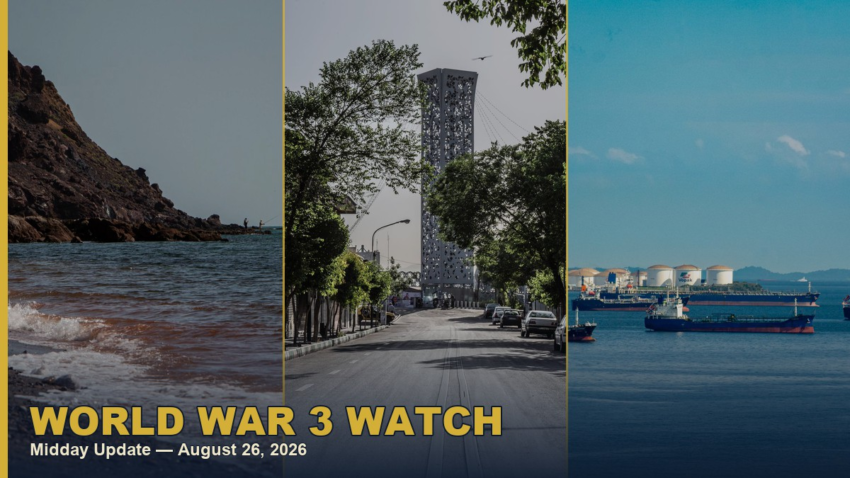
World War 3 Watch — Midday Update — August 26, 2026
- Iran’s IRGC says a month-old revenue-sharing deal with Oman can reopen the Strait of Hormuz — but only if Washington accepts its terms (CBS News, 2026).
- Secretary of State Marco Rubio has told allies there will be “no further strikes on Iran for now,” as the administration pivots to sanctions and maritime enforcement (MSN, 2026).
- Trump told Al Jazeera the US is “achieving a very big victory,” but said the war will continue “for as long as necessary,” with no timetable for peace talks (CBS News, 2026).
- Most shipping through the strategic channel has shut down, with Iran and the US running separate blockades (Detroit News, 2026).
- Chinese coverage leads with a merchant-ships-only reopening memorandum — and Tehran’s “propaganda lie” charge against US mine-clearance claims (Sina Finance, 2026, authors’ translation).
- Prediction markets put just a 15.5% chance on a US-Iran deal that includes reconstruction funding (CryptoBriefing, 2026).
Video: US Moves to Revoke 200,000 Visas | Horizons Middle East & Africa 8/24/2026. Source: Bloomberg Television.
The Story So Far
Iran’s Islamic Revolutionary Guard Corps says it reached agreement with Oman a month ago on running the Strait of Hormuz — and sharing its revenue. The only obstacle, the IRGC’s spokesman insists, is the United States (CBS News, 2026).
Washington is publicly pulling back from the brink. Rubio has told allies there will be “no further strikes on Iran for now” (MSN, 2026).
President Trump is framing that pause as strength. He told Al Jazeera the US is “achieving a very big victory,” while ruling out any timetable for resuming peace talks (CBS News, 2026).
The result is a war near the six-month mark that is neither escalating into new strikes nor moving toward a deal. A critical passage for global oil shipments stays shut by two rival blockades (Detroit News, 2026; CryptoBriefing, 2026).
Video: Very skeptical on Oman-Iran deal regarding the Strait of Hormuz, says Energy Aspects' Amrita Sen. Source: CNBC Television.
1. Tehran’s Ultimatum: A Month-Old Deal, Still Blocked
Brig. Gen. Hossein Mohebi, spokesman for Iran’s Islamic Revolutionary Guard Corps, says the deal with Oman was finished about a month ago. “About a month ago, we entered into negotiations with Oman and reached results that were acceptable to both sides,” he told state broadcaster IRIB (CBS News, 2026).
The negotiations settled terms broader than a shipping lane. Mohebi said the two sides reached agreements on each country’s share of the waters of the strait, and on the share of revenues for Iran and Oman (CBS News, 2026).
But the memorandum activates only if Washington signs on. “If the United States stops obstructing and returns to the memorandum of understanding, we can open the Strait of Hormuz within the framework of the agreement reached,” Mohebi said (CBS News, 2026).
Until then, he warned, “the Strait of Hormuz will remain closed” (CBS News, 2026). Iran separately says the agreement is being delayed by US opposition, with Mohebi accusing Washington of obstructing the process (MSN, 2026).
There is daylight between the IRGC’s certainty and the official picture. A senior Iranian source told Reuters that Iran and Oman are still working on the details of the accord (MSN, 2026).
Video: Iran-Oman Strait Of Hormuz Deal | New Shipping Corridor Plan | N18G. Source: CNBC-TV18.
2. Washington’s Pivot: From Strikes to Sanctions
The military track is cooling, at least for now. Rubio has told allies there will be “no further strikes on Iran for now” (MSN, 2026).
The administration is shifting its focus toward sanctions, maritime enforcement and pressure on oil exports (MSN, 2026).
Chinese financial media highlight one piece of that strategy that Washington is apparently holding back. The implementation of secondary sanctions is being postponed, they report (Sina Finance, 2026, authors’ translation).
The diplomatic track looks more threadbare. Israeli Prime Minister Benjamin Netanyahu said he told Trump that a diplomatic deal with Iran is “not possible,” describing the Islamic Republic’s leadership as “savages” (CBS News, 2026).
Trump has repeatedly insisted the strait is open — a claim that sits uneasily beside Iran’s closure declaration and reports of shuttered shipping (CBS News, 2026; Detroit News, 2026).
3. Trump’s ‘Very Big Victory’ Meets a Skeptical Market
President Trump used an interview with Al Jazeera to declare the campaign a success. The US is “achieving a very big victory,” he said, as the Iran war nears the six-month mark (CBS News, 2026).
That victory has no defined endpoint. Trump said the war “will continue for as long as necessary,” and offered no timetable to resume peace talks (CBS News, 2026).
A separate account quotes Trump asserting that the US is “winning very big” through a combination of economic measures and military strikes, even as diplomatic talks stall (CryptoBriefing, 2026).
Markets are not buying the full picture. Prediction-market odds put only a 15.5% chance on a US-Iran deal that includes reconstruction funding (CryptoBriefing, 2026).
Some sub-markets recently moved toward a higher probability of a deal, yet the overall outlook stays skeptical. The developments to watch, the outlet says, are further military action, sanctions — and whether the strait actually reopens (CryptoBriefing, 2026).
4. Two Blockades and a Merchant-Only Corridor
The scene inside the strait is the clearest picture of how bad the standoff has become. “Most shipping has since been shut down, as Iran and the U.S. have tried to assert control over the strategic channel, imposing separate blockades” (Detroit News, 2026).
The proposed fix, floated Tuesday, is a temporary shipping route managed by Iran and Oman. The two governments are also discussing a plan to clear sea mines from the waterway (CBS News, 2026).
Chinese coverage describes the arrangement as a memorandum of understanding limited to merchant ships — a narrow carve-out, not a general reopening (Sina Finance, 2026, authors’ translation; Lianhe Zaobao, 2026, authors’ translation).
Even that corridor is conditional. Tehran insists the US must lift its naval blockade and the war must end before any ships resume transiting (CBS News, 2026).
Iran also rejects the idea that the waterway is already safe. Chinese media report Tehran’s dismissal of the US claim that it has cleared the strait’s mines as a “propaganda lie” (Sina Finance, 2026, authors’ translation).
The impasse with the United States persists, leaving the corridor plan in limbo (Detroit News, 2026).
5. English vs Chinese Coverage: What Each Side Chose to Run
The two language universes are reporting the same story from different vantage points. English-language coverage leads with the White House: Trump’s victory claims, Rubio’s strike pause, and Netanyahu’s verdict that a deal with Iran is “not possible” (CBS News, 2026; MSN, 2026).
Chinese-language coverage leads with the mechanics of a limited reopening. Headlines there center on the merchant-ships-only memorandum and on Iran’s dismissal of the US mine-clearance claim as a “propaganda lie” (Sina Finance, 2026, authors’ translation; Lianhe Zaobao, 2026, authors’ translation).
The Chinese pickup of the day is economic. US postponement of secondary sanctions gets prominent billing, and one morning briefing paired the Hormuz story with Canada’s announcement of retaliatory tariffs on US goods — turning a war dispatch into a trade-war dispatch (Sina Finance, 2026, authors’ translation; 21st Century Business Herald, 2026, authors’ translation).
That divergence shapes what each audience understands about the war. The dynamic is exactly what we mapped in our narrative-comparison report on how US, Israeli, Iranian, and BRICS media each tell this war.
Is This Actually World War 3?
Today’s source set is entirely about the Gulf — there are no China-Taiwan items in this batch, so the series’ second front is silent today. What remains is a regional war near its six-month mark with a critical oil chokepoint closed (CBS News, 2026; Detroit News, 2026).
The escalation ladder, per today’s briefs, runs through leverage rather than firepower: a pause on further strikes, a sanctions and maritime-enforcement pivot, and Iran’s demand that Washington accept its corridor deal (MSN, 2026; CBS News, 2026).
“World War 3” implies a clash of great powers. Today’s evidence shows a two-sided blockade war with widening economic ripple effects — including, in the Chinese morning briefing, Canada’s retaliatory tariffs on US goods (21st Century Business Herald, 2026, authors’ translation).
That may be the more dangerous shape: a war with no timetable and no stated endpoint, where the near-term levers are economic, and where Iran holds the strait closed until Washington accepts its terms (CBS News, 2026; CryptoBriefing, 2026).
What You Can Do Right Now
- Watch whether the Strait of Hormuz reopens: it is a critical passage for global oil shipments, and most shipping through it has been shut down (CryptoBriefing, 2026; Detroit News, 2026).
- Review our survival skills and preparedness guide for practical preparation steps while most shipping through the strait remains shut down (Detroit News, 2026).
- Track prediction markets as a temperature gauge: a US-Iran deal including reconstruction funding is currently priced at just 15.5% (CryptoBriefing, 2026).
SUPPORT KEMETIC MINDS
Enjoying this coverage? Back the work and find every way to connect with us in one place.
Support the Page →Kemetic Minds Analysis
This roundup pulled directly from the day’s English- and Chinese-language wires side by side, because the gap between what each side chooses to report is often as informative as any single strike count. Treat the Key Takeaways above as the verified factual floor, and the framing differences noted in the sections above as the more interesting, harder-to-fake signal about where this war is actually headed next.
References
- MSN. (2026, August 26). Iran, Oman strike Hormuz revenue deal; Tehran warns US must meet demands to reopen waterway. msn.com
- MSN. (2026, August 26). Iran and Oman still working on Strait of Hormuz accord, says senior Iranian source. msn.com
- Detroitnews. (2026, August 26). Iran and Oman plan for temporary Hormuz corridor as impasse with US persists. detroitnews.com
- MSN. (2026, August 26). US-Israel-Iran war live news: 'No further strikes on Iran for now,' Marco Rubio tells allies as US tightens sanctions & targets oil exports. msn.com
- Cryptobriefing. (2026, August 26). Trump claims US “winning very big” against Iran with economic and military measures. cryptobriefing.com
- Cbsnews. (2026, August 26). Iran War Updates: Trump says U.S. "achieving a very big victory," war "will continue for as long as necessary". cbsnews.com
- finance.sina.com.cn. (2026, August 26). 伊朗:霍尔木兹海峡临时航线谅解达成 仅限商船通行 美国声称已清除霍尔木兹海峡水雷是“宣传谎言” [Iran: Temporary Route Understanding Reached in Strait of Hormuz, Limited to Merchant Vessels; US Claim of Clearing Mines in Strait Called 'Propaganda Lie]. finance.sina.cn
- finance.sina.com.cn. (2026, August 26). 伊朗与阿曼筹备霍尔木兹海峡协议,美国暂缓实施次级制裁 [Iran and Oman Prepare Strait of Hormuz Agreement as US Delays Secondary Sanctions]. finance.sina.cn
- 联合早报. (2026, August 26). 伊朗称霍尔木兹海峡临时航线谅解达成 仅限商船通行 [Iran says temporary route deal reached for Strait of Hormuz, limited to commercial vessels]. zaobao.com
- finance.sina.com.cn. (2026, August 25). 伊朗称霍尔木兹海峡临时航线谅解达成 仅限商船通行 [Iran says temporary route understanding reached in Strait of Hormuz, limited to commercial vessels]. finance.sina.com.cn
- 21财经. (2026, August 26). 国际新闻早知道丨伊朗与阿曼拟建霍尔木兹海峡安全海上通道加拿大宣布对美商品征收反制关税 [World News Briefing | Iran and Oman Plan Safe Maritime Passage in Strait of Hormuz; Canada Announces Retaliatory Tariffs on US Goods]. m.21jingji.com
Investigative Methodology: This roundup is generated on a fixed schedule (noon and evening, America/Chicago) from live English- and Chinese-language wire sources. Every claim is grounded in fetched source text with an APA7 in-text citation; translated Chinese-language quotes are marked “authors’ translation.” Every video embed is verified to be a real, existing video via YouTube’s oEmbed endpoint before publication — none are written by the drafting model. No Wikipedia sources are used.
Stay Connected

Kemetic Minds Editorial Desk
Verified NewsroomPrimary-sourced investigative intelligence on civil rights, voting rights, federal policy, and consumer protection. Sourced from primary legal filings, government statistics, and direct field reporting.